When Space Saving Pile Turners Make Sense for Sheet Plant Layouts
On a corrugated sheet plant drawing, a pile turner can look like a small decision: one machine, one handling point, one more box to fit between the corrugator, storage lanes, printers, die-cutters, or conversion equipment. In reality, it often exposes the strengths and weaknesses of the whole material-flow concept.
For project managers, floor space is rarely “empty.” It is claimed by sheet buffers, forklift paths, electrical cabinets, maintenance access, fire aisles, finished-goods staging, and the room needed to recover when production falls behind schedule. That is why space saving pile turners deserve consideration when a plant must handle sheets safely and consistently without extending its footprint unnecessarily.
A compact pile-turning solution is not automatically the right answer for every facility. Its value depends on what arrives in the pile, what must happen after turning, how much buffering the plant needs, and whether the machine supports the intended automation level. The better question is not “Can a pile turner fit?” but “Does turning the pile at this point remove a real flow constraint?”
The layout problem is usually larger than the machine footprint
Corrugated sheet plants frequently deal with an awkward transition: sheets come off the corrugator in a stack orientation that may not be ideal for downstream flexographic printing, litho-lamination, die-cutting, digital printing, or specialty converting. Depending on the board grade, warp direction, print requirement, feeding method, and stacking arrangement, operators may need to reverse, rotate, aerate, align, or inspect a pile before the next process.
Without an organized turning point, this task can migrate into open floor space. A forklift moves a load to a temporary area. Operators wait for room near the next machine. Stacks are handled again when the press is ready. In a lightly loaded plant, this may be tolerable. In a factory with frequent order changes and short delivery windows, those extra movements can turn into congestion, handling damage, and uncertainty about which pallet belongs to which job.
The footprint of a compact pile turner therefore needs to be judged against the footprint it may eliminate elsewhere: an oversized staging zone, a wide forklift turning area, a manual rehandling position, or an improvised buffer near a converting line. A machine that occupies several square metres can still make the layout meaningfully smaller if it makes sheet movement more direct and predictable.
When space saving pile turners are a sensible choice
Compact pile turners tend to make the most sense where sheet handling is important but available space is constrained by existing equipment or building geometry. Several conditions make the business case more compelling.
A downstream process needs a different pile orientation
The clearest application is a physical mismatch between the corrugator delivery arrangement and the feed orientation required by the next process. A sheet plant may need to present board in a particular lead-edge direction to a printer, die-cutter, laminator, or feeder. If piles must be rotated or inverted as a routine part of production, a dedicated turning station offers more control than repeated forklift handling.
This becomes especially relevant where printing quality and sheet presentation matter. Board that reaches a feeder unevenly, with dust, loose edges, or poor stack alignment, can contribute to feeding interruptions and setup losses. A pile turner does not solve every board-quality issue, but it can create a more orderly handoff between processes.
The plant is adding converting capacity into an established building
Greenfield projects allow more freedom, but many investments happen in facilities where the corrugator is already operating and a new printer, die-cutter, or folder gluer must fit around it. Columns, docks, low-clearance zones, existing conveyor routes, and utility rooms limit the options.
In these projects, a conventional handling arrangement may require wide circulation space around the stack. Space saving pile turners can be positioned as a compact transfer point between production islands, reducing the need to send every load through a large shared staging area. The result is not merely a tighter plan; it can be a layout with fewer crossing movements between forklifts, operators, and moving material.
Short runs create frequent handling events
A plant running long, repetitive orders may accept manual intervention because the number of pile changes is low. Short-run production changes the equation. More jobs mean more stack identification, more transitions, more opportunities for a pile to wait in the wrong location, and more pressure on operators to keep equipment supplied.
Where turnaround speed matters, a turner can become part of a repeatable job-change routine. The pile enters, is turned or aligned, is confirmed for the next operation, and exits along a defined path. This is particularly useful when a plant is trying to reduce the hidden time between “board produced” and “board ready to convert.”
Manual handling is creating safety or quality exposure
Large corrugated stacks are not forgiving. Forklift transfers near machines require adequate visibility, stable loads, and disciplined traffic management. Repeated movements can damage corners, disturb stack alignment, or introduce uncertainty when sheets have sensitive printed surfaces or demanding cosmetic requirements.
A compact pile-turning station cannot replace sound forklift practices, but it can reduce unnecessary movements. It also gives the process a fixed location, which makes it easier to define safety zones, operator responsibilities, job identification rules, and inspection points.
Do not confuse “compact” with “easy to install”
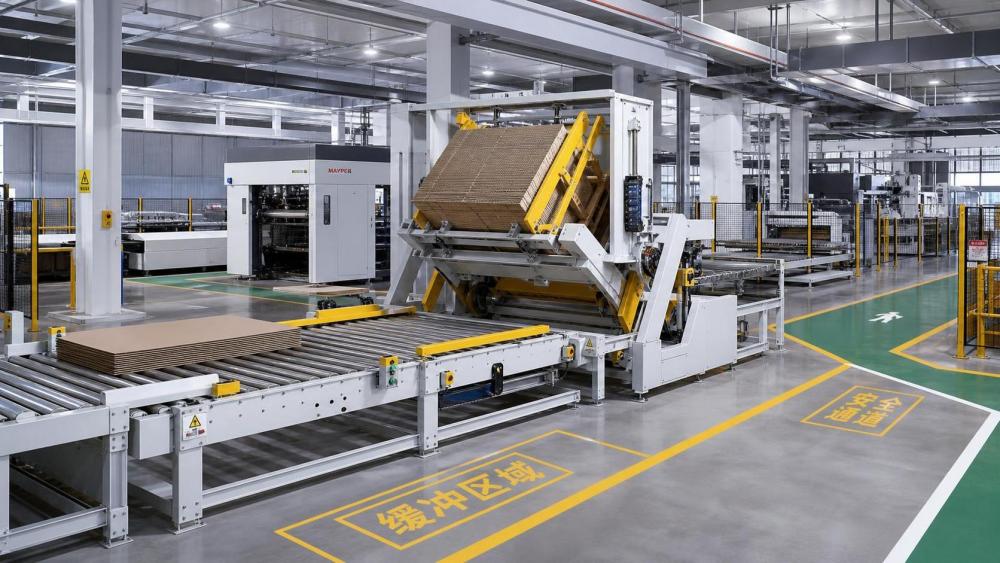
A common planning mistake is to compare only the published dimensions of the pile turner. The machine envelope is just one part of the installation. Project teams should map the operating envelope: pallet infeed and outfeed, clamp movement, loading access, operator standing positions, control-panel access, guarding, and the clearance needed to remove a jammed or damaged stack safely.
Maintenance space also matters. Hydraulic components, drives, sensors, and clamps need inspection access. If the turner is placed tightly between a wall and a conveyor merely to preserve floor area on paper, routine service may become slow or unsafe. A layout that saves space but creates recurring maintenance disruption is not a space-efficient design.
For this reason, the preferred location is often not the narrowest available gap. It is the point where the turner can serve two process steps with the least material travel while retaining clear access for people, pallets, and service work.
Choose the equipment sequence before choosing the machine
A pile turner should be evaluated as part of the route, not as a standalone purchase. The sequence may be simple: corrugator delivery, temporary buffer, pile turner, printing line. Or it may be more complex: board production, conditioning or inspection, turning, staging, litho-lamination, die-cutting, and palletizing.
The central decision is whether the turner is a flow-through asset or a batch handling asset. In a flow-through arrangement, incoming and outgoing movement should be coordinated with conveyors, pallet transport, automated guided vehicles, or a planned forklift route. The objective is to prevent the machine from becoming a queue point. In a batch arrangement, the turner may serve several lines or be used only for selected orders; flexibility is more important than continuous throughput.
Neither model is inherently superior. A dedicated inline approach can be justified when volume is stable and the downstream machine is sensitive to pile orientation. A shared compact unit may be more appropriate where formats vary widely, converting routes change day to day, or capital spending must remain measured.
Questions that should appear on the layout review sheet
- Which board grades, flute combinations, and pile heights will pass through the turner?
- What are the smallest and largest sheet formats, including unusual customer sizes?
- Is the purpose inversion, 90-degree rotation, aeration, alignment, pallet exchange, or a combination of these functions?
- How many piles per shift genuinely require turning, rather than occasionally benefiting from it?
- Will the unit serve one downstream line or several competing processes?
- How is job identity maintained before and after pile handling?
- What happens when the next machine stops: is there sufficient buffer without blocking the corrugator route?
- Can forklifts, pallet trucks, conveyors, or automated transport vehicles approach and leave without crossing a pedestrian route?
These questions may sound operational, but they are also investment questions. A machine selected only around maximum pile size may be technically capable and still poorly matched to the plant’s actual workflow.
Automation can shrink travel, but it can also make a layout brittle
Many project teams see compact equipment as a natural gateway to automation. There is logic in that: a defined pile-turning point can exchange signals with conveyors, upstream production controls, downstream feeders, barcode systems, and manufacturing execution platforms. A controlled transfer point improves traceability and reduces dependence on verbal instructions.
Yet automation should follow operational clarity, not precede it. If the plant has not established who releases a pile, where it waits, how exceptions are handled, or how mixed jobs are prevented, adding conveyors and sensors may simply automate confusion.
A practical staged approach is often more resilient. Design the footprint, safety interface, power supply, and data connection so that future integration is possible. Begin with controlled manual loading if volumes or process routes are still evolving. Once the handling pattern is stable, add pallet conveyors, automatic centering, barcode confirmation, or digital job tracking where the return is clear.
For corrugated operations moving toward connected production, the pile turner can become a useful data point. It may confirm that a stack has been transferred, identify a delay between boardmaking and converting, or support job-level traceability. But it should not be treated as a substitute for broader production scheduling and material-control discipline.
Where a compact turner may not be the best answer
There are cases where the attractive floor-space argument weakens. If pile turning is needed only rarely, a well-designed forklift procedure and a properly sized staging zone may be more economical. If stack sizes vary beyond the practical capacity range of a compact model, operators may end up creating workarounds that defeat the purpose.
Likewise, a plant with very high continuous output must examine cycle time carefully. A turner that handles one pile safely but cannot keep pace with the corrugator or converting line will become a bottleneck. Additional buffering may solve the throughput issue, but that buffer consumes the space the project intended to save.
Very delicate board, unstable stacks, high pile heights, or unusual pallet conditions also demand close technical review. Clamp pressure, support geometry, turning speed, and sheet-edge protection should be considered alongside nominal machine capacity. The right solution may be a larger heavy-duty system, a different material-handling method, or changes upstream to how sheets are stacked.
A better way to assess layout value
Instead of asking whether a pile turner saves floor space in isolation, project managers can calculate its impact across the material path. Trace one representative job from corrugator discharge to the next production step. Count each lift, transfer, wait point, identification handoff, and direction change. Then repeat the exercise for a short-run job and for a high-volume job. The differences are often revealing.
The preferred layout is usually the one that reduces avoidable motion while preserving recovery capacity. Corrugated plants need room for real-world variation: quality holds, machine stoppages, rush orders, board conditioning, and maintenance. The aim is not to compress every aisle. It is to make the necessary movements intentional and keep exceptional movements from disrupting the entire plant.
For CPCS readers evaluating equipment and factory automation, space saving pile turners should be viewed as a targeted layout tool. They can support safer handling, cleaner process transitions, better sheet presentation, and more disciplined integration between board production and conversion. Their strongest value emerges when the plant has a recurring orientation or handling problem, limited usable space, and a clearly defined route for material before and after the turn.
When those conditions are present, a compact turner is more than a smaller machine. It is a way to give a crowded sheet plant a more orderly rhythm—one in which board moves with purpose rather than being repeatedly moved simply to make room for the next problem.
Related News
 Folder Gluer Line Cost Factors That Shape Payback and ROIExplore folder gluer line cost factors that shape payback and ROI—from automation and changeovers to waste, labor, uptime, and lifetime cash performance.Ms. Vivienne Cross
 Steam Boiler Price Factors That Shape Industrial Energy BudgetsSteam boiler price depends on capacity, fuel, efficiency, installation, and reliability. Discover how to control lifecycle costs and protect packaging production.Ms. Vivienne Cross
 How Paperboard Converting Machines Reduce Waste and Improve ThroughputPaperboard Converting Machines reduce waste, speed up setup, stabilize production, and improve carton quality. Explore smarter ways to boost throughput and yield.Ms. Vivienne Cross
 Is an Offset Press Cost-Effective for Short-Run Carton Jobs?Is an offset press economical for short-run carton work? Explore break-even costs, setup waste, quality demands, and workflow factors to choose the most profitable print route.Ms. Vivienne Cross
 How Shaftless Unwind Stands Reduce Changeover Time and Material WasteShaftless unwind stands reduce roll-change time, stabilize web tension, and cut paper waste for more efficient corrugated and packaging production.Ms. Vivienne Cross
 How an Automatic Paper Reel Handling System Improves Mill SafetyDiscover how an automatic paper reel handling system reduces crush risks, forklift traffic, and downtime while improving mill safety and reliable production flow.Ms. Vivienne Cross