What Factors Determine the Price of Roll Handling Equipment?
Two roll handling systems with the same rated capacity can carry very different prices because lifting capacity describes only part of the job. A machine that raises a roll beside a printing press is not equivalent to one that collects it from storage, rotates it, transports it through an aisle, and positions it at an unwind stand. The meaningful comparison is the cost of completing the same handling cycle safely, at the required frequency, without damaging the material.
Roll handling equipment price is therefore driven by the operating envelope, gripping method, duty cycle, automation, and installation scope—not simply by maximum roll weight. Before comparing quotations, define where the supplier’s responsibility starts and ends. A lower equipment price can become a higher installed cost when attachments, guarding, floor modifications, controls integration, or commissioning are excluded.
The handling task sets the price category
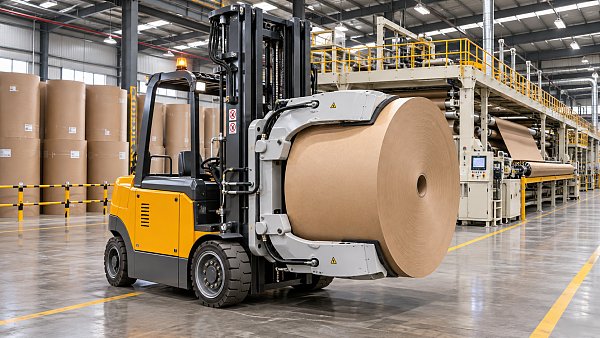
“Roll handling equipment” covers several fundamentally different purchases. A manually propelled roll lifter, a forklift-mounted attachment, a powered roll transporter, an overhead lifting device, and an automated transfer system do not provide interchangeable functions. Their prices reflect different structures, power systems, safety measures, and installation requirements.
The first distinction is between lifting, transporting, turning, and positioning. Each additional movement introduces engineering requirements. Rotating a roll from vertical to horizontal requires controlled restraint throughout the movement. Loading an unwind shaft may require precise alignment rather than simple elevation. Transferring rolls automatically between storage and a corrugator introduces traffic control and machine-to-machine coordination.
Existing assets also change the comparison. A forklift attachment may have a lower acquisition cost than a dedicated transporter, but it depends on a compatible truck with sufficient residual capacity. Its economic value also depends on whether that truck is available when production needs a roll change. Equipment that appears inexpensive in isolation can consume capacity elsewhere in the plant.
Capacity must be specified as an operating envelope
A maximum load figure is meaningful only when linked to roll geometry, load position, lifting height, and attachment configuration. Increasing capacity can require a stronger mast or frame, larger actuators, different bearings, additional counterweight, or a larger chassis. However, two machines rated for the same weight may still have different usable capabilities.
The specification should describe:
- Maximum and minimum roll weight, diameter, and face width.
- Core internal diameter, material, and allowable condition where core gripping is proposed.
- Pickup and delivery orientation, including any turning or tilting movement.
- Required lifting height, horizontal reach, and positioning tolerance.
- The location of the roll’s center of gravity relative to the handling device.
A wide roll held away from a mast creates a different overturning moment from a compact roll of equal weight held close to it. For forklift attachments, attachment weight and the changed load center affect the truck’s usable capacity. The complete truck-and-attachment combination must therefore be assessed, rather than treating the attachment’s nominal rating as sufficient.
Designing for an unusually large future roll can also increase the machine footprint and reduce access around existing equipment. Capacity margin should reflect a credible production requirement. Paying for unused capacity is particularly difficult to justify if it makes routine handling slower or prevents access to the intended loading position.
The gripping method affects both equipment cost and material loss
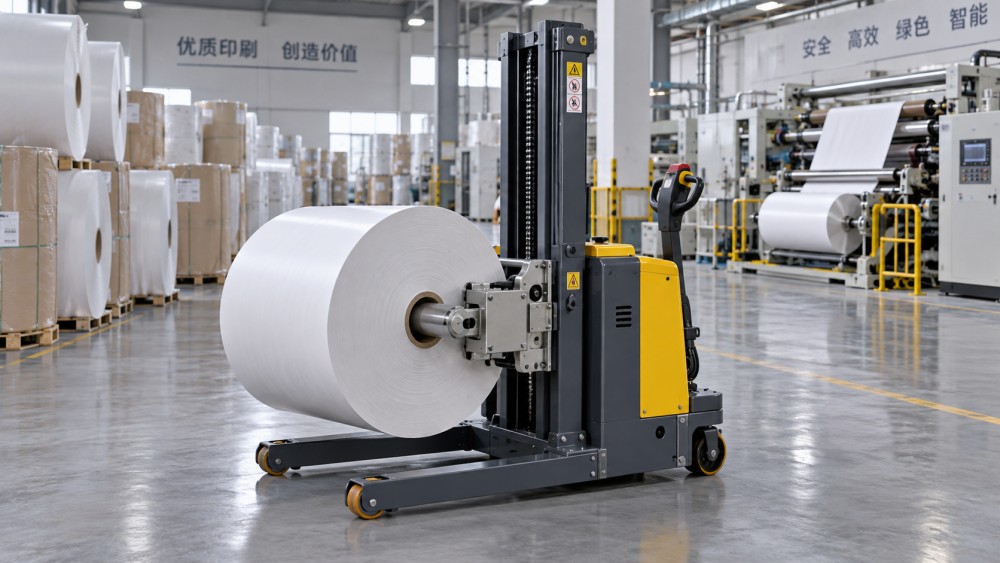
How the roll is held can be more important than how it is lifted. External clamps, expanding core mandrels, cradle supports, and vacuum devices place different demands on the material and the machine.
An external clamp needs sufficient holding force without crushing or marking the roll. Pad geometry, contact area, pressure control, and the condition of the outer wrapping all affect suitability. A clamp intended for robust paper rolls should not be assumed suitable for a pressure-sensitive coated substrate merely because the weight is within range.
A core-gripping device avoids contact with the outside surface but depends on core strength, dimensions, and condition. It must also support the load and any turning forces without unacceptable deformation. Multiple core sizes may require interchangeable tooling or an adjustable mechanism, adding both purchase cost and changeover work.
Cradles can provide broad support but may restrict pickup access or require a suitable transfer arrangement. Vacuum handling requires an assessment of sealing conditions, surface suitability, and load retention measures. It is not a universal substitute for mechanical gripping.
Custom tooling raises the quotation because it requires design, manufacture, and validation for the intended material range. That premium should be evaluated against avoided damage and reliable handling, not treated automatically as an optional accessory. Ask suppliers to explain which roll conditions fall outside their proposed gripping method and how suitability will be demonstrated.
Duty cycle and automation change what the machine must deliver
Handling ten rolls across a shift is a different requirement from feeding a production line through repeated roll changes with little recovery time. The relevant specification includes loaded and unloaded travel, lift and turn movements, waiting time, charging opportunities, and peak demand—not just an average daily roll count.
Higher duty can require different motors, hydraulic cooling, batteries, charging arrangements, wear components, or structural design. A low-duty machine may complete a demonstration successfully yet fail to sustain the required schedule. Suppliers should state the operating conditions behind their capacity and cycle-time claims.
Automation adds another layer. Powered lifting reduces physical effort, but it does not necessarily remove manual alignment or operator travel. Automatic positioning requires sensors, control logic, and repeatable reference points. A fully automated transfer system also needs procedures for blocked routes, incorrect roll locations, communication loss, and manual recovery.
The financial distinction is between automating a movement and removing a production constraint. If an operator must still accompany every cycle and manually prepare the receiving station, the labor saving may be limited. Conversely, reliable staging before a roll change may have value even when headcount remains unchanged.
Cycle-time comparisons should use identical boundaries: from a roll being ready for collection to the handling device being ready for its next assignment. A quotation based only on lifting speed cannot be compared directly with one based on the complete transport-and-loading sequence.
Safety and site conditions belong in the base comparison
Safety provisions are not a discretionary premium to remove when negotiating price. Their required scope depends on the hazards created by the equipment, its surroundings, and the applicable destination requirements. Suspended loads, crushing zones, moving vehicles, rotating rolls, and unexpected release each require appropriate assessment.
Depending on the design, the quotation may need to cover load-holding arrangements, overload protection, travel limits, interlocks, emergency stops, guarding, or personnel detection. The important question is whether the proposed system addresses the identified risks, including foreseeable faults and recovery tasks.
For cross-border purchases, request the applicable conformity documentation, operating instructions, electrical information, and inspection requirements for the destination. A generic certificate does not establish that every configuration or integrated installation complies. Responsibilities for the completed system should be explicit, especially where several suppliers provide equipment and controls.
Site constraints can change the price materially. A larger base may be unacceptable in a narrow aisle; an overhead device may require structural assessment and supporting steelwork. Floor loading, flatness, gradients, thresholds, doorway clearances, and available turning space can affect a mobile system. Utilities, charging locations, and access for maintenance also need confirmation.
Integration with a corrugator or printing line adds costs when roll delivery must be coordinated with unwind readiness, machine status, or production scheduling. Clarify who supplies the interfaces, programming, testing, and fault-recovery logic. An undefined interface is a potential change order, not a completed saving.
Compare quotations on a common supply boundary
A useful comparison separates the base machine from the components and services needed to make it operational. Otherwise, a complete proposal can appear expensive beside one that leaves essential work to the buyer.
International offers also need a consistent currency and tax basis. Freight, import duties, brokerage, insurance, and local inspection costs should be assigned to the correct party under the agreed delivery terms. Payment milestones and acceptance conditions affect commercial risk even when the headline price is unchanged.
Customization deserves separate attention. A standard platform with application-specific tooling differs from a fully bespoke machine. Ask which assemblies are standard, which are engineered for the order, and what design information must be approved before manufacture. Late changes to roll dimensions, layout, or interfaces can affect both cost and delivery.
Calculate ownership cost without overstating the savings
The useful financial comparison is the installed cost plus operating and maintenance expenditure over a common evaluation period. Include energy, consumables, planned service, wear parts, inspections, software charges where applicable, and expected component replacement. Battery replacement or specialist gripping components can matter more than small differences in electricity consumption.
Labor savings need particular care. Reducing handling time does not automatically reduce payroll. The benefit may instead be additional production capacity, less overtime, or the ability to assign an operator to another task. Count only the benefit that the operating plan can realistically capture.
For example, assume one proposal costs $20,000 more and is expected to avoid $5,000 in annual operating costs. Its simple payback is four years before financing, tax, and residual value. Those figures are illustrative, not market prices. If the claimed saving depends on eliminating labor that will remain on the shift, the payback calculation needs revision.
Downtime and material damage should be assessed separately rather than hidden inside an optimistic annual saving. Request prices and lead times for critical spares, identify local service capabilities, and check whether fault diagnosis depends on proprietary tools or remote access. A warranty has limited operational value if restoring service requires a long wait for an unavailable component.
Make acceptance prove the value being purchased
Price comparisons become more reliable when acceptance criteria are agreed before the order. Testing should cover representative rolls and the demanding conditions within the specified range: relevant core sizes, maximum load position, required orientation changes, and the complete handling cycle.
Acceptance should also address sustained operation, positioning, material damage, safety functions, and recovery from defined interruptions. Separate factory tests from checks that can only be completed at the installation site, and identify who supplies test rolls and supporting equipment.
A higher quotation is justified when it buys a capability the application requires, removes a measurable operating cost, or includes work that another offer excludes. A lower quotation is attractive when it meets the same verified requirements with a simpler design. The deciding figure is not the lowest price per tonne of rated capacity, but the cost of a complete, supportable handling process that fits the production task.
Related News
 When Is a Servo Folder Gluer Line Worth the Investment?Is a servo folder gluer line worth the investment? Explore the production challenges, ROI factors, and supplier questions that can guide your decision.Ms. Vivienne Cross
 US Justice Department Investigates Pricing by Major Corrugated Packaging ProducersThe US Justice Department is investigating containerboard pricing by major corrugated packaging producers. Explore potential implications for buyers and supply chains.Ms. Vivienne Cross
 What Affects Folder Gluer Machine Price and Total Cost?Folder gluer machine price is only part of the investment. Discover what drives costs and how to compare quotes, operating expenses, and long-term value.Ms. Vivienne Cross
 How Roll Handling Equipment Price Affects Project ROIRoll handling equipment price affects more than upfront costs. Learn how to compare installed costs, quantify savings, and build a stronger project ROI case.Ms. Vivienne Cross
 How Stacking Machines Reduce Bottlenecks in Sheet PlantsStacking Machines reduce sheet plant bottlenecks by improving pile quality and flow. Discover how to choose and integrate the right system.Ms. Vivienne Cross
 Italian Packaging Machinery Sales Up Just 0.9% as Orders Fall 4.7%Italian packaging machinery sales rose just 0.9% as orders fell 4.7%. Explore UCIMA's figures and what weaker demand could mean for buyers and exporters.Ms. Vivienne Cross