Is an Offset Press Cost-Effective for Short-Run Carton Jobs?
Is an offset press economical for short-run carton work? It can be, but only when the job mix, finishing requirements, and production workflow support its setup costs.
For carton producers handling frequent changeovers and tight delivery windows, plates, makeready sheets, labor, waste, and downstream converting capacity matter as much as press speed.
Offset remains valuable for premium folding cartons, color-critical branded packaging, and repeatable designs. However, digital, flexographic, and hybrid workflows may produce better margins on smaller orders.
Start With the Real Short-Run Cost Equation
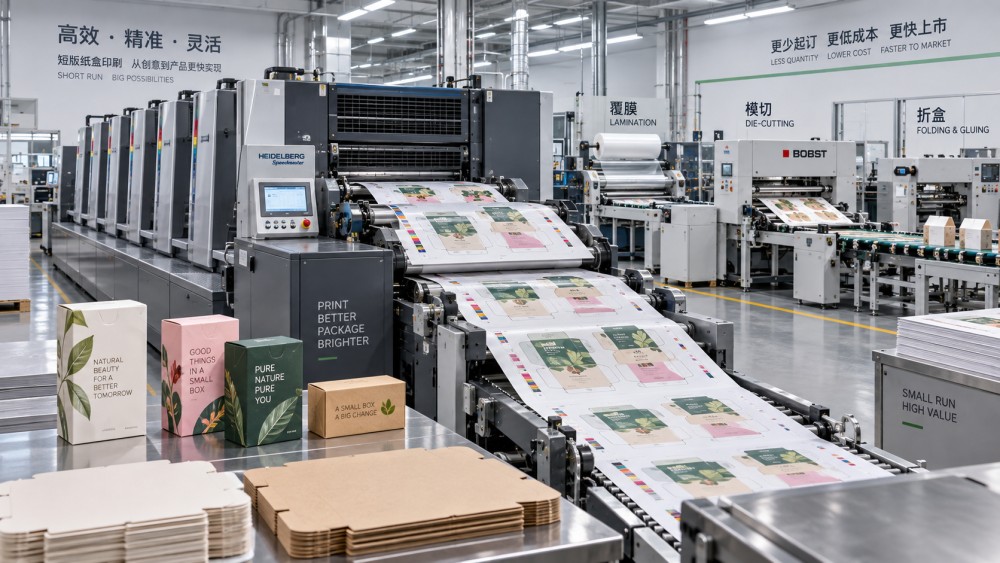
Short-run carton economics should never be judged from the press purchase price alone. The relevant question is the total cost of producing one saleable carton.
That total includes prepress preparation, plates, job scheduling, press makeready, substrate waste, ink consumption, labor, drying, inspection, finishing, rework, and delivery readiness.
An offset press can deliver a low unit printing cost once the press reaches stable production. The difficulty is recovering fixed preparation costs across limited quantities.
For a 500-carton order, plate creation and setup may represent a large share of the job cost. For 50,000 cartons, those same costs become relatively minor.
Managers should calculate contribution margin by order rather than relying on an assumed average cost per thousand sheets. Short runs create far more variation between jobs.
A premium carton with strong margins may justify conventional offset preparation even at modest quantities. A commodity carton with aggressive pricing usually will not.
Cost analysis should also include the opportunity cost of press time. A long makeready can displace higher-value work or delay jobs with contractual delivery commitments.
In many carton plants, the press is not the only constraint. Die-cutting, foil stamping, stripping, folding, gluing, and inspection can determine the actual order profitability.
Therefore, an offset press is economical for short-run carton work only when its fixed costs, available capacity, quality benefits, and finishing route align with the order.
When Offset Printing Still Makes Commercial Sense
Offset printing remains a practical short-run option when carton appearance carries significant commercial value. Cosmetics, pharmaceuticals, premium food, and specialty retail packaging often fit this profile.
These applications may require fine typography, smooth tonal transitions, precise brand colors, metallic effects, embossing, or detailed images that buyers expect to look consistent.
When the order uses an existing die, repeat artwork, approved color targets, and familiar board grades, the setup burden can be substantially lower than a new job.
Repeat short runs are especially important. Plates may be stored, color recipes may be documented, and operators can reproduce proven settings without extended trial-and-error.
Offset becomes more attractive when several compatible orders can be grouped efficiently. Similar board calipers, coating requirements, ink sets, and finishing paths reduce downtime between jobs.
Gang-running can also improve economics, although it requires careful planning. Different customers should share compatible sheet sizes, delivery dates, color requirements, and finishing specifications.
High sheet quality is another reason to choose offset. Stable registration and predictable print behavior can reduce downstream die-cutting alignment problems and visual quality disputes.
For regulated cartons, reliable image quality may protect more value than it costs. Poorly printed text, unreadable codes, or inconsistent artwork can trigger rejection and expensive rework.
Offset is strongest where the order is short relative to long-run packaging production, but large enough to absorb preparation costs and protect a premium selling price.
Where Offset Usually Loses Money on Short Runs
Offset becomes difficult to justify when every order requires fresh artwork, new plates, unique colors, rapid approval changes, and immediate delivery with little schedule flexibility.
Very low quantities are the clearest warning sign. If a customer needs several hundred cartons, conventional plate and makeready costs can outweigh offset's production-speed advantage.
Variable-data requirements also weaken the case. Individual codes, regional languages, personalized designs, serialized labels, or changing promotions introduce complexity that digital systems handle more naturally.
Jobs with frequent customer revisions can consume prepress resources before a sheet reaches the press. Those hidden engineering and proofing costs should be assigned to the order.
Small, irregular orders may also cause excessive substrate waste. Press operators need enough sheets for color adjustment, registration, inspection, and stable running before usable production begins.
Material waste is especially significant for premium coated boards and specialty substrates. Rising paperboard prices make every non-saleable sheet a more visible margin issue.
Short-run work can create bottlenecks after printing. A digitally printed batch may flow directly to finishing, while an offset batch can wait for drying, coating, or curing.
Plants should avoid treating high press speed as proof of cost efficiency. A fast press that runs only briefly after a long setup is not necessarily productive.
If order quantities, artwork volatility, and delivery pressure remain consistently low, investing in a digital carton workflow may produce a more predictable and scalable cost structure.
Use a Break-Even Model Instead of a Fixed Quantity Rule
There is no universal quantity at which offset becomes cheaper than digital printing. The break-even point changes according to equipment, substrate, labor rates, coverage, and workflow design.
A useful model begins with fixed cost. Add prepress labor, plates, press setup time, wash-up, approved makeready sheets, and any unique finishing preparation.
Next, calculate variable cost per saleable carton. Include board, ink or toner, click charges where relevant, energy, finishing labor, packaging, and expected spoilage.
The comparison should use saleable output rather than sheets fed into the press. A realistic waste allowance prevents a seemingly cheap production method from creating inaccurate margins.
For offset, fixed cost is normally higher but variable cost declines rapidly as quantity grows. For digital, fixed cost is lower but unit charges may remain relatively stable.
The economic crossover occurs where total offset cost equals total digital cost. A plant should calculate this point separately for major carton formats and production routes.
Do not rely only on printing cost. Include coating, die-cutting, foil stamping, window patching, gluing, inspection, and packing because these operations may alter the best route.
For example, a short digital print job may still require a conventional die-cutter. If tooling is new, die cost may dominate the decision regardless of printing technology.
Review the model quarterly. Board prices, click costs, wages, downtime, and demand patterns change, so a break-even calculation becomes outdated if it remains static.
Evaluate Setup Time, Waste, and Changeover Discipline
For short-run carton production, setup efficiency often matters more than maximum rated press speed. Plants gain margin by reducing nonproductive time between approved jobs.
Measure the full changeover cycle from the final good sheet of one order to the first approved sheet of the next. This reveals operational losses clearly.
Include plate loading, blanket preparation, ink changes, wash-up, feeder settings, registration adjustment, color matching, quality approval, and removal of previous job materials.
Many plants underestimate setup time because they count only the minutes when the press is stopped. Prepress delays and operator waiting time are equally relevant.
Standard operating procedures can improve offset short-run economics without changing equipment. Documented presets, color standards, plate handling, and job kitting reduce avoidable variation.
Automated plate changing, closed-loop color control, preset ink keys, camera registration, and centralized job data can materially reduce makeready on compatible modern presses.
Waste reduction deserves equal attention. Operators need defined approval criteria so they do not continue making adjustments after acceptable production quality has already been achieved.
Production data should distinguish between planned setup waste and abnormal waste. Without this separation, managers cannot identify whether problems come from jobs, materials, or machines.
A well-managed offset workflow can be profitable on shorter work than an inefficient one. Operational discipline often moves the break-even point more than marketing claims suggest.
Consider Carton Quality and Brand Risk Alongside Cost
Lowest production cost is not always the best commercial outcome. Cartons protect products, communicate brand value, support compliance, and influence customer confidence at the point of sale.
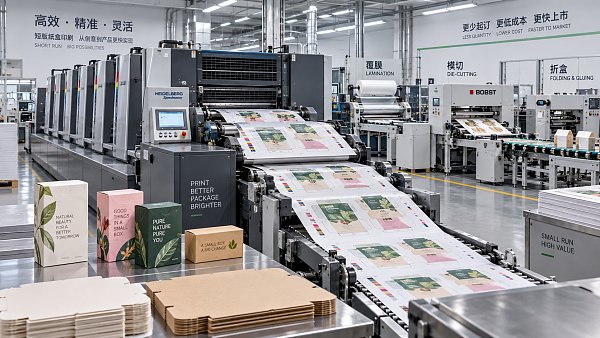
Offset printing can provide strong image detail, sharp text, smooth solid areas, and reliable color management when the plant maintains plates, blankets, inks, and calibration properly.
These strengths matter where buyers compare cartons directly on shelves. A visibly inconsistent package can reduce perceived product quality even when the structure performs correctly.
Pharmaceutical, healthcare, and food-related cartons require particular care. Small text, warning information, batch coding areas, and barcode zones must remain clear throughout production.
Color-critical brand programs may demand approved targets across repeat orders. Offset workflows with disciplined color management can support predictable reproduction over longer customer relationships.
However, quality expectations should be compared fairly. Modern digital presses can meet demanding carton applications, particularly where variable content and rapid revisions create operational value.
Request representative samples using the actual board, coating, design coverage, and finishing process. Generic press samples rarely show the true production performance of a carton job.
Inspection capability should be included in the comparison. Vision systems can detect print defects, registration errors, missing codes, or version mistakes before they become shipment failures.
The right technology is the one that reaches the required quality level reliably at an acceptable total cost, not simply the one with the highest theoretical image quality.
Match the Press Decision to the Entire Converting Workflow
Carton profitability depends on how printed sheets move through the factory. Printing decisions should be coordinated with die-cutting, stripping, folding, gluing, and final packing capacity.
Offset sheets may require drying or coating before converting. This can be manageable in a planned workflow but problematic when the customer expects same-day dispatch.
Digital production can reduce waiting time for selected jobs, yet it may introduce different substrate limitations, coating requirements, color constraints, or finishing compatibility questions.
Before quoting a job, confirm the complete route. Ask whether the board can run through every planned machine and whether printed surfaces will tolerate creasing and glue application.
Finishing setup can exceed printing setup for complex cartons. New dies, stripping tools, embossing dies, foil blocks, and folder-gluer adjustments need realistic cost allocation.
Plants with automated material handling and connected production data can reduce handoffs between departments. This is especially useful when many short orders move through the same facility.
Order scheduling should prioritize compatible work rather than only promised delivery dates. Grouping jobs intelligently can reduce board changes, ink wash-ups, and downstream machine adjustments.
Integration also improves traceability. Job data, approved artwork versions, inspection results, and batch records should follow the carton from prepress through shipment.
For this reason, an offset investment should be evaluated as part of a carton production system. Isolated press economics can produce misleading conclusions for management teams.
A Practical Decision Framework for Carton Producers
Begin by segmenting your order book. Separate repeat jobs, premium branded cartons, variable-data work, urgent orders, commodity cartons, and complex finished structures.
Then identify which segment creates the greatest margin opportunity and which segment creates the most disruption. These are not always the same group of orders.
Use actual production records to measure setup hours, spoilage, labor, downtime, customer revisions, late deliveries, rework, and finishing delays for each production method.
Calculate profitability at the job level for representative orders. Include realistic overhead allocation, but do not hide operational problems inside broad average cost assumptions.
Compare offset, digital, flexographic, and outsourced options where appropriate. The objective is not to force every job onto one machine but to select the right route.
Consider capacity utilization before purchasing equipment. An underused offset press can look inexpensive per hour while still carrying high annual ownership, maintenance, and financing costs.
Also assess operator capability. Short-run offset work requires disciplined prepress coordination, skilled color control, fast troubleshooting, and accurate job documentation.
Ask suppliers for application-specific demonstrations, not only maximum-speed presentations. Use your own carton artwork, board grades, production quantities, and finishing expectations during evaluation.
Finally, build a routing policy that sales, planning, prepress, pressroom, and converting teams can follow. Consistent decisions protect margins better than informal judgment alone.
Conclusion: Offset Can Work, but It Must Earn Its Place
An offset press can be cost-effective for short-run carton jobs when order quantities can absorb setup costs and customers value dependable, high-quality package presentation.
It is most compelling for repeat premium cartons, stable artwork, established color standards, compatible production groups, and workflows where finishing capacity supports planned output.
It is less suitable for highly variable, urgent, personalized, or extremely low-volume work where plates, makeready, waste, and administrative handling consume the available margin.
The best decision comes from measuring total job cost, not from applying a fixed quantity threshold. Every plant has different labor, material, equipment, and workflow conditions.
For packaging producers, the practical goal is not to prove that offset or digital is universally superior. It is to route each carton job to the most profitable process.
With accurate production data, realistic break-even models, controlled changeovers, and integrated converting planning, carton manufacturers can make offset capacity a commercially disciplined asset.
Related News
 Folder Gluer Line Cost Factors That Shape Payback and ROIExplore folder gluer line cost factors that shape payback and ROI—from automation and changeovers to waste, labor, uptime, and lifetime cash performance.Ms. Vivienne Cross
 Steam Boiler Price Factors That Shape Industrial Energy BudgetsSteam boiler price depends on capacity, fuel, efficiency, installation, and reliability. Discover how to control lifecycle costs and protect packaging production.Ms. Vivienne Cross
 How Paperboard Converting Machines Reduce Waste and Improve ThroughputPaperboard Converting Machines reduce waste, speed up setup, stabilize production, and improve carton quality. Explore smarter ways to boost throughput and yield.Ms. Vivienne Cross
 Is an Offset Press Cost-Effective for Short-Run Carton Jobs?Is an offset press economical for short-run carton work? Explore break-even costs, setup waste, quality demands, and workflow factors to choose the most profitable print route.Ms. Vivienne Cross
 How Shaftless Unwind Stands Reduce Changeover Time and Material WasteShaftless unwind stands reduce roll-change time, stabilize web tension, and cut paper waste for more efficient corrugated and packaging production.Ms. Vivienne Cross
 How an Automatic Paper Reel Handling System Improves Mill SafetyDiscover how an automatic paper reel handling system reduces crush risks, forklift traffic, and downtime while improving mill safety and reliable production flow.Ms. Vivienne Cross