How to Run Lightweight Board on a Folder Gluer Machine for Folding Cartons
Running lightweight paperboard successfully starts with controlling the blank before increasing speed. A folder gluer machine for folding cartons needs to feed one blank at a time, maintain alignment through each transfer, fold along the intended creases, and hold the glue joint without deforming the carton. Low-stiffness stock leaves less room for uneven pressure, abrupt folding movements, or unsupported travel.
The practical approach is to establish a stable setup at moderate speed, identify where control first deteriorates, and adjust that section before changing downstream settings. Extra belt pressure or delivery compression may hide a symptom while creating marking, buckling, or seam distortion elsewhere.
Check the blank before adjusting the machine
“Lightweight” does not describe machine behavior precisely enough. Grammage indicates mass per area, but caliper, bending stiffness, grain direction, moisture condition, coating, and carton geometry also affect how a blank travels. Two boards with similar grammage can require different settings.
Start with representative production blanks, including their actual printing, varnish, windows, and glue areas. Unprinted samples may feed and bond differently from finished stock. Check whether blanks lie reasonably flat, separate cleanly, and have cleanly stripped edges without projecting waste or connected nicks that interfere with feeding.
Fold several samples by hand along each working crease. Look for a fold that follows the crease consistently, without excessive resistance, wandering, or surface cracking. A crease that works on heavier board may give poor hinge control after a stock change. Creasing rule and channel selection need to suit the actual board and fold geometry; folder-gluer adjustments cannot reliably compensate for unsuitable die-cutting.
Grain direction also affects fold resistance and springback. Where structural design and print layout allow a choice, assess grain direction during carton development. If the layout is fixed, treat it as a setup condition and include it in production trials.
Set the feeder for separation and support
Light blanks can bow under stack weight or drag adjacent sheets into the feeder. Begin with a manageable pile and observe whether feeding changes as the pile becomes lower. A setup that works only with a nearly empty magazine will create repeated interruptions in production.
Set side guides to locate the stack without squeezing it. Adjust the feed gate and separation devices to the actual stock, following the machine’s setup procedure. Excessive clearance can permit doubles; excessive restriction can damage leading edges or cause intermittent feeding. Make adjustments with the machine stopped and secured wherever access requires it.
Use feeder belt positions that support the blank’s usable panel areas. Avoid relying on narrow flaps or heavily cut sections for traction. If vacuum assistance is available, apply enough to achieve reliable pickup and separation while checking for distortion or surface marks. More suction does not automatically improve feeding.
Establish consistent blank spacing before raising output. Irregular spacing can disrupt folding and glue timing. Double-sheet detection is useful where fitted, but it should support a stable separation setup rather than compensate for persistent feeding problems.
Maintain control through belts, guides, and transfers
Once the blank leaves the feeder, watch its leading edge and reference side through each transfer. Lightweight stock often loses alignment where support ends, where a guide engages abruptly, or where belt contact changes. A small skew introduced early can become a visibly uneven glue seam later.
Position upper and lower belts over structurally sound areas wherever the carton design permits. Set enough contact pressure to maintain traction without embossing the surface, polishing the coating, or forcing the blank into a wave. Clean belt surfaces and sound belt condition matter: increasing pressure against a contaminated or worn belt can add damage without restoring consistent grip.
Use guides and hold-downs to control lifting and lateral movement while allowing free passage. Tight guides can create drag on one side and rotate the blank. Unsupported flaps may flutter as speed rises, so support should extend close enough to the relevant folding or transfer point without obstructing the fold.
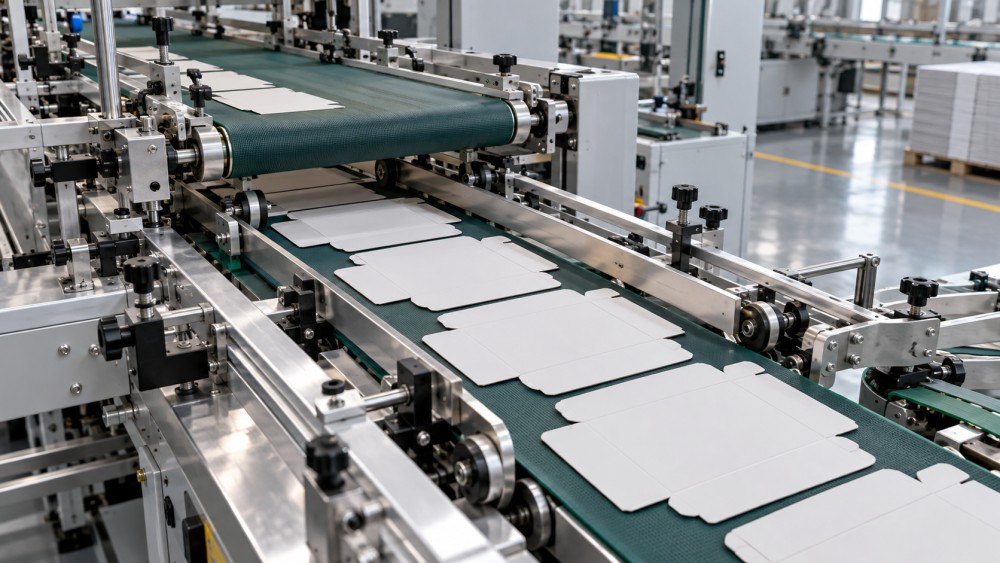
When checking a suspected alignment problem, compare samples collected after successive sections using the machine’s safe sampling procedure. If blanks are square before a transfer and skewed immediately afterward, investigate that transfer first. Changing final-fold settings before locating the initial disturbance makes troubleshooting less reliable.
Make the crease do the folding work
Pre-breaking helps a crease bend predictably and reduces the resistance that later folding elements must overcome. On lightweight cartons, the objective is a controlled hinge. Excessive pre-breaking can weaken the crease or mark a printed surface, while insufficient pre-breaking leaves more springback for the final folding section to manage.
Set hooks, rails, and folding belts so they engage the intended panel and develop the fold progressively. An abrupt change in direction can push a soft panel into a buckle instead of rotating it around the crease. Check entry position, tool clearance, and support beneath the blank before adding force.
Inspect both the crease and the panel during slow operation. If the fold develops beside the score, possible causes include poor crease definition, tool position, or blank misalignment. If the score folds correctly but the panel wrinkles farther away, review local support and the folding path.
Complex styles need separate attention. Crash-lock bottoms and multipoint cartons place more demands on flap sequence, hooks, and support than a straightforward side-seam carton. Success on one style does not establish suitability for every carton made from the same board.
Match adhesive application to the surface and available time
A lightweight glue flap has limited resistance to wetting, drag, and uneven pressure. Excess adhesive can spread outside the joint, contaminate belts, or encourage local distortion. Too little adhesive can leave an incomplete bond, especially when the glue line misses part of the intended contact area.
Choose adhesive for the actual bonding surfaces and process conditions. Water-based carton adhesives may be appropriate for absorbent glue areas, while coated or otherwise difficult surfaces can require a different formulation or a prepared glue area. Hot-melt systems have their own requirements for temperature, application pattern, and compression timing. Select the adhesive and settings together.
Position the glue pattern within the usable flap area, allowing for normal registration variation. Check nozzle condition or wheel cleanliness, application consistency, and start-and-stop timing. Keep adhesive preparation and viscosity control within the supplier’s operating guidance; uncontrolled dilution can change application behavior and bond development.
Speed changes affect the time between application, joint closure, and release from compression. Recheck the joint after each meaningful speed increase. A carton that looks closed at delivery can still reopen during handling if the adhesive has not developed enough initial strength.
Inspect bonds after an appropriate setting period as well as immediately after delivery. Fiber tear can be useful evidence on suitable paper-to-paper joints, but acceptance should reflect the substrate, adhesive system, and carton’s functional requirements.
Use delivery compression without crushing the carton
Compression should maintain intimate contact across the glue joint while the adhesive develops strength. Excess pressure can flatten creases, mark printed panels, or force a lightweight carton into an uneven shape. Insufficient pressure allows local gaps or springback.
Check pressure distribution across the joint, belt tracking, and the way cartons enter the delivery stream. An uneven overlap or a corner catching at entry may distort cartons even when the nominal compression setting appears reasonable.
Consider compression time as well as pressure. Raising line speed reduces time in a fixed-length compression section. If the seam begins opening only after a speed increase, review adhesive behavior, contact quality, and available holding time together. Additional pressure cannot substitute indefinitely for the time needed to establish a bond.
Use the defect location to choose the next adjustment
Change one relevant variable at a time and retain samples from each setting. This makes it easier to distinguish a genuine improvement from a temporary change caused by pile height, board variation, or adhesive condition.
Prove a production window before accepting the speed
A useful trial establishes the range within which the process remains stable. Begin with approved samples and agreed acceptance criteria covering seam position, squareness, surface appearance, bond integrity, and opening behavior. Include erection or packing checks where folded-carton quality affects downstream equipment.
Run at a moderate speed until feeding, folding, and gluing are repeatable. Increase speed in controlled stages, checking samples and recording interruptions at each stage. When defects emerge, identify their first point of appearance. Reduce speed if necessary while correcting the cause.
The trial should extend beyond a short demonstration with carefully selected blanks. Include normal pile replenishment, a stop and restart, and representative material variation. Inspect cartons after stacking and handling because some seam and deformation problems become visible only later.
Record enough information to reproduce the result: board grade and caliper, grain direction, blank revision, belt and guide positions, folding settings, adhesive conditions, compression settings, and accepted speed. Machine recipes help with repeatability, but physical checks remain necessary when material or tooling changes.
Compare performance using accepted cartons per production hour, waste, stops, and setup effort. A higher displayed speed can deliver fewer usable cartons if operators repeatedly clear misfeeds or reject distorted work.
What a machine trial should establish before purchase
When evaluating a folder gluer machine for folding cartons, use the lightest and least forgiving blanks in the intended product mix. A supplier’s demonstration on a stiff, simple carton provides limited evidence for thin stock with large panels, windows, narrow glue flaps, or demanding bottom folds.
Look for adjustable support through transfers, controllable belt pressure, suitable folding tools, and access for cleaning and repeatable setup. Inspection and rejection systems can help contain defects, but their detection capability must match the faults that matter, such as missing glue or incorrect folding.
Ask for a documented run using production-equivalent material and agreed quality criteria. Acceptance should include sustained output, restart behavior, bond quality, and downstream carton function. The useful operating speed is the one the machine can maintain while consistently producing cartons that meet those requirements.
Related News
 When Is a Servo Folder Gluer Line Worth the Investment?Is a servo folder gluer line worth the investment? Explore the production challenges, ROI factors, and supplier questions that can guide your decision.Ms. Vivienne Cross
 US Justice Department Investigates Pricing by Major Corrugated Packaging ProducersThe US Justice Department is investigating containerboard pricing by major corrugated packaging producers. Explore potential implications for buyers and supply chains.Ms. Vivienne Cross
 What Affects Folder Gluer Machine Price and Total Cost?Folder gluer machine price is only part of the investment. Discover what drives costs and how to compare quotes, operating expenses, and long-term value.Ms. Vivienne Cross
 How Roll Handling Equipment Price Affects Project ROIRoll handling equipment price affects more than upfront costs. Learn how to compare installed costs, quantify savings, and build a stronger project ROI case.Ms. Vivienne Cross
 How Stacking Machines Reduce Bottlenecks in Sheet PlantsStacking Machines reduce sheet plant bottlenecks by improving pile quality and flow. Discover how to choose and integrate the right system.Ms. Vivienne Cross
 Italian Packaging Machinery Sales Up Just 0.9% as Orders Fall 4.7%Italian packaging machinery sales rose just 0.9% as orders fell 4.7%. Explore UCIMA's figures and what weaker demand could mean for buyers and exporters.Ms. Vivienne Cross