How to Prevent Sheet Damage When Using Heavy Duty Pile Turners
Sheet damage during pile turning can lead to misfeeds, print defects, wasted material, and costly production delays. For operators using heavy duty pile turners, protecting paper and corrugated sheets starts with understanding how clamping pressure, pile alignment, load stability, and handling speed affect the material. This guide explains practical steps to prevent crushed edges, scratches, and sheet shifting, helping your team maintain consistent quality and keep printing and converting operations running smoothly.
Start With the Pile, Not the Turn Button
A pile turner can handle a substantial load, but capacity alone does not tell you whether a particular pile is safe to rotate. Sheet dimensions, pile height, weight distribution, pallet condition, and material stiffness all affect how the load behaves between the clamps.
Before loading, check the job ticket against the machine’s permitted load and pile dimensions. Include the weight of any pallets, boards, and other items that will be carried during the cycle, according to the manufacturer’s capacity definition. A load may be within the weight rating but still be too tall, too wide, or too unstable for the machine.
Look at the pile itself. Sheets protruding from one side, a leaning stack, damaged corners, or a broken pallet can turn a routine operation into a waste problem. Correct the pile using an approved handling method before it enters the turner. Do not expect clamping pressure to straighten a badly built stack.
Different materials need different care. Lightweight paper can shift or wrinkle easily; coated sheets may show scuffs; freshly printed stock can mark if the ink or coating is not sufficiently dry or cured. Corrugated board has another vulnerability: excessive compression can damage the flutes, even when the outer liner appears acceptable.
Set Clamping Pressure for Security Without Crushing
The clamp must hold the pile securely throughout rotation, but more pressure is not automatically safer. Excessive force can leave pressure marks on paper, deform cartonboard, or compress corrugated sheets. Too little force allows movement between sheets, which can cause edge damage, scuffing, or an unstable load.
Use the machine manufacturer’s instructions and your site’s approved settings as the starting point. Where pressure is adjustable, settings should reflect the material, pile size, and support arrangement—not just the weight displayed on the job ticket. If a new stock or pile configuration is unfamiliar, agree on a trial procedure with a supervisor or qualified technician rather than guessing a pressure value.
After a controlled trial, inspect the outer sheets and several accessible sheets within the pile for pressure marks, edge deformation, and movement. On corrugated board, look for flattened areas, particularly where pressure may have been concentrated. If damage appears, stop and review the setup; reducing pressure without confirming load stability can create a different hazard.
A sound support board may help distribute contact pressure where the equipment and job procedure allow it. It must be suitable for the load and correctly sized; a warped or undersized board can create concentrated pressure instead. Never add makeshift spacers or modify clamp surfaces without authorization.
Keep the Load Centered and Supported
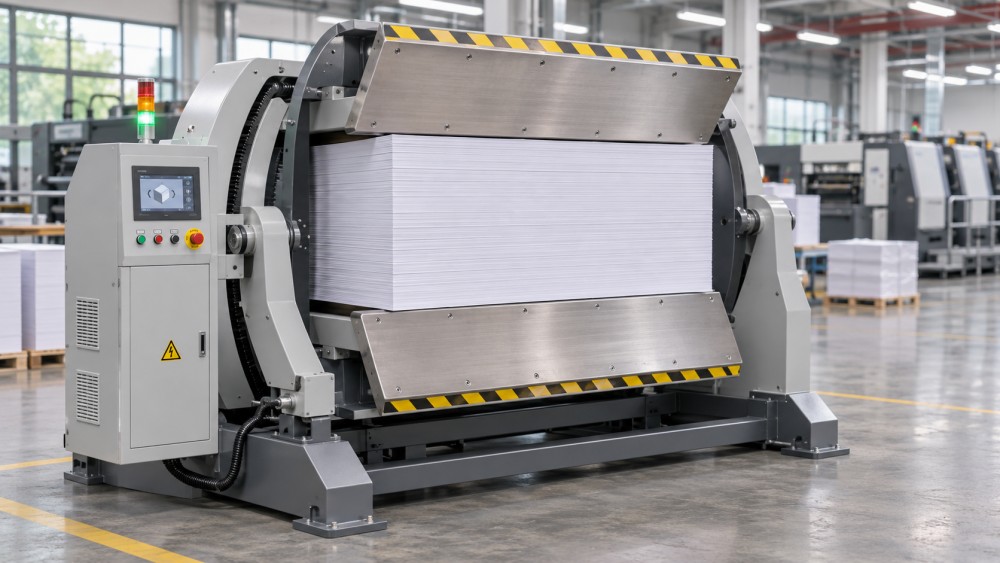
A centered pile gives the clamps a better chance of applying force evenly. An off-center load can shift during rotation, especially if its center of gravity is not where the operator expects. Follow the machine’s loading guides and permitted positioning range rather than judging the position from one edge alone.
Pay particular attention when changing pallets. The incoming and outgoing pallets or support boards must be appropriate for the sheet size and compatible with the turner. A pallet that is too small can leave sheet edges unsupported; one with raised fasteners, loose boards, or trapped debris can mark the bottom sheets.
Check that the pile is fully supported before releasing the clamp. If the machine includes a pallet-changing function, follow its specified sequence. Do not reach into the machine to reposition a pallet or sheet while any part of the equipment can move. Stop the operation and use the site’s isolation procedure when intervention is required.
Control Movement, Air, and Contact Surfaces
A pile that looks stable at rest can behave differently during acceleration and rotation. Where the turner offers adjustable movement or material-specific programs, select the approved setting for the job. Avoid abrupt starts or changes in direction if the machine permits smoother operation. If the pile visibly shifts, stop using the normal safe-stop controls and investigate; do not continue merely because the load has not fallen.
Some pile turners include air joggers or aeration systems to separate sheets and align the pile. These can help prepare stock for a feeder, but air that is poorly directed or too aggressive for the material can disturb lightweight sheets or spread an already uneven pile. Follow the equipment instructions and adjust only within the permitted operating range. Aeration is not a substitute for a stable, correctly clamped load.
Cleanliness matters just as much as speed. Paper dust, dried ink, adhesive residue, pallet splinters, and grit on contact surfaces can leave marks that travel through later printing or finishing stages. Inspect and clean the machine using approved methods and only when it is safe to do so. Report torn pads, rough edges, damaged plates, or recurring hydraulic problems to maintenance rather than trying to compensate with a different operating setting.
Match the Handling Method to the Material
Coated and Printed Sheets
On coated stock, minor rubbing can be visible on a finished surface. Keep contact surfaces clean, minimize unnecessary movement between sheets, and check whether protective boards or interleaving are specified for the job. For freshly printed work, confirm that the production team has released the pile for handling. Drying or curing requirements depend on the ink, coating, substrate, and process; a pile that feels dry on top is not necessarily ready throughout.
Corrugated Board and Cartonboard
With corrugated sheets, inspect beyond the corners. Localized flattening can affect board performance and may not be obvious until the sheets reach printing, die-cutting, or folding. Check the pile’s support and pressure distribution, especially when sheet sizes or board grades change. Some corrugated loads may require a different handling method; confirm that the turner is suitable for the board and pile configuration before proceeding.
Cartonboard can also show dents or permanent edge distortion. If a job has demanding print or finishing requirements, inspect representative sheets before releasing the pile to the next process. A clean-looking outer sheet does not guarantee that the sheets against a pallet or support board are undamaged.
Mixed or Uneven Loads
Avoid treating a mixed pile as if it were uniform. Different sheet sizes, grades, or stack heights can produce uneven contact and unexpected movement. Separate or rebuild the load where the production procedure requires it. If a pile is leaning, water-damaged, or visibly unstable, escalate the issue rather than trying to secure it by increasing clamp force.
Use the Damage Pattern to Find the Cause
When defects appear, record where they occur before changing several settings at once. The location often narrows the investigation:
- Crushed or dented areas near contact points: Check pressure, support-board condition, load centering, and whether the contact area is appropriate.
- Scratches or repeated marks: Inspect pallets, clamp surfaces, and supports for debris, protrusions, or damaged coverings.
- Staggered edges after turning: Review pile alignment, clamp security, acceleration, and any aeration or jogging settings.
- Marks on printed faces: Check handling readiness, sheet movement, contamination, and the need for approved protection.
- Feeder problems without obvious damage: Examine pile alignment, sheet separation, curl, and the condition of sheets deeper in the stack.
These are starting points, not proof of cause. Damage may have occurred during stacking, storage, forklift transport, or an earlier process. Compare the pile before and after turning where practical, and keep suspect sheets separate so the next shift can see the defect rather than relying on a verbal description.
Build a Repeatable Check Into Every Changeover
The most useful operating record is often a short one: material and grade, sheet size, approximate pile height and weight, pallet or support arrangement, approved machine setting, and the result of the inspection. Add the location and type of any defect. That gives the next operator a defensible starting point and gives maintenance a clearer description if the same problem returns.
At changeover, verify that the previous job’s settings still make sense. A setup that worked for a stable pile of heavy board may not suit lightweight coated paper. If the machine has stored recipes, treat them as controlled starting points, not a replacement for checking the actual load.
Keep the downstream process in the conversation. Press operators may notice scuffing or double-sheet feeds; die-cutting teams may see distorted edges or inconsistent feeding. Sharing those observations with pile-turner operators helps distinguish handling damage from problems introduced elsewhere.
CPCS approaches this kind of issue as a production-system question: material handling, printing, and converting affect one another. When a defect repeats, review the machine manual, maintenance history, material characteristics, and handoff conditions together. If the safe operating window remains unclear, involve the equipment manufacturer or a qualified service provider before returning the load to production.
Related News
 When Is a Servo Folder Gluer Line Worth the Investment?Is a servo folder gluer line worth the investment? Explore the production challenges, ROI factors, and supplier questions that can guide your decision.Ms. Vivienne Cross
 US Justice Department Investigates Pricing by Major Corrugated Packaging ProducersThe US Justice Department is investigating containerboard pricing by major corrugated packaging producers. Explore potential implications for buyers and supply chains.Ms. Vivienne Cross
 What Affects Folder Gluer Machine Price and Total Cost?Folder gluer machine price is only part of the investment. Discover what drives costs and how to compare quotes, operating expenses, and long-term value.Ms. Vivienne Cross
 How Roll Handling Equipment Price Affects Project ROIRoll handling equipment price affects more than upfront costs. Learn how to compare installed costs, quantify savings, and build a stronger project ROI case.Ms. Vivienne Cross
 How Stacking Machines Reduce Bottlenecks in Sheet PlantsStacking Machines reduce sheet plant bottlenecks by improving pile quality and flow. Discover how to choose and integrate the right system.Ms. Vivienne Cross
 Italian Packaging Machinery Sales Up Just 0.9% as Orders Fall 4.7%Italian packaging machinery sales rose just 0.9% as orders fell 4.7%. Explore UCIMA's figures and what weaker demand could mean for buyers and exporters.Ms. Vivienne Cross