How to Evaluate an Automatic Cartoning Machine Manufacturer
The strongest automatic cartoning machine manufacturer is the one that can demonstrate reliable output with your products, carton materials, and production schedule—and make the cost of achieving that output clear. A low quotation loses its advantage when the machine requires constant intervention, wastes cartons during setup, or cannot recover quickly after a stoppage. Compare suppliers against a defined application, documented trials, and a consistent ownership-cost model before comparing final prices.
Rated speed is only a starting point. The more useful measure is the number of correctly packed, accepted cartons produced over an agreed period, including the interruptions that occur in normal production. That distinction changes how machine specifications, supplier capability, and performance guarantees should be evaluated.
Define the application before requesting a firm quotation
A quotation based on carton dimensions alone leaves too much room for misunderstanding. The loading process depends on the product’s shape, rigidity, surface friction, orientation, and presentation at the machine infeed. A rigid bottle, a flexible pouch, and a stack of sachets require different handling arrangements even when they fit inside the same carton.
Provide actual product samples and carton drawings, together with the expected production mix. Include dimensional tolerances, weight variation, pack count, leaflet requirements, closure method, and the condition in which products arrive from upstream equipment. For grouped products, define whether counting and collation belong within the cartoner’s scope or must be completed before transfer.
Carton specifications need comparable detail. Board stiffness, grain direction, crease quality, glue-seam consistency, and storage conditions affect opening and loading. A carton that opens easily by hand can still resist a vacuum opening mechanism or spring back before product insertion. Nominal board thickness alone does not describe this behavior.
Identify difficult combinations rather than sending only the easiest format. Small cartons with tight loading clearances, bulky products, unstable groups, and formats requiring frequent adjustment are useful trial candidates. Where the product range is wide, ask for a format-by-format capability statement. A broad minimum-to-maximum dimension range does not establish that every combination within it is workable.
Examine where the manufacturer’s engineering responsibility begins and ends
Establish which parts of the proposed system the supplier designs, builds, integrates, and supports. Purchased drives, sensors, and adhesive equipment are normal components of machinery construction. The important question is whether the supplier controls the application engineering and can diagnose problems across the complete system, including outsourced feeding modules.
Request evidence from machines handling comparable products and carton styles. Similarity should extend to the difficult operation: opening stiff cartons, inserting fragile products, maintaining grouped-product alignment, or closing cartons at the required rate. A reference installation packaging a different product at high speed offers limited evidence for your application.
A factory assessment should follow the proposed machine through assembly, wiring, software configuration, and testing. Look for controlled drawings, identifiable machine versions, documented settings, and a process for recording modifications. These details affect whether a replacement part fits and whether a later software change preserves the accepted performance.
Discuss a realistic fault with the engineering team. For example, cartons failing to open could result from vacuum leakage, inconsistent blank presentation, carton resistance, or incorrect timing. A credible explanation separates those causes and describes how they would be measured. A proposal to increase vacuum without examining material behavior leaves the underlying problem unresolved.
Make product trials expose the limits of the machine
A demonstration using selected cartons and a steady product supply shows that the machine can run under those conditions. A useful evaluation establishes how it behaves when materials vary, supply becomes uneven, or a format changes. Agree on the trial protocol before sending samples, including the sample quantities needed for setup and measured production.
Use production-representative cartons and products, preferably from more than one material batch where variation is expected. Record the carton specification and condition so that results remain traceable. If the trial uses specially prepared blanks, manually arranged products, or temporary feeding equipment, document those differences and their effect on the proposed installation.
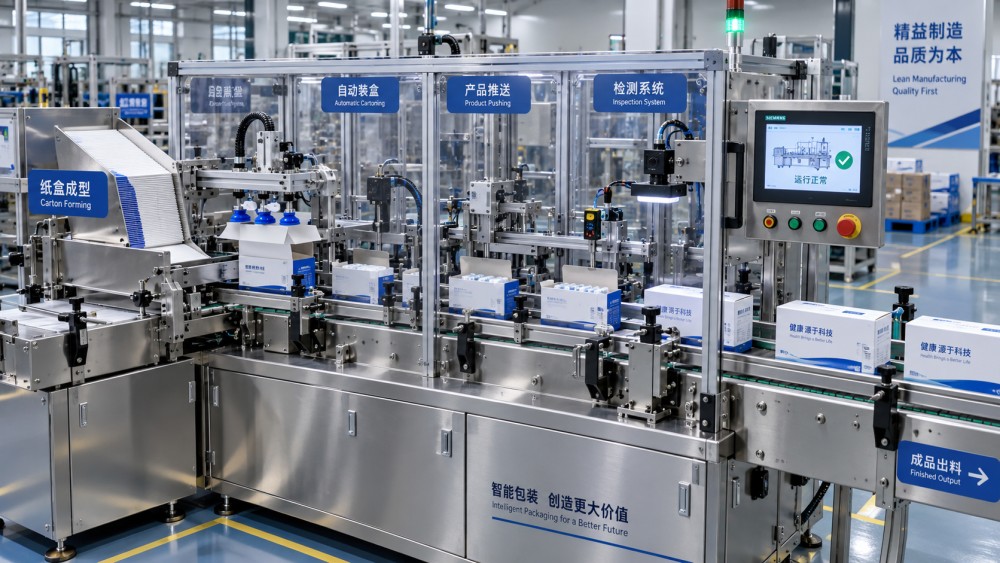
The trial should reveal the complete sequence: carton extraction, erection, product loading, insertion of any leaflet, closure, inspection, and discharge. Observe where intervention occurs. Repeated assistance at the magazine or loading station is part of the performance result, even if the machine reaches the quoted speed between interruptions.
Measure elapsed time and accepted output together. Also record rejected cartons, damaged products, stoppage reasons, and recovery time. Distinguish faults generated by the cartoner from interruptions caused by upstream starvation or downstream blockage. The distinction helps diagnose performance, while the total elapsed result still describes what the production line delivers.
Define quality acceptance in observable terms. “Good carton appearance” is too subjective for a contract. Specify requirements such as complete product count, undamaged contents, correctly engaged tuck flaps, acceptable adhesive closure, and readable codes where applicable. For glued cartons, evaluate the bond after the relevant setting time; appearance immediately after discharge does not establish closure strength.
Separate format flexibility from changeover effort
A machine’s ability to handle several sizes does not establish how quickly it moves between them. Ask which adjustments are recipe-controlled, which require manual positioning, and which need dedicated change parts. Electronic recipes reduce repeated setting work only when the mechanical adjustments and product-feeding arrangements are also reproducible.
Time a changeover from the last accepted carton of the previous format to stable accepted production of the next. Including startup adjustments gives a more useful result than measuring only the replacement of guides and tooling. Record how many cartons and products are consumed before stable running returns.
The production schedule changes the value of this evidence. Long campaigns place greater emphasis on sustained running and wear. Short campaigns make setup time, accessible adjustments, and repeatable settings more influential. A faster machine can deliver less weekly output if frequent format changes consume the available production window.
Inspect change parts for clear identification, practical storage, and handling. Heavy or awkward tooling adds work that may be absent from a quoted changeover time. Ask whether a new format requires only a tooling package or also engineering changes, software work, and another validation trial.
Resolve integration and maintenance access before the layout is approved
The cartoner’s footprint is only part of its space requirement. Carton replenishment, guard opening, maintenance access, adhesive servicing, and change-part removal need clearance. Confirm these areas on the installation drawing alongside conveyor elevations, product transfer points, and available utilities.
Define the line’s behavior during starvation, blockage, and emergency stops. If upstream equipment continues discharging while the cartoner stops, the installation needs a suitable accumulation or controlled stopping arrangement. Buffer capacity must relate to the actual product and interruption pattern; adding conveyor length does not automatically create usable accumulation.
Assign responsibility for interface signals, conveyor controls, coding data, and inspection results. “Ready for integration” should be translated into an agreed interface document. Where rejected packs leave the main flow, include containment and confirmation of rejection so that detected defects cannot continue downstream unnoticed.
Maintenance access deserves a physical demonstration. Vacuum cups, belts, chains, bearings, and adhesive nozzles need inspection or replacement at different intervals. Ask to see representative tasks performed with the guarding arrangement in place. Poor access increases service time and makes routine maintenance harder to complete consistently.
Compare ownership cost using the same assumptions
Build the comparison around a common production schedule, product mix, evaluation period, and accepted-output requirement. Otherwise, one proposal may appear cheaper simply because it excludes feeding equipment, installation work, or recurring costs included by another supplier.
Cost per accepted carton = total ownership cost over the evaluation period ÷ accepted cartons produced during that period.
Ownership cost should include the installed machine, required tooling, commissioning, training, maintenance, consumables, utilities, and production labor. Include expected material losses and downtime effects using site-specific assumptions. State whether financing and residual value are included, and apply the same treatment to every proposal.
Compressed air deserves particular attention where vacuum generation and pneumatic movements are extensive. Ask for consumption at the proposed operating condition and clarify the measurement basis. Installed electrical power indicates connected capacity; it is not a direct measure of energy consumed per accepted carton.
Test the cost model against realistic changes. Compare longer runs with frequent short orders, and examine what happens when output is below plan or spare-part delivery takes longer than expected. Avoid counting the same loss twice: reduced output, extra labor, and lost production contribution need separate definitions. The purpose is to identify which assumptions could reverse the supplier ranking.
Convert support promises and trial results into contract terms
“Fast technical support” needs a defined service arrangement. Establish support hours, time zone, available languages, remote diagnostic access, and the route to an onsite visit. A response acknowledging a fault is different from a diagnosis or repair. Each commitment should describe the service actually being offered.
Request a recommended spare-parts list that distinguishes routine wear items from components whose failure stops production. Include part identification, quoted lead times, and the availability of replacements for configured control components. Clarify access to software backups, machine parameters, electrical drawings, and recovery instructions. These resources determine how quickly a failed controller or lost configuration can be restored.
The purchase agreement should reference the approved product and carton specifications, equipment scope, trial protocol, and measurable acceptance conditions. Define factory acceptance and site acceptance separately. Factory testing establishes performance before shipment; site testing confirms operation with the installed utilities, interfaces, and actual production materials.
State what happens if acceptance criteria are missed: the correction process, responsibility for retesting costs, and the payment milestone affected. Also define how a later change in carton material or product specification will be assessed. The final supplier comparison then rests on demonstrated capability, explicit obligations, and a cost model whose assumptions remain visible.
Related News
 When Is a Servo Folder Gluer Line Worth the Investment?Is a servo folder gluer line worth the investment? Explore the production challenges, ROI factors, and supplier questions that can guide your decision.Ms. Vivienne Cross
 US Justice Department Investigates Pricing by Major Corrugated Packaging ProducersThe US Justice Department is investigating containerboard pricing by major corrugated packaging producers. Explore potential implications for buyers and supply chains.Ms. Vivienne Cross
 What Affects Folder Gluer Machine Price and Total Cost?Folder gluer machine price is only part of the investment. Discover what drives costs and how to compare quotes, operating expenses, and long-term value.Ms. Vivienne Cross
 How Roll Handling Equipment Price Affects Project ROIRoll handling equipment price affects more than upfront costs. Learn how to compare installed costs, quantify savings, and build a stronger project ROI case.Ms. Vivienne Cross
 How Stacking Machines Reduce Bottlenecks in Sheet PlantsStacking Machines reduce sheet plant bottlenecks by improving pile quality and flow. Discover how to choose and integrate the right system.Ms. Vivienne Cross
 Italian Packaging Machinery Sales Up Just 0.9% as Orders Fall 4.7%Italian packaging machinery sales rose just 0.9% as orders fell 4.7%. Explore UCIMA's figures and what weaker demand could mean for buyers and exporters.Ms. Vivienne Cross