How to Compare Carton Ejector Price Without Missing Hidden Costs
How to Compare Carton Ejector Price Without Missing Hidden Costs
Comparing carton ejector price is rarely as simple as lining up three quotations and picking the lowest number. In carton production, the ejector sits close to the point where die-cut sheets, stripped waste, finished blanks, and downstream handling must stay synchronized. If that section is unstable, the cost shows up elsewhere: slower throughput, more manual intervention, damaged blanks, extra labor, and avoidable stops.
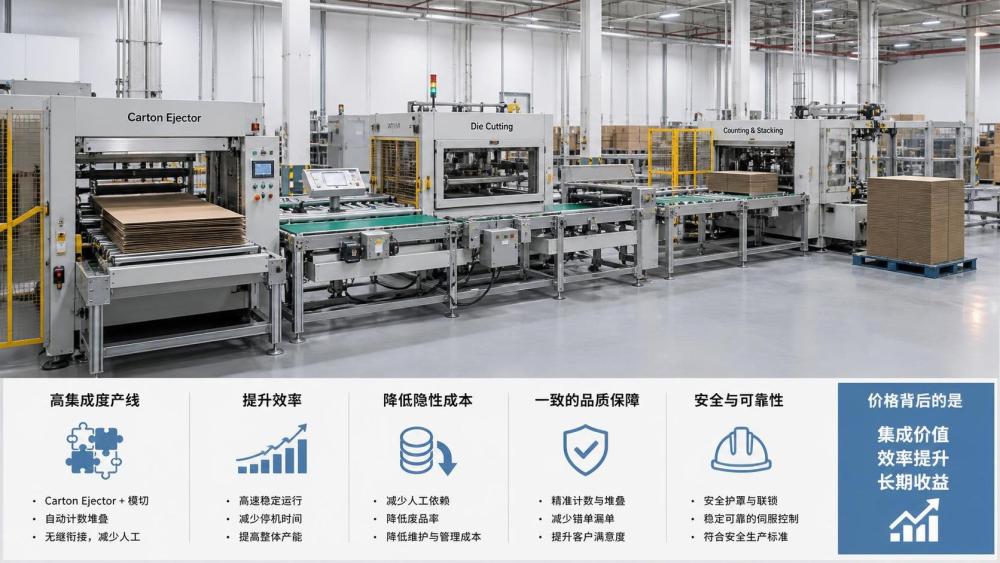
That is why experienced buyers no longer treat this kind of equipment as an isolated purchase. In corrugated and paper-based packaging plants, a machine is part of a wider converting flow that may include flatbed die-cutting, stripping, delivery, counting, bundling, inspection, palletizing, and digital production management. A platform such as CPCS has value here because it frames equipment decisions in operational terms, not just list price. For procurement teams, that shift matters. A cheaper machine can become the more expensive option once installation, format flexibility, downtime exposure, and support limits are included.
Start with the real comparison unit, not the quoted number
A quotation often gives the impression of clarity: machine base price, optional modules, maybe a shipping estimate. But carton ejector price only becomes meaningful when the scope is fixed. Buyers should first confirm what exactly is being compared.
In practice, two suppliers may both offer a “carton ejector,” while one includes servo control, change parts, safety guarding, commissioning, operator training, and interface preparation for the upstream die-cutter, and the other does not. On paper, the second quote looks better. On the factory floor, it may create a chain of add-on purchases and engineering adjustments.
A more useful comparison unit is total delivered and operable system cost for your target job range. That means asking: can this machine run the board grades, blank sizes, and order patterns we actually produce, at an output rate that matches the rest of the line?
The hidden costs usually appear in five places
Most procurement surprises are not mysterious. They repeat from project to project.
1. Installation and line integration
A standalone price may exclude electrical connection, air supply preparation, foundation requirements, guarding adjustments, conveyor matching, and PLC communication with upstream or downstream equipment. If the ejector has to connect with existing die-cutting, counting, or stacking sections, integration effort can be significant. Older plants especially need to check signal compatibility, physical layout limits, and access for maintenance.
This is where procurement should involve maintenance and production early. If the machine footprint forces a conveyor rebuild or a safety redesign, the “good price” starts to look thin.
2. Tooling and format-related expense
Some ejectors need dedicated change parts for different carton sizes, blank styles, or stacking patterns. Others rely more on servo-driven adjustment and have lower mechanical change-part dependency. Neither approach is automatically better; it depends on your order mix. Plants with frequent short runs and high SKU variation usually care more about setup speed and reduced tooling complexity than plants running long, repetitive batches.
When comparing carton ejector price, ask for a full list of required accessories for your common formats, not just the starter configuration.
3. Energy and utilities
Power demand, compressed air consumption, vacuum requirements, and even dust extraction needs can change operating cost over time. On their own, these may not seem large compared with the machine price. But in high-volume converting plants, utility use accumulates, especially where energy costs are volatile or where several automated stations run in parallel.
It is worth requesting utility consumption under normal production conditions, not only theoretical installed power. Those are different things.
4. Maintenance and spare parts exposure
The lower-priced machine sometimes depends on wear parts that are cheap individually but replaced often, sourced slowly, or only available from one channel. The issue is not only spare part cost. It is lead time, stock policy, and the practical skill needed to service the machine without calling the supplier each time.
Procurement teams should ask what preventive maintenance looks like in real operating hours, which components are expected to wear, and whether local technical support exists. In packaging factories that run tight delivery schedules, delayed maintenance can cost more than any spare part invoice.
5. Performance loss that never appears on the quotation
This is the biggest blind spot. If the ejector struggles with warped board, mixed order patterns, high-speed delivery consistency, or precise blank separation, the effect may not show up as a clear service cost. Instead, it appears as lower line speed, more operator attention, jams, reject piles, and difficulty maintaining output during shift changes.
For buyers in corrugated packaging and carton converting, uptime stability is often more valuable than an attractive purchase price. CPCS regularly emphasizes this broader equipment view across converting, inspection, and end-of-line automation because the weakest module can limit the productivity of the entire system.
What procurement should request before comparing offers
A useful RFQ process for this equipment should go beyond “please quote your machine.” Suppliers need a job profile. Without it, they will fill the gap with assumptions, and assumptions are where cost disputes begin.
Once this information is shared, quotes become more comparable. If a supplier cannot clearly state what is included, what assumptions were made, and what falls outside scope, that itself is a risk signal.
Cheap versus economical are not the same thing
Procurement teams are often under pressure to defend capital cost. That is reasonable. But in packaging plants, a machine with a lower acquisition price may still have a higher total cost of ownership if it adds labor, wastes board, or causes unstable output after the die-cutting stage.
This distinction is becoming more important as factories move toward system-based investment. E-commerce packaging, shorter runs, more SKU changes, traceability requirements, and tighter delivery windows all make downstream handling more sensitive. A carton ejector that works acceptably in a simple production environment may become a pain point in a plant that also runs inline inspection, automated counting, robotic palletizing, or data-connected order scheduling.
That broader context is one reason industry decision-makers follow structured equipment intelligence rather than relying only on supplier brochures. CPCS, for example, covers not just one machine category but the interactions among corrugated board production, printing, converting, inspection, and plant automation. For buyers, this matters because equipment value is often created between machines, not inside one machine alone.
Questions that expose hidden cost quickly
A few practical questions can save weeks of back-and-forth later:
- What production speed is achievable on our actual carton styles, not only under ideal test conditions?
- Which format changes require parts, and which can be done by adjustment?
- What is included in commissioning, and how many days of training are part of the offer?
- What spare parts are recommended for the first year?
- Can the machine communicate with our current control system or future production management tools?
- What are the utility requirements under normal production load?
- If service is needed, what is the expected support method: remote diagnosis, local technician, or factory dispatch?
These are not aggressive negotiation questions. They are scope-control questions. Good suppliers usually answer them clearly because they reduce later disputes.
When a higher price may be justified
A higher carton ejector price may be reasonable if it buys real operational protection: faster setup for mixed orders, better stability on lightweight or variable board, lower dependence on manual sorting, simpler maintenance access, or cleaner integration with existing converting lines. It may also be justified if the supplier can support documentation, installation coordination, and future expansion more effectively.
Not every plant needs the highest automation level. A factory with stable long runs and ample labor may choose differently from one handling frequent design changes and strict delivery windows. The point is not to spend more. It is to spend in the place where your operation loses money today.
A workable decision method for procurement
If you need a simple internal process, compare offers in three layers.
Layer one is purchase scope: machine, options, shipping, installation, training, and spare parts. Layer two is operating fit: speed, changeover, utility use, maintenance burden, and operator dependence. Layer three is system impact: compatibility with upstream and downstream equipment, likelihood of becoming a bottleneck, and support for future automation or traceability requirements.
A quote that looks weak in layer one may still win on layers two and three. That is often where the real economics sit.
Before issuing a final PO, it is worth validating the offer against actual production conditions: board types, carton formats, line speed, changeover rhythm, available utilities, and service expectations. If those points are still vague, the price comparison is not finished yet. It is only early arithmetic.
Related News
 Folder Gluer Line Cost Factors That Shape Payback and ROIExplore folder gluer line cost factors that shape payback and ROI—from automation and changeovers to waste, labor, uptime, and lifetime cash performance.Ms. Vivienne Cross
 Steam Boiler Price Factors That Shape Industrial Energy BudgetsSteam boiler price depends on capacity, fuel, efficiency, installation, and reliability. Discover how to control lifecycle costs and protect packaging production.Ms. Vivienne Cross
 How Paperboard Converting Machines Reduce Waste and Improve ThroughputPaperboard Converting Machines reduce waste, speed up setup, stabilize production, and improve carton quality. Explore smarter ways to boost throughput and yield.Ms. Vivienne Cross
 Is an Offset Press Cost-Effective for Short-Run Carton Jobs?Is an offset press economical for short-run carton work? Explore break-even costs, setup waste, quality demands, and workflow factors to choose the most profitable print route.Ms. Vivienne Cross
 How Shaftless Unwind Stands Reduce Changeover Time and Material WasteShaftless unwind stands reduce roll-change time, stabilize web tension, and cut paper waste for more efficient corrugated and packaging production.Ms. Vivienne Cross
 How an Automatic Paper Reel Handling System Improves Mill SafetyDiscover how an automatic paper reel handling system reduces crush risks, forklift traffic, and downtime while improving mill safety and reliable production flow.Ms. Vivienne Cross