How an Automatic Paper Reel Handling System Improves Mill Safety
A paper reel arriving at a corrugator, printing press, or unwind stand can weigh far more than an operator can safely control by hand. The highest-risk moments are often not during normal production, but during receiving, storage, transfer, reel selection, loading, and recovery from a jam or misalignment. A reel that rolls unexpectedly, is lifted from the wrong position, or is placed on an unstable surface can create an immediate crush, collision, or traffic hazard.
An automatic paper reel handling system improves mill safety by replacing uncontrolled manual and forklift-dependent movements with defined, guarded, and interlocked transfer steps. It does not remove every risk automatically; poor reel specifications, damaged cores, blocked transfer routes, and weak operating procedures can still create hazards. Its safety value comes from controlling where reels travel, how they are supported, who can enter the operating area, and what happens when the equipment detects an abnormal condition.
Where reel-handling risk usually starts
Paper reels are difficult to manage because their mass, cylindrical shape, and surface condition create risks that are different from ordinary palletized materials. A reel may appear stable while resting on a floor, but a small slope, loose wrapping, contact from a vehicle, or incorrect chock placement can cause it to move. During high-output periods, these risks can be compounded by pressure to keep the corrugator or press supplied without delay.
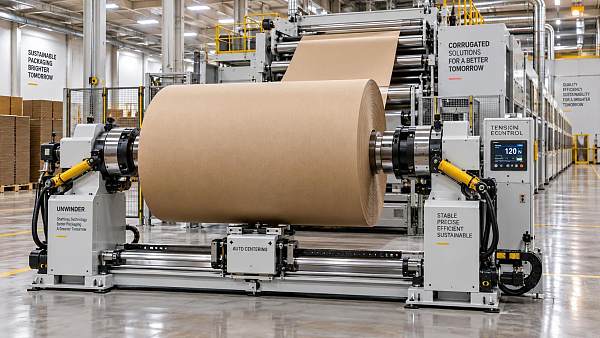
In a conventional workflow, a forklift may collect reels from storage, place them near the machine, reposition them for the correct unwind direction, and remove spent reels or waste material. Each transfer adds vehicle movement, visibility limitations, and opportunities for communication errors. Operators working near the machine may also need to guide positioning, remove packaging, inspect the core, or intervene when a reel does not enter the loading position correctly.
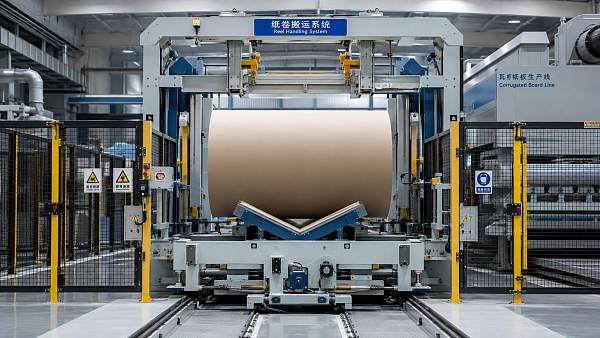
The goal of automation is not simply faster transport. It is to make reel movement repeatable and to separate people from hazardous motion. Depending on the layout, the system may include receiving conveyors, storage positions, shuttle cars, transfer tables, reel turners, lift devices, automatic loading stations, empty-core handling, and control interfaces connected to production scheduling.
Safety improvements that matter in daily operation
Less exposure to crush and roll hazards
A reel should remain positively supported throughout transfer. Automated conveyors, cradles, V-shaped supports, stops, and controlled lift mechanisms are designed to hold the reel in a known position rather than relying on an operator to stabilize it. Where reel rotation or orientation is required, a turning station can perform the task within a controlled zone instead of asking personnel to push, lever, or redirect a heavy roll.
This matters especially at machine infeed points. A loading sequence should confirm that the unwind position is ready, the reel is correctly aligned, and the transfer path is clear before movement begins. Physical end stops, presence sensors, and position feedback can reduce the chance that a reel travels beyond its intended position. These measures are most effective when they are treated as safeguards, not as reasons to allow staff inside an active transfer zone.
Reduced interaction between forklifts and pedestrians
Forklifts remain useful in many mills, particularly at goods receiving and dispatch, but repeated reel delivery to production equipment creates a dense mix of vehicles, operators, maintenance staff, and quality personnel. An automated route can reduce the number of routine forklift trips around the production line. Fewer crossings can improve visibility, reduce congestion, and make traffic management more realistic.
The benefit depends on the boundary of the system. A mill should map the entire reel journey rather than treating the loading station as an isolated machine. If forklifts still queue beside automated conveyors, if operators must walk across transfer lanes to inspect labels, or if manual recovery repeatedly brings people into the same area, the residual risk may remain high. Safe layout includes defined pedestrian routes, controlled vehicle crossings, adequate clearance, and clearly assigned handover points between vehicle and automated handling.
More predictable loading and changeover activity
At a corrugator or web-fed printing line, a reel change can involve time pressure, paper grade changes, and coordination between material handling and production teams. Automation can stage the next approved reel in a designated location before it is needed. That reduces hurried movements near the unwind stand and allows the operator to verify the reel identity, width, grade, condition, and winding direction without managing the physical transfer at the same time.
Predictability also supports quality control. A wrong reel loaded at the wrong station can lead to board quality variation, web breaks, printing problems, or avoidable waste. A properly integrated handling system can associate a reel with a production order or machine position, but the control logic must reflect the mill’s actual material rules. Safety and traceability should not be separated: a system that prevents an incorrect transfer can also prevent an operator from making an unsafe last-minute correction.
Automation is a safety function only when the control design is credible
Mechanical automation alone is not enough. Safety performance depends heavily on the control system, safety-related parts of the control system, and the way abnormal conditions are managed. A transfer system needs a clearly defined safe state. In some areas, that may mean stopping motion; in others, it may require holding a reel in position, preventing restart, releasing stored energy safely, or allowing only a limited recovery movement under controlled conditions.
During specification and acceptance, the mill should ask how the system deals with foreseeable faults rather than focusing only on normal-cycle speed. Useful questions include:
- What happens when a reel is detected out of position or its dimensions do not match the programmed range?
- Can a sensor failure cause the equipment to continue moving without reliable position confirmation?
- How is unexpected restart prevented after a guard door is opened, an emergency stop is activated, or power is restored?
- Which actions require a reset, and is the reset control located where the operator can see that the danger zone is clear?
- Can a person enter the transfer area while a reel remains elevated, clamped, or held by stored pneumatic, hydraulic, or mechanical force?
- What conditions must be satisfied before automatic mode resumes after a fault?
These questions are closely aligned with the risk-assessment approach used for industrial machinery. Applicable legal duties and standards vary by country and site, so the project team should identify the governing requirements before final design. In practice, the machinery risk assessment should cover normal operation, foreseeable misuse, cleaning, reel changeover, setup, fault recovery, maintenance, and decommissioning activities. It should not assume that operators will never bypass a guard when production is interrupted.
Guarding and access control need to match the real work
Fixed guards, perimeter fencing, interlocked access doors, light curtains, scanners, and pressure-sensitive protective devices can all have a role, but none is automatically suitable for every section. The choice should reflect reel momentum, stopping distance, transfer speed, access frequency, and whether the hazard can be eliminated before a person enters the area.
A fully fenced area may be appropriate around a shuttle or multi-reel transfer section where movement can occur from several directions. At an interface where regular operator access is essential, an interlocked gate or safeguarded loading position may be more practical. Protection devices should be selected so that a person cannot reach the danger point before hazardous motion has stopped. Placement, approach speed, machine stopping time, and reset arrangement all affect whether a safeguard actually provides protection.
Guarding often fails operationally when it makes routine work unnecessarily difficult. For example, an operator may need to remove damaged wrapping, verify a reel label, or clear paper debris near a sensor. If those tasks require repeated defeat of an interlock, the system has not been designed around the real process. The safer solution may be a separate inspection point, improved label visibility, a debris-management routine, or a controlled maintenance mode with restricted movement and hold-to-run controls where permitted by the site’s safety rules.
Fault recovery is the point where risk can return
Most serious handling concerns arise when the intended sequence does not complete. A reel may stop short of a transfer point, skew on a conveyor, arrive with a damaged core, or trigger a sensor because of loose paper or packaging material. In these situations, production teams may feel pressure to restore flow quickly. That is exactly when the automatic sequence should be prevented from restarting until the condition has been assessed.
A safe recovery procedure should distinguish between a simple control reset and physical intervention. Resetting a nuisance sensor from outside the guarded area is not the same as entering an area where a reel may move, roll, drop, or release stored energy. Entry should require isolation appropriate to the hazard, verification that motion cannot occur, and a clear method for returning the system to service. Where several people can work on the same equipment, the isolation process must prevent one person from restarting the system while another is still exposed.
Quality personnel have a useful role here. Repeated sensor faults, reel skewing, torn wrappers, or core damage should not be treated only as maintenance interruptions. They can indicate incoming material issues, unsuitable reel dimensions, poor storage conditions, contamination on conveyor surfaces, or a mismatch between reel specification and equipment settings. Recording the pattern helps separate a one-time incident from a process condition that needs correction.
Material condition is part of safe handling
An automatic system is designed around an expected range of reel diameter, width, core size, weight, and outer-wrap condition. Reels outside that range may not sit correctly in cradles, may not be gripped reliably, or may interfere with guards and sensors. A safety review should therefore include the paper procurement and receiving process, not only the machine itself.
What to review before approving a system
Safety managers should request a documented description of operating modes, hazard zones, safeguarding logic, emergency-stop arrangements, and maintenance access. The documentation should be specific enough to show who is permitted to perform each task and under what conditions. A generic statement that the equipment is “safe” is not a substitute for a risk assessment tied to the installed layout.
Factory and site acceptance activities should test credible abnormal events. This can include a missing reel, an incorrectly positioned reel, an obstructed transfer path, guard opening during a sequence, loss of a position signal, emergency stopping, controlled restart, and recovery after power interruption. The purpose is not to force the equipment into damaging conditions, but to verify that the defined protective response occurs and that personnel can recover the system without entering uncontrolled danger zones.
Training should focus on decisions, not just button functions. Operators need to recognize when a fault can be reset externally and when it requires isolation. Maintenance teams need access to energy-isolation points and clear information about trapped or suspended loads. Supervisors should understand which manual overrides exist, who may use them, and how their use is recorded. Temporary overrides that become normal practice are a warning that the process or equipment design needs attention.
Measuring whether safety has actually improved
The most useful indicators are not limited to injury records. Review near-miss reports involving reel movement, pedestrian and forklift interactions, guard-interlock activations, manual interventions, recovery time, and instances of damaged reels entering the system. These records can reveal whether risk has genuinely been removed or merely moved to a different stage of the workflow.
A well-designed automatic paper reel handling system creates a controlled chain from storage to machine loading: the correct reel is identified, transferred on a defined route, supported throughout movement, and delivered without routine human exposure to heavy rolling loads. When guarding, fault recovery, material controls, and training are built around that chain, automation can improve both mill safety and the consistency needed for stable paper-based packaging production.
Related News
 Folder Gluer Line Cost Factors That Shape Payback and ROIExplore folder gluer line cost factors that shape payback and ROI—from automation and changeovers to waste, labor, uptime, and lifetime cash performance.Ms. Vivienne Cross
 Steam Boiler Price Factors That Shape Industrial Energy BudgetsSteam boiler price depends on capacity, fuel, efficiency, installation, and reliability. Discover how to control lifecycle costs and protect packaging production.Ms. Vivienne Cross
 How Paperboard Converting Machines Reduce Waste and Improve ThroughputPaperboard Converting Machines reduce waste, speed up setup, stabilize production, and improve carton quality. Explore smarter ways to boost throughput and yield.Ms. Vivienne Cross
 Is an Offset Press Cost-Effective for Short-Run Carton Jobs?Is an offset press economical for short-run carton work? Explore break-even costs, setup waste, quality demands, and workflow factors to choose the most profitable print route.Ms. Vivienne Cross
 How Shaftless Unwind Stands Reduce Changeover Time and Material WasteShaftless unwind stands reduce roll-change time, stabilize web tension, and cut paper waste for more efficient corrugated and packaging production.Ms. Vivienne Cross
 How an Automatic Paper Reel Handling System Improves Mill SafetyDiscover how an automatic paper reel handling system reduces crush risks, forklift traffic, and downtime while improving mill safety and reliable production flow.Ms. Vivienne Cross