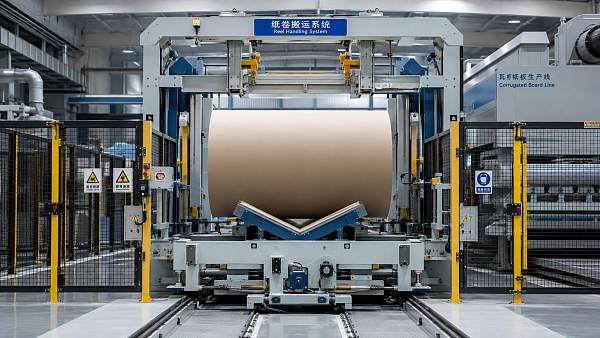
How Shaftless Unwind Stands Reduce Changeover Time and Material Waste
How Shaftless Unwind Stands Reduce Changeover Time and Material Waste
For corrugated and packaging operations, every roll change can affect uptime, board quality, and paper cost. Shaftless unwind stands help operators load and align heavy paper rolls faster while maintaining steadier web tension during production. By simplifying roll handling and reducing setup adjustments, they can shorten changeover time, minimize damaged material, and support more consistent output across demanding, high-speed converting and corrugated board applications.
That sounds straightforward, but the practical value is not simply “no shaft.” A well-matched shaftless unwinding system changes several parts of the operating routine at once: how a roll is positioned, how quickly it is centered, how reliably it is clamped, how tension responds as roll diameter falls, and how easily operators recover from a splice, web break, or paper-quality variation. In a plant running frequent order changes, those small improvements can add up to a noticeably calmer and more predictable production day.
Why conventional roll changes often create avoidable loss
A conventional shafted stand requires the shaft to be inserted through the paper core before the roll can be lifted and mounted. For large linerboard, medium, kraft paper, coated grades, or specialty papers, that process may involve an overhead hoist, floor handling equipment, manual alignment, and more than one operator. If the core is damaged, the shaft does not slide smoothly, or the roll is not seated evenly, the change takes longer and raises the risk of edge damage.
The visible delay is only part of the problem. During a rushed changeover, operators may accept imperfect web alignment and correct it after the machine starts. On a corrugator, that can contribute to wandering paper, uneven preheating, poor tracking through the single facer or double facer, unstable web tension, and trim loss at slitting. In printing or converting, misalignment can become a registration issue, a wrinkle, a splice failure, or a roll-edge defect that appears later in the run.
Shafted systems are not inherently unsuitable. They remain practical for certain roll sizes, machine layouts, and lower-volume applications. The difficulty appears when production demands faster order turnover while rolls become heavier, more varied in width, or more expensive to waste. In these conditions, handling time and tension control become production concerns rather than simple material-loading tasks.
What changes with a shaftless unwinding system
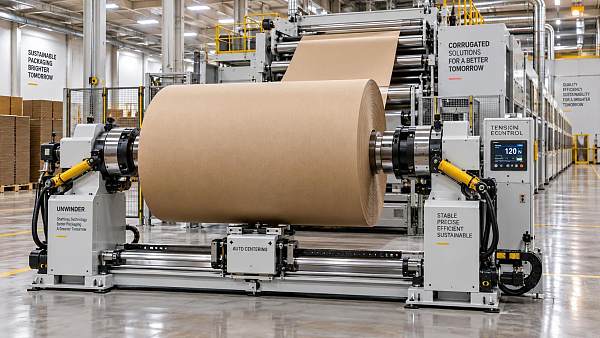
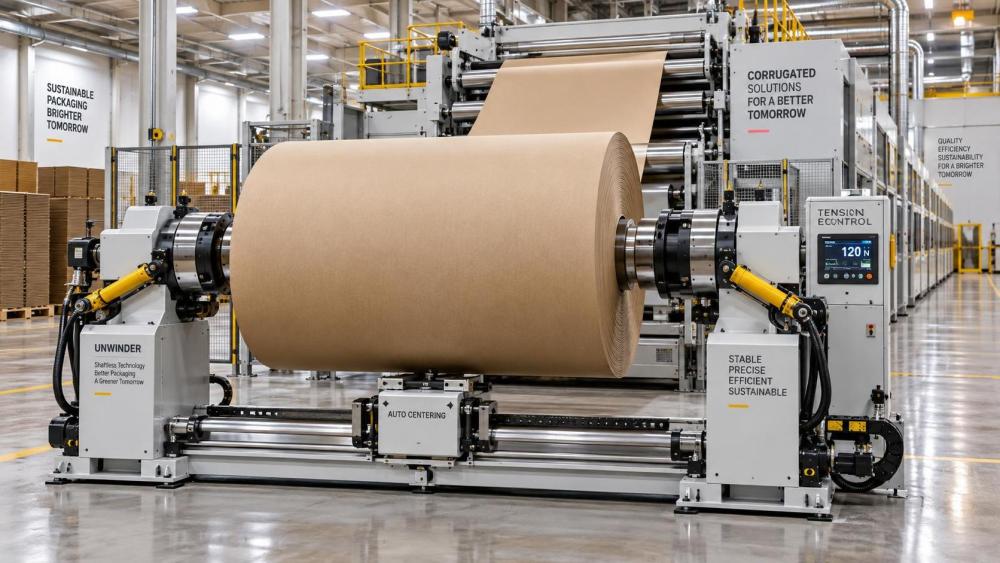
Shaftless unwind stands typically support a roll through chucks or expandable core-holding elements mounted on movable arms. Instead of threading a long shaft through the core, the operator brings the arms into position and engages the roll from both sides. Depending on the equipment design, the stand may include powered lift movement, lateral positioning, automatic centering, braking control, and interfaces with the machine’s tension-control system.
The important operational advantage is that roll loading becomes a positioning task rather than a shaft-installation task. The forklift or handling device places the roll near the loading position; the stand then lifts, centers, and secures it. Where the layout supports this workflow, the operator spends less time handling accessories, checking shaft engagement, and making repeated side-to-side corrections.
It also removes one common source of delay: finding, transporting, inspecting, and maintaining heavy shafts. A bent shaft, worn bearing surface, contaminated shaft, or poorly matched shaft diameter can turn a normal roll change into an interruption. With a shaftless arrangement, attention shifts to the condition of the chucks, the core, the stand arms, and the brake or drive system. That does not eliminate maintenance, but it can make the process more direct.
Where changeover time is actually saved
The strongest gains usually come from reducing non-productive movements, not from one dramatic speed improvement. A shaftless setup can shorten the sequence of unloading an empty core, preparing the next roll, inserting a shaft, lifting the assembly, seating it in the stand, and then correcting its position. It can also make parallel preparation easier: while one roll is running, the next roll may be staged nearby if the machine layout, safety rules, and roll-handling method allow it.
On corrugated board lines, this matters because paper changes are tied to order transitions. A change from one flute combination, board grade, paper weight, or customer specification to another may require changes across multiple paper webs. Even when automatic splicers are used, roll preparation and alignment influence how smoothly the splice is completed. If one unwinding position is slow or unstable, the entire order-change plan can lose momentum.
In flexographic pre-printing, laminating, coating, and other web-converting processes, shorter changes support smaller batch sizes without making every job disproportionately expensive to set up. The stand alone does not solve plate changes, ink wash-up, registration setup, or downstream adjustments. Still, it removes a recurring mechanical bottleneck that can otherwise make operators wait for roll handling to catch up with the rest of the line.
Material waste is closely connected to tension stability
Paper waste is often discussed as a cutting, trim, or reject problem. In reality, poor unwinding conditions can create waste before the material reaches those stages. A web that starts off-center may need additional threading and adjustment. A roll held unevenly can introduce lateral movement. Braking that is too aggressive may stretch or break the web; braking that is too weak can allow slack, wrinkles, or unstable feed.
Shaftless unwind stands can support lower waste when their mechanical design and control logic are suited to the material. Stable core gripping helps maintain roll position. Properly selected brake torque or regenerative drive control helps the machine react as roll diameter changes. Dancer systems, load cells, diameter calculation, and closed-loop tension control may all be part of the wider solution, depending on the line. The stand provides the physical foundation, but tension performance depends on the complete unwinding architecture.
This is especially relevant for lightweight papers, recycled-content grades, moisture-sensitive materials, and reels with less-than-perfect winding quality. These materials may react more strongly to sudden tension changes and uneven edge guidance. Operators who know the machine well often notice the issue first: the web becomes noisier, the edges begin to move, or the line needs more corrections than usual. A better unwind system cannot repair poor incoming paper, but it can prevent ordinary handling and tension variation from making the problem worse.
The details that determine whether the stand helps or frustrates operators
Not every shaftless design produces the same result. The practical fit depends on roll weight, maximum and minimum roll diameter, core diameter, web width, operating speed, material range, and the available loading space. These values should be verified against actual production conditions rather than a single nominal paper specification. A stand selected around the average roll may struggle with the heaviest, narrowest, widest, or most difficult reels used on the line.
Core condition deserves more attention than it usually receives. Shaftless chucks need a suitable core surface and adequate core strength to grip securely. If suppliers use different core materials, if cores are frequently crushed in transport, or if roll storage practices allow moisture damage, chuck selection becomes critical. Mechanical, pneumatic, and hydraulic gripping approaches have different maintenance and operating characteristics. The right choice should reflect the roll supply chain as well as the machine specification.
Operators should also be able to see and understand the positioning process. Controls that are technically capable but difficult to use can replace one kind of delay with another. Clear arm movement, accessible emergency stops, sensible loading height, reliable roll-centering references, and a straightforward response to alarms matter more on the shop floor than an impressive feature list. If an operator cannot confidently load a roll after training, the system has not fully delivered its intended value.
Questions worth checking before a retrofit or new-line decision
- What are the true maximum roll weight, diameter, width, and minimum core size, including occasional non-standard reels?
- How are rolls delivered, staged, lifted, and removed today, and does the proposed stand fit that traffic flow?
- Is the existing brake, drive, dancer, or tension-control system compatible with the new stand?
- Will the installation require changes to guarding, floor loading, electrical supply, controls, or operator access?
- Which wear parts need routine inspection, and can maintenance staff access them without disrupting production?
- What happens when a roll core is damaged, out of round, or outside the normal tolerance range?
A faster roll change will not compensate for weak process discipline
A common mistake is to treat the unwind stand as an isolated upgrade. It is more effective when paired with disciplined roll preparation, documented loading procedures, reliable paper identification, and clear communication between the corrugator, warehouse, and scheduling teams. If the correct paper roll is not ready at the machine, no stand design can recover that lost time. If incoming rolls are stored without protecting cores and edges, faster loading may simply reveal the condition problem sooner.
The same applies to splicing. The web path, splice-table condition, adhesive or tape method, operator timing, and tension settings around the splice all affect waste. Shaftless unwind stands can make roll replacement more controlled, but the full benefit emerges when the changeover sequence is treated as one connected process. For plants pursuing automatic changeover, this connection becomes even more important because mechanical readiness and digital order instructions must match.
It is useful to observe several real changeovers before defining a project. Record the steps, but also note where operators wait, where they make manual corrections, what causes rethreading, and which rolls are hardest to load. This often reveals whether the main constraint is the stand itself, material staging, a lack of lifting capacity, poor core quality, or tension settings downstream.
Looking at unwinding as part of the packaging production system
For packaging plants, investment decisions increasingly depend on the relationship between equipment rather than on the headline capability of one machine. A high-speed corrugated board line needs consistent paper delivery to support preheating, single-facing, adhesive application, bonding, slitting, scoring, cutting, and stacking. A printing or converting line needs stable web behavior to protect registration, coating quality, die-cutting accuracy, and finished-product consistency. Unwinding is upstream, but its effects travel through the line.
Global Commercial Print & Corrugated Packaging Intelligence (CPCS) examines this kind of connection across corrugated machinery, printing systems, converting equipment, factory automation, inspection, and production management. The useful question is rarely whether a component is “advanced.” It is whether it reduces a recurring source of lost time, handling risk, quality variation, or paper consumption within the plant’s actual operating model.
Shaftless unwind stands are often most compelling where heavy reels, frequent job changes, limited labor availability, and pressure to reduce paper loss occur together. They may be less urgent on stable, long-run operations with modest roll weights and little changeover pressure. The decision should therefore begin with observed production conditions: roll-change frequency, handling difficulty, web-break patterns, setup waste, and the ability of the current system to hold tension through the full roll cycle.
Before specifying a system, confirm the full material range, core quality, handling layout, control integration, safety requirements, and maintenance plan. That level of preparation helps ensure that a shaftless stand becomes a practical tool for faster changes and cleaner runs, rather than another machine feature that looks better on a drawing than it performs on the floor.
Related News
 Folder Gluer Line Cost Factors That Shape Payback and ROIExplore folder gluer line cost factors that shape payback and ROI—from automation and changeovers to waste, labor, uptime, and lifetime cash performance.Ms. Vivienne Cross
 Steam Boiler Price Factors That Shape Industrial Energy BudgetsSteam boiler price depends on capacity, fuel, efficiency, installation, and reliability. Discover how to control lifecycle costs and protect packaging production.Ms. Vivienne Cross
 How Paperboard Converting Machines Reduce Waste and Improve ThroughputPaperboard Converting Machines reduce waste, speed up setup, stabilize production, and improve carton quality. Explore smarter ways to boost throughput and yield.Ms. Vivienne Cross
 Is an Offset Press Cost-Effective for Short-Run Carton Jobs?Is an offset press economical for short-run carton work? Explore break-even costs, setup waste, quality demands, and workflow factors to choose the most profitable print route.Ms. Vivienne Cross
 How Shaftless Unwind Stands Reduce Changeover Time and Material WasteShaftless unwind stands reduce roll-change time, stabilize web tension, and cut paper waste for more efficient corrugated and packaging production.Ms. Vivienne Cross
 How an Automatic Paper Reel Handling System Improves Mill SafetyDiscover how an automatic paper reel handling system reduces crush risks, forklift traffic, and downtime while improving mill safety and reliable production flow.Ms. Vivienne Cross