How Pile Turners for Corrugated Sheets Help Reduce Handling Damage
How Pile Turners for Corrugated Sheets Help Reduce Handling Damage
Crushed edges, scuffed surfaces, and misaligned stacks can turn routine sheet handling into costly waste before printing or converting begins. For projects involving material-handling upgrades, pile turners for corrugated sheets offer a way to reduce manual restacking and control stack inversion. Their effectiveness, however, depends on matching clamping pressure, pile dimensions, and handling sequences to the board grades in production.
The practical question is not simply whether a machine can turn a load. It is whether it can deliver that load to the next operation without introducing compression damage, sheet movement, or another handling step that cancels out the benefit.
Find the damaging transfer before choosing the equipment
Corrugated sheets often pass through several handling points between corrugator delivery and converting. A pile may be stored, transferred to another pallet, turned to suit a feeder, squared, and moved again. Each intervention creates an opportunity for damage, but the causes differ.
Fork contact can damage bottom sheets. Pulling sheets across a rough pallet can abrade liners. Manual inversion in small batches can bend corners and produce an uneven pile. Repeatedly striking a stack against a stop may straighten its appearance while crushing vulnerable edges.
A useful starting point is to inspect the same load at successive checkpoints: after stacking, after transport, after inversion, and at the feeder. Record where damage first appears, not merely where an operator finally rejects it. Board rejected beside a die-cutter may have been damaged much earlier.
If most losses come from forklift impacts during warehouse transport, a pile turner alone will not solve the problem. If damage appears during manual turning or pallet exchange, controlled pile inversion is a more direct intervention.
What controlled inversion changes
A suitable pile turner supports and restrains the stack while rotating it to the required orientation. Depending on the machine configuration, the operation may also support pallet exchange or preparation for downstream feeding. These functions should be confirmed individually; turning capability does not automatically include automatic pile alignment or pallet handling.
The main damage-reduction mechanism is straightforward: fewer sheets need to be lifted, dragged, or turned by hand. Instead of repeatedly disturbing small batches, the equipment moves the supported pile as a load.
This can protect corners and reduce surface rubbing, provided the sheets remain stable during rotation. If restraint is inadequate, layers can slide against one another. If restraint is excessive, the machine may leave compression marks or reduce board caliper. Mechanization replaces variable manual handling with a repeatable process, but that process still needs a safe operating window.
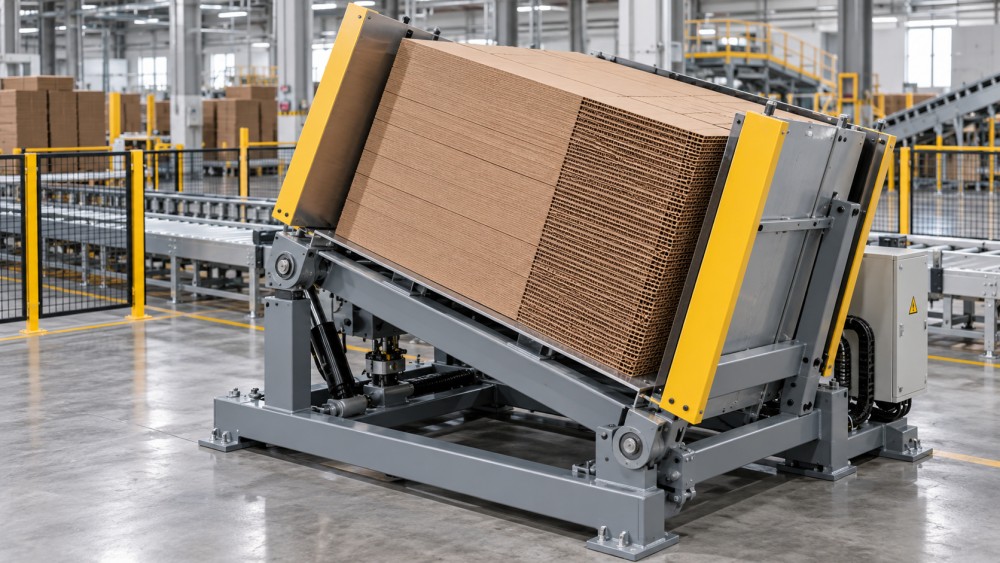
Consider a sheet plant turning piles before a flatbed die-cutter. The useful comparison is not machine rotation time versus manual turning time alone. It is the complete sequence: receiving the pile, securing it, turning it, releasing it, and presenting it to the feeder. An efficient turn followed by difficult unloading can simply move the handling problem downstream.
Clamping pressure is a board-quality setting
Corrugated board should not be treated as solid paperboard. Its flute structure can suffer permanent compression even when the liner looks acceptable. That makes the restraint system, contact surfaces, and pressure adjustment central to equipment selection.
There is no universal pressure setting for all corrugated sheets. Appropriate restraint depends on pile weight, sheet dimensions, flute construction, liner properties, moisture condition, contact area, and machine geometry. A hydraulic pressure reading also does not directly describe the pressure distributed across the board.
Ask the supplier how clamping force is controlled and how that force reaches the load. Broad, even contact matters because local high spots can carry disproportionate force. Damaged pallets, debris, uneven support plates, or distorted piles can create concentrated loading even when the selected setting appears reasonable.
Commissioning should establish validated settings for representative board families rather than rely on one aggressive setting for every job. Check for pile movement during the cycle, then inspect for indentation, edge distortion, and caliper change afterward. Where compression performance is critical, appearance alone is not enough; agree on relevant board or finished-package testing with the quality team.
Do not use the turner to force poor board into shape
Freshly produced board may still be warm, and its moisture condition can vary. Warped sheets also make uneven contact within a pile. Increasing pressure until the stack looks flat can conceal the condition temporarily while increasing compression risk.
A pile turner is not a substitute for correcting corrugator process instability, unsuitable storage conditions, or inadequate conditioning time. Optional aeration or jogging features, where offered, need trials on the actual corrugated products. Capabilities demonstrated on commercial printing paper should not be assumed to transfer directly to corrugated sheets.
Specify the awkward loads, not just the largest pile
Maximum sheet size and rated load capacity are necessary checks, but they do not define the whole application. A machine that handles the largest production pile may be less suitable for short stacks, narrow formats, or lightweight board.
The operating envelope should include minimum and maximum pile height, actual load weight, pallet dimensions, permitted overhang, and sheet orientation. Clarify how partial piles are restrained and whether the machine supports the sheet area adequately throughout rotation.
For printed or coated sheets, surface contact deserves a separate check. Clean support surfaces and fully dried or cured print reduce avoidable marking risks, but compatibility still depends on the ink, coating, contact pressure, and handling conditions. A successful trial with unprinted board does not establish suitability for display-packaging work.
A compact acceptance matrix helps expose these differences:
Integration can preserve the benefit—or lose it
The best location is usually where a required orientation change can be combined with an existing transfer. Installing a turner away from the material route may add forklift journeys, temporary storage, and extra pallet exchanges.
Map the load path with production and logistics staff. Confirm entry and exit direction, truck approach space, conveyor height where relevant, pallet removal arrangements, and buffer capacity. Check whether turning changes which face or edge is presented to the next machine. A correctly inverted pile can still arrive in the wrong feeding orientation.
Measure throughput using the full handling cycle, including waiting for transport and clearing the discharge position. Frequent short orders may make setup and pallet exchange more important than rotation speed. Capacity planning should reflect the plant’s actual order mix rather than the fastest demonstration cycle.
Safety also affects layout. Rotating loads and clamping mechanisms require appropriate guarding, interlocks, access control, and safe maintenance procedures. The installation needs a site-specific risk assessment against applicable local requirements. Operators should never have to enter a danger zone to correct a shifting pile.
Prove damage reduction before assigning a payback
Supplier trials should use production-representative sheets and pallets, including difficult formats. Inspect loads before and after turning so pre-existing defects are not credited to—or blamed on—the machine. Run repeated cycles with agreed settings; one successful turn demonstrates less than consistent performance across the intended range.
Track handling-related rejects, restacking labor, feeder interruptions, and sheets removed from pile tops, bottoms, or edges. Keep defect categories separate. Fewer visibly crushed corners do not necessarily mean fewer surface marks, and downstream feeder stoppages can have causes unrelated to pile handling.
For the investment calculation, use measured reductions in scrap and labor, then account for maintenance, energy, floor space, training, and any additional transport. Avoid counting recovered production time as revenue unless downstream capacity and customer demand can actually use it.
This system-level assessment reflects the equipment-evaluation approach covered by Global Commercial Print & Corrugated Packaging Intelligence (CPCS): judge machinery through material utilization, setup demands, uptime, and operating cost—not purchase price alone.
Pile turners for corrugated sheets are most convincing when they remove a known damaging intervention and deliver a stable, correctly oriented pile to the next process. Before approving the project, ask for a witnessed trial using the most vulnerable board in the production mix. Agree on acceptable pile movement, board condition, and downstream feeding performance in advance. Those results are a stronger basis for investment than a fast cycle with an easy load.
Related News
 When Is a Servo Folder Gluer Line Worth the Investment?Is a servo folder gluer line worth the investment? Explore the production challenges, ROI factors, and supplier questions that can guide your decision.Ms. Vivienne Cross
 US Justice Department Investigates Pricing by Major Corrugated Packaging ProducersThe US Justice Department is investigating containerboard pricing by major corrugated packaging producers. Explore potential implications for buyers and supply chains.Ms. Vivienne Cross
 What Affects Folder Gluer Machine Price and Total Cost?Folder gluer machine price is only part of the investment. Discover what drives costs and how to compare quotes, operating expenses, and long-term value.Ms. Vivienne Cross
 How Roll Handling Equipment Price Affects Project ROIRoll handling equipment price affects more than upfront costs. Learn how to compare installed costs, quantify savings, and build a stronger project ROI case.Ms. Vivienne Cross
 How Stacking Machines Reduce Bottlenecks in Sheet PlantsStacking Machines reduce sheet plant bottlenecks by improving pile quality and flow. Discover how to choose and integrate the right system.Ms. Vivienne Cross
 Italian Packaging Machinery Sales Up Just 0.9% as Orders Fall 4.7%Italian packaging machinery sales rose just 0.9% as orders fell 4.7%. Explore UCIMA's figures and what weaker demand could mean for buyers and exporters.Ms. Vivienne Cross