How Paperboard Converting Machines Reduce Waste and Improve Throughput
Waste reduction and throughput improvement are often treated as separate goals in paperboard converting. In practice, they are tightly connected. A plant that loses time to unstable feeding, repeated registration corrections, poor blank separation, glue-related rejects, or manual handling will also lose board, labor capacity, and delivery reliability. The most effective paperboard converting machines reduce both losses by making each sheet’s path through die-cutting, stripping, folding, gluing, inspection, and delivery more controlled.
The important distinction is that rated machine speed does not equal usable output. Usable output is the volume of saleable cartons or blanks produced per shift after setup sheets, stoppages, rejected work, rework, and handling delays are removed. Converting investments deliver value when they improve that outcome across the real job mix—not merely when they offer a higher maximum speed on a favorable specification sheet.
Where waste is actually created in converting operations
Paperboard waste is not limited to visibly defective cartons. It begins with make-ready sheets used to establish registration, die pressure, crease quality, stripping performance, fold geometry, and adhesive settings. It continues through production when feeding is inconsistent, printed sheets drift, die-cut waste fails to clear, glue application varies, or finished cartons are packed before defects are detected. A small instability at one station can create a disproportionate downstream loss because value has already been added through printing and material processing.
For a litho-laminated carton or printed folding box, the loss can be especially costly. By the converting stage, the sheet may already contain graphics, coatings, foil, embossing, or special substrate components. Rejecting it after gluing or final inspection means losing not only the board but also the accumulated cost of all previous operations.
Modern paperboard converting machines address this problem through repeatability. Servo-controlled registration, automated feeder settings, job-memory functions, pressure control, closed-loop inspection, and synchronized delivery systems reduce the number of variables that depend on repeated manual adjustment. This does not eliminate the need for skilled operators; it moves their work away from constant correction and toward process verification, exception handling, and quality control.
Make-ready reduction is usually the first source of measurable gain
Shorter job runs and more frequent SKU changes make setup performance commercially significant. When order patterns include multiple carton sizes, board grades, print designs, or structural formats, a machine may spend a material share of available time changing from one job to another. A high-speed line with slow or unpredictable make-ready can produce less usable output than a lower-rated machine that returns to stable production quickly.
Automated presetting helps in several areas. Feeder settings can be recalled for sheet size and caliper; side lays and front lays can be positioned with less manual intervention; die-cutting pressure can begin closer to the correct operating range; stripping tools can be prepared using known job parameters; and folder-gluer carriers, belts, and guides can be set with repeatable references. The result is not simply fewer setup minutes. It is fewer sheets consumed while operators search for stable conditions.
Job memory is valuable only when the stored settings reflect a disciplined production process. If job data are entered inconsistently, or if tooling condition and substrate variation are ignored, stored recipes can create false confidence. Plants should treat setup data as controlled production information: identify the board grade, caliper range, print side condition, die specification, crease rule configuration, adhesive type, and acceptable operating window. A recalled job then becomes a useful baseline rather than an assumption that conditions are identical.
Die-cutting illustrates why this matters. Excessive pressure may appear to solve incomplete cutting, but it can crush board edges, damage the cutting forme, accelerate wear on the cutting plate, and compromise crease behavior. Insufficient pressure creates hanging nicks, incomplete cuts, and stripping failures. A repeatable pressure setting, combined with well-maintained tooling and appropriate packing, reduces the trial-and-error cycle that consumes both time and sheets.
Stable sheet control protects material yield before the die-cutting section
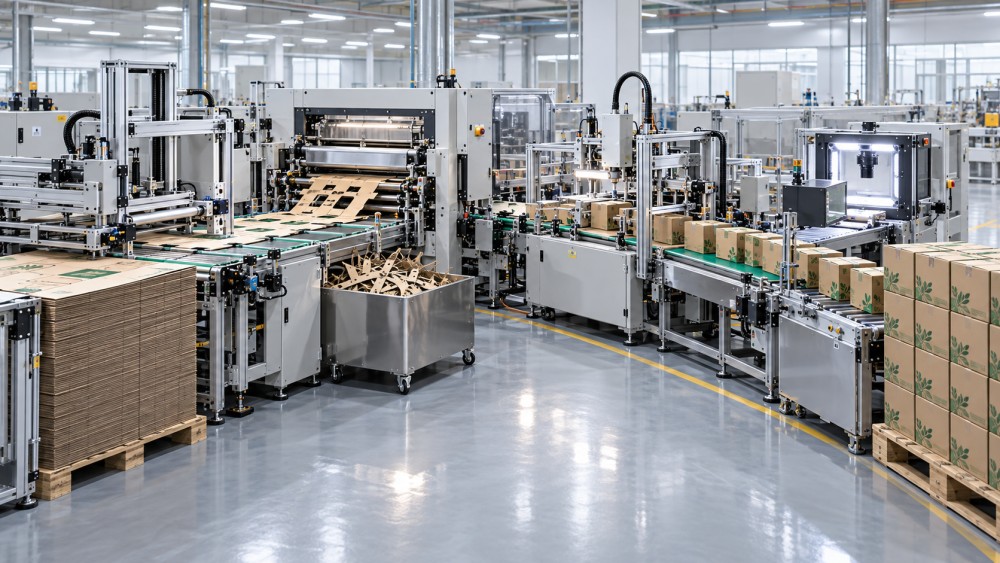
Many apparent die-cutting or gluing problems originate at the feeder. Paperboard is not a perfectly uniform material. Moisture condition, curl, warp, caliper variation, static charge, coating characteristics, and print coverage can all affect how sheets separate and travel. If the feeder double-sheets, misses sheets, scuffs printed surfaces, or introduces skew, the rest of the machine is forced to compensate for an unstable input.
High-quality feeding systems reduce this exposure through controlled suction, sheet separation, overlap management, vacuum transport, and registration correction. Their purpose is not just to move sheets faster. They establish a predictable sheet position before the sheet reaches cutting, creasing, embossing, or gluing stations. Better positioning reduces off-register die cuts, uneven margins, distorted creases, and alignment errors between printed artwork and structural features.
For decision-makers, the relevant question is whether a feeder has been designed for the actual substrate range. A machine intended mainly for flat, uncoated cartonboard may behave differently with heavy solid-board grades, laminated sheets, metallized surfaces, or recycled-content material with greater variability. The quoted speed should be evaluated alongside the board formats, calipers, surface conditions, and print treatments that represent the production mix.
This is also where environmental control becomes operationally relevant. Board stored in unsuitable humidity conditions can develop curl or dimensional movement. No converting machine can fully compensate for material that is unstable before feeding. Waste-reduction programs should therefore link machine capability to warehouse conditioning, stack preparation, print-to-convert timing, and material handling practices.
Integrated stripping turns die-cut quality into usable output
Die-cutting creates value only when blanks are separated cleanly and waste is removed without damaging the product. In complex carton designs, stripping is often the point at which theoretical press speed diverges from actual throughput. Small internal holes, narrow waste bridges, tightly nested blanks, windows, handle cuts, and detailed decorative features all increase the risk of waste retention or blank damage.
Manual stripping can be practical for limited quantities or unusually complex work, but it introduces labor dependence and creates a queue between die-cutting and gluing. Automated stripping systems improve flow when tooling is properly designed and waste evacuation remains consistent at production speed. Upper and lower stripping tools, blanking systems, and controlled delivery reduce the need for operators to separate units by hand, while also helping maintain stack consistency for the next process.
The limiting factor is often tooling engineering rather than the machine frame. Nick placement, ejection rubber condition, stripping pin layout, waste bridge design, and the relationship between board stiffness and cut geometry determine whether waste will release reliably. Buying a machine with advanced stripping capability without strengthening die-making and tooling maintenance discipline can leave the expected productivity gain unrealized.
Plants should also distinguish between a machine that can strip a sample successfully and one that can sustain stripping across a full production run. The latter requires stable board behavior, accurate registration, correct cutting pressure, clean waste paths, and tooling that remains effective as it wears. Throughput depends on maintaining this system, not on one isolated feature.
Folding and gluing are frequent sources of hidden rework
Folder-gluers are often described in terms of speed, but their economic contribution lies in repeatable carton geometry and adhesive performance. A carton may look acceptable at delivery yet fail later during packing, filling, distribution, or retail display if folds are inaccurate, glue has insufficient bond strength, or compression during transfer has been inconsistent.
Automated alignment systems, pre-fold sections, servo-controlled carriers, and stable compression belts help maintain the intended folding path. They reduce problems such as fish-tailing, open side seams, skewed lock-bottom cartons, incorrect pre-fold angles, and variable squareness. When these defects occur intermittently, they are particularly expensive because they may evade visual checks and appear later in a customer’s packing operation.
Glue control deserves the same attention as mechanical alignment. Adhesive volume, pattern placement, nozzle or wheel condition, substrate absorption, ambient temperature, and compression time all influence bond performance. Applying excess adhesive is not a reliable quality safeguard: it can create squeeze-out, visual contamination, longer drying behavior, and unnecessary consumable use. Insufficient or misplaced adhesive produces weak seams and avoidable rejects.
Systems that monitor glue application or confirm carton presence at key points can reduce the risk of systematic defects. However, inspection must be linked to a defined response. If a sensor identifies a missing glue pattern but the affected products are not positively rejected and traced, detection alone does not protect yield. The useful design is one that connects detection, rejection, count reconciliation, and fault reporting.
Inspection changes the economics of defect detection
Inline vision inspection is often justified as a quality feature, but its waste-reduction role is equally important. It identifies defects before nonconforming products are bundled, palletized, or dispatched. Depending on system configuration, inspection can check print registration, color-reference characteristics, barcode readability, code presence, variable-data accuracy, die-cut position, carton integrity, glue application, and other defined attributes.
The business case depends on the failure mode. For high-value printed cartons, a defect discovered after shipment may trigger sorting, replacement production, freight cost, and disruption at the packer. For regulated or traceable packaging applications, an incorrect code or missing mark can create a batch-control issue beyond the cost of the board itself. Earlier detection reduces the quantity of material that advances through subsequent value-adding stages.
Inspection parameters should be set around meaningful tolerances, not idealized perfection. An overly sensitive system can generate excessive false rejects and operator interventions; a weak threshold can allow material defects through. The correct acceptance window depends on the product’s functional and brand requirements, the printing process, substrate variation, and the capability of upstream operations. Inspection is most effective when its defect data are reviewed to identify recurring causes rather than treated as a simple pass-or-fail gate.
Automation improves throughput when it removes bottlenecks, not when it merely replaces labor
Automatic pile logistics, blank separation, counting, bundling, conveying, and palletizing can stabilize production flow around converting equipment. Their value is clearest where manual handling causes stoppages, inconsistent stack quality, ergonomic exposure, or accumulation between processes. A die-cutter or folder-gluer cannot sustain productive output if operators must repeatedly clear delivery piles, prepare bundles, or transport work-in-progress before the next batch can run.
Yet automation should match the actual constraint. Installing robotic palletizing after a folder-gluer will not improve plant output if the main delay is die-cutting setup, adhesive curing behavior, or manual inspection. Mapping the end-to-end path of a representative job is more useful than examining each machine in isolation. The relevant questions are where sheets wait, where operators intervene, which defects cause rework, and which station forces the line to slow down.
Data connectivity supports this analysis. Production counters alone are insufficient because they do not separate good output from waste, setup consumption, rejected cartons, or downtime by cause. A useful production data model distinguishes planned runtime, actual runtime, changeover time, material loss, quality rejects, mechanical stops, and waiting time caused by upstream or downstream constraints. It should also connect job-level material consumption with saleable output. Without that relationship, a plant can report impressive speed while still underperforming on yield.
What should be evaluated before investing in paperboard converting machines
Capital decisions should begin with the production profile rather than a preferred equipment category. A plant focused on long, repeat runs may prioritize sustained mechanical stability, rapid waste removal, robust delivery, and maintenance access. A business handling many short runs may gain more from automated setup, tool-change discipline, recipe management, and fast format adjustment. Complex premium cartons may justify more sophisticated registration, inspection, and folding control even if headline speed is lower.
Several questions expose whether a proposed configuration fits the operation:
- What proportion of current waste arises during setup, in-run defects, stripping, gluing, or post-production sorting?
- Which board grades, sheet sizes, coatings, laminations, and structural designs create the most interruptions?
- Can existing die-making, prepress, adhesive management, and maintenance practices support the precision of the new equipment?
- Will upstream printing and downstream packing sustain the intended operating rate without creating new queues?
- How will quality data, rejected-product handling, spare parts, operator training, and preventive maintenance be managed after commissioning?
The last point is often underestimated. Higher automation can reduce routine manual adjustment, but it increases the importance of calibration, sensor cleanliness, software configuration, spare-part availability, and trained troubleshooting. A machine’s lifecycle value depends on whether the operation can preserve its designed capability over time.
Paperboard converting machines reduce waste and improve throughput when they make the process more repeatable from feeder to finished stack. The strongest results come from treating converting as a connected production system: stable material preparation, accurate feeding, disciplined tooling, controlled die-cutting and stripping, reliable folding and gluing, timely inspection, and handling that does not interrupt flow. That approach shifts the investment discussion away from nominal speed and toward the more consequential measure—how consistently a plant turns purchased board into conforming, deliverable packaging.
Related News
 Folder Gluer Line Cost Factors That Shape Payback and ROIExplore folder gluer line cost factors that shape payback and ROI—from automation and changeovers to waste, labor, uptime, and lifetime cash performance.Ms. Vivienne Cross
 Steam Boiler Price Factors That Shape Industrial Energy BudgetsSteam boiler price depends on capacity, fuel, efficiency, installation, and reliability. Discover how to control lifecycle costs and protect packaging production.Ms. Vivienne Cross
 How Paperboard Converting Machines Reduce Waste and Improve ThroughputPaperboard Converting Machines reduce waste, speed up setup, stabilize production, and improve carton quality. Explore smarter ways to boost throughput and yield.Ms. Vivienne Cross
 Is an Offset Press Cost-Effective for Short-Run Carton Jobs?Is an offset press economical for short-run carton work? Explore break-even costs, setup waste, quality demands, and workflow factors to choose the most profitable print route.Ms. Vivienne Cross
 How Shaftless Unwind Stands Reduce Changeover Time and Material WasteShaftless unwind stands reduce roll-change time, stabilize web tension, and cut paper waste for more efficient corrugated and packaging production.Ms. Vivienne Cross
 How an Automatic Paper Reel Handling System Improves Mill SafetyDiscover how an automatic paper reel handling system reduces crush risks, forklift traffic, and downtime while improving mill safety and reliable production flow.Ms. Vivienne Cross