Pharmaceutical Carton Inspection Systems: Compliance Checks You Cannot Miss
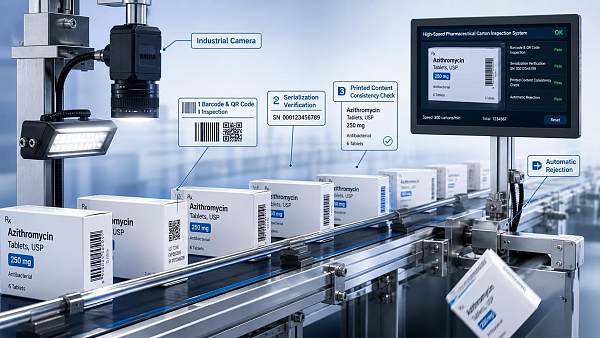
In pharmaceutical packaging, a single missed defect can trigger recalls, compliance failures, and patient safety risks. Pharmaceutical Carton Inspection Systems are no longer optional—they are critical safeguards for verifying print accuracy, barcode readability, serialization integrity, and carton consistency at production speed. For quality control and safety managers, understanding the compliance checks you cannot miss is essential to reducing risk, protecting brand trust, and ensuring every carton meets strict regulatory expectations.
What makes carton inspection so demanding is not just the number of checks, but the speed and consequence of each one. A carton may look ordinary to the eye, yet it carries legal identity, traceability, dosage information, and market-specific labeling rules. If any of those elements are wrong, unclear, or missing, the packaging line may still run—but the batch can become unfit for release. That is why modern Pharmaceutical Carton Inspection Systems are designed to do more than “spot defects.” They verify whether each carton is truly compliant before it leaves the line.
Compliance starts with the artwork, not the camera
Many inspection problems begin before the first carton is even printed. The artwork approval stage is where specification drift often enters: a revised product name, an outdated leaflet reference, a missing dosage line, or a barcode format that no longer matches the intended market. If the approved master data is incomplete, even a high-end vision system will only confirm a bad print is bad—it will not prevent the error from being manufactured repeatedly.
That is why compliance checks should begin with version control. Quality teams need a clear link between approved artwork, batch records, serialization parameters, and the inspection recipe loaded on the line. The system should not only detect defects; it should help prevent the wrong template from being run in the first place. In regulated packaging, prevention is always cheaper than rejection.
The checks that matter most on a pharma carton line
Not every visual issue carries the same risk. A faint scuff on a secondary carton may be cosmetic, while a missing lot code or unreadable 2D code can stop release immediately. For this reason, the inspection logic should reflect compliance priorities rather than simple appearance rules.
- Print presence and legibility: Confirm mandatory text, dosage statements, warning lines, and variable data are present and readable.
- Barcode and 2D code verification: Check code quality, contrast, placement, and scanability for track-and-trace systems.
- Serialization integrity: Match each unique code to the correct batch, avoid duplicates, and flag sequencing errors.
- Artwork and version match: Verify the carton matches the approved reference for that market and SKU.
- Packaging consistency: Detect missing glue, warped blanks, poor folds, or damage that may affect downstream handling.
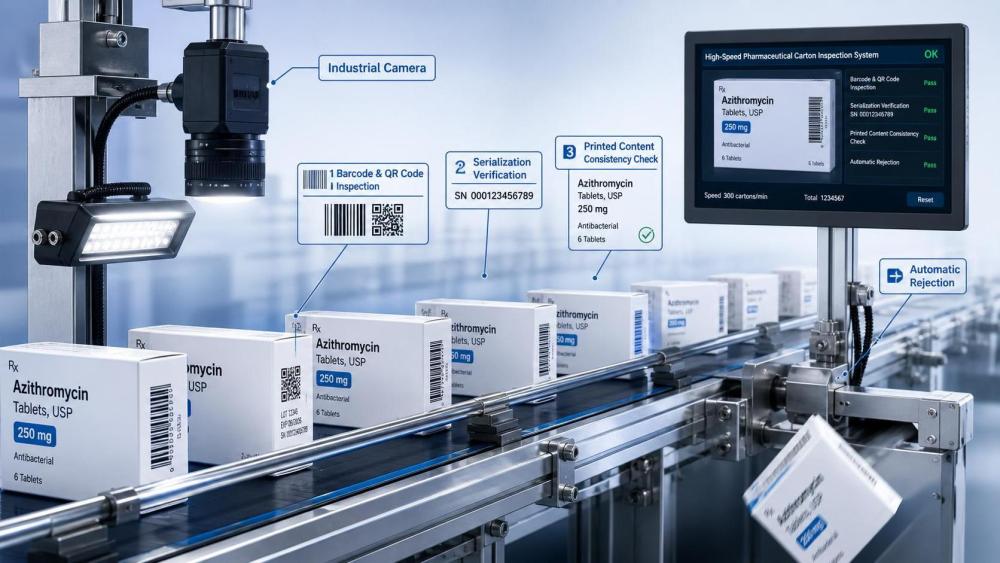
These checks sound straightforward, but in production they are complicated by speed, lighting, substrate variation, and changing print conditions. Ink density may shift slightly across a run. Cartons may move or flutter. A code may be technically printed but still fail if its position or contrast is outside the acceptable range. Good systems are built for that reality.
Why barcode readability deserves special attention
For pharmaceutical cartons, barcode readability is not a narrow technical detail—it is a compliance gate. A code that cannot be scanned reliably can break warehouse operations, hospital intake, and supply chain traceability. In many environments, one unreadable carton is enough to raise questions about the rest of the batch.
Inspection systems should therefore assess more than whether a barcode exists. They need to evaluate quality, alignment, and consistency across the full run. This is especially important when multiple markets are involved, each with its own serialization format or regulatory requirement. A line running at high speed cannot rely on manual checks to catch every anomaly. Automated verification is the only practical way to maintain confidence without slowing production to a crawl.
Serialization: where small errors become expensive
Serialization adds another layer of responsibility. A carton can be perfectly printed and still be non-compliant if the serial number is duplicated, out of sequence, or linked to the wrong product record. In practice, this means Pharmaceutical Carton Inspection Systems must communicate with the line control and coding systems, not just observe the print surface.
When serialization is handled well, the inspection system becomes part of the record chain. It confirms that the correct code was applied, that the code can be read, and that the same identity is not appearing twice. It should also support rejection handling, so faulty cartons are physically removed and logged without ambiguity. For quality and safety teams, that traceable rejection path matters as much as the detection itself.
Inspection should reflect the real failure modes
One common mistake is treating all defects as equal. In pharmaceutical packaging, that approach creates noise. Too many false rejections lead operators to distrust the system. Too few checks leave blind spots. The better approach is to map inspection rules to actual failure modes: wrong artwork, missing code, mixed batch, damaged carton, poor print quality, or unreadable label data.
That mapping should also account for line conditions. Carton gloss, substrate whiteness, print method, and folding geometry can all affect inspection performance. A system that works on a stable carton board may need adjustment for matte finishes or variable ambient light. This is where practical validation matters. The question is not whether a system looks sophisticated on paper, but whether it keeps making correct decisions during a full production shift.
How QC teams can evaluate a system before adoption
When a plant is reviewing Pharmaceutical Carton Inspection Systems, the right questions are often operational rather than promotional. Can the system handle the required line speed without increasing reject rates? Can recipes be controlled by role and version? Can inspectors review reject images quickly enough to support batch disposition? Does the system log enough evidence for audits and investigations?
It also helps to test the human side. Operators should be able to understand alarms without decoding technical jargon. Quality teams should be able to trace why a carton was rejected. Maintenance should not need to rebuild the system after every product change. The strongest inspection setups are not the most complicated ones; they are the ones people can trust under pressure.
In a regulated environment, trust comes from evidence. That evidence includes images, timestamps, rejection records, and batch-linked inspection data. When those records are easy to retrieve, deviation handling becomes faster and less stressful. When they are scattered or incomplete, even a small issue can turn into a long investigation.
What good compliance looks like in daily production
Daily compliance is rarely dramatic. It looks like cartons moving smoothly through the line, operators intervening only when needed, and quality records that are complete without being stitched together later. It looks like a system catching the right problems at the right time, without creating unnecessary interruptions. It also looks like confidence during audits, because every carton identity can be explained and verified.
That is the real value of Pharmaceutical Carton Inspection Systems. They do not replace quality discipline; they make it enforceable at speed. For teams responsible for patient safety and production integrity, the goal is simple: no missing codes, no wrong artwork, no unreadable data, and no surprises at release.
In pharmaceutical packaging, those are not optional standards. They are the line between routine manufacturing and avoidable risk.
Related News
 Pharmaceutical Carton Inspection Systems: Compliance Checks You Cannot MissPharmaceutical Carton Inspection Systems help prevent recalls by verifying artwork, barcodes, serialization, and print quality—see the compliance checks every pharma line cannot afford to miss.Dr. Elias Vance
 Packaging Compliance Moves Toward a Full “Design–Materials–Production–Traceability” FrameworkOn August 12, 2026, the EU Packaging and Packaging Waste Regulation (PPWR, Regulation (EU) 2025/40) entered its general application phase. The regulation, which entered into force on February 11, 2025, aims to establish a harmonized regulatory framework for packaging across the European Union and raise sustainability requirements covering packaging design, material composition, reusability, recyclability, labeling, and packaging waste management.Dr. Elias Vance