Packaging Compliance Moves Toward a Full “Design–Materials–Production–Traceability” Framework
On August 12, 2026, the EU Packaging and Packaging Waste Regulation (PPWR, Regulation (EU) 2025/40) entered its general application phase. The regulation, which entered into force on February 11, 2025, aims to establish a harmonized regulatory framework for packaging across the European Union and raise sustainability requirements covering packaging design, material composition, reusability, recyclability, labeling, and packaging waste management.
For the global corrugated box, paperboard printing, and packaging machinery industries, the impact of PPWR is no longer limited to packaging converters and brand owners. Compliance requirements are increasingly cascading upstream across the entire value chain, including paper and board, inks, adhesives, printing equipment, die-cutting systems, folder gluers, and quality inspection technologies.
From “Recyclable Packaging” to a Verifiable Packaging Manufacturing System
PPWR covers packaging and packaging waste placed on the EU market and introduces requirements concerning packaging manufacturing, composition, reusability, and recyclability.
This means that packaging manufacturers will no longer be asking only:
“Is this package environmentally friendly?”
The question is becoming:
“What materials were used? How was it manufactured? Does it meet the applicable design and recycling requirements? And can its environmental claims be substantiated through technical documentation and supply-chain data?”
This shift is pushing corrugated packaging production away from a pure focus on speed and output toward a broader combination of material yield, production stability, process data, and compliance traceability.
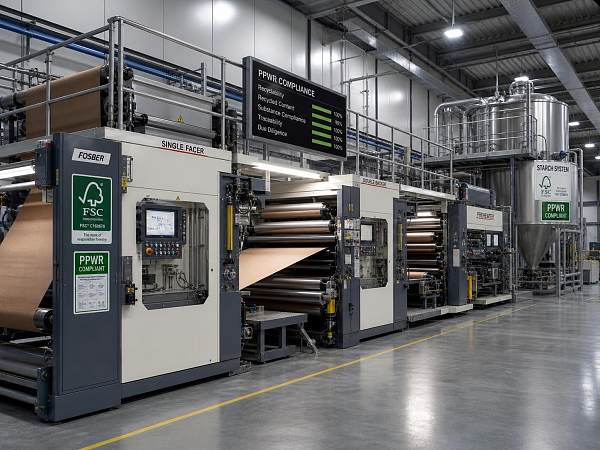
For high-speed corrugated board production, the stable operation of single facers, double backers, preheaters, and starch adhesive application systems directly affects paper consumption and product consistency. In flexographic printing, die-cutting, and folder-gluing, accurate registration, low-waste job changeovers, stable gluing, and inline vision inspection are becoming increasingly important technologies for reducing material waste and improving finished-packaging quality.
FSC: From Forest-Sourced Certification to Supply-Chain Data Management
At the same time, FSC Chain of Custody (CoC) is becoming an increasingly important component of the paper-based packaging supply chain.
FSC is currently progressing with the revision of its Chain of Custody standards. A second revised draft was subject to public consultation from May 15 to June 15, 2026, and the process has subsequently moved into the analysis and processing of stakeholder feedback. FSC also published its latest Chain of Custody Interpretations in July 2026, continuing to refine and clarify the existing certification framework.
For the corrugated packaging industry, this means that “FSC-certified paper” is increasingly evolving from a procurement-side label into a broader supply-chain management capability covering raw-material sourcing, production processing, batch management, product claims, and sales delivery.
Machinery Manufacturers Must Also Rethink “Compliance”
Another important consequence of PPWR and FSC is that packaging machinery itself is becoming part of the sustainable manufacturing equation.
Traditional equipment competition has typically focused on:
· Maximum production speed
· Maximum working width
· Number of printing units
· Die-cutting pressure
· Folder-gluer speed
· Automatic job-change time
A new generation of packaging-capital decisions, however, is adding another set of metrics:
OEE, Setup Waste, Material Yield, Energy Efficiency, Traceability, and Inspection Accuracy.
If a high-speed corrugated line can reduce startup waste through automatic job changeover, intelligent web alignment, and recipe-based parameter management; if a flexographic press can reduce print waste through high-precision Anilox technology, automatic registration control, and inline inspection; and if die-cutting and folder-gluing systems can reduce setup losses through advanced servo control, these motion-control technologies ultimately translate into more tangible material savings and compliance competitiveness for packaging manufacturers.
CPCS Strategic Intelligence View: Compliance Is Becoming a New Equipment-Purchasing KPI
CPCS believes that in the PPWR era, packaging machinery competition will gradually shift from “Who can run the machine faster?” toward:
Who can deliver higher packaging value with lower material waste, greater equipment stability, and more complete production-data traceability?
For manufacturers of corrugated board lines, flexographic presses, flatbed die-cutters, folder gluers, and vision inspection systems seeking access to the European market, future competitiveness will increasingly depend on their ability to connect mechanical precision, material efficiency, quality inspection, and compliance data.
PPWR defines an increasingly stringent regulatory framework for packaging placed on the European market, while FSC and related supply-chain systems strengthen the credibility and traceability of paper-based raw materials. Together, these developments are pushing the global packaging machinery industry into a new phase:
Compliance is no longer a paperwork exercise. It is becoming an engineering KPI.
For CPCS, this means that “Absolute Material Yield” and “Geek-level Motion Precision” are no longer merely technical concepts. They are becoming increasingly important decision-making criteria in global packaging machinery investments.
The CPCS Strategic Intelligence Center will continue monitoring the implementation of EU PPWR, evolving packaging recyclability and design requirements, developments in FSC Chain of Custody standards, and the practical impact of these regulatory changes on corrugated board lines, flexographic presses, die-cutters, folder gluers, and inline vision inspection systems.
Related News
 Pharmaceutical Carton Inspection Systems: Compliance Checks You Cannot MissPharmaceutical Carton Inspection Systems help prevent recalls by verifying artwork, barcodes, serialization, and print quality—see the compliance checks every pharma line cannot afford to miss.Dr. Elias Vance
 Packaging Compliance Moves Toward a Full “Design–Materials–Production–Traceability” FrameworkOn August 12, 2026, the EU Packaging and Packaging Waste Regulation (PPWR, Regulation (EU) 2025/40) entered its general application phase. The regulation, which entered into force on February 11, 2025, aims to establish a harmonized regulatory framework for packaging across the European Union and raise sustainability requirements covering packaging design, material composition, reusability, recyclability, labeling, and packaging waste management.Dr. Elias Vance