Why Servo Intermittent Motion Drive Improves Carton Line Accuracy
On a carton line, accuracy problems rarely show up as one dramatic failure. More often, they arrive as a pattern that keeps stealing time: print-to-die-cut drift on some jobs, inconsistent crease location after a changeover, feeder timing that feels “close enough” at low speed but starts wandering when production pushes harder. People adjust settings, slow the machine, inspect sheets, restart the order, and still feel that the line is behaving differently from one batch to the next.
That is usually the point where the discussion moves beyond operator skill and into motion control. If the machine depends on repeated start-stop positioning, every small variation in acceleration, dwell, index timing, and return motion can become visible on the carton. For teams responsible for specification, retrofit planning, or new line evaluation, the question is not simply whether a servo intermittent motion drive is newer than a mechanical indexing method. The real question is why it tends to improve carton line accuracy in practical production conditions.
Many people first look at registration sensors, tooling wear, board quality, vacuum settings, or downstream conveyor handoff. Those are valid checks. But on lines where cartons or blanks must be indexed precisely into printing, die-cutting, gluing, coding, or inspection positions, the motion profile itself often decides whether the process stays repeatable. A drive that can stop in the same place, with the same timing, under changing load conditions, gives the rest of the machine a stable reference. Without that, even good subsystems end up compensating for unstable motion.
Where the usual trouble starts
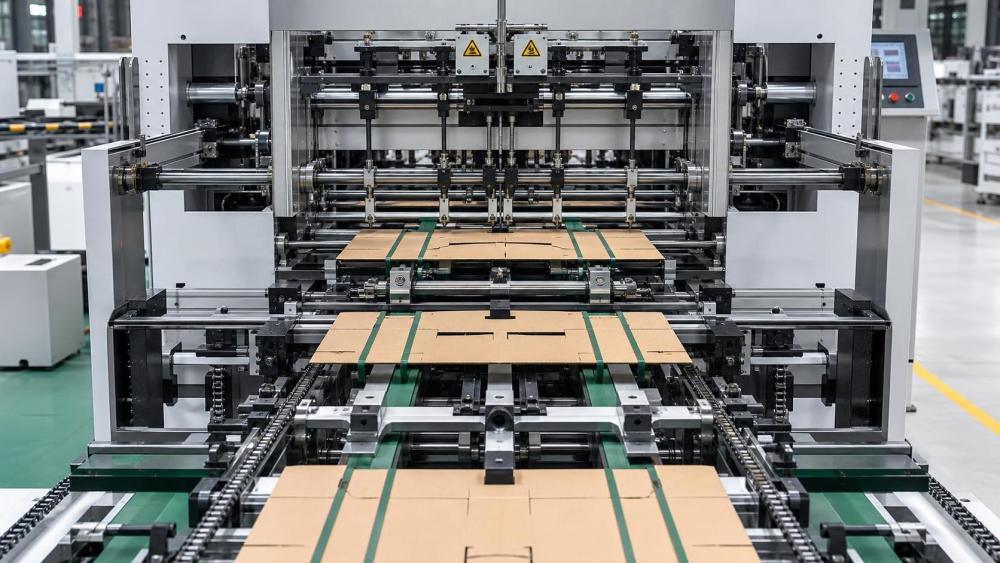
Intermittent motion is common in carton production because many operations are not continuous by nature. A blank may need to pause briefly for a punching action, for adhesive application in a defined window, for code printing, or for a pick-and-place transfer. Traditional intermittent systems can perform these tasks well, but over time they may show limits when production becomes more variable. Short runs, mixed carton formats, board grade changes, and frequent job switching create conditions where fixed motion characteristics are no longer ideal.
A common misunderstanding is to treat accuracy as a static mechanical issue only. In reality, carton accuracy in an intermittent section is dynamic. It depends on how the blank enters the station, how fast it decelerates, whether the stop position is consistent, how long the dwell remains stable, and whether the next index starts smoothly enough to avoid shifting the material. If any of those stages vary, the carton may reach the tool or print position slightly off target even when static alignment appears correct.
This is why teams sometimes chase the wrong root cause. They may replace guides, tighten couplings, rework tooling, or recalibrate sensors, only to find that the problem becomes smaller but not fully resolved. The line still behaves differently during speed ramps, after format changes, or when heavier carton styles are introduced. That is a sign that the motion system deserves a closer look.
Why servo control changes the quality conversation
A servo intermittent motion drive improves accuracy because it controls position, speed, acceleration, and deceleration as programmable variables rather than relying mainly on a fixed mechanical motion pattern. That difference matters most when the line is expected to produce repeatable results across changing production conditions.
In carton manufacturing, repeatability is often more important than peak speed by itself. A machine can be fast and still create waste if every index lands a little differently. Servo control helps by making each motion cycle more deliberate. The drive can be tuned so that the carton reaches the target position with less overshoot, less vibration, and better synchronization with the station doing the work. That directly supports print registration, cutting alignment, crease consistency, glue placement, and code position stability.
Another important point is that accuracy on a carton line is not only about the final stop point. The path to that stop matters. Mechanical intermittent systems may transmit shock differently depending on wear, backlash, lubrication condition, or load variation. A servo-based system allows motion profiles to be shaped for the application. If a carton style is light and sensitive to slip, the profile can reduce abrupt handling. If a process needs a longer stable dwell for a station to complete its action, that can be built into the cycle without relying on a compromise from a fixed cam geometry.
That flexibility does not eliminate the need for solid mechanics. Poor frame rigidity, unstable feeding, worn tooling, or inconsistent material still create errors. But when the machine structure is fundamentally sound, a servo system gives engineers a more precise way to match motion behavior to the process.
Looking at the problem from the line, not just the drive
One practical mistake in equipment reviews is to evaluate the drive in isolation. On a real carton line, accuracy is shared across several handoffs. The feeder must present the blank consistently. The intermittent section must index it predictably. The station action must happen at the right timing window. Delivery or transfer must not disturb the position that was just achieved. A servo intermittent motion drive helps most when it is considered as part of that chain.
For example, if a die-cut or coding station is synchronized to indexed blank position, tighter motion repeatability reduces the amount of compensation required from sensors and control logic. If the line uses vision inspection, stable indexing also improves the consistency of the inspection window. If the machine changes job sizes often, storing motion recipes with defined acceleration and dwell characteristics can shorten the time spent re-tuning the line after every changeover.
This is one reason engineering teams often prefer servo-based motion in environments where order patterns are no longer uniform. A fixed setup may work well for one dominant carton format, but once the production mix becomes broader, the ability to adapt motion parameters by job becomes more valuable than the original simplicity.
Symptoms that often point back to intermittent motion quality
Not every accuracy issue means the drive should be changed, but certain patterns are worth noting. One is when carton positioning looks stable at moderate speed and then becomes less reliable as throughput rises, even though tooling and sensors check out. Another is when changeovers produce acceptable first sheets only after repeated manual adjustment of timing values that seem hard to reproduce later. A third is when delicate or lighter blanks show shifting during index transitions, while heavier blanks appear more tolerant.
Teams also notice this during maintenance reviews. The machine may not be “broken,” but the process window feels narrow. Small disturbances create quality deviations too easily. In that situation, servo intermittent motion is often considered not because the existing mechanism cannot run, but because the process has become less forgiving than the current motion system.
What to compare before making a decision
If you are reviewing whether a servo intermittent motion drive is justified, it helps to compare options using production criteria rather than general claims. The first criterion is repeatable stop position under normal operating variation. Not on an empty test cycle, but during real board handling with expected speed changes and load conditions.
The second is changeover behavior. Ask whether motion settings can be stored and recalled by job, and whether parameter changes are practical for the people who will run and maintain the equipment. Accuracy gains are easier to keep when they do not depend on repeating manual fine adjustment every time a format returns.
The third is synchronization with adjacent functions. On many carton lines, motion accuracy matters because another process is waiting on it: print registration, glue application timing, code placement, inspection trigger, robotic pick timing, or stack transfer. A servo system becomes more valuable when the line architecture depends on these coordinated events.
The fourth is maintenance behavior over time. Mechanical indexing systems can be robust, but wear characteristics influence repeatability. Servo systems shift part of the optimization into control and feedback, which can reduce some mechanical compromise, though they also require competent commissioning and diagnostics. The better choice depends on the line’s duty pattern, available technical support, and the cost of instability in actual production.
Where accuracy gains usually come from in practice
It is tempting to assume that the improvement comes from “faster response,” but that description is too vague. In practical carton production, gains usually come from four more specific effects.
First, the indexed stop tends to be more consistent because the drive continuously corrects toward the target position. Second, the transition into and out of the dwell can be tuned to reduce carton disturbance. Third, timing between the index motion and the working station can be adjusted with finer resolution than a purely mechanical relationship normally allows. Fourth, recipe-based control helps keep one order’s motion behavior from being recreated differently by different shifts.
None of this means every machine should be converted automatically. Some lines run well with established mechanical systems, especially when product mix is narrow and process tolerance is forgiving. But where carton quality depends on precise repeated indexing across many job types, servo control often addresses the underlying source of variation more directly than repeated correction elsewhere.
Implementation questions that deserve attention early
When teams discuss retrofits or new machine specifications, they sometimes focus on the drive selection and forget the surrounding requirements. Accuracy improvements depend on proper encoder feedback, control integration, motion tuning, and mechanical stiffness. If the blank path allows lateral movement, or if the station tooling introduces its own inconsistency, the servo system may reveal those weaknesses rather than hide them.
It is also worth reviewing the relationship between motion profile and carton characteristics. A profile that works for rigid blanks may not suit lighter substrates or cartons with coatings that change friction behavior. Good implementation means matching the motion curve to the material handling reality, not just choosing a servo and expecting an automatic result.
Another point that often matters in packaging plants is operator interaction. If a system provides many motion parameters but no clear rules for when to adjust them, consistency can suffer. The best use of a servo intermittent motion drive usually comes with defined setup logic: which parameters are recipe-controlled, which are maintenance-protected, and which can be adjusted during production without affecting process stability.
A more useful way to judge the upgrade
For engineering leads, the best test is not whether the technology sounds advanced, but whether it reduces dependence on compensation. If your line currently relies on frequent manual timing correction, speed restrictions to maintain registration, or repeated troubleshooting around indexed stations, then motion control is already shaping your quality cost. In that context, a servo intermittent motion drive is less a feature upgrade and more a way to create a steadier reference for the entire converting process.
That is why it often improves carton line accuracy. It gives the machine a more controlled stop-start behavior, better repeatability from cycle to cycle, and more adaptable synchronization with the work being done on the carton. For plants dealing with tighter tolerances, shorter runs, and more variable product mixes, those characteristics matter because they help accuracy hold up not only during ideal conditions, but during the kind of daily production changes that usually expose weak motion control first.
Related News
 How Inline Ink Viscosity Sensors Help Stabilize Flexo Print QualityDiscover how inline ink viscosity sensors help stabilize flexo print quality through temperature tracking, reliable measurement, and controlled dosing. Learn what makes a setup effective.Prof. Kaelen Sterling
 What Drives the Total Cost of a Web Tension Control SystemWeb tension controller manufacturer insights: uncover total system costs, from installation and integration to waste reduction, uptime, and long-term support.Prof. Kaelen Sterling
 How Real Time Ink Viscosity Sensors Improve Flexo Press StabilityReal time ink viscosity sensors help flexo printers stabilize color, reduce waste, and control ink drift with faster, data-driven adjustments.Prof. Kaelen Sterling
 How to Compare Ink Viscosity Sensors Price Against Process ValueInk viscosity sensors price is only one factor. Learn how to compare sensor costs with quality, waste reduction, automation needs, and long-term press value.Prof. Kaelen Sterling
 Ink Handling Systems: Choosing the Right Setup for Viscosity ControlInk handling systems for flexographic printing: discover how to choose viscosity control, circulation, cleaning, and automation setups that reduce waste and improve color consistency.Prof. Kaelen Sterling
 How to Choose an Ink Recirculation System Manufacturer for Stable Print QualityChoose an ink recirculation system manufacturer that delivers stable print quality through precise flow control, ink compatibility, cleanability, and reliable automation.Prof. Kaelen Sterling