Ink Handling Systems: Choosing the Right Setup for Viscosity Control
Ink Handling Systems: Choosing the Right Setup for Viscosity Control
For a technical evaluator, an ink handling system is rarely a minor accessory around the press. It affects color repeatability, start-up waste, operator workload, cleaning time, solvent or water consumption, and the ability to keep a production schedule when conditions change. In flexographic printing, particularly for corrugated packaging and high-volume paper-based packaging work, viscosity control can be the difference between a press that runs predictably and one that needs constant manual correction.
The right setup is not simply the most automated one. A compact flexo line producing a narrow range of water-based inks has different needs from a multi-color corrugated post-print press, a pre-print operation handling long runs, or a commercial print facility changing colors several times per shift. The useful question is not “Which ink handling system is best?” It is: “Which system can maintain the required ink condition, at the required production rhythm, with acceptable cleaning and maintenance effort?”
That distinction matters because viscosity is only one part of ink stability. Temperature, shear, pH in water-based ink applications, foam control, pigment settling, circulation rate, filtration, pipe length, and return-line design can all influence what finally reaches the anilox roller and printing plate.
Viscosity Control Is a Process Issue, Not Just a Measurement Issue
In practical pressrooms, viscosity drift often shows up before anyone looks at a measurement. Operators may see a density change, inconsistent solids, altered dot reproduction, weaker coverage on absorbent linerboard, or a color that suddenly looks different from the approved drawdown. On corrugated jobs, changing board moisture and surface characteristics can make diagnosis even less straightforward. It is easy to blame the ink when the actual issue lies in circulation, temperature, anilox condition, or an unstable supply loop.
A viscosity cup remains common because it is simple and familiar, but manual checking depends heavily on repeatable operator practice. The cup must be clean, the timing method consistent, and the sample representative of the ink condition at the point of use. A sample taken from a container may not reflect the ink that has travelled through a warm pump, a long hose run, and the chamber doctor blade system. Manual control can work well on less demanding operations, but it becomes less reliable as press speed, color count, job frequency, and quality expectations increase.
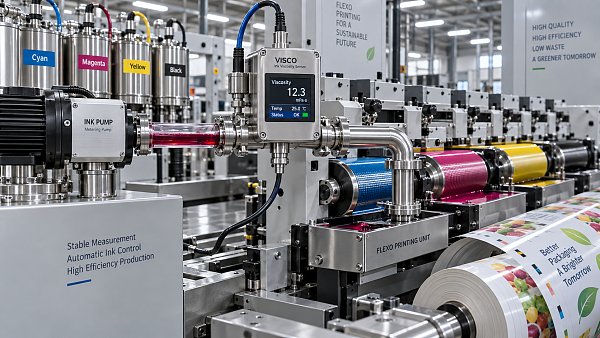
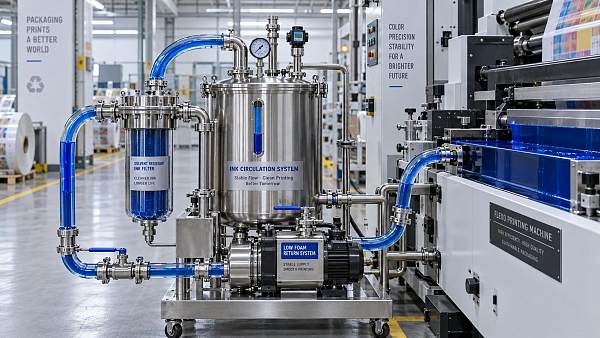
Automated viscosity control adds value when it is integrated into a properly designed ink loop. The controller may measure ink behavior and dose water, solvent, or another approved adjustment medium according to the target range. Yet automation cannot compensate for poor fundamentals. A sensor installed where the ink is aerated, poorly mixed, or exposed to temperature swings may generate control actions that make the situation worse rather than better.
Start with Ink Chemistry and the Press Configuration
The first selection step is to identify the ink family and the press architecture. Water-based flexographic inks used on corrugated board commonly require attention to viscosity, pH, foaming tendency, and drying conditions. Solvent-based inks introduce different safety, recovery, ventilation, and compatibility questions. UV and UV-LED ink systems have their own handling requirements, including protection from unintended light exposure, control of contamination, and careful management of cure-related process variables.
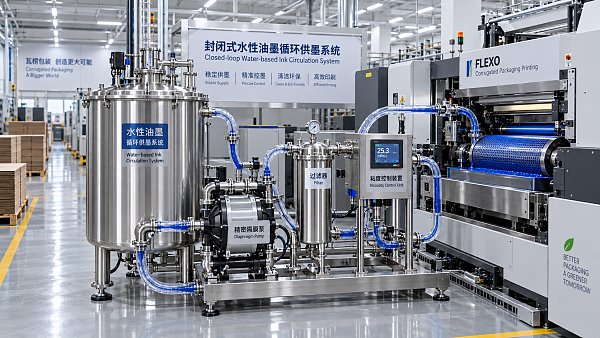
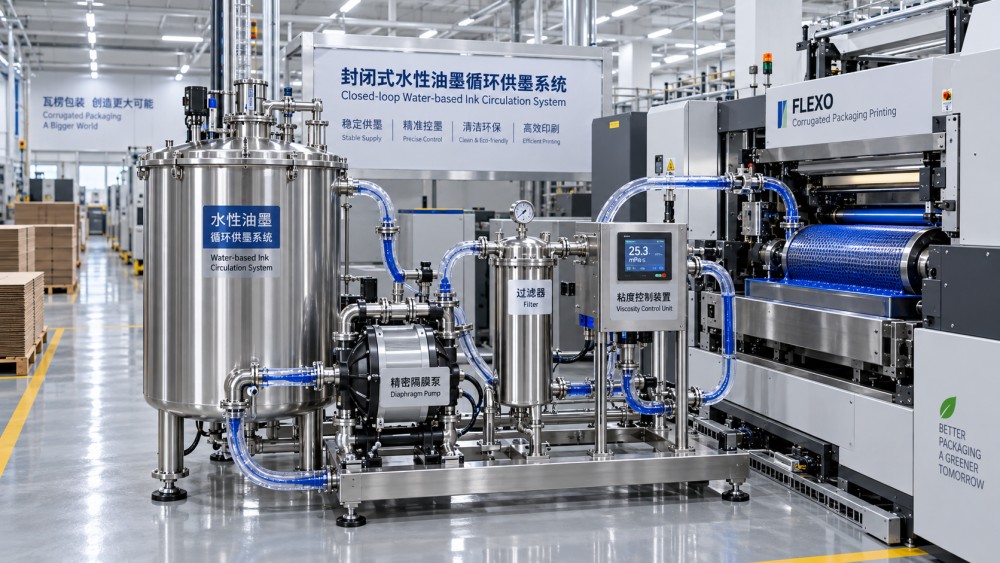
A central ink kitchen serving several presses is a very different project from a local supply unit installed beside each print deck. Centralized handling can improve batch consistency and reduce the number of containers handled around the plant. It may also support more disciplined inventory control and traceability. However, longer circulation routes create more opportunities for pressure loss, temperature variation, cleaning complexity, and color contamination during changeovers. For plants running short jobs, the recovery and wash-up sequence may matter more than the theoretical benefit of central supply.
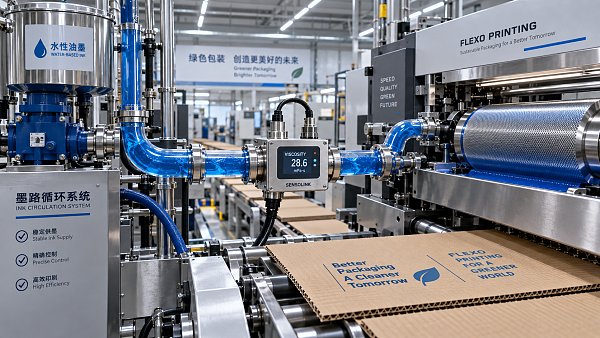
Technical teams should also examine how the ink reaches the print unit. Open trays, enclosed chambers, diaphragm-pump loops, peristaltic dosing arrangements, and press-side containers each have operational implications. A chamber doctor blade system can support stable metering and reduce exposure, but it relies on clean, adequately circulated ink and well-maintained seals. If return flow is restricted or filtration is neglected, the resulting print problem may be mistaken for an anilox or plate issue.
The Questions That Usually Reveal the Right System Size
System sizing should be based on real operating patterns rather than nameplate press speed alone. A supplier will need information about the number of colors, ink consumption by job type, expected production hours, number of daily changeovers, pipe distance, ink container format, and whether several presses may draw from the system at the same time. Evaluators should provide this information early. Without it, a proposal can look complete while leaving critical circulation and cleaning assumptions unresolved.
It is also worth asking what happens during low-consumption jobs. A large circulation system serving a small ink demand can create unnecessary residence time. Some inks tolerate this without difficulty; others may be more sensitive to foam, settling, temperature movement, or repeated shear. Conversely, an undersized system may struggle to maintain supply during high-coverage work, particularly on wide-web or high-speed flexographic presses.
The table is not a substitute for a process audit. It does, however, expose a common mistake: selecting tanks and pumps before mapping the operating sequence. The sequence should include ink receiving, mixing, storage, transfer, press supply, return, adjustment, recovery, cleaning, and disposal or reuse. If one stage is vague, it usually becomes a labor-intensive workaround after installation.
Where Automation Pays Off—and Where It Can Add Complexity
Automatic viscosity control is most compelling where consistency has a direct commercial consequence. This may include branded packaging with tight color expectations, work requiring reliable barcode contrast, repeat jobs that must match previous production, or high-speed output where operators cannot reasonably make frequent manual adjustments. Integration with recipe management and production records can also support traceability when a plant is investigating a quality deviation.
Still, a fully automated system needs a credible maintenance plan. Sensors require verification and cleaning. Dosing components need to be compatible with the ink chemistry. Pumps, valves, seals, hoses, and filters are consumable or service items, not permanent infrastructure. The most sophisticated controller will not provide stable results if its readings are not trusted by the press team.
A sensible approach for many plants is to automate the areas where deviation is frequent and costly while keeping the system understandable for operators and maintenance staff. For example, controlled replenishment and monitored circulation may be more valuable than a broad automation package that nobody has time to calibrate or use properly. The decision should reflect available technical capability on each shift, not only the features shown in a supplier demonstration.
Do Not Underestimate Cleaning, Recovery, and Color Changeover
Ink handling projects are often evaluated around production flow, but the economic reality frequently sits in the periods between jobs. A system with high internal volume may run very smoothly during a long production campaign, yet consume significant time and material during every wash-up. On a plant dominated by short-run e-commerce cartons, seasonal packaging, promotional displays, or customized print work, this can outweigh the benefits of a larger shared loop.
Ask suppliers to explain the cleaning boundary clearly. Which pipes, pumps, chambers, filters, and return lines are included in the wash cycle? Can residual ink be recovered before flushing? How is cleaning media separated from usable ink? What manual disassembly remains necessary? These questions can feel unglamorous during equipment selection, but they directly affect changeover time, waste handling, and the likelihood that operators will follow the intended procedure under schedule pressure.
For water-based ink operations, cleaning quality also affects microbiological housekeeping and odor control, although the specific risk depends on the formulation, site conditions, and storage practices. For solvent-based systems, safety engineering, grounding, ventilation, and compliance with applicable local requirements must be considered as part of the complete installation, not as an afterthought. Material compatibility should be confirmed with both the ink supplier and equipment supplier.
Use Data, But Keep It Close to Press Reality
Modern ink handling systems can generate useful information: viscosity trends, dosing events, temperature behavior, alarm history, consumption by job, and cleaning-cycle records. Connected production management can make that information visible alongside press speed, downtime, inspection results, and order status. For packaging factories moving toward digital production control, this connection can help technical teams distinguish recurring process drift from isolated operator intervention.
But data only becomes useful when its context is known. A viscosity alarm may relate to room temperature, an incorrect target, a fresh ink batch, a blocked filter, a return-line restriction, or a press that has been idling. It should not automatically trigger a quality conclusion. The best operating procedures link ink measurements with press conditions, substrate information, anilox specifications, color targets, and visual or instrument-based print inspection.
This broader view is especially relevant in corrugated packaging, where print quality is shaped by board properties as well as ink condition. A stable ink loop cannot correct an uneven board surface, unsuitable anilox selection, poor plate mounting, or a drying imbalance. It can, however, remove one major source of variability and make other problems easier to identify.
A More Practical Procurement Checklist
Before comparing quotations, technical evaluators should ask for a documented process description rather than only a component list. The review should cover the intended ink types, target control method, total system volume, circulation path, return arrangement, filtration location, temperature exposure, cleaning sequence, recovery options, operator tasks, maintenance access, alarms, and integration boundaries with the press or plant software.
It is useful to involve three groups early: press operators, maintenance personnel, and the ink supplier. Operators understand where daily adjustments and delays actually occur. Maintenance teams can identify access, spare-part, pump, and valve concerns that are easy to miss in a layout drawing. Ink suppliers can advise on chemical compatibility and recommended handling conditions for specific formulations. A system selected without those perspectives may meet the specification on paper but remain awkward in daily production.
Platforms such as Global Commercial Print & Corrugated Packaging Intelligence (CPCS) are useful in this stage because ink handling should be assessed as part of the wider production system: flexographic press design, anilox and doctor blade arrangement, color management, inspection, changeover requirements, automation architecture, and long-term operating cost. The purchase decision becomes clearer when the ink loop is treated as part of press reliability rather than a stand-alone utility.
Choose for the Jobs You Actually Run
The most appropriate ink handling system is usually not the one with the longest feature list. It is the one that maintains ink condition through the plant’s real mix of production speeds, substrates, colors, run lengths, and changeovers—without creating an unreasonable cleaning or maintenance burden.
For long, stable production runs, a robust automated circulation and viscosity-control arrangement may be justified. For short-run converting and frequent color changes, low retained volume and rapid cleanability can be the stronger priority. In either case, evaluate the entire loop from mixing container to print chamber and back again. That is where viscosity control becomes dependable press performance rather than another setting for operators to chase.
Related News
 What Drives the Total Cost of a Web Tension Control SystemWeb tension controller manufacturer insights: uncover total system costs, from installation and integration to waste reduction, uptime, and long-term support.Prof. Kaelen Sterling
 How Real Time Ink Viscosity Sensors Improve Flexo Press StabilityReal time ink viscosity sensors help flexo printers stabilize color, reduce waste, and control ink drift with faster, data-driven adjustments.Prof. Kaelen Sterling
 How to Compare Ink Viscosity Sensors Price Against Process ValueInk viscosity sensors price is only one factor. Learn how to compare sensor costs with quality, waste reduction, automation needs, and long-term press value.Prof. Kaelen Sterling
 Ink Handling Systems: Choosing the Right Setup for Viscosity ControlInk handling systems for flexographic printing: discover how to choose viscosity control, circulation, cleaning, and automation setups that reduce waste and improve color consistency.Prof. Kaelen Sterling
 How to Choose an Ink Recirculation System Manufacturer for Stable Print QualityChoose an ink recirculation system manufacturer that delivers stable print quality through precise flow control, ink compatibility, cleanability, and reliable automation.Prof. Kaelen Sterling
 How Precision Intermittent Motion Drives Improve Indexing AccuracyPrecision intermittent motion drive solutions improve indexing accuracy, reduce vibration, and stabilize dwell performance for high-speed packaging and converting equipment.Prof. Kaelen Sterling