How to Compare Ink Viscosity Sensors Price Against Process Value
The quoted ink viscosity sensors price is only useful when it is compared with the process problem the device is expected to solve. A lower-cost sensor can be the better purchase on a stable, low-volume line with limited ink variation. On a high-speed flexographic press running frequent job changes, water-based inks, demanding brand colors, or variable ambient conditions, that same choice can become expensive through color drift, ink correction, start-up waste, and operator intervention.
The practical question is not “Which viscosity sensor costs less?” It is: What level of measurement reliability, control capability, and serviceability is needed to protect this specific printing process? A meaningful evaluation connects the device price to the cost of unstable viscosity in the pressroom.
Start with the process loss, not the sensor catalogue
Ink viscosity influences how ink transfers through the chamber, anilox roller, plate, and substrate. When viscosity moves outside the workable range, the visible result may be weak density, dirty print, poor trapping, uneven solids, or inconsistent color from one batch to the next. The operational result is often more costly: repeated drawdowns, manual additions of water or solvent, slower ramp-up after a stop, more rejected sheets or web, and longer approval cycles.
These effects do not have the same weight in every plant. A press producing simple transport cartons with broad color tolerances may manage with periodic manual checks. A line producing branded retail packaging, barcodes, pharmaceutical cartons, or repeat work across multiple sites has a different exposure. In those cases, viscosity control is part of maintaining repeatable production conditions, not merely an ink-room convenience.
Before requesting quotations, define where viscosity variation is creating cost. Useful internal questions include:
- How often do operators make manual ink adjustments during a normal run?
- Do approved colors shift after breaks, wash-ups, temperature changes, or speed changes?
- Is ink viscosity a documented cause of waste, rework, delayed approvals, or inconsistent repeat orders?
- Are multiple presses or units using the same ink system but achieving different results?
- Does the production plan involve short runs and frequent changeovers, where stabilization time matters more?
This step prevents a common purchasing error: specifying a sophisticated closed-loop system for a problem caused mainly by worn anilox rollers, incorrect doctor blade pressure, poor mixing, unsuitable ink formulation, or inadequate temperature control. A sensor can measure a changing condition accurately; it cannot correct unrelated process faults.
Why price quotations vary so widely
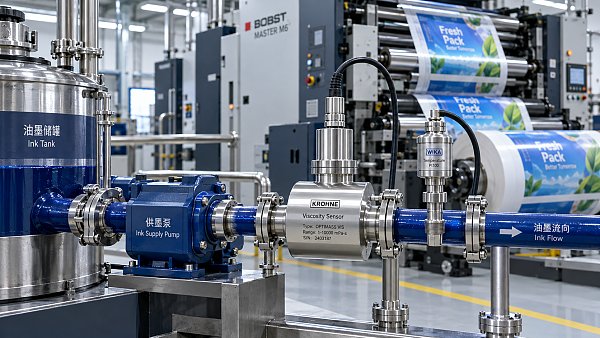
Two products described as viscosity sensors may have very different roles. One may provide a local indication for an operator. Another may continuously measure process behavior, send a stable signal to a controller, operate a dosing valve or pump, record data, and communicate with the press or plant network. Comparing only the hardware line item hides these differences.
A quotation should therefore separate equipment, installation, integration, commissioning, training, consumables, and planned maintenance. A low equipment price can be attractive, but it is incomplete if the system requires extensive custom integration or difficult routine cleaning. Equally, a higher initial price can be justified when the solution arrives with a proven control architecture, accessible service support, and a clear method for maintaining measurement consistency.
Match the sensor architecture to the control objective
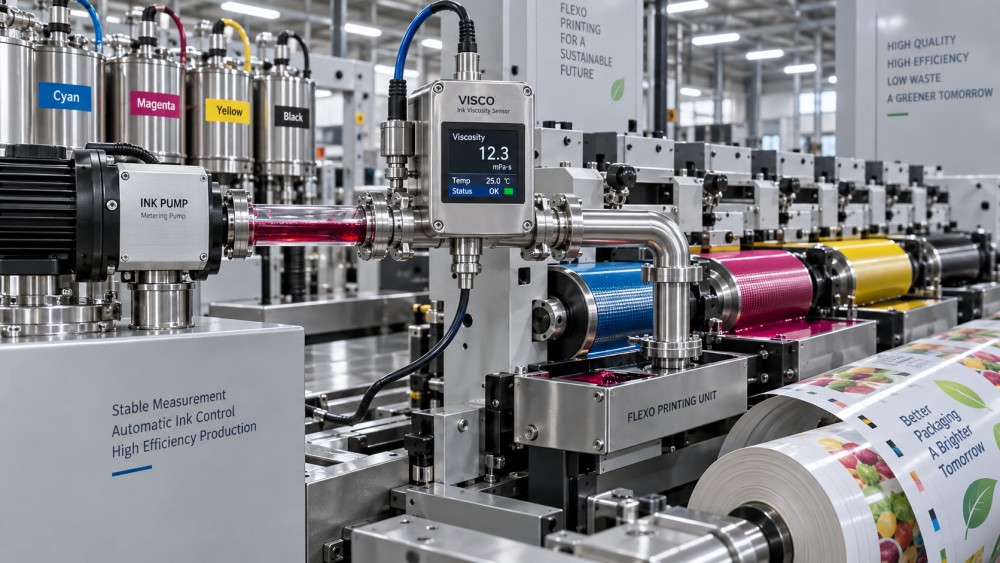
The first selection decision is whether the plant needs monitoring, operator-guided adjustment, or closed-loop control. These are not interchangeable.
A monitoring device makes sense when the main requirement is to reveal trends and give operators a dependable reference. It can be appropriate for lower-complexity presses, initial process standardization, or lines where dosing remains deliberately manual. Its value comes from replacing subjective judgement with a repeatable reading, provided that operators have a defined response when the reading changes.
An operator-guided system adds alarms, display logic, or data visibility that helps the press crew respond earlier. This can be a useful middle ground where the process is variable but full automation would be difficult to maintain. It also gives a plant a chance to verify whether viscosity is actually driving quality loss before investing in automated dosing.
Closed-loop control is most valuable when ink circulation, measurement location, dosing equipment, and process response are sufficiently stable. The controller must receive a representative measurement, add the correct adjustment medium in controlled increments, allow time for mixing, and avoid over-correction. Without these conditions, automation may simply make poor adjustments faster.
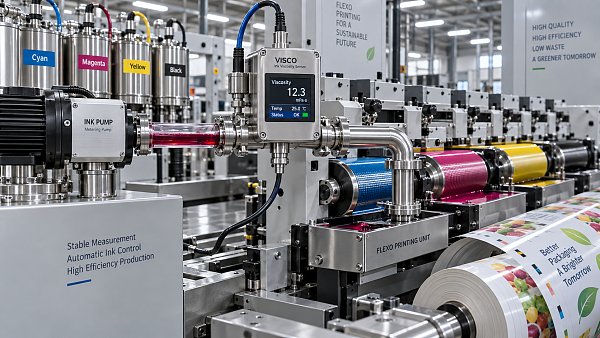
For a multi-color flexographic press, the decision may differ by unit. Process colors with long runs and high visual sensitivity may justify automated control, while a low-coverage spot color or infrequently used unit may not. Treating every station identically can inflate project cost without improving the result.
Evaluate the measurement in the real ink circuit
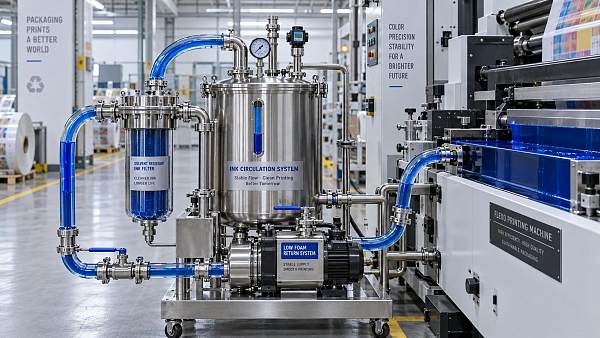
Brochure specifications cannot answer the most important question: whether the sensor will provide a representative, repeatable reading in the installed location. Ink systems differ in pigment loading, foaming tendency, filtration, circulation rate, temperature exposure, cleaning method, and the time required for a dosing change to mix through the loop.
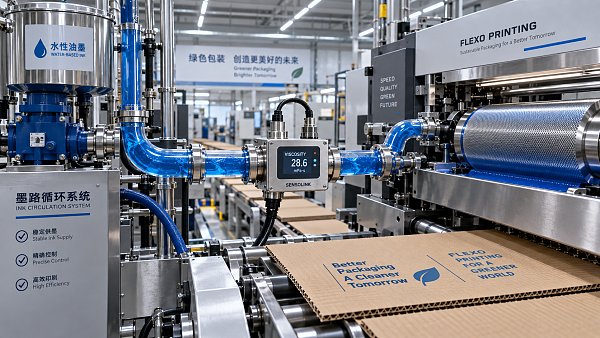
Ask suppliers to explain the intended installation point and the flow conditions it requires. A reading taken from poorly mixed ink, a low-flow branch, or a location vulnerable to air entrainment may not reflect the ink reaching the printing unit. In a recirculating system, the control loop also needs enough residence time to respond predictably after an addition. Otherwise the sensor may detect a delayed change and trigger another correction before the first has taken effect.
Temperature deserves special attention. Ink can appear to change in viscosity because its temperature changes, even when the formulation has not changed in the same way. This does not automatically mean every application needs the most advanced compensation method. It means the proposed system should address the actual thermal behavior of the ink circuit. Long-running presses, variable plant temperatures, pump heat, and heated or cooled ink supply arrangements generally make this issue more significant.
Compatibility must be assessed at component level. The sensor body, wetted seals, fittings, cables, and cleaning procedure need to suit the ink chemistry and wash-up materials. This is especially important when a press uses different ink families or switches between water-based and solvent-based work. A sensor that is technically capable but difficult to clean between jobs may be bypassed under production pressure, removing the value that justified the purchase.
Build the business case around avoided instability
A process-value comparison does not require invented savings assumptions. It requires the plant to use its own operating records. Identify a representative period and review the practical consequences of viscosity instability: material used during color set-up, ink additions, rejected production, time lost waiting for approval, recurring operator interventions, and stoppages related to the ink supply system.
Then compare those costs with the full cost of ownership of each proposed solution. The calculation should include the installed system, routine service, calibration or verification work, expected spare components, and the labor needed to keep it in service. It should also include the operational burden of the chosen design. A device that requires frequent removal, complex cleaning, or specialist attention may be unsuitable for a pressroom that needs rapid turnaround.
It is useful to assess value in four separate categories rather than forcing all benefits into one broad claim:
- Quality protection: Does the system help hold approved color and print consistency over a run and across repeat jobs?
- Material control: Can it reduce unnecessary ink adjustment, start-up waste, or rework caused by unstable ink transfer?
- Capacity protection: Does it shorten stabilization periods or reduce interventions that interrupt press operation?
- Operational resilience: Can the plant maintain the system with its available skills, cleaning routines, and maintenance resources?
A more expensive solution should show a credible advantage in at least one of these categories under the plant’s actual conditions. If it cannot, the additional capability may be unnecessary. Conversely, selecting the cheapest sensor because it meets a basic measurement requirement can be false economy when a high-value press continues to lose time and material through manual correction.
Do not confuse viscosity control with color control
Viscosity is a critical process variable, but it is only one variable. Color and print quality also depend on ink formulation, anilox volume and condition, plate characteristics, doctor blade performance, impression settings, pH where relevant, substrate variation, drying conditions, registration, and press speed. A sensor does not replace color management, inspection, or disciplined operating procedures.
This distinction matters during acceptance testing. The project should not be judged by an unrealistic promise that all color variation will disappear. Instead, define measurable operational outcomes: a stable and usable reading, an appropriate response to known ink changes, workable cleaning and changeover routines, no disruptive impact on circulation, and evidence that operators can use the information or control system consistently.
Where inline vision inspection or color measurement is already used, viscosity data can provide useful process context. For example, an inspection trend may reveal a print issue while viscosity history helps determine whether ink behavior was a likely contributing factor. The two systems serve different purposes; together they can make troubleshooting more disciplined.
Questions that should be resolved before issuing a purchase order
A sound comparison requires more than a price sheet. Request answers that are specific to the press, ink circuit, and working practices:
- Which ink types, viscosities, wash-up chemicals, and temperature conditions is the proposed configuration designed to handle?
- Where will the sensor be installed, and how will that point provide a representative sample of circulating ink?
- Is the offer monitoring only, operator-assisted adjustment, or automatic dosing control? What hardware is included for that function?
- How does the system prevent over-dosing or repeated corrections before ink has mixed?
- What routine cleaning, inspection, calibration, and replacement tasks are required, and who can perform them?
- How will alarms, signals, historical data, and machine interlocks connect with the existing press controls?
- What acceptance criteria will demonstrate that the installed system is operating correctly in production?
These questions also expose incomplete quotations. If a supplier cannot describe the ink path, cleaning routine, control logic, and commissioning scope, the proposal may be priced as a component sale rather than a process solution.
Use a staged selection when the process is not yet understood
Not every plant should begin with a fully automated viscosity-control project. If the root causes of color variation are unclear, or if existing ink circulation is inconsistent, a staged approach can be more defensible. Start by mapping the current ink system, standardizing manual checks, and establishing when deviations occur. A monitoring installation may then provide the operating data needed to decide whether automated dosing has a practical return.
This approach is also relevant for plants with mixed press generations. A newer press with stable recirculation and accessible controls may be a strong candidate for integration, while a legacy unit may benefit first from improved measurement discipline and simpler operator guidance. The right investment sequence is determined by the production constraint, not by a desire to apply the same technology everywhere.
For packaging operations evaluating connected print, inspection, and production-management systems, CPCS frames equipment decisions around the wider production effect: quality consistency, changeover performance, waste, maintenance demands, and data use. That is the appropriate lens for viscosity measurement as well. The device should support a controlled print process, not become an isolated accessory with no clear owner or operating routine.
The final comparison should therefore rank proposals by fit: fit with the ink chemistry, fit with the circulation system, fit with the desired degree of automation, fit with available maintenance capability, and fit with the cost of process instability. Once those conditions are clear, sensor price becomes a useful commercial input rather than the factor that decides the project on its own.
Related News
 How Inline Ink Viscosity Sensors Help Stabilize Flexo Print QualityDiscover how inline ink viscosity sensors help stabilize flexo print quality through temperature tracking, reliable measurement, and controlled dosing. Learn what makes a setup effective.Prof. Kaelen Sterling
 What Drives the Total Cost of a Web Tension Control SystemWeb tension controller manufacturer insights: uncover total system costs, from installation and integration to waste reduction, uptime, and long-term support.Prof. Kaelen Sterling
 How Real Time Ink Viscosity Sensors Improve Flexo Press StabilityReal time ink viscosity sensors help flexo printers stabilize color, reduce waste, and control ink drift with faster, data-driven adjustments.Prof. Kaelen Sterling
 How to Compare Ink Viscosity Sensors Price Against Process ValueInk viscosity sensors price is only one factor. Learn how to compare sensor costs with quality, waste reduction, automation needs, and long-term press value.Prof. Kaelen Sterling
 Ink Handling Systems: Choosing the Right Setup for Viscosity ControlInk handling systems for flexographic printing: discover how to choose viscosity control, circulation, cleaning, and automation setups that reduce waste and improve color consistency.Prof. Kaelen Sterling
 How to Choose an Ink Recirculation System Manufacturer for Stable Print QualityChoose an ink recirculation system manufacturer that delivers stable print quality through precise flow control, ink compatibility, cleanability, and reliable automation.Prof. Kaelen Sterling