How an Ink Metering System for Flexo Press Improves Print Control
For technical evaluators, an ink metering system for flexo press is not a secondary accessory tucked between the ink circuit and the plate cylinder. It is one of the main control mechanisms that determines whether a press can hold color, survive speed changes, minimize setup waste, and remain predictable across long production runs. In corrugated and packaging printing, that distinction matters. At high line speeds, even small instability in ink film thickness can turn into visible print variation, dot gain shifts, dirty solids, excessive consumption, and frequent operator intervention.
The practical question is not whether metering matters. It is how much print control depends on the design, condition, and integration of the metering system with the anilox, ink chemistry, doctor blade chamber, pumping loop, and press operating window. A modern ink metering system for flexo press improves control by making ink transfer more repeatable, less operator-dependent, and more stable under real production conditions rather than ideal lab assumptions.
In technical evaluations, this is where the discussion should begin: not with a generic description of parts, but with what the system actually stabilizes on press.
What print control really means in flexo production
“Print control” is often used too loosely. On a flexo line, it usually combines several different performance targets:
- Consistent ink film volume delivered from the anilox to the plate
- Stable density and color strength through startup, acceleration, and steady-state production
- Clean cell filling and effective doctoring at target speed
- Reduced foaming, contamination, and viscosity-related variation
- Fast return to specification after stoppages or wash cycles
- Predictable behavior across different board grades, print motifs, and ink sets
These targets are interdependent. A press can show acceptable density in a short trial but still perform poorly if the metering system cannot maintain chamber pressure, control recirculation, or prevent air entrainment over time. That is why experienced evaluators look beyond nominal print quality and focus on process stability.
How the metering system influences the ink transfer chain
In flexographic printing, the metering system sits at the center of a transfer chain that starts in the ink reservoir and ends on the substrate. Each stage introduces variability:
- Ink rheology changes with temperature, shear, pH, solvent or water balance, and contamination
- Anilox cells must fill consistently at operating speed
- The doctor blade must remove excess ink cleanly without starving cells
- The plate must pick up and release the metered ink uniformly
- The substrate must accept the transferred film without mottling, flooding, or uneven holdout
The metering system does not solve every problem in this chain, but it heavily influences the first three. When those are unstable, downstream corrections become difficult or expensive. Operators may compensate with impression, viscosity adjustment, speed reduction, or blade changes, but these are often reactive measures rather than true control.
A well-designed system improves repeatability in three ways: it presents ink to the anilox in a consistent condition, it meters excess ink off the anilox with minimal variability, and it maintains that state despite speed or job changes.
Why enclosed chamber doctor blade systems changed the control standard
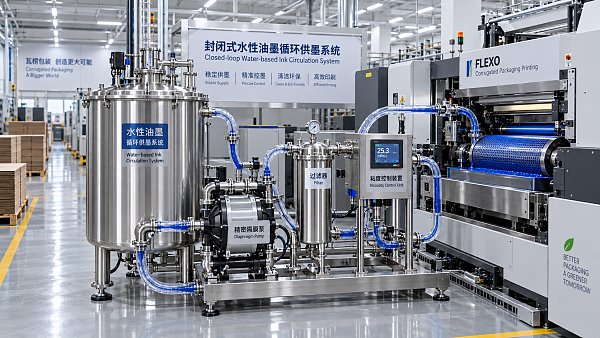
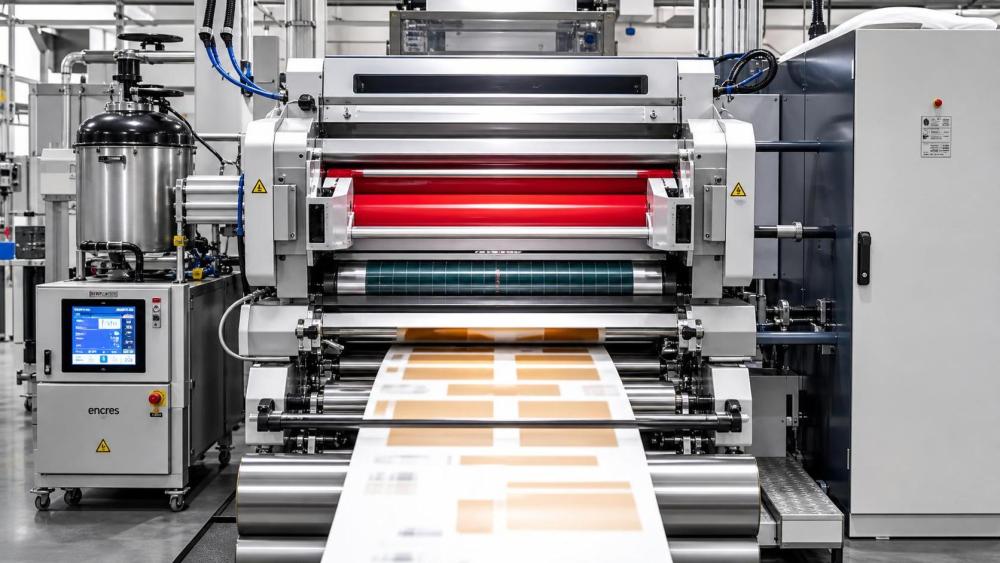
In many modern packaging applications, enclosed chamber doctor blade systems have become the reference point for controlled metering. The reason is straightforward: they create a more defined metering environment than open pan systems.
With an open system, ink exposure to the atmosphere is greater, contamination risk is higher, and the relationship between fountain condition, roll speed, and ink pickup is less controlled. For lower-demand applications this may remain acceptable, but on high-speed corrugated and demanding graphics work, the limitations show up quickly.
An enclosed chamber system improves control by:
- Maintaining a more stable ink supply at the anilox surface
- Reducing evaporation and associated viscosity or pH drift, especially in water-based systems
- Supporting cleaner doctoring through defined blade geometry and chamber pressure
- Reducing splash, misting, and external contamination
- Improving repeatability between jobs and operators
That does not mean every enclosed chamber performs well. Sealing quality, chamber geometry, blade loading, end seal life, and flow management all directly affect print control. In practice, poor chamber design can produce striping, leakage, blade chatter, and air entrainment that offset the expected gains.
The most important control variables are often not the obvious ones
Technical teams sometimes overemphasize pump capacity or chamber size while underestimating the variables that actually move print performance. Several of the most important are less visible during a basic machine inspection.
Blade condition and blade geometry
The doctor blade is not just a wear part. It is a precision metering element. Blade material, tip profile, contact angle, loading consistency, and wear rate all affect how cleanly excess ink is removed from the anilox. Inconsistent doctoring can cause density fluctuation, scoring risk, or fine-line contamination. On long runs, blade wear stability may matter more than initial print appearance.
Chamber pressure stability
Too little pressure can lead to incomplete cell filling. Too much can increase leakage, seal wear, foaming, and unnecessary ink agitation. The useful question is not whether the system pressurizes the chamber, but how steadily it maintains the pressure range required for the ink set and speed window.
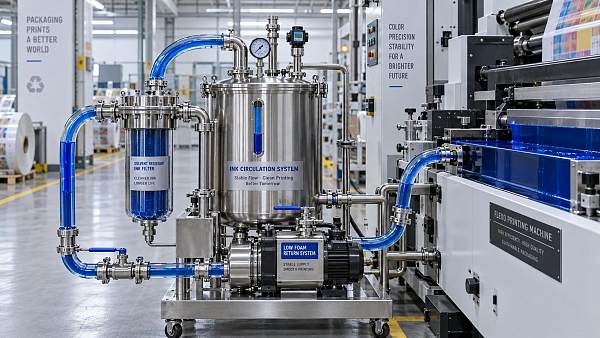
Ink recirculation behavior
Flow path design affects shear exposure, sedimentation control, temperature rise, and contamination transport. A system with poor recirculation may look acceptable at startup but lose consistency over time, especially with white inks, high-viscosity coatings, or pigment-heavy formulations.
Air management
Air entrainment remains an underestimated source of print instability. Entrained air can interfere with cell filling, promote foam, and create intermittent density defects that are difficult to diagnose. The problem is often not the ink alone, but pump selection, return-line design, chamber turbulence, and operating speed.
Wash-up and changeover performance
A metering system that prints well but traps residual ink in dead zones creates another kind of control problem: contamination during the next job. For converters running frequent SKU changes, the system’s cleanability is part of print control because it affects color carryover, setup waste, and the time needed to return to target density.
How advanced metering improves print stability at higher speeds
High-speed production narrows the tolerance for process variation. As speed increases, the time available for cell filling, doctoring, and transfer decreases, while the consequences of instability become more expensive. Waste accumulates faster, and operator corrections may lag behind the process.
Advanced ink metering systems improve this situation less by adding complexity than by reducing uncontrolled variables. Their value appears in conditions such as:
- Fast acceleration after job setup
- Long runs where ink properties drift gradually
- Frequent stop-start cycles on corrugated lines
- Print motifs with heavy solids next to fine text or barcodes
- Jobs requiring repeatability across shifts or plants
In these cases, stable metering helps maintain a more uniform ink film on the anilox, which supports more consistent plate transfer. The result is not always “better print” in a marketing sense. More often, it is narrower variation, fewer corrective adjustments, and quicker convergence to target after disturbance. For OEE, that is usually more valuable than a short-lived peak result.
The system cannot be evaluated in isolation from anilox specification
One common evaluation mistake is to judge the metering system without considering the anilox program. Metering quality and anilox specification are tightly linked. Cell volume, line screen, engraving geometry, surface condition, and wear state all influence how the chamber and blades behave.
If cell geometry is mismatched to the ink and graphic requirement, even a strong chamber system will not deliver good control. Similarly, dirty or worn anilox rolls can create symptoms that are wrongly assigned to metering hardware.
For technical assessment, the relevant question is whether the metering system remains stable across the actual anilox range used on the press:
- Low-volume rolls for finer graphics
- Higher-volume rolls for solids or coatings
- Different engravings for water-based, UV, or specialty inks
Compatibility across that range is more meaningful than performance on a single demonstration roll.
Water-based, solvent-based, and UV inks do not stress the system in the same way
Another reason generic claims about flexo metering should be treated cautiously is that ink chemistry changes the operating challenge.
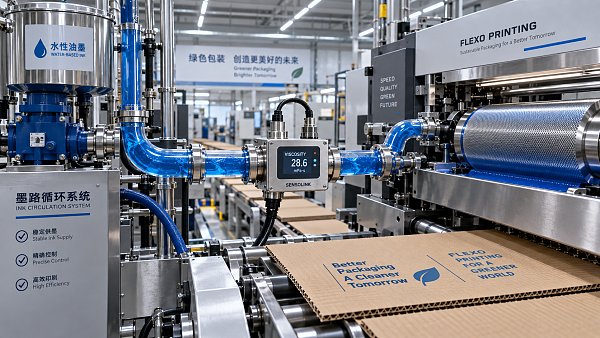
Water-based inks often require close attention to pH drift, viscosity stability, and foam behavior. In corrugated printing, where water-based systems are common, the metering system must support stable recirculation without over-agitating the ink. Solvent-based systems raise different concerns around evaporation control and safety integration. UV systems introduce their own viscosity behavior, cleaning demands, and sensitivity to contamination.
So when a supplier or machine builder claims improved print control, technical evaluators should ask: under which ink family, at what speed, on which substrate, and with what maintenance discipline? Control performance is always conditional.
Where the gains appear in real plant metrics
Metering-system upgrades are sometimes discussed as quality projects, but in production reality their effect is broader. When control improves, the gains usually show up in metrics that operations teams already track:
- Lower startup spoilage before color stabilizes
- Reduced frequency of operator adjustments during runs
- Improved repeatability after stops and wash-ups
- Less ink waste from leakage, over-circulation, or contamination
- Higher usable speed on demanding jobs
- More stable barcode, fine-line, and solid-area performance
For corrugated converters and packaging printers, these are not marginal effects. A small reduction in setup waste and fewer unplanned print interventions can materially change line efficiency, especially when board cost and delivery pressure are high.
Common misreadings during technical evaluation
Several recurring mistakes lead to weak decisions.
The first is evaluating the system only on fresh installation performance. Many metering arrangements print acceptably when everything is new. The more revealing question is how they behave after seal wear, blade aging, viscosity drift, and normal cleaning cycles.
The second is focusing on nominal machine speed rather than stable operating speed. If print control collapses near the upper end of the speed range, the rated speed is not the useful benchmark.
The third is treating automation as proof of control. Sensors, pressure monitoring, and closed-loop functions can improve consistency, but only if the underlying fluid path and chamber mechanics are sound. Digital visibility is not the same as process stability.
The fourth is ignoring maintainability. A technically elegant system that is difficult to clean, align, or service may underperform in real plants where maintenance windows are limited and operator skill varies by shift.
What technical evaluators should verify before drawing conclusions
A credible evaluation should cover more than print samples. It should include operational evidence from realistic production conditions. Useful checkpoints include:
- Stability of density or color through speed changes and long runs
- Leakage behavior at normal and upper-range speeds
- Blade life consistency and changeover repeatability
- Response after stop-start events
- Wash-up completeness and contamination risk between jobs
- Pump and chamber behavior with the actual ink set used in production
- Compatibility with the press’s existing anilox management and viscosity control practices
Where possible, those checks should be tied to measurable plant outcomes rather than subjective visual judgments alone.
Why metering is becoming more strategic in modern packaging print
The role of metering is expanding because print conditions are becoming less forgiving. Brand color expectations remain high, SKU counts continue to rise, and sustainability pressure makes waste harder to tolerate. At the same time, converters are asked to run faster, change jobs more frequently, and maintain quality on increasingly varied substrates.
Under those conditions, print control depends less on operator correction and more on system-level stability. The metering unit is one of the few places where that stability can be engineered directly.
For technical evaluators, the right conclusion is not that every advanced ink metering system for flexo press is automatically a major improvement. It is that metering deserves to be assessed as a core control architecture, not a consumable support function. When it is specified and maintained correctly, it tightens the entire ink transfer process, reduces process noise, and makes the press more predictable. In a production environment where OEE and waste reduction are under constant pressure, that predictability is often the real performance advantage.
Related News
 What Drives the Total Cost of a Web Tension Control SystemWeb tension controller manufacturer insights: uncover total system costs, from installation and integration to waste reduction, uptime, and long-term support.Prof. Kaelen Sterling
 How Real Time Ink Viscosity Sensors Improve Flexo Press StabilityReal time ink viscosity sensors help flexo printers stabilize color, reduce waste, and control ink drift with faster, data-driven adjustments.Prof. Kaelen Sterling
 How to Compare Ink Viscosity Sensors Price Against Process ValueInk viscosity sensors price is only one factor. Learn how to compare sensor costs with quality, waste reduction, automation needs, and long-term press value.Prof. Kaelen Sterling
 Ink Handling Systems: Choosing the Right Setup for Viscosity ControlInk handling systems for flexographic printing: discover how to choose viscosity control, circulation, cleaning, and automation setups that reduce waste and improve color consistency.Prof. Kaelen Sterling
 How to Choose an Ink Recirculation System Manufacturer for Stable Print QualityChoose an ink recirculation system manufacturer that delivers stable print quality through precise flow control, ink compatibility, cleanability, and reliable automation.Prof. Kaelen Sterling
 How Precision Intermittent Motion Drives Improve Indexing AccuracyPrecision intermittent motion drive solutions improve indexing accuracy, reduce vibration, and stabilize dwell performance for high-speed packaging and converting equipment.Prof. Kaelen Sterling