How Viscosity Control Systems Improve Ink Consistency Across Production Runs
In high-speed packaging printing, a job can look perfectly controlled at start-up and still drift noticeably before the next production run. A slight change in ink viscosity may alter color strength, dot gain, drying behavior, edge definition, or barcode contrast. On corrugated flexo lines, the result can be especially costly: a printed shipper that passes visual inspection may later fail a scan test, show uneven solids, or trigger a brand complaint because the color no longer matches the approved sample.
Viscosity Control Systems address one of the most persistent sources of variation in ink handling. They help maintain a defined ink condition while temperature changes, solvents or water evaporate, press speed shifts, and recirculation conditions evolve. For quality personnel, this is not merely a convenience feature on a press. It is a practical process-control tool that supports repeatable print density, more reliable inspection results, and clearer accountability from one run to the next.
Why ink consistency is difficult to preserve between runs
Ink viscosity is a measure of resistance to flow. In printing, that flow behavior influences how ink transfers from the chamber or fountain to the anilox roller, then to the plate and substrate. The target is not simply “thin” or “thick” ink. It is ink held within the operating window validated for a particular formulation, anilox volume, plate design, substrate, drying system, and press condition.
That window is under constant pressure. Water-based flexographic ink can thicken as water and co-solvents evaporate, particularly around open ink circuits or during long production periods. Solvent-based systems can experience rapid viscosity movement due to solvent loss, temperature changes, and cleaning practices. Even a change in warehouse conditions, ink batch temperature, or mixing time can affect the starting point.
Corrugated packaging adds further complexity. Linerboard absorbency may vary between paper grades and lots. High-speed corrugator-fed or post-print operations can change the practical transfer conditions as speed increases. A formulation that produces clean graphics on a coated liner may need different control discipline on a more absorbent recycled substrate. If operators compensate manually by adding water, solvent, or fresh ink based on visual judgement alone, variation can accumulate quietly across shifts.
The same issue affects commercial printing applications where color repeatability, readable codes, and controlled finishing are expected. In these environments, viscosity should be treated as one linked process variable—not as an isolated ink-room measurement.
What a Viscosity Control System actually controls
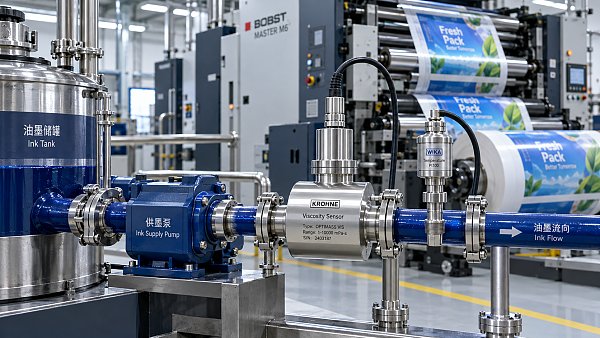
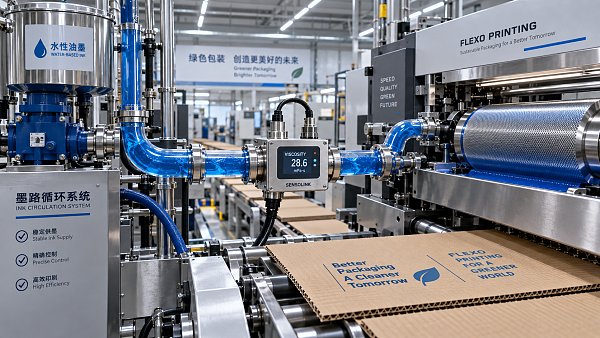
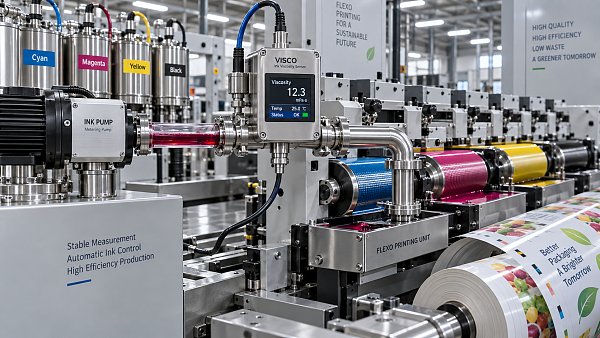
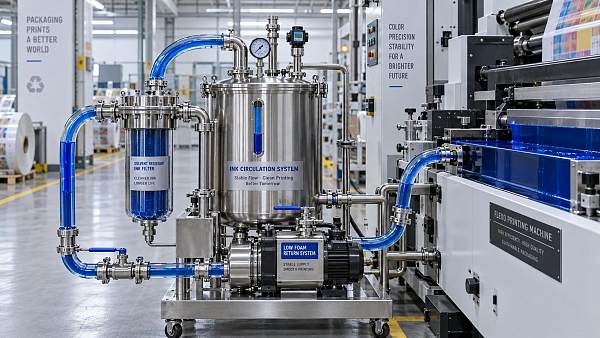
A typical system measures ink viscosity in a supply or return circuit and compares the reading with a preset target or allowable range. When the measurement moves beyond the required condition, the system doses a designated reducer, such as water, solvent, or a compatible blend, in controlled quantities. The ink is then mixed and recirculated before the next measurement cycle. More advanced arrangements can record trends, provide alarms, communicate with press controls, or support recipe-based settings for repeat jobs.
The measurement principle matters. Some systems use a cup-based or flow-time approach, while others rely on sensors that assess flow resistance or related physical behavior electronically. No measurement method is automatically “better” in every plant. What matters is whether the selected method is suitable for the ink chemistry, temperature range, contamination risk, cleaning regime, and control precision required by the application.
A good system does not eliminate the need for an ink technician or press operator. It makes their decisions more consistent. Rather than asking an operator to guess whether an ink feels too heavy, the process provides a visible, traceable signal: the ink is within target, approaching a limit, or requires investigation.

From viscosity stability to print stability: the control chain
It is tempting to assume that a stable viscosity reading guarantees stable color. In reality, ink viscosity is one important link in a longer control chain. Quality teams should understand both its influence and its limits.
- Ink transfer: When viscosity moves outside the established operating range, the amount of ink transferred through the anilox and plate system may change. Solid areas can become weaker or heavier, while fine text and reverse graphics may lose definition.
- Color density and shade: A shift in ink film weight can affect density and perceived color. For branded cartons and retail-ready corrugated displays, even modest run-to-run variation can become visible when products stand side by side.
- Drying and rub performance: Incorrect dilution can influence drying behavior, especially where ink, coating, substrate absorption, and hot-air capacity must work together. Adding too much reducer to chase a low reading may create new problems downstream.
- Barcode and code readability: Barcodes depend on contrast, edge quality, quiet zones, and print uniformity. A viscosity-related loss of definition may not be obvious to the naked eye, yet it can reduce scanning reliability.
- Waste and restart performance: When ink conditions drift during a run, operators often need to stop, adjust, and re-establish color. The waste is not only the affected sheets or board; it includes time, paper, energy, cleanup, and the risk of mixed-quality product.
This is why the most useful Viscosity Control Systems are integrated into a broader quality approach involving anilox maintenance, doctor blade condition, temperature awareness, pH control where relevant, color measurement, drying verification, and documented approval standards.
Temperature is often the hidden variable
Many plants focus on evaporation but underestimate temperature. Ink viscosity can change as the ink warms through pumping, mechanical circulation, ambient heat, or proximity to drying units. A cooler morning start and a warmer afternoon run may behave differently even when the same ink batch, anilox roller, and job settings are used.
For this reason, quality procedures should clarify whether the viscosity target is temperature-compensated or measured at a defined process temperature. A number without its measurement context can be misleading. If a plant uses flow-cup readings, the team should also control the cup type, ink temperature, timing technique, cleaning condition, and sampling method. Otherwise, two people may report the same “target” while measuring different realities.
In automated control, temperature monitoring can provide valuable context even when the viscosity device itself is the main control point. When a trend chart shows repeated dosing during temperature rise, the corrective action may involve cooling, shielding, recirculation design, or environmental control—not simply changing the viscosity setpoint.
Building a control standard that operators can follow
A system delivers its greatest value when it is supported by a workable standard operating procedure. Quality managers should avoid a document that lists one universal viscosity number for all inks. A more reliable approach defines job- and formulation-specific ranges, with clear responsibility for approval and adjustment.
Start by establishing a validated reference condition for representative jobs. Record the ink product and batch, target viscosity range, measuring method, temperature, pH where applicable, anilox specification, press speed range, substrate grade, color targets, and drying settings. This creates a usable baseline when the job returns weeks later or moves from one shift to another.
Then distinguish between a control limit and an investigation trigger. A small movement may be normal and automatically corrected. Repeated corrections, a sudden steep trend, or a discrepancy between controlled viscosity and print quality should prompt a check of the wider process. Possible causes include contamination, incorrect reducer, dosing valve malfunction, blocked filters, poor recirculation, damaged seals, excessive foaming, or an ink formulation issue.
For safety managers, the procedure should also specify approved reducers and handling rules. Solvent-based inks require particular attention to ventilation, ignition control, static management, chemical labeling, storage, and spill response. Automated dosing can reduce routine manual exposure, but it does not remove the need for compatible equipment, preventive maintenance, and safe cleaning practices. With water-based systems, chemical exposure may be lower, yet operators still need controls for additives, cleaning agents, microbial management, and slip hazards around ink stations.
Where plants make avoidable mistakes
One common mistake is treating automatic dosing as permission to ignore the ink circuit. If the sensor is fouled, the system may control to an unreliable reading. Filters, sampling chambers, sensors, pumps, and dosing lines need inspection and cleaning intervals suited to the ink and operating schedule.
Another is adding the wrong material. A reducer should be approved for the formulation and purpose. Water, solvent, retarder, pH adjuster, defoamer, and fresh ink do not perform the same function. Using them interchangeably can disturb color strength, drying, adhesion, foam behavior, or regulatory compliance for the intended packaging application.
Plants also sometimes react to a density problem by changing viscosity before confirming the root cause. Anilox plugging, doctor blade wear, plate damage, excessive impression, substrate variation, poor registration, or drying imbalance can all affect the printed result. A Viscosity Control System supplies a stable foundation; it should not become a convenient explanation for every print defect.
How to evaluate a system for flexo and packaging printing
When comparing solutions, quality and safety teams should look beyond the headline promise of automatic control. Ask how the system handles the actual inks used in the facility, including pigment load, viscosity range, water-based or solvent-based chemistry, and cleaning requirements. Confirm whether it is intended for individual decks, central ink supply, or multiple press stations.
Response speed is important, but overcorrection is a risk. The system should dose in a controlled way, allow sufficient mixing time, and avoid chasing short-term measurement noise. Consider how setpoints are protected from unauthorized changes, how alarms are acknowledged, and whether records can be exported or reviewed during a quality investigation.
Traceability is increasingly relevant for packaging operations. A logged history of viscosity readings, dosing events, alarm conditions, and operator interventions can help explain why a run differed from its approved reference. It can also support continuous improvement: repeated deviations on one press, shift, ink family, or substrate become visible instead of remaining anecdotal.
Integration deserves equal attention. In a connected packaging plant, viscosity data can complement press speed, temperature, color measurement, vision inspection, barcode verification, and production records. The objective is not to collect data for its own sake. It is to identify the conditions under which a stable, saleable product is produced with less intervention and less material loss.
A practical quality review after installation
After introducing Viscosity Control Systems, do not judge success only by whether the display remains near the target. Review a meaningful series of production runs. Compare start-up adjustment time, frequency of manual additions, color-density variation, barcode verification results, press stoppages related to ink condition, and the amount of product held for inspection or rework.
Speak with operators as well. They will often identify realities that do not appear in a trend report: a difficult-to-clean sensor location, a dosing delay during high-speed work, an ink that foams after a certain adjustment, or a recipe that needs a different range for a particular board grade. Those observations are valuable process knowledge, not resistance to automation.
For commercial printers and corrugated converters, consistent ink behavior is ultimately about confidence. The quality team needs confidence that approved color and codes can be repeated. The safety team needs confidence that adjustment materials are handled under controlled conditions. Production needs confidence that a stable run will remain stable long enough to meet delivery commitments. By controlling viscosity as a measured, documented process variable, packaging plants create a firmer basis for all three.
Related News
 How Inline Ink Viscosity Sensors Help Stabilize Flexo Print QualityDiscover how inline ink viscosity sensors help stabilize flexo print quality through temperature tracking, reliable measurement, and controlled dosing. Learn what makes a setup effective.Prof. Kaelen Sterling
 What Drives the Total Cost of a Web Tension Control SystemWeb tension controller manufacturer insights: uncover total system costs, from installation and integration to waste reduction, uptime, and long-term support.Prof. Kaelen Sterling
 How Real Time Ink Viscosity Sensors Improve Flexo Press StabilityReal time ink viscosity sensors help flexo printers stabilize color, reduce waste, and control ink drift with faster, data-driven adjustments.Prof. Kaelen Sterling
 How to Compare Ink Viscosity Sensors Price Against Process ValueInk viscosity sensors price is only one factor. Learn how to compare sensor costs with quality, waste reduction, automation needs, and long-term press value.Prof. Kaelen Sterling
 Ink Handling Systems: Choosing the Right Setup for Viscosity ControlInk handling systems for flexographic printing: discover how to choose viscosity control, circulation, cleaning, and automation setups that reduce waste and improve color consistency.Prof. Kaelen Sterling
 How to Choose an Ink Recirculation System Manufacturer for Stable Print QualityChoose an ink recirculation system manufacturer that delivers stable print quality through precise flow control, ink compatibility, cleanability, and reliable automation.Prof. Kaelen Sterling