How Real Time Ink Viscosity Sensors Improve Flexo Press Stability
Real time ink viscosity sensors improve flexo press stability by turning a changing ink condition into a visible, controllable process variable. Instead of discovering a viscosity shift after color density, dot gain, drying, or print cleanliness has already moved, the press receives a continuous indication of what is happening in the circulation system. That earlier signal supports smaller corrections and reduces the chance that a temporary disturbance becomes a long run of off-specification print.
Viscosity is the resistance of ink to flow. In flexographic printing, it influences how ink fills the anilox cells, transfers through the doctor blade chamber, releases onto the plate, and wets the substrate. A stable reading does not guarantee stable print by itself, because anilox volume, plate condition, impression, pH, temperature, substrate absorption, and drying also matter. It does, however, remove one major source of uncertainty: whether the ink arriving at the print unit is behaving as intended.
Why viscosity changes during a press run
Water-based flexographic inks are particularly sensitive to evaporation and temperature. As water and volatile components leave an open ink system, the ink can become more concentrated and flow less easily. A temperature rise can move viscosity in the opposite direction by reducing resistance to flow. These changes are not always slow or uniform. A long run, a press-speed increase, a warm ink return line, different ambient conditions, or an extended pause can alter the condition at the print deck.
Corrugated printing adds further variation. The surface of linerboard may differ between deliveries or even between portions of a job. A more absorbent sheet can pull liquid from the ink film rapidly, while a harder or less absorbent surface can leave more ink on the print surface. These substrate effects are sometimes mistaken for a viscosity problem. Continuous measurement does not eliminate that distinction, but it allows the ink-side condition to be confirmed before adjustments are made elsewhere.
Ink systems with recirculation also develop gradients. Ink in the reservoir, pump line, chamber, return pipe, and print unit does not always share exactly the same temperature or concentration. A hand sample taken from a bucket can therefore represent a different condition from the ink passing the anilox roller at that moment. A sensor installed in a representative flowing section of the circuit provides a more useful process signal than an occasional sample from a stagnant location.
From delayed correction to controlled response
Manual viscosity checks remain useful for verification, especially at job start and after a major ink adjustment. Their limitation is timing. A cup measurement or similar test provides a snapshot, and the result can vary with sampling technique, sample temperature, cup cleanliness, and the time taken to perform the test. Between checks, the press may have moved far from the desired condition.
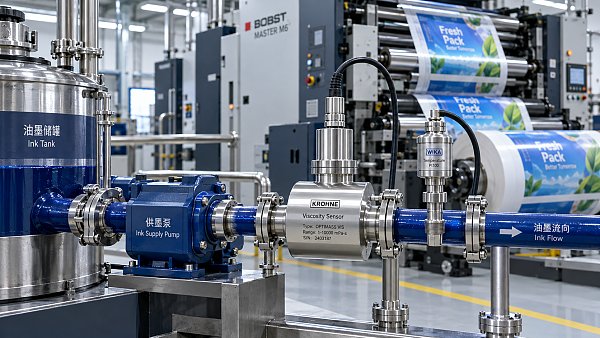
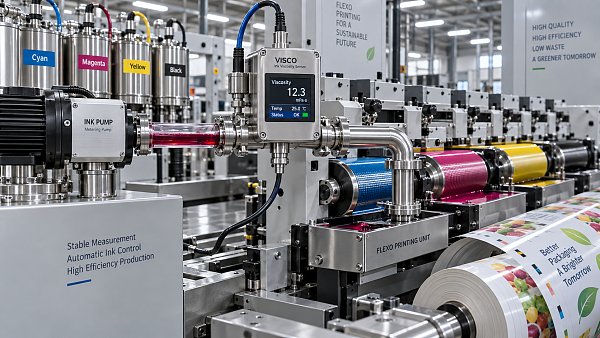
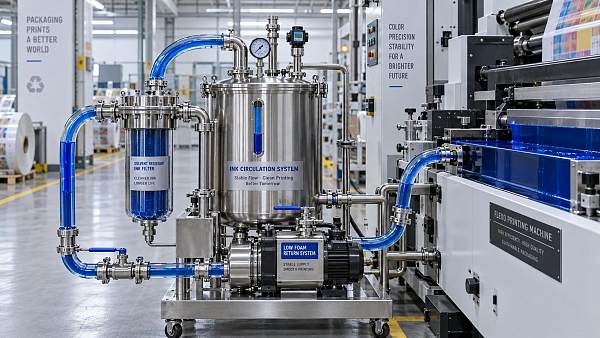
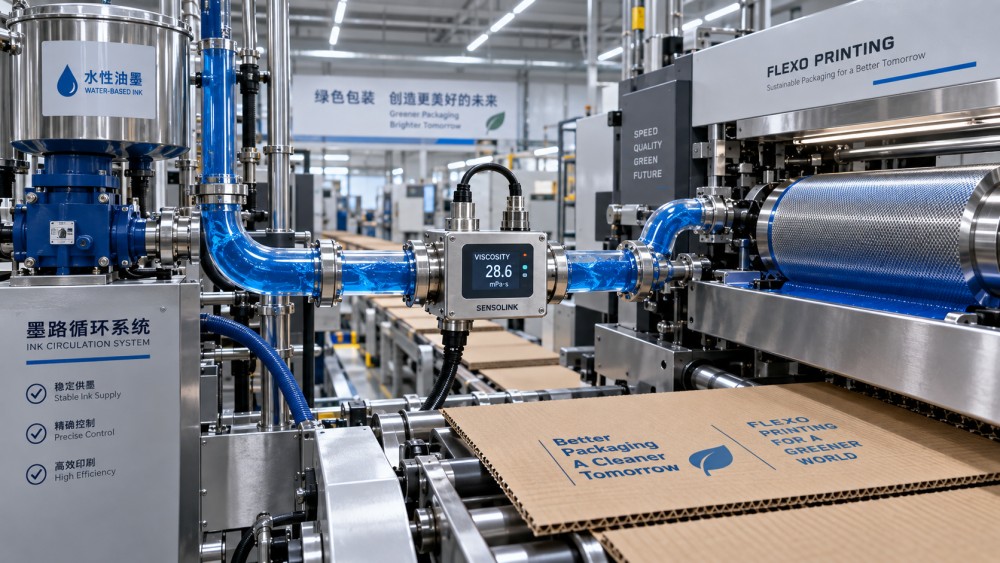
Real time ink viscosity sensors continuously measure the ink stream and send a signal to a display, controller, or production data system. Depending on the design, the sensor may use vibration, rotational resistance, pressure-flow behavior, or another measurement principle. The practical objective is the same: identify drift soon enough to correct the ink before print symptoms spread across a significant quantity of material.
When connected to a controlled addition system, the sensor signal can govern measured additions of water, solvent, or approved reducer. The control loop should be deliberately limited. Large or frequent additions create their own instability, especially when the circulation volume is small or the measurement point is close to the addition point. The ink needs enough mixing and transport time for a change to reach the sensor as a representative condition. Without that delay allowance, the control system can overcorrect, producing repeated swings around the setpoint.
A well-tuned loop generally makes modest corrections, waits for the ink circuit to respond, and verifies that the trend is settling. The target should be based on the approved ink specification and the actual press condition, rather than copied blindly from another job. A formulation that prints cleanly on coated paper at one speed may require a different controlled range on absorbent corrugated linerboard or on a press with a different anilox and drying arrangement.
What press stability looks like at the print unit
The first benefit is more consistent ink transfer. If viscosity rises, an ink film may become less uniform, especially in fine text, line work, small reverse areas, and highlight screens. Excessive resistance to flow can also increase sensitivity to doctor blade condition and chamber pressure. Ink may not replenish anilox cells as consistently, while dried material or debris becomes more likely to affect the metering contact.
When viscosity falls too far, the ink film can become overly mobile. This can contribute to excessive density, loss of edge definition, dirty reverses, filling of fine detail, or color variation as substrate absorption changes. Thin ink is not automatically the cause of these defects. Excessive impression, worn plates, damaged anilox cells, incorrect doctor blade contact, or unsuitable drying can create similar visual results. The sensor reading narrows the diagnostic path by showing whether viscosity changed at the same time as the defect.
Color stability also improves because the ink condition is less dependent on periodic judgment. Density targets, spectral values, or visual color approval still require their own controls. Viscosity should not be treated as a substitute for color measurement. Its role is to stabilize a physical condition that strongly influences color transfer. When viscosity remains within its intended operating window, color corrections are less likely to be used to compensate for an underlying ink-flow change.
This distinction matters during press acceleration. A color that appears acceptable at a low setup speed may shift once circulation rate, drying load, substrate movement, and ink temperature change at production speed. If the viscosity trend remains stable while density changes, attention should move toward anilox selection, impression, substrate behavior, drying, or color-control settings. If density and viscosity move together, the ink circuit deserves immediate attention.
Sensor location determines whether the reading is useful
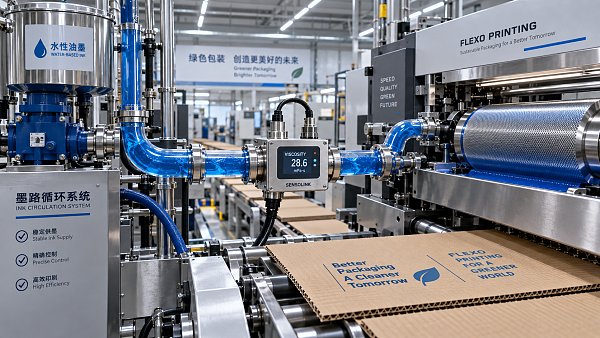
Installation location is a technical decision rather than a simple plumbing task. The sensing point needs a flowing, well-mixed ink stream that reflects the condition delivered to the print unit. A return line is often suitable when it carries a continuous, representative flow, but the exact position depends on the circulation layout, pump type, filtration arrangement, and where additives enter the system.
Dead legs and low-flow branches should be avoided. Ink in these areas can settle, cool, warm, dry, or accumulate entrained air without matching the active stream. A sensor placed immediately after an addition point may see a concentrated local change before the mixture has dispersed. A position too far from the print unit can fail to detect temperature or evaporation effects developing downstream. The selected position should balance mixing quality with response relevance.
Air bubbles deserve particular attention. Foam, pump cavitation, loose suction fittings, a low reservoir level, or an unsuitable return arrangement can introduce air into the measurement zone. Depending on the sensing principle, entrained air can cause unstable readings, apparent viscosity shifts, or signal alarms. Treating a bubble-related signal as a real ink change may lead to unnecessary dilution and a genuine print problem later. A fluctuating trace should therefore be compared with pump behavior, tank level, return flow, and visible foam before formulation adjustments are made.
Temperature must be read alongside viscosity
A viscosity value without temperature context can be misleading. The same ink may produce different readings at different temperatures even when its formulation has not changed. Many sensor systems include temperature compensation or provide a separate temperature channel. Compensation is useful, but it needs to match the ink chemistry and the control objective. A compensated reading may describe material consistency, while the uncorrected temperature effect may still influence transfer at the press.
For this reason, both the viscosity trend and the temperature trend should be visible during troubleshooting. A gradual viscosity change that follows a temperature increase can indicate a thermal issue in the circulation loop rather than an incorrect addition rate. Cooling capacity, heat exposure from nearby equipment, pump shear, line insulation, and tank residence time may then be more relevant than the viscosity setpoint itself.
Setpoints need an operating range, not a single unquestioned number
The most useful control target is established during approved production conditions: correct ink, clean anilox roller, stable doctor blade contact, normal press speed, suitable substrate, and accepted color and print definition. That condition becomes the reference for the job or product family. The target should include a practical tolerance band so the system does not chase insignificant measurement noise.
Different inks should not be forced into the same nominal reading. Pigment loading, resin system, pH sensitivity, additives, and intended application affect flow behavior. Two inks can show a similar viscosity value yet respond differently to dilution, temperature, and anilox transfer. Likewise, a reading from one sensor technology cannot automatically be compared with a cup time or a value from another instrument unless their relationship has been established under controlled conditions.
Calibration, cleaning, and validation protect the measurement
A sensor becomes unreliable when deposits alter the sensing surface or when the reference relationship has drifted. Dried ink, resin buildup, pigment deposits, and incomplete wash-up can all affect the measurement. Cleaning procedures must suit the sensor construction and the ink chemistry. Abrasive tools or incompatible cleaning fluids can damage sensitive surfaces, seals, or protective coatings.
Validation should be tied to a known reference method and performed under controlled sampling conditions. The purpose is not to force perfect agreement between instruments that use different principles. It is to confirm that the installed sensor gives a repeatable, meaningful signal across the normal operating range. A reference check taken at a substantially different temperature, from a different point in the circuit, or after excessive standing time will create a false comparison.
After an ink change, a thorough flush matters as much as recalibration. Residual ink from a previous color or chemistry can contaminate the next job and distort both print behavior and sensor response. The risk is higher where narrow bypass lines, sensor chambers, filters, and low points retain material. A wash-up sequence should leave the measurement path as clean as the rest of the circulation system.
Where automatic control needs restraint
Automatic addition is effective only when the permitted adjustment medium is compatible with the ink and the process. Adding water to correct a water-based ink can also influence pH, drying, surface tension, color strength, and rub performance. A sensor detects viscosity, not every property changed by the addition. If pH control is separate, the two loops need coordinated limits so one correction does not undermine the other.
Frequent small additions can be preferable to a large correction, but even small additions need a minimum interval based on circulation volume and mixing time. The controller should also include alarms for conditions outside the controllable range. A sudden reading change caused by a blocked filter, empty supply container, failed pump, disconnected hose, or abnormal temperature cannot be solved safely by continued automatic dilution.
Stable flexographic printing comes from a controlled relationship among ink, anilox, plate, substrate, drying, and press mechanics. Real time viscosity measurement strengthens that relationship by making ink drift visible while there is still time to respond. Used with representative installation, temperature awareness, validated setpoints, and disciplined cleaning, it reduces corrective guesswork and supports steadier color and print quality through changing production conditions.
Related News
 How Inline Ink Viscosity Sensors Help Stabilize Flexo Print QualityDiscover how inline ink viscosity sensors help stabilize flexo print quality through temperature tracking, reliable measurement, and controlled dosing. Learn what makes a setup effective.Prof. Kaelen Sterling
 What Drives the Total Cost of a Web Tension Control SystemWeb tension controller manufacturer insights: uncover total system costs, from installation and integration to waste reduction, uptime, and long-term support.Prof. Kaelen Sterling
 How Real Time Ink Viscosity Sensors Improve Flexo Press StabilityReal time ink viscosity sensors help flexo printers stabilize color, reduce waste, and control ink drift with faster, data-driven adjustments.Prof. Kaelen Sterling
 How to Compare Ink Viscosity Sensors Price Against Process ValueInk viscosity sensors price is only one factor. Learn how to compare sensor costs with quality, waste reduction, automation needs, and long-term press value.Prof. Kaelen Sterling
 Ink Handling Systems: Choosing the Right Setup for Viscosity ControlInk handling systems for flexographic printing: discover how to choose viscosity control, circulation, cleaning, and automation setups that reduce waste and improve color consistency.Prof. Kaelen Sterling
 How to Choose an Ink Recirculation System Manufacturer for Stable Print QualityChoose an ink recirculation system manufacturer that delivers stable print quality through precise flow control, ink compatibility, cleanability, and reliable automation.Prof. Kaelen Sterling