How Inline Ink Viscosity Sensors Help Stabilize Flexo Print Quality
Inline ink viscosity sensors help stabilize flexographic print quality by detecting changes in circulating ink early enough for controlled correction. Their value comes from linking a representative measurement to temperature, ink condition, and a well-tuned adjustment loop. A steady sensor reading supports repeatable ink transfer, but it does not prove that color, drying, or anilox delivery is correct. Acceptance criteria therefore need to connect viscosity control with printed results under defined production conditions.
During a long run, evaporation, press heating, fresh ink additions, and interruptions change the behavior of ink in the circulation system. Periodic cup measurements capture individual samples; continuous sensing reveals the direction and timing of drift. This makes it easier to distinguish a gradual concentration change from a temperature shift or a short disturbance after replenishment.
Where viscosity affects the printed result
Ink must fill the anilox cells, pass through the metering process, release to the plate, and transfer to the substrate. Viscosity influences these stages alongside surface tension, wetting, anilox geometry, blade condition, and press speed. Excessive viscosity can restrict cell filling or release and contribute to uneven coverage. Excessive dilution can reduce color strength and change drying behavior. Neither direction produces a universal defect pattern across all ink systems.
A change in solid ink density is therefore insufficient evidence for a viscosity correction. A partially blocked anilox, altered impression setting, or a more absorbent paper surface can produce a similar result. Adding diluent in response to every density change risks moving otherwise suitable ink outside its working range.
The useful reference is a validated operating window for a specific ink formulation and print condition. That window should be established with an identified anilox, substrate, press speed, and drying setup. Transferring a target from another job solely because the color name matches overlooks differences in formulation and ink delivery.
The measurement principle determines what the number means
Inline instruments do not all measure viscosity in the same way. Vibrating or resonant sensors infer fluid properties from the response of an immersed sensing element. Other designs use rotational resistance or pressure loss through a defined flow path. Each method exposes the ink to different measurement conditions, so readings from different technologies are not automatically interchangeable.
Many flexographic inks exhibit shear-dependent behavior. Their apparent viscosity changes with the deformation imposed during measurement. A sensor in a circulation pipe does not reproduce the conditions inside an anilox cell or at the plate contact. Its measurement is useful when it has a stable, demonstrated relationship to the process, even though it is not a direct measurement of ink behavior at every transfer point.
Reported units also require attention. Dynamic viscosity, commonly expressed in mPa·s, differs from kinematic viscosity, commonly expressed in mm²/s. Conversion between them requires density. Efflux-cup seconds describe drainage through a particular cup under specified conditions; they are not a universal viscosity unit. A controller displaying “cup seconds” may be using an empirical conversion that requires validation for the actual ink family and temperature range.
Instrument documentation should identify the measured quantity, operating range, temperature limits, accuracy conditions, and sensitivity to density, bubbles, or flow. Display resolution alone says little about usable process performance: a finely resolved reading can still contain installation bias or formulation-dependent error.
Separate temperature effects from concentration changes
As ink warms, viscosity generally decreases. Evaporation tends to increase the concentration of nonvolatile material and raise viscosity. These effects can occur simultaneously, leaving the measured value apparently stable while ink composition changes. Temperature measurement beside the viscosity sensor helps expose this ambiguity.
A temperature-compensated value estimates viscosity at a reference temperature using a model. That model must suit the formulation and working range. A compensation curve developed for one ink should not be assumed valid for another, particularly when resin chemistry or solvent composition changes. Recording both measured viscosity and compensated viscosity preserves information that a single corrected display can hide.
Automatic dilution based only on uncompensated viscosity can add liquid when ink cools during a stoppage, even though evaporation has not created the need. When the press warms again, the ink may become too thin. Temperature stabilization, validated compensation, or control inhibition during defined transitions prevents this mechanism from driving unnecessary additions.
Water-based ink introduces a further variable: pH. Where binder solubility depends on alkalinity, pH drift can alter ink behavior independently of simple water loss. Water addition cannot be assumed to restore the original balance. For solvent-based ink, unequal evaporation of blend components can change drying and solvency even after viscosity returns to target. Adjustments must follow the ink formulation’s approved replenishment approach.
A representative installation is part of the measurement
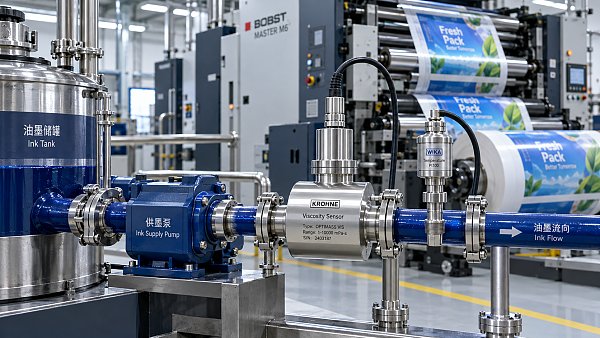
The sensor needs to encounter ink representative of the material reaching the print station. A well-mixed circulation line is often suitable, provided the instrument remains fully wetted and the location meets its flow requirements. A stagnant branch can lag behind the working ink; a point beside the dilution inlet can register a concentrated correction pulse before mixing is complete.
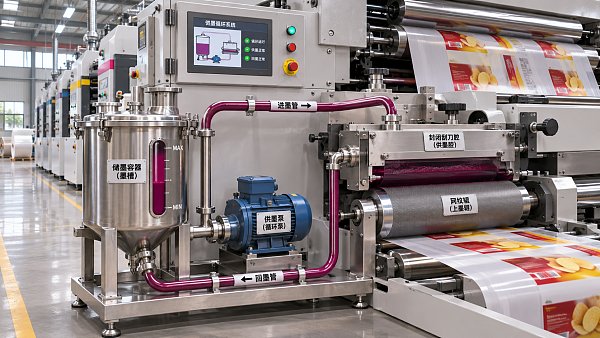
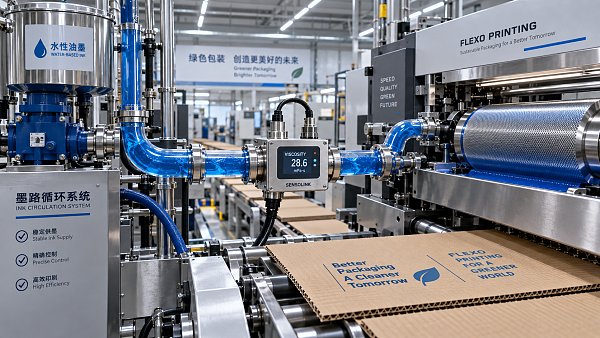
The relationship between the reservoir, pump, sensor, dosing inlet, and chamber matters more than mounting convenience. Positioning must account for mixing and transport delay. A sensor upstream of the dosing point will detect the correction only after the adjusted ink completes the relevant circulation path. That delay must be included in the control logic.
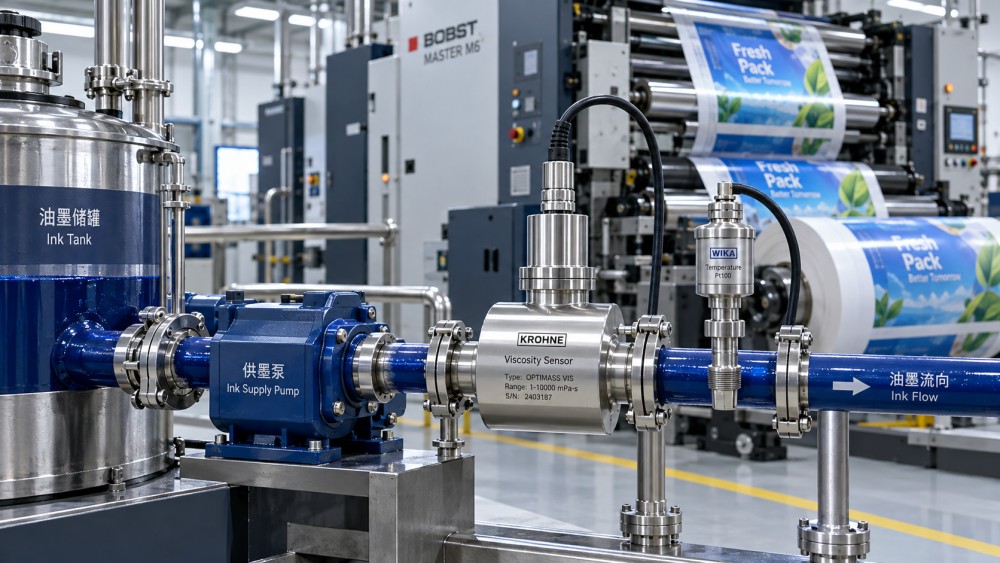
Air entrainment deserves particular attention in return lines and poorly flooded suction arrangements. Bubbles can disturb the sensing response, while foaming creates a mixture that differs from bulk liquid ink. Pump pulsation, changing back pressure, or an intermittently empty pipe can also make a stable ink appear unstable. Flow sensitivity varies by sensor design, so installation requirements should follow the instrument’s validated operating conditions.
Pigment deposits and dried binder can coat the sensing element and shift its response. The installation needs access for inspection and a cleaning sequence compatible with wetted materials. A reliable signal immediately after cleaning, followed by progressive drift during production, is evidence to investigate fouling before changing the recipe target.
Control adjustments must respect circulation delay
Continuous measurement becomes active control when the system meters water, an approved solvent blend, or another specified adjustment fluid. Stable control requires more than switching a valve whenever the reading crosses a limit. Each addition takes time to disperse, travel to the sensing point, and influence the measured ink.
If the controller doses repeatedly during this delay, additions accumulate before their effects become visible. The result is overshoot, followed by a prolonged recovery that further dilution cannot reverse. A practical strategy uses bounded additions, an appropriate mixing interval, and limits on cumulative dosing. More advanced control can account for delay explicitly, but still requires commissioning with the actual circulation system.
The adjustment rate must also suit the active ink volume. A dose that is modest for a large reservoir can significantly disturb a small chamber circuit. Changes in reservoir level alter this relationship. Control behavior should therefore be assessed across the intended operating volume, including low-level conditions.
Automatic dosing should be inhibited when the measurement is invalid, circulation is lost, or cleaning fluid is present. Start-up, job changeover, and press stoppage need defined control states. Signal loss must generate a clear fault rather than be interpreted as a request for more diluent. Logged valve commands and measured additions help distinguish a control decision from a dosing hardware failure.
Validation needs both reference measurements and print evidence
Calibration establishes the instrument’s response against a reference; process correlation establishes how that response relates to working ink and acceptable printing. These are separate activities. A calibration fluid can confirm instrument performance without demonstrating that the selected production target is suitable for a shear-dependent ink.
Reference comparisons require matched conditions. A sample taken from the reservoir and measured several minutes later can cool, evaporate, or change through handling. Comparison with the inline reading should use a documented sampling point, measurement temperature, timing, and preparation method. Where an efflux cup remains the reference, cup identity, cleanliness, and endpoint interpretation must be consistent.
No single viscosity target or tolerance applies to every flexographic process. A meaningful specification states the measurement method and temperature basis alongside the ink and operating conditions. Otherwise, two systems can report different values while both function correctly, or report matching values while measuring different fluid behavior.
A production trial should capture conditions that challenge control, including warm-up, sustained running, replenishment, and restart after a pause. Relevant evidence includes:
- Viscosity and temperature trends, aligned with press speed and dosing events, to reveal delay, overshoot, and recovery.
- Color measurements taken under consistent conditions, with solid coverage or other job-relevant features assessed separately.
- Reference samples around disturbances, especially when the inline trend and printed result disagree.
- Cleaning and changeover records that show whether residual ink or wash fluid affects the next recipe.
Success means that the system maintains the validated working range through these disturbances and supports acceptable print results. A smoother trend alone is weak evidence if aggressive filtering hides changes or color variation persists.
Reading disagreements without chasing the wrong variable
These observations identify investigation paths, rather than unique diagnoses. More than one mechanism can operate at once, particularly when heating, evaporation, and replenishment overlap.
Carry the validated conditions into each recipe
A usable viscosity-control recipe records the ink identity, target range, temperature basis, permitted adjustment fluid, dosing limits, and relevant circulation settings. Retaining these conditions makes a repeat job reproducible and prevents an old setpoint from being applied to a changed formulation.
When viscosity stays within range but print quality moves outside its acceptance limits, the next investigation should follow the affected feature: ink concentration and transfer for color strength, wetting for coverage, or drying conditions for blocking and rub performance. Keeping those relationships visible allows inline sensing to control a defined process variable without turning every print defect into an instruction to dilute the ink.
Related News
 How Does a Closed Loop Ink Recirculation System Reduce Waste?Discover how a closed loop ink recirculation system reduces ink and print waste, and learn which recovery and cleaning practices maximize savings.Prof. Kaelen Sterling
 How Do Ink Viscosity Sensors for Flexo Ink Help Stabilize Print Color?Discover how ink viscosity sensors for flexo ink help stabilize print color, detect drift early, and support precise dosing. Learn what matters for reliable control and less waste.Prof. Kaelen Sterling
 How Inline Ink Viscosity Sensors Help Stabilize Flexo Print QualityDiscover how inline ink viscosity sensors help stabilize flexo print quality through temperature tracking, reliable measurement, and controlled dosing. Learn what makes a setup effective.Prof. Kaelen Sterling
 What Drives the Total Cost of a Web Tension Control SystemWeb tension controller manufacturer insights: uncover total system costs, from installation and integration to waste reduction, uptime, and long-term support.Prof. Kaelen Sterling
 How Real Time Ink Viscosity Sensors Improve Flexo Press StabilityReal time ink viscosity sensors help flexo printers stabilize color, reduce waste, and control ink drift with faster, data-driven adjustments.Prof. Kaelen Sterling
 How to Compare Ink Viscosity Sensors Price Against Process ValueInk viscosity sensors price is only one factor. Learn how to compare sensor costs with quality, waste reduction, automation needs, and long-term press value.Prof. Kaelen Sterling