When a Plasma Treater for Surface Treatment Solves Ink Adhesion Issues
When a Plasma Treater for Surface Treatment Solves Ink Adhesion Issues
Ink adhesion failures rarely begin as dramatic press problems. More often, they appear as a small rub mark after drying, uneven solid coverage on one area of a sheet, ink lifting during tape testing, or a code that becomes difficult to read after handling. In commercial printing and corrugated packaging, those defects can turn into rejected cartons, rework, missed delivery windows, and difficult conversations with brand customers.
A plasma treater for surface treatment is often considered when normal adjustments to ink viscosity, drying, anilox condition, or press settings do not restore stable adhesion. It is not a universal cure for every print defect. But when the underlying issue is low surface energy, surface contamination, or inconsistent wetting on a difficult material, plasma treatment can give operators a practical way to prepare the substrate immediately before printing, coating, gluing, or coding.
The important question is not simply whether plasma works. It is whether the adhesion problem is actually a surface-preparation problem, and whether the treatment can be integrated into the real speed, material flow, maintenance routine, and quality controls of the production line.
Why Ink Fails to Hold Even When the Press Looks Correct
For ink to anchor properly, it must first wet the substrate. If the liquid ink pulls back, beads, or spreads unevenly, the printed film may look acceptable at first but remain vulnerable to rubbing, folding, moisture exposure, or later converting operations. Surface energy is central to this behavior: a surface with insufficient energy may resist wetting by the ink or coating applied to it.
This is especially relevant with films, laminated structures, coated papers, varnished board, metallized materials, and some synthetic labels. These substrates may arrive with surface treatments already applied, but that does not guarantee consistent printability at the point of production. Storage time, dust, handling, silicone transfer, oil, release agents, moisture, and variation between material batches can all change the effective surface condition.
Corrugated packaging creates a different but related challenge. A corrugated sheet may include highly absorbent linerboard, recycled content with variable surface characteristics, coated top liners, or areas affected by dust and fiber debris. A flexographic press can be adjusted carefully, yet print quality may still drift if surface conditions are changing faster than the operator can compensate. The same principle applies to coding systems: a clean-looking carton surface is not automatically a code-ready surface.
Before treating the material, it is worth separating adhesion failure from other common causes. Incomplete curing, unsuitable ink chemistry, excessive ink film weight, poor drying, wrong varnish sequence, worn printing plates, contamination in the ink system, and poor web or sheet handling can all create defects that resemble a surface-energy issue. Plasma will not correct those process failures.
What Plasma Treatment Changes on the Material Surface
Plasma treatment uses an energized gas to modify the outermost surface of a material. Depending on the material and process setup, it can remove light organic contamination, increase surface energy, and create a more receptive surface for inks, coatings, adhesives, or functional layers. The treatment acts at the surface rather than changing the bulk structure of the board, film, or component.
For an operator, the practical outcome is usually better wetting consistency. Ink can spread more evenly instead of retracting from low-energy areas. That can support stronger adhesion and reduce the temptation to compensate by over-applying ink, slowing the press unnecessarily, or repeatedly changing formulation. In a production environment, stability is often more valuable than an isolated improvement in a laboratory test.
Atmospheric plasma systems are commonly considered for inline use because they can be positioned before the application point without requiring a vacuum chamber. The exact equipment configuration depends on whether the line handles a continuous web, individual sheets, formed cartons, trays, labels, or irregular packaging components. Treatment width, distance to the substrate, conveyor or web speed, available installation space, extraction requirements, and access for maintenance all need to be considered early.
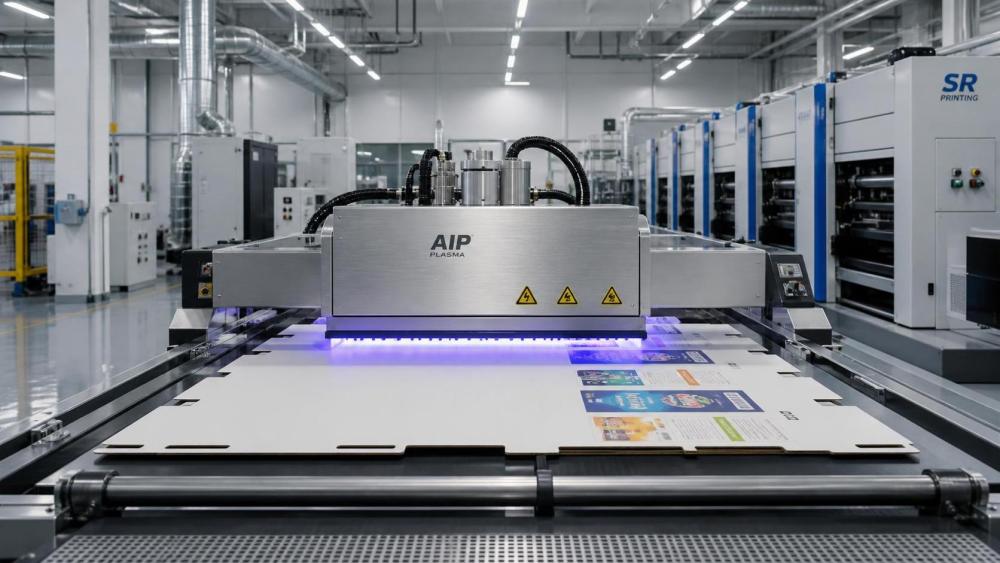
A plasma treater for surface treatment is therefore best understood as part of process control. It prepares the material so the chosen ink or coating has a better chance to perform consistently. It does not remove the need for correct ink selection, proper curing, clean handling, or disciplined inspection.
Situations Where Treatment Is Worth Investigating
The strongest signal is repeatability. If adhesion problems appear intermittently across different shifts, material deliveries, or jobs, and standard press adjustments do not explain the pattern, surface variability deserves investigation. This is common where a packaging plant is processing several substrate grades under short changeover cycles and cannot afford extended trial-and-error at the press.
Plasma treatment may be relevant when printing on coated or non-porous materials with water-based, UV, or other ink systems that require reliable wetting. It can also be useful before adhesive application in window patching, specialty converting, label production, or assembly steps where bond strength is sensitive to surface condition. For folding cartons and corrugated applications, it may be considered where high-value graphics, variable data, barcodes, or secondary coatings need to remain intact through downstream handling.
Another trigger is a process change. A printer may move to a new board supplier, introduce a different coating, reduce solvent use, add digital overprinting, or convert more recycled-content material. Adhesion performance may change even though the machine itself has not. In such cases, plasma can be one option among several, but the team should first document what changed: substrate specification, stored material age, ink batch, drying conditions, press speed, humidity, and downstream test method.
Symptoms that should prompt a surface check
- Ink or coating pulls away from selected areas despite stable print settings.
- Tape, rub, scratch, or fold tests fail inconsistently between material lots.
- Solid areas show poor leveling or visible dewetting on a film or coated board.
- Adhesion drops after material has been stored, moved, or exposed to a dusty process area.
- A change in ink, varnish, liner, laminate, or supplier creates a defect not seen on the prior job.
- Barcode or traceability marks print visually but do not remain readable after normal handling.
None of these signs proves that plasma is required. They do, however, justify a structured diagnosis instead of treating every failure as an ink problem.
How to Confirm the Root Cause Before Adding Equipment
A sensible evaluation starts with samples from both acceptable and failed production. Compare the substrate, ink or coating, drying or curing settings, and the conditions under which the defect occurred. Surface-energy test inks, dyne solutions, or other suitable plant test methods can provide an initial indication, provided staff follow the relevant handling procedure and understand the limits of the test. Results should not be treated as a stand-alone guarantee of print performance.
It is also useful to examine when the failure happens. Does the ink fail immediately after printing, only after curing, after die-cutting, after a folder gluer, or after distribution simulation? An adhesion defect after creasing may be related to board cracking or coating flexibility rather than inadequate surface activation. A defect after UV curing may point toward cure energy, lamp condition, or formulation compatibility. The timing of failure narrows the investigation.
Trial work should resemble production rather than a simple hand sample. A treatment setting that looks promising on a stationary piece may not produce the same result at operating speed, with actual line vibration, real substrate temperature, and normal operator changeovers. The most useful trials compare untreated and treated material using the same ink, print conditions, curing method, and acceptance test.
Integration Matters More Than a Single Treatment Result
A treatment unit can improve surface readiness and still create production headaches if it is poorly integrated. On a flexographic line, the position relative to unwinding, cleaning, printing, and drying matters. On a sheet-fed or corrugated application, the system must treat the intended print face consistently while accommodating sheet width, warp, dust, and conveyor movement. If the gap between the treatment head and substrate changes substantially, the process may become less uniform.
The interval between treatment and printing also matters. Some activated surfaces can lose part of their improved wettability over time, depending on the material and environment. For that reason, inline treatment directly before the application station is often operationally attractive. Where offline treatment is being considered, the actual delay, storage conditions, and material handling route should be tested rather than assumed.
Operators need a process they can run repeatedly, not a setting that only one specialist understands. The work instruction should identify the approved substrate families, treatment settings or validated operating window, inspection method, cleaning routine, fault response, and conditions that require escalation. If treatment power or speed is linked to a recipe system, those links should be checked during job changeover just as carefully as color, anilox, registration, or curing settings.
Maintenance also deserves attention. Dust-heavy corrugated environments can affect surrounding equipment and access. Electrodes, treatment heads, cables, air supply arrangements, extraction, safety interlocks, and control interfaces require planned inspection according to the equipment supplier’s instructions. A system that is technically capable but difficult to clean or verify during a busy shift can become another source of variation.
Avoiding the Common “More Power” Mistake
When adhesion is poor, it is tempting to increase treatment intensity until the test passes. That approach can be misleading. Excessive treatment may affect sensitive materials, alter appearance, create unwanted surface changes, or mask a different problem in the printing process. The target is not maximum treatment; it is a stable treatment level that supports the required ink or adhesive performance without damaging the substrate or complicating production.
This is particularly important for coated paperboard, thin films, printed laminates, and materials with functional barriers. A planned trial should consider the full downstream route: printing, coating, creasing, die-cutting, gluing, packing, and end use. A carton may pass a simple adhesion check yet show an issue after folding or friction in automated packing equipment.
Quality teams should agree in advance on what “solved” means. It may involve a defined adhesion test, acceptable barcode verification, a rub standard used internally or by the customer, visual inspection under normal production conditions, or successful completion of a converting step. The appropriate acceptance method depends on the application and any customer specification; it should not be copied blindly from an unrelated material or market.
A More Useful Investment Conversation
For packaging plants, the decision is not only whether a plasma system can improve adhesion. It is whether it reduces avoidable disruption across the line. A treatment project should be assessed against scrap caused by print defects, press downtime for troubleshooting, reprint exposure, inspection burden, material variability, energy use, operator workload, and future job mix. The lowest initial equipment price may not be the most meaningful comparison if integration, support, or maintenance access are weak.
Global Commercial Print & Corrugated Packaging Intelligence (CPCS) approaches these questions from the wider packaging production system rather than from a single machine category. Ink behavior interacts with flexographic presses, UV curing, registration control, vision inspection, coding, die-cutting, folder gluing, and production data management. Looking at the process chain helps teams avoid installing a surface-treatment solution while leaving the real source of variation untouched.
When a plasma treater for surface treatment is under consideration, start with the failed material, the actual operating sequence, and the acceptance requirement. Confirm whether the issue is wetting and surface condition, run representative trials at realistic production conditions, and define how treatment performance will be checked shift after shift. That is usually the point at which plasma moves from an interesting technology to a controlled answer for a recurring ink adhesion problem.
Related News
 How to Choose a Glue Dispensing System Manufacturer for Your LineChoose a glue dispensing system manufacturer with confidence. Compare adhesive compatibility, line integration, testing, and lifecycle costs to find the right fit for your production line.Spatial Folding Strategist
 How to Fix Weak Glue Bonds on Carton Folder Gluers at High SpeedsCarton Folder Gluers losing bond strength at high speeds? Learn how to optimize glue placement, adhesive selection, and compression to reduce rejects and keep production running reliably.Spatial Folding Strategist
 How Window Patching Machines Apply Film to Folding Carton WindowsDiscover how Window Patching Machines apply film to folding cartons. Learn key controls for precise placement, strong bonds, and fewer rejects before choosing your equipment.Spatial Folding Strategist
 How Does a Crash Lock Pre Breaking Unit Improve Carton Folding?Discover how a crash lock pre breaking unit reduces crease resistance, improves carton folding consistency, and supports reliable opening—with practical setup tips to avoid board damage.Spatial Folding Strategist
 How a Folder Gluer Pre-Breaking Unit Improves Carton Fold QualityDiscover how a folder gluer pre breaking unit improves carton fold quality and reduces spring-back. Get practical setup tips for consistent seam alignment and smoother production.Spatial Folding Strategist
 How to Evaluate a Cold Glue System Manufacturer for Reliable BondingChoose a cold glue system manufacturer with proven application control, uptime-focused design, seamless integration, and responsive service for reliable bonding.Spatial Folding Strategist