What to Ask a Plasma Treater Manufacturer About Surface Adhesion
Choosing a plasma treater manufacturer requires more than comparing equipment specifications. For technical evaluators in printing and packaging, the critical question is whether the system can deliver consistent surface adhesion across the substrates, inks, coatings, and adhesives used in production. That answer depends on the complete process: material condition, treatment uniformity, time to the next operation, line speed, maintenance, and the way adhesion is verified.
A successful laboratory demonstration is a starting point, not an acceptance test. Before requesting quotations, define the actual adhesion failure and ask suppliers to show how their proposed treatment will address it under production conditions.
What surface are you treating—and what is failing?
“Poor adhesion” can describe several different problems. Ink may rub off a film, a coating may separate from a laminated board, or a glued carton seam may open after forming. Plasma treatment may help when the exposed surface has poor wettability, but it will not automatically correct unsuitable ink chemistry, insufficient adhesive application, inadequate curing, contamination beneath a coating, or a weak paper surface.
Give the supplier a specific failure description. Does the ink detach from the substrate, or does it split within the ink layer? Does a carton glue joint fail at the adhesive interface, or does the paper itself tear? A failure analysis involving the ink, coating, adhesive, and substrate suppliers can prevent a team from buying treatment equipment for the wrong problem.
Material identification needs the same care. “Paperboard” might mean an uncoated sheet, a varnished carton, or board laminated with a polymer film. A corrugated case may have a printed or coated glue flap whose surface differs from the rest of the blank. Ask the manufacturer which layer the plasma will actually reach and whether the proposed treatment is appropriate for that layer.
Can the proposed system treat the actual production area?
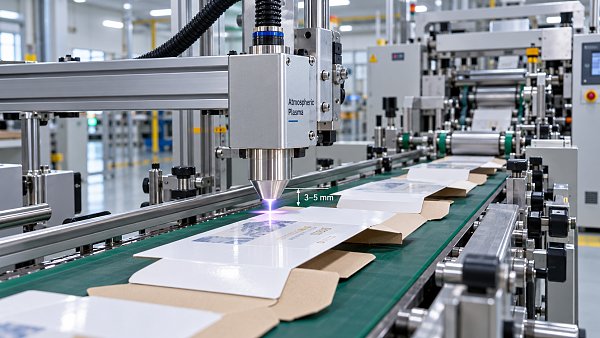
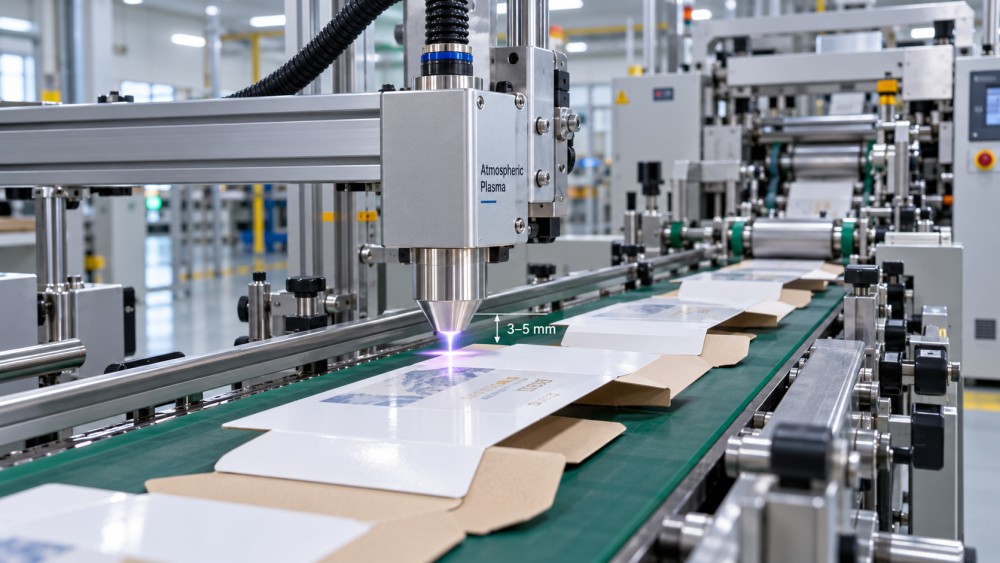
Plasma equipment is not one interchangeable category. Atmospheric plasma systems may use a directed head for a narrow strip or a wider arrangement for broader coverage. The right configuration depends on the application, available space, and required throughput. Ask the supplier to explain why its approach fits the job rather than simply accepting a maximum treatment width on a datasheet.
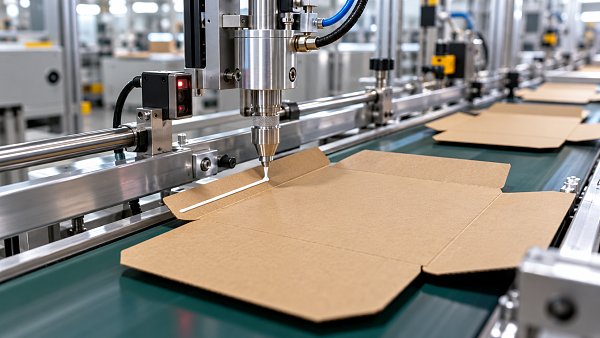
For a folder gluer, a targeted treatment head may be practical when the problem is confined to a coated glue flap. But blank registration, flap position, and conveyor movement determine whether the treatment stays on the intended path. A system that works on a carefully positioned sample can miss part of the glue area when sheets move laterally at production speed.
For a film web before printing or coating, ask about coverage across the full usable width, including edges and overlap between treatment zones. Confirm how the proposed equipment handles web flutter, wrinkles, splices, and changes in tension. For corrugated or embossed materials, surface height variation and recessed areas deserve particular attention: a treatment head set for the high points may not deliver the same effect elsewhere.
Request a drawing showing the treatment footprint, head position, operating gap, material direction, and adjustment range. This makes the discussion concrete before anyone commits to a layout.
How will the supplier prove adhesion, not just surface activation?
Ask for a trial plan using your actual production materials, preferably including representative lots and the inks or adhesives used on the line. A clean sample from a supplier’s demonstration kit may not reflect a substrate carrying slip additives, dust, residual processing aids, or a variable coating.
Surface energy indicators, including dyne test liquids, can help screen treatment consistency on suitable surfaces. They do not prove that a particular ink or adhesive will perform in use. Results can also be affected by test technique, contamination, and surface characteristics; porous paper and board require particular care when interpreting wetting results.
The more useful evidence is a combination of surface measurements and a functional test agreed with the project team. Depending on the application, that might mean a defined ink adhesion or rub test, a coating adhesion test, or destructive evaluation of a cured glue joint. Agree on the method, sample preparation, cure conditions, number of samples, and acceptance criteria before the trial. Where a customer or application specifies a test method, use that requirement rather than substituting an easier demonstration.
Ask to see untreated controls alongside treated samples. Record the failure mode as well as the pass or fail result: paper fiber tear, adhesive separation, and ink removal point to different process conditions. If a test produces mixed results across the width or along a glue flap, the average result can conceal the problem that matters most.
What happens between treatment and the next process?
A treated surface can change with time and handling. The rate depends on the material, formulation, storage environment, and other conditions, so there is no universal waiting period that guarantees adhesion. A web treated immediately before coating presents a different risk from carton blanks treated, stacked, stored, and glued later.
Ask the supplier to test the intended delay as well as the immediate result. Include realistic storage and handling where these are part of production. If a planned workflow requires an overnight wait, a test performed only seconds after treatment does not establish that the process will be reliable.
Placement also affects contamination risk. Treating a surface before a dusty conveying section, for example, may undermine the benefit before adhesive reaches it. Moving the head closer to the application point can help, but only if access, registration, extraction, and safety requirements still work.
Can treatment follow the line through speed changes and stops?
A rated line speed is meaningful only when paired with the required treatment width, substrate, head configuration, and quality target. Ask for evidence at the intended operating speed and across the normal speed range—not just at a convenient trial setting.
Discuss acceleration, deceleration, missing sheets, and stoppages. Depending on the system, excessive exposure or incorrect head positioning can damage a sensitive surface, while inadequate exposure can leave an inconsistent treatment. The supplier should explain how the equipment responds to speed signals, material presence, faults, and emergency stops.
For sheet-fed converting, triggering and blank spacing matter. For a web line, speed feedback, web position, and treatment-zone control may be more consequential. In both cases, ask what happens after a restart: does the operator need to remove suspect material, reset a recipe, or verify treatment before releasing production?
The best control scheme is not necessarily the one with the most data fields. It is the one that makes a failed treatment visible and gives the operator a clear action.
What will integration and maintenance actually require?
A treater must fit the machine mechanically and operationally. Review mounting stiffness, access for head adjustment, guarding, electrical supply, compressed air or process gas if required, and any extraction arrangements. Ask the equipment manufacturer and line builder to identify interface responsibilities early; a gap between their scopes can become a commissioning delay.
Confirm whether the process generates ozone or other emissions under the proposed operating conditions and what ventilation, monitoring, or controls are required. The answer depends on the technology and installation. Site safety personnel should assess the complete arrangement against applicable local requirements rather than relying on a generic statement that the unit is suitable for factory use.
Maintenance questions should be equally specific. Which parts need cleaning or replacement? How does paper dust, coating debris, or adhesive buildup affect performance? Can the head be accessed without disturbing registration? Ask for inspection intervals as a starting recommendation, then confirm how they may change with the production environment.
Also establish what an operator can check without specialist service support. A fault alarm is helpful, but the team needs to know whether it indicates loss of power, inadequate gas flow, a head problem, or another condition—and whether material produced before the alarm needs to be isolated.
Which costs and acceptance criteria belong in the quotation?
Compare proposals on the same basis. Alongside equipment price, request the expected utility requirements, consumables, replacement parts, installation work, training, commissioning support, and service arrangements. Include any planned downtime, guarding modifications, extraction work, and controls integration in the internal project estimate.
A lower-cost head can be the right choice for a stable, narrow application. It may not be economical if frequent repositioning, cleaning, or manual inspection slows changeovers on a high-mix folder gluer. Conversely, a broad and sophisticated system is difficult to justify when only a small, repeatable glue area needs treatment.
Before issuing the purchase order, turn the trial findings into a written acceptance plan. Identify the representative substrates and production speeds, the location and uniformity of treatment, the functional adhesion test, and the response to a missed or failed treatment. Specify who supplies materials, who runs the tests, and how disagreements will be resolved.
That system-level view is consistent with the way CPCS examines printing and packaging investments: equipment performance matters, but so do changeovers, uptime, maintenance, material variation, and downstream quality. The supplier worth shortlisting is the one prepared to discuss those limits openly and demonstrate a repeatable process on the materials your plant actually runs.
Related News
 How to Prevent Clogs in a High Temperature Hot Melt Glue GunPrevent high temperature hot melt glue gun clogs with practical tips on adhesive selection, safe cleaning, and maintenance to keep work flowing.Spatial Folding Strategist
 What Factors Affect the Price of a Corona Treater?Discover what affects corona treater price, from treatment width and power to installation costs. Compare quotes and choose the right system for your production line.Spatial Folding Strategist
 What to Ask a Plasma Treater Manufacturer About Surface AdhesionChoosing a plasma treater manufacturer? Ask these essential questions about adhesion testing, line integration, maintenance, and production reliability before you buy.Spatial Folding Strategist
 How to Prevent Clogging in a Precision Glue Nozzle During ProductionPrevent precision glue nozzle clogs with proven filtration, cleaning, and shutdown practices. Discover practical steps to reduce downtime and keep packaging bonds strong.Spatial Folding Strategist
 How to Adjust Compression Sections to Prevent Carton Seams OpeningAdjust Compression Sections to prevent carton seams from opening. Learn how to balance pressure, dwell time, and alignment for stronger bonds, less board damage, and fewer rejects.Spatial Folding Strategist
 How a Precision Adhesive Application System Reduces Glue WasteDiscover how a precision adhesive application system can reduce glue waste, protect bond strength, and lower packaging costs. Explore practical controls and ROI checks before you invest.Spatial Folding Strategist