What Engraved Glue Rollers Cost and Which Specs Matter Most
For procurement teams evaluating corrugated packaging equipment, engraved glue rollers are a small component with a major impact on adhesive control, board quality, waste, and operating cost.
Understanding what drives roller pricing and which specifications affect coating consistency, durability, and line compatibility helps buyers compare suppliers beyond the initial quote.
The practical conclusion is straightforward: the lowest-priced engraved glue roller is rarely the lowest-cost option when poor glue transfer causes delamination, warp, excess starch use, or frequent replacement.
Start With Total Cost, Not the Roller Quote
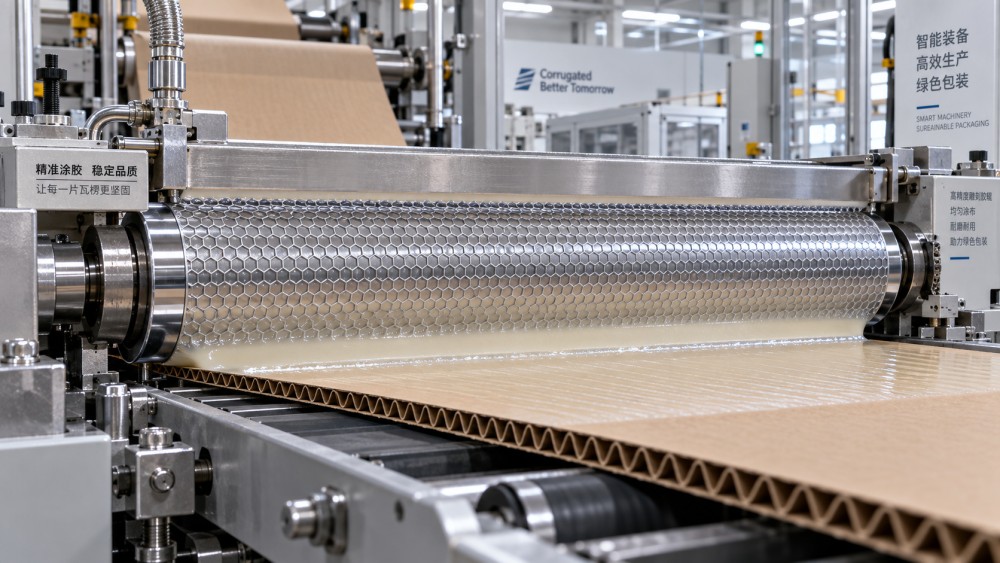
Procurement teams searching for engraved glue rollers usually want a usable price range, but the better question is what performance level the quoted roller actually delivers.
Prices vary widely because glue rollers are engineered components, not generic steel cylinders. Roller dimensions, engraving method, coating materials, shaft design, balancing requirements, and finishing standards all affect cost.
A replacement roller for a smaller single facer or glue unit may cost substantially less than a large precision roller designed for a high-speed corrugator.
Buyers should also separate the roller purchase price from related costs, including freight, bearings, seals, installation, machining changes, inspection, and production downtime during replacement.
In corrugated board production, a roller that applies glue unevenly can create costs far beyond its purchase value through bonding failures, rejected sheets, customer claims, and unnecessary starch consumption.
For that reason, supplier quotations should be compared on a like-for-like technical basis. A lower number may reflect shallower cells, lower-quality plating, looser tolerances, or incomplete accessories.
Ask suppliers to define exactly what is included: roller body material, engraving specification, surface treatment, journals, bearings, dynamic balancing, inspection documentation, and warranty conditions.
When evaluating two similar quotes, calculate the expected annual effect on adhesive consumption, board quality, cleaning frequency, and replacement intervals before selecting the apparent bargain.
What Determines the Cost of Engraved Glue Rollers
Roller diameter, face width, and overall length are primary cost drivers because larger rollers require more base material, machining time, coating capacity, and handling during manufacture.
Long rollers used on wide corrugators also require strong stiffness control. Deflection across the working width can change the glue film and create inconsistent bond quality.
The engraving pattern is another major variable. A roller with precisely machined cells generally costs more than a simpler surface pattern, but it offers more predictable adhesive metering.
Cell geometry determines how much adhesive the roller carries and releases. This directly influences starch consumption, flute tip bonding, and the ability to run different paper grades.
Chrome plating, ceramic coatings, or specialized surface treatments can increase the upfront price. They may also improve wear resistance, corrosion resistance, release behavior, and cleaning durability.
The required manufacturing tolerance matters as well. Tight concentricity, runout, surface roughness, and balance specifications demand more accurate machining and more extensive quality inspection.
For high-speed lines, dynamic balancing is not optional detail. Vibration can affect glue transfer, bearing life, machine stability, and the consistency of the finished corrugated board.
Custom journal dimensions, nonstandard mounting arrangements, integrated seals, and compatibility with existing glue stations often raise cost because they require dedicated engineering rather than standard production.
Finally, supplier location affects freight, delivery time, support availability, and import risk. A lower factory quote may lose its advantage when urgent replacement logistics are considered.
Which Engraving Specifications Have the Biggest Production Impact
For buyers, engraving specifications matter more than decorative descriptions of the roller surface. The key objective is stable adhesive transfer at the plant’s real operating speeds and paper mix.
Cell volume is usually the first value to examine. It indicates the adhesive-carrying capacity of the engraved surface and strongly influences the applied glue quantity.
Higher cell volume can support heavier glue application, but more is not automatically better. Excess adhesive can increase moisture, cause warp, contaminate equipment, and raise starch costs.
Lower cell volume may reduce adhesive consumption, yet insufficient transfer can cause poor bonding, dry edges, flute separation, or delamination during converting and distribution.
Cell count or screen specification affects how finely adhesive is distributed across the roller surface. Finer patterns may improve uniformity but can be more sensitive to contamination.
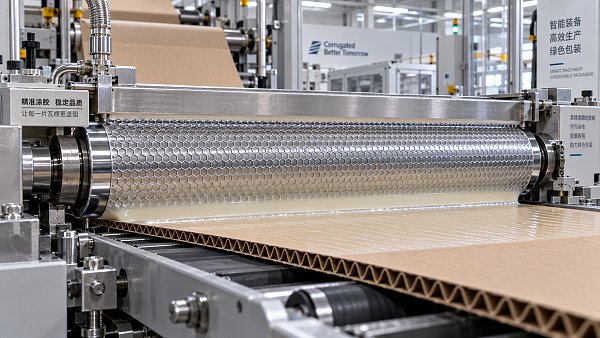
Cell shape also matters. Hexagonal, quadrangular, trihelical, and other engraved geometries can produce different filling, release, cleaning, and wear characteristics under specific adhesive conditions.
Procurement teams should request the engraving specification in measurable terms rather than accepting broad labels such as “standard pattern” or “high-efficiency surface.”
The specification sheet should state cell volume, line count, cell geometry, engraving angle where relevant, coating thickness, hardness, and acceptable surface condition after finishing.
Those values should be reviewed alongside the factory’s starch formulation, solids content, viscosity range, glue gap settings, board grades, flute profiles, and normal production speed.
Match Roller Design to Adhesive, Paper, and Corrugator Conditions
An engraved glue roller cannot be selected correctly in isolation. Its effective performance depends on the complete adhesive application system and the conditions surrounding the corrugator.
Starch adhesive with different solids levels, viscosity behavior, temperature conditions, and additives may fill and release from engraved cells differently during actual production.
A roller designed for one adhesive formulation can perform poorly after a plant changes starch chemistry or begins using more recycled linerboard and medium.
Recycled papers often have different absorbency, surface variation, moisture behavior, and strength characteristics. These changes can alter the acceptable glue film and bonding window.
Flute type is equally important. Fine flutes, heavy-duty flutes, single-wall board, and double-wall board can require different adhesive transfer characteristics and operating adjustments.
Line speed should be treated as a design input, not merely a production target. At higher speeds, roller stability and controlled glue release become increasingly important.
Buyers should provide suppliers with the normal speed range, maximum speed, paper widths, flute profiles, board construction, adhesive type, and recurring quality issues before requesting a final specification.
This information allows a supplier to recommend a roller based on application conditions rather than simply reproducing the dimensions of the component currently installed.
Replacement by identical dimensions is appropriate only when the existing roller performs well. Persistent bonding or excess-glue problems may indicate that the original engraving is unsuitable.
Material, Coating, and Surface Finish Affect Service Life
The roller body and surface treatment determine whether an engraved glue roller maintains its performance after repeated cleaning, chemical exposure, abrasion, and continuous high-speed operation.
Steel roller bodies are common because they provide strength and machinability. However, material selection should account for corrosion exposure, mechanical loading, and the plant’s cleaning practices.
Hard chrome surfaces remain widely used for durability and cost control. The quality of plating preparation, thickness, adhesion, and final grinding affects actual service life.
Ceramic-coated rollers can offer strong wear resistance in demanding applications, although they generally require higher investment and careful evaluation of engraving quality and repair options.
Surface hardness should not be considered alone. A hard surface with poor adhesion, uneven thickness, or inappropriate roughness can still crack, wear irregularly, or impair glue release.
Cleaning methods deserve procurement attention because aggressive mechanical tools or unsuitable chemicals can damage engraved cells and shorten the useful life of an otherwise capable roller.
Ask suppliers for recommended cleaning procedures, approved chemical exposure limits, inspection intervals, and clear indicators that reconditioning or replacement is needed.
Also determine whether the roller can be re-engraved, replated, recoated, or repaired locally. Refurbishment capability can materially improve lifecycle economics for large custom rollers.
A documented service history from comparable corrugator installations is more valuable than a generic claim about long life, especially for plants operating multiple shifts.
Critical Mechanical Specs Buyers Should Verify
Engraving receives most attention, but mechanical accuracy determines whether the designed glue pattern reaches the board uniformly across the full working width.
Confirm face width, total length, outer diameter, shaft diameter, bearing-seat dimensions, keyways, journal details, and mounting interfaces against the current machine drawings.
Small dimensional errors can delay installation, require emergency machining, damage bearings, or create alignment problems that undermine the roller’s intended coating performance.
Radial runout and total indicated runout should be specified clearly. Excessive runout causes changing nip conditions and can create visible variation in adhesive application.
Concentricity between the engraved surface and journals is similarly important. A roller may look acceptable when stationary yet behave poorly under line speed.
Dynamic balancing requirements should match the maximum operating speed, not only the plant’s current average output. Future speed increases should be considered during procurement.
Surface roughness requirements should be understood in context. The finish must support controlled glue pickup and release without encouraging unnecessary buildup or difficult cleaning.
Require an inspection report covering the agreed dimensions, runout, concentricity, balance grade, coating condition, and engraving measurements before shipment where practical.
For critical production lines, include a receiving inspection procedure. Measuring the roller before installation is far easier than resolving a specification dispute after a quality failure.
How to Compare Suppliers and Avoid Weak Quotations
A useful engraved glue roller quotation should connect price to technical scope. Procurement teams should be cautious when suppliers provide only dimensions and a single total amount.
Request a structured comparison table covering roller construction, engraving volume, cell pattern, coating, hardness, tolerances, balance standard, delivery period, warranty, and service support.
Ask whether the supplier has experience with corrugated starch adhesive applications specifically. Experience with printing anilox rollers does not automatically prove suitability for glue stations.
Supplier references should be relevant in roller size, corrugator speed, board type, and operating environment. Comparable installations provide better evidence than broad industry claims.
Clarify who is responsible if the supplied roller does not meet documented mechanical specifications or produces unacceptable glue transfer under agreed operating conditions.
Warranty terms should state what is covered, including plating failure, engraving defects, dimensional errors, premature wear, and shipping damage. Vague warranties have limited procurement value.
Evaluate lead time realistically. A long lead time may be acceptable for planned upgrades, but a plant with limited spare inventory needs a reliable emergency replacement strategy.
Consider ordering a spare engraved glue roller for high-output lines where failure would stop production. The financial case often depends on avoided downtime rather than component price.
Before issuing a purchase order, align maintenance, production, quality, and engineering teams on the final specification. Their operating knowledge reduces the risk of buying an unsuitable roller.
Build a Procurement Decision Around Measurable Results
The best purchasing decision links roller specifications to measurable factory outcomes. Procurement should define what success means before selecting the supplier or approving the budget.
Relevant measures include starch consumption per square meter, bond strength, delamination rate, board warp, waste percentage, cleaning time, roller service life, and unplanned downtime.
For a replacement project, record baseline operating data before installation. This allows the factory to judge whether the new engraved glue roller delivers its promised value.
During commissioning, check glue distribution across the width, bond quality at normal and high speeds, performance after order changes, and behavior with difficult paper grades.
Do not judge the roller exclusively during a short trial using favorable materials. A reliable evaluation includes the production conditions that usually expose application problems.
Where possible, negotiate acceptance criteria based on documented dimensions and observable performance. This creates a clearer basis for supplier accountability and internal project review.
For multi-site packaging groups, standardizing specifications can improve spare-parts management and purchasing leverage, but only where corrugator configurations and adhesive conditions are genuinely comparable.
Standardization should never override application requirements. A common roller specification that performs poorly on one line can create recurring quality and operating costs across the network.
Conclusion: Buy the Roller That Controls the Process
Engraved glue rollers should be evaluated as adhesive-control components, not as simple replacement parts. Their cost is shaped by size, engraving, coating, tolerances, balancing, and customization.
For procurement teams, the most important specifications are usually cell volume, engraving geometry, surface durability, runout, concentricity, balance quality, and compatibility with actual adhesive conditions.
A technically complete comparison will reveal whether a lower quote represents true value or simply transfers risk into higher glue usage, weaker bonding, maintenance burden, and production waste.
The strongest buying decision combines a detailed specification, relevant supplier evidence, measurable acceptance criteria, and lifecycle-cost analysis tied to the corrugator’s real operating conditions.