What Determines Cold Glue System Price and Long-Term Operating Cost
A cold glue system quotation can look straightforward: pump, tank, hoses, applicator heads, controls, and installation. For a packaging buyer, however, the quoted amount is only the entry point. The more useful question is whether the system will apply the right amount of adhesive, at the required line speed, across the board grades and carton designs the plant actually runs.
A lower-priced system can be economical in a stable, low-speed application with limited glue patterns and consistent substrates. It can become expensive when frequent product changes, uneven corrugated board, difficult adhesive behavior, or demanding quality requirements force operators to make repeated adjustments. In those conditions, adhesive waste, rejected cartons, cleaning time, and unplanned stops can exceed the apparent saving on capital cost.
What the Initial Price Usually Includes
Cold glue systems range from simple manually adjusted units to integrated application platforms connected to folder gluers, corrugated converting equipment, print finishing lines, or automated packaging cells. Price differences usually reflect the configuration required to control adhesive delivery rather than a single difference in pump size or brand name.
The first pricing variable is the application method. A basic wheel or disc applicator may be appropriate for repetitive carton work where glue placement is broad and the production window is forgiving. Nozzle-based systems, pattern controllers, spray systems, and electronically controlled heads generally carry a higher initial cost because they offer more precise placement and more flexible application patterns. That added control matters when glue must be kept away from print areas, windows, scores, barcode zones, or downstream handling surfaces.
The number of glue stations also has a direct effect. A system designed for one straight-line glue seam has a very different cost structure from one serving multiple independently controlled heads across a folding carton or corrugated box line. Buyers should distinguish between the number of installed heads and the number of heads that require individual pattern control, flow adjustment, or quick changeover. These are not interchangeable requirements.
Other elements that influence cold glue system price include:
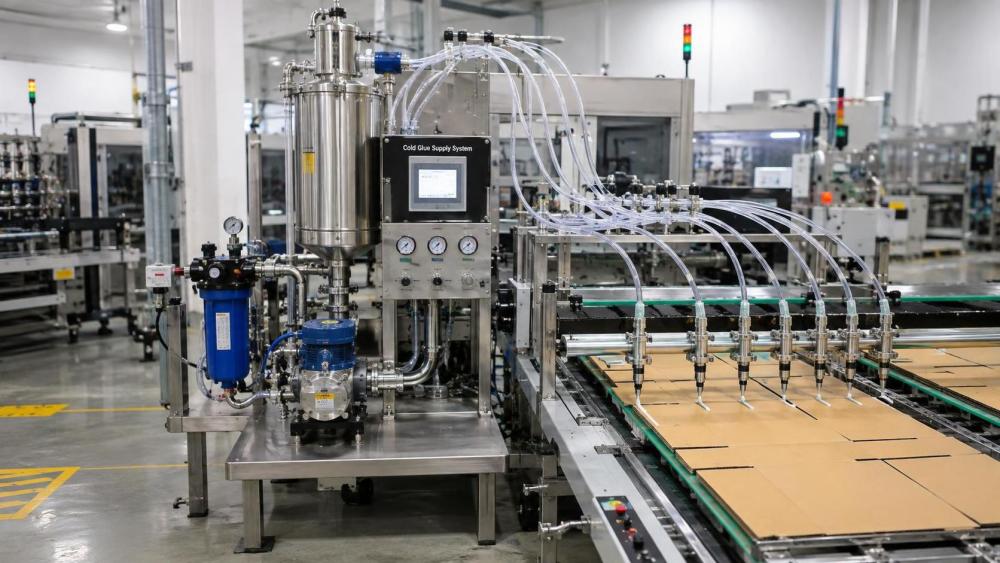
- Tank capacity, agitation, filtration, level monitoring, and adhesive conditioning features.
- Pump type and pressure capability, especially where long hose runs or several application points are involved.
- Hose length, heated or insulated components where required by the adhesive process, and the routing complexity of the production line.
- Manual, pneumatic, or servo-controlled applicator adjustment.
- Pattern control, encoder integration, sensors, recipe storage, and connection to the host machine control system.
- Stainless steel or chemically resistant wetted parts suited to the planned adhesive family and cleaning chemistry.
- Installation, commissioning, operator training, spare parts packages, and local technical support.
Quotations should separate these elements where possible. A package price makes budgeting easier, but it can hide important assumptions: whether integration is included, whether all heads are independently controllable, whether adhesive supply equipment is sized for peak output, and whether the supplier has allowed for the plant’s actual line layout.
Application Accuracy Often Determines the Cost Curve
Adhesive consumption is frequently treated as a material purchasing issue. It is also an equipment performance issue. Excess glue can cause squeeze-out, staining, longer setting time, warped paperboard, poor stacking behavior, and contamination of belts or guides. Too little glue may create open seams, weak bonds, delamination, or failures later in distribution. Both outcomes create cost beyond the adhesive itself.
For this reason, the cheapest system is not automatically the one with the lowest adhesive delivery capacity. It is the system that can hold a repeatable application level at production conditions. A buyer should ask how the supplier’s configuration manages variation caused by changes in speed, substrate thickness, board flatness, adhesive viscosity, ambient temperature, and start-stop operation.
On a corrugated packaging line, board surface variation can be significant. Warp, flute profile, liner quality, dust, and moisture condition all affect contact between the glue applicator and substrate. A setting that performs well on one board grade may not transfer cleanly to another. For folding cartons, the practical challenge may be narrower glue lines, coated surfaces, complex folds, or high-speed compression sections. The correct system design depends on where the bonding risk sits in the process.
Buyers should therefore avoid comparing quoted glue consumption targets without understanding the test conditions behind them. A nominal application weight is useful only when tied to a defined substrate, line speed, glue pattern, adhesive type, and bond requirement. It should not be treated as a universal operating promise.
Why Adhesive Compatibility Cannot Be Left Until Commissioning
Cold glue systems are commonly used with water-based adhesives, including formulations selected for paper, corrugated board, coated board, labels, and various converting applications. Yet “water-based” does not guarantee that every adhesive will behave the same way in the same delivery system. Viscosity, solids content, tack development, open time, shear sensitivity, foaming tendency, and drying behavior can alter how the glue pumps, transfers, and cleans.
The purchasing team does not need to become an adhesive laboratory, but it should establish a clear operating envelope before issuing a final specification. That envelope should cover the adhesive families expected to be used, the lowest and highest practical viscosity range, ambient plant conditions, planned storage approach, and the required cleaning routine. If the plant purchases adhesives from multiple sources, that should be discussed early. A system optimized around one formulation may require different settings, components, or maintenance practices when another formulation is introduced.
Compatibility has a long-term cost effect in several ways. Inadequate filtration can lead to blocked nozzles or inconsistent flow. Poor agitation or unsuitable tank design can affect adhesive uniformity. Components that are difficult to flush may increase cleaning labor and make a rapid product change less realistic. Materials of construction also matter, particularly where cleaning agents or specialized adhesive additives are used.
A supplier should be able to explain the boundaries of the proposed system: which adhesive characteristics it is designed to handle, what preventive cleaning is expected, and which process changes would require reconfiguration. Vague assurances that a unit “works with all cold glues” are less useful than a defined compatibility statement.
Production Speed Has Value Only When the Glue Process Keeps Up
System capacity should be assessed against the line’s usable output, not only its maximum mechanical speed. A folder gluer, corrugated converting machine, or automated assembly line may have a high nameplate speed, but the glue system must maintain stable placement during acceleration, deceleration, job changes, and routine operating variation. A unit that performs acceptably only at a narrow speed range can limit the value of the host machine.
This is especially relevant where plants run a mix of short and long orders. Long, repetitive production runs may justify a simpler setup if the glue pattern changes infrequently. Short-run work places more value on recipe recall, fast mechanical adjustment, clear operator interfaces, and the ability to verify settings without extensive trial material. The premium for automation should be assessed against the order profile, rather than assumed to be either essential or unnecessary.
There is also a practical distinction between fast adjustment and stable adjustment. A system may allow an operator to change a glue pattern quickly, yet still require several machine cycles and repeated checks before it is running consistently. Procurement specifications should include the expected job-change process: what must be changed manually, which parameters can be stored, how heads are positioned, and how the first acceptable product is confirmed.
Maintenance and Downtime Are Part of the Purchase Decision
Cold glue equipment is often seen as a secondary subsystem because it occupies relatively little space compared with a press, corrugator, die-cutter, or folder gluer. That can lead to under-specification. When adhesive delivery becomes unstable, however, the entire line may need to slow down or stop while operators clean a head, purge a hose, correct a pattern, or investigate a bond issue.
The relevant maintenance question is not whether a system requires maintenance. Every adhesive system does. The question is whether routine work is predictable, accessible, and proportionate to the operating schedule. Procurement teams should ask to see the normal daily, weekly, and periodic maintenance tasks. They should also identify the parts most likely to require replacement and whether those parts are locally available.
Access is a design issue, not a convenience feature. Tanks located where they are difficult to refill or clean create unnecessary labor. Applicators mounted without adequate service space make routine inspection slower. Hoses routed through congested machine areas may complicate fault finding and increase the risk of accidental damage. These details should be reviewed against the actual installation layout before placing an order.
Support arrangements deserve the same scrutiny. A supplier with a technically sound system may still be a poor fit if spare parts, remote diagnostics, service documentation, or commissioning support are weak in the buyer’s region. Buyers should establish which faults can be handled by plant maintenance personnel, which require supplier intervention, and what information will be available to diagnose a recurring issue.
Build the Evaluation Around Total Cost per Good Carton or Box
Comparing capital expenditure alone encourages the wrong trade-off. The useful comparison is the expected cost of producing acceptable finished packs over the planned life of the equipment. That calculation does not require artificial precision. It does require the purchasing, production, maintenance, and quality teams to agree on the cost categories that are most sensitive in their own operation.
These usually include adhesive consumption, cleaning materials, operator time, setup waste, rejected product, maintenance parts, energy used by associated pumps or controls, and lost output during glue-related stops. In a plant with tight delivery schedules, disruption cost may matter more than a small difference in adhesive price. In a low-volume operation, a highly automated configuration may not recover its premium if simple manual adjustment is adequate.
A practical request-for-quotation should ask suppliers to state the assumptions behind their proposal. Include line speed range, product dimensions, substrate types, glue patterns, number of changeovers, adhesive characteristics, installation constraints, and required interfaces. Ask them to identify exclusions and optional elements separately. This makes it easier to compare competing offers without assuming that systems with similar descriptions provide the same operating capability.
Before final selection, procurement should also involve the people who will own the daily consequences of the decision: operators, maintenance technicians, process engineers, and quality staff. Their input often reveals requirements that a financial comparison misses, such as cleaning access, tolerance for board variation, ease of fault recovery, or the need to retain settings for recurring jobs.
A Better Buying Question Than “Which System Is Cheapest?”
The most useful buying question is: what level of glue control is required to produce the planned mix of work with acceptable waste and interruption? Once that is defined, the price range becomes easier to interpret. A basic system may be the soundest investment for consistent products and uncomplicated bonding. A more capable system can justify its higher purchase cost where accuracy, changeover speed, traceability, or production continuity carry material value.
Cold glue system price should therefore be treated as a combination of equipment scope, process risk, and operating discipline. Buyers who specify the real production conditions, test the assumptions behind adhesive use, and examine maintenance access before ordering are in a stronger position to avoid paying twice: once for equipment and again through avoidable waste and downtime.
Related News
 How to Choose a Glue Dispensing System Manufacturer for Your LineChoose a glue dispensing system manufacturer with confidence. Compare adhesive compatibility, line integration, testing, and lifecycle costs to find the right fit for your production line.Spatial Folding Strategist
 How to Fix Weak Glue Bonds on Carton Folder Gluers at High SpeedsCarton Folder Gluers losing bond strength at high speeds? Learn how to optimize glue placement, adhesive selection, and compression to reduce rejects and keep production running reliably.Spatial Folding Strategist
 How Window Patching Machines Apply Film to Folding Carton WindowsDiscover how Window Patching Machines apply film to folding cartons. Learn key controls for precise placement, strong bonds, and fewer rejects before choosing your equipment.Spatial Folding Strategist
 How Does a Crash Lock Pre Breaking Unit Improve Carton Folding?Discover how a crash lock pre breaking unit reduces crease resistance, improves carton folding consistency, and supports reliable opening—with practical setup tips to avoid board damage.Spatial Folding Strategist
 How a Folder Gluer Pre-Breaking Unit Improves Carton Fold QualityDiscover how a folder gluer pre breaking unit improves carton fold quality and reduces spring-back. Get practical setup tips for consistent seam alignment and smoother production.Spatial Folding Strategist
 How to Evaluate a Cold Glue System Manufacturer for Reliable BondingChoose a cold glue system manufacturer with proven application control, uptime-focused design, seamless integration, and responsive service for reliable bonding.Spatial Folding Strategist