How to Select a Precision Adhesive Application System for Cartons
Selecting a precision adhesive application system for cartons should begin with the carton, the adhesive, and the production profile, not with a dispenser catalogue. A system that performs well on long runs of one board grade may create excessive glue use, weak bonds, or difficult clean-up when the plant moves to coated folding cartons, recycled corrugated material, frequent order changes, or variable line speeds.
For a project manager, the practical question is whether the application system can place the required amount of adhesive in the required location, repeatedly, under normal production variation. Precision matters when glue appearance affects pack presentation, when adhesive reaches a narrow seam or a small tab, when material cost is sensitive, or when a missed bond can cause downstream failure. It matters less where broad, forgiving glue areas are used and carton geometry leaves substantial tolerance.
Start with the bonding task, not the equipment category
“Carton” covers several very different applications. Corrugated shipping cases may need controlled adhesive patterns on porous liners at high throughput. Folding cartons may require clean, narrow glue lines near printed or coated surfaces. Display packs, multi-point glued cartons, and specialty structures can introduce short panels, irregular flap positions, tight tolerances, and more complex folding paths.
Before comparing systems, define the actual bonding task for each priority product family:
- Carton material, including board grade, coating, recycled content, moisture variation, dust level, and surface treatment.
- Adhesive chemistry, such as cold glue, hot melt, water-based adhesive, or a specialty formulation required by the pack.
- Bond geometry: line, dot, swirl, intermittent pattern, broad bead, or multiple parallel tracks.
- Required adhesive position and acceptable placement tolerance.
- Minimum and maximum line speed, including acceleration, deceleration, and stop-start operation.
- Open time, set time, compression conditions, and the point at which the carton is handled after gluing.
- Job mix, expected changeover frequency, and the number of glue patterns required in a shift.
This exercise often changes the specification. A high-speed carton line may appear to require maximum pump capacity, yet its recurring problem may be unstable bead placement during speed changes. Another line may have adequate application accuracy but lose time because operators must manually reposition heads and purge adhesive during every order change.
A precision adhesive application system should therefore be evaluated as part of the forming, folding, and compression process. Adhesive performance cannot be separated from blank registration, folding accuracy, board condition, and the available compression time. Better dispensing alone will not resolve a poorly controlled carton path.
Match the application method to the adhesive and substrate
System selection becomes more reliable once the application method is tied to the behavior of the adhesive. Cold glue and water-based systems are commonly assessed for viscosity control, filtration, pump consistency, nozzle cleanliness, and resistance to drying at the application point. Hot-melt systems add temperature stability, melt capacity, hose and gun control, char management, and safe maintenance procedures to the decision.
For porous corrugated board, penetration can be helpful up to the point where too much adhesive weakens appearance, increases drying demand, or contributes to warp. For coated or printed cartonboard, surface wetting and bond development deserve closer attention. Adhesive may sit on the surface rather than penetrate, so a narrow and visually clean pattern can still fail if the chosen glue, application temperature, compression, and open time do not work together.
Do not assume that a finer nozzle automatically produces a better bond. Small nozzles can provide cleaner application and reduce glue consumption, but they may be less tolerant of adhesive contamination, viscosity drift, or infrequent cleaning. Likewise, a wider bead can offer greater positional tolerance, but may create squeeze-out, staining, longer set time, or unnecessary adhesive use.
Ask suppliers to demonstrate the proposed configuration with representative blanks and the intended adhesive. The demonstration should include normal production speeds as well as the conditions that create problems: line ramp-up, short blanks, frequent pattern changes, difficult surfaces, and the first cartons after a planned stop. A trial limited to a stable, uninterrupted run can hide the operating issues that drive reject rates later.
Define precision in measurable operating terms
“Precision” is often discussed as a machine feature, but the project team should convert it into operating acceptance criteria. A specification that simply asks for accurate adhesive application leaves too much room for interpretation.
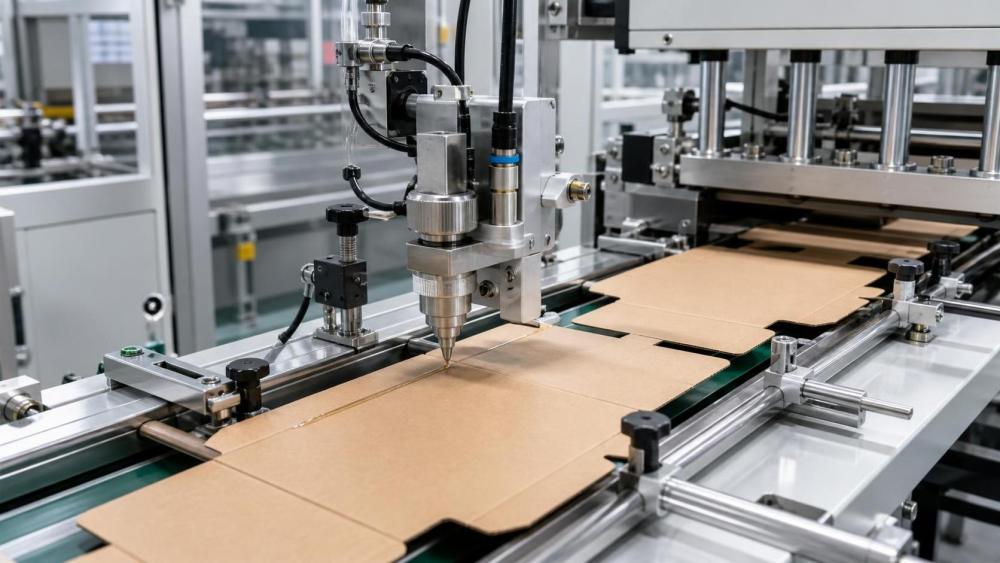
Useful criteria may include repeatable bead position relative to the carton edge or score line, consistency of bead length, reliable start and stop points, acceptable adhesive weight or volume variation, and a defined rate of missed or unintended application. The appropriate values depend on the carton design and adhesive process; they should be based on what the package can tolerate rather than on an arbitrary system claim.
The interface between adhesive control and carton transport deserves particular scrutiny. Encoder-based timing, carton detection, and programmable application patterns can improve repeatability, but their value depends on stable signals and correct installation. Sensor location, blank spacing, conveyor slip, registration drift, and dust contamination can all affect the final glue position.
Assess changeovers as a production-cost issue
In plants with long, repetitive runs, a robust fixed-head configuration may be commercially sensible. In a mixed-order operation, the same configuration can become a constraint if each new carton size or glue pattern requires lengthy manual adjustments. The system’s changeover design should be evaluated against actual order behavior, not average annual volume alone.
Look for the practical sequence required to move from one job to another. Can operators call up adhesive recipes? Are head positions adjustable with repeatable references? Does a pattern change require an adhesive purge? How much product must be discarded while the system stabilizes? Can a new job be checked quickly without holding the entire line?
Automation is valuable where it removes recurring sources of variation. Recipe management can reduce dependence on individual operator memory. Servo positioning can help when several applicators must move with carton size changes. Integrated controls can coordinate adhesive timing with upstream printing, die-cutting, or folding equipment. Yet additional automation also adds sensors, drives, software settings, and service requirements. A lightly automated system with clear mechanical references may be more appropriate for a narrow product range than a highly configurable platform that the plant cannot maintain consistently.
Do not evaluate glue savings in isolation
Lower adhesive consumption is a legitimate objective, but it should be tested against bond security and total operating cost. Reducing bead width or application volume can produce attractive consumption figures while narrowing the process window. Board variation, minor registration shifts, or colder production conditions may then create intermittent bonding failures that cost more than the saved adhesive.
A stronger business case combines several effects: adhesive use, carton rejects, rework, cleanup time, line stoppages, start-up waste, maintenance labor, spare parts, energy demand, and the cost of a pack failure after shipment. Project teams should compare these factors over the expected operating life of the line, with assumptions visible to production, maintenance, and quality stakeholders.
It is also useful to separate controllable waste from process allowance. Some adhesive loss is inherent in flushing, warm-up, cleaning, and changeover. The target is not zero loss; it is a stable process where waste is understood, monitored, and not masked by over-application during normal production.
Plan inspection and fault response before commissioning
A precision system is only as useful as the plant’s ability to detect when it falls outside specification. For higher-risk cartons, especially where bond failure affects product containment, automated verification may be justified. Depending on the application, this can involve glue presence detection, pattern monitoring, vision inspection, or downstream carton integrity checks.
The inspection choice should follow the failure mode. A sensor that confirms adhesive was dispensed may not prove that the bead was correctly positioned. A camera can assess placement but may require careful lighting, cleaning, recipe management, and integration with the line’s reject logic. Inspection should not create a false sense of control; its detection capability must match the defects that matter.
Define the response as well. When a fault occurs, should the line stop, reject affected cartons, alert an operator, or shift to a controlled reduced-speed mode? The correct answer depends on carton value, downstream handling, and how easily affected units can be isolated. Clear fault ownership and accessible diagnostics are often more important to uptime than a long feature list.
Use the factory acceptance process to test real boundaries
The final selection should be supported by an acceptance plan that reflects production reality. Include representative carton styles, the intended adhesive grades, expected operating speeds, and defined checks for bond integrity and pattern placement. Test a reasonable range of board condition and job changes where those variables are common in the plant.
For project managers, the most useful supplier discussion is not “What is the most precise system available?” It is “What configuration will hold our required bond standard across our expected materials, speeds, and changeovers, and how will we prove it before handover?” That framing keeps the decision connected to output quality, operating discipline, and the cost of sustaining performance after commissioning.
A suitable precision adhesive application system is one that gives the carton line a dependable process window, not merely a narrow bead in an ideal demonstration. When substrate variation, adhesive behavior, transport control, changeover demands, and verification are specified together, the investment is far more likely to deliver consistent cartons at the pace the operation actually needs.
Related News
 How to Choose a Glue Dispensing System Manufacturer for Your LineChoose a glue dispensing system manufacturer with confidence. Compare adhesive compatibility, line integration, testing, and lifecycle costs to find the right fit for your production line.Spatial Folding Strategist
 How to Fix Weak Glue Bonds on Carton Folder Gluers at High SpeedsCarton Folder Gluers losing bond strength at high speeds? Learn how to optimize glue placement, adhesive selection, and compression to reduce rejects and keep production running reliably.Spatial Folding Strategist
 How Window Patching Machines Apply Film to Folding Carton WindowsDiscover how Window Patching Machines apply film to folding cartons. Learn key controls for precise placement, strong bonds, and fewer rejects before choosing your equipment.Spatial Folding Strategist
 How Does a Crash Lock Pre Breaking Unit Improve Carton Folding?Discover how a crash lock pre breaking unit reduces crease resistance, improves carton folding consistency, and supports reliable opening—with practical setup tips to avoid board damage.Spatial Folding Strategist
 How a Folder Gluer Pre-Breaking Unit Improves Carton Fold QualityDiscover how a folder gluer pre breaking unit improves carton fold quality and reduces spring-back. Get practical setup tips for consistent seam alignment and smoother production.Spatial Folding Strategist
 How to Evaluate a Cold Glue System Manufacturer for Reliable BondingChoose a cold glue system manufacturer with proven application control, uptime-focused design, seamless integration, and responsive service for reliable bonding.Spatial Folding Strategist