How to Choose a Glue Dispensing System Manufacturer for Your Line
A folder gluer can run smoothly through a supplier demonstration and still struggle with your cartons. A different board coating, a shorter compression section, or frequent stops may expose problems that never appeared during the trial. Choosing a glue dispensing system manufacturer therefore means looking beyond purchase price and asking whether the proposed system can produce reliable bonds under your actual production conditions.
For procurement teams, the challenge is turning competing specifications into a defensible decision. Adhesive compatibility, application consistency, line integration, maintenance access, and service coverage all matter—but only when evaluated against the same operating requirements. The most useful comparison starts with your packaging process, not the supplier’s equipment catalog.
Define the bonding task before requesting quotations
“A glue system for a packaging line” is not a complete specification. A folding-carton side seam, a corrugated case closure, and a specialty display assembly place different demands on adhesive delivery, timing, and compression. Even within one plant, a single equipment configuration may not suit every application.
Prepare a short application brief with production, maintenance, and quality personnel before approaching suppliers. Include:
- Substrates: board grades, recycled content where relevant, coatings, varnishes, laminates, and the surfaces being bonded.
- Product range: carton dimensions, flap geometry, glue locations, and the smallest and largest formats.
- Production conditions: normal and peak speeds, product pitch, shift patterns, stop frequency, and changeover frequency.
- Bond requirements: handling strength at discharge, final bond expectations, appearance limits, and customer-specific test requirements.
- Existing equipment: line make and model, available installation space, controls, utilities, and compression arrangements.
Include troublesome jobs, not just your highest-volume product. If glossy cartons cause intermittent bonding failures or short runs create excessive cleaning work, those details should shape the proposal. Otherwise, suppliers may quote a system that meets the easy conditions while leaving your real constraints unresolved.
Match the adhesive technology to the process
A credible manufacturer should explain why its recommended dispensing method suits your substrates and production sequence. It should also identify limitations. A supplier that recommends the same arrangement for every application deserves closer questioning.
This distinction matters in corrugated packaging procurement. A starch application system on a corrugator is not interchangeable with the glue dispensing equipment used on a folder gluer. Similar purchasing terminology can conceal fundamentally different engineering requirements.
Confirm adhesive compatibility with both the equipment manufacturer and the adhesive supplier. For food-related packaging, request documentation relevant to the intended use; equipment selection alone does not establish compliance of the finished package.
Read dispensing specifications in the context of your line
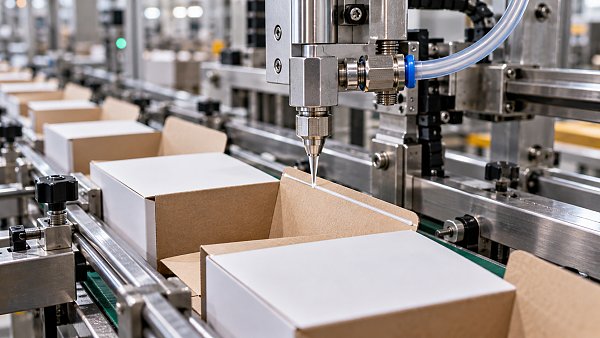
Maximum output and valve response time are useful specifications, but neither tells you whether glue will land correctly on a moving carton. Position accuracy also depends on product sensing, encoder signals, controller behavior, applicator placement, and sheet transport stability.
Ask the glue dispensing system manufacturer to distinguish between adhesive delivery consistency, pattern placement accuracy, and finished bond quality. These are related, but they are not interchangeable. A consistent bead can still be misplaced, and a correctly positioned bead can fail if compression or adhesive selection is unsuitable.
Test speed transitions—not only steady running
Packaging lines accelerate, slow down, pause, and restart. The proposed system should demonstrate how it maintains pattern position and adjusts adhesive delivery across that operating range. Clarify whether flow compensation is automatic, how it is controlled, and what happens below the validated operating speed.
For hot-melt systems, compare usable melt capacity with expected adhesive consumption and replenishment conditions, rather than tank size alone. For water-based systems, examine pressure stability, filtration, and the effect of viscosity changes. In both cases, ask how nozzle contamination, dripping, stringing, or missed applications are detected and addressed.
Also check the distance between glue application and compression. Adhesive open time must fit the actual travel time, while the compression section must provide suitable contact conditions. A larger dispensing unit will not resolve a fundamentally mismatched bonding process.
Make integration responsibility visible
A quotation may cover the supply unit, controller, hoses, and applicators while excluding the work that makes them function as part of the line. That gap often becomes visible only during installation, when production is already waiting.
Request a layout showing applicator positions, mounting arrangements, hose routing, sensor locations, operator access, and service clearances. The drawing should make it possible to judge whether technicians can remove a filter or service a valve without dismantling surrounding equipment.
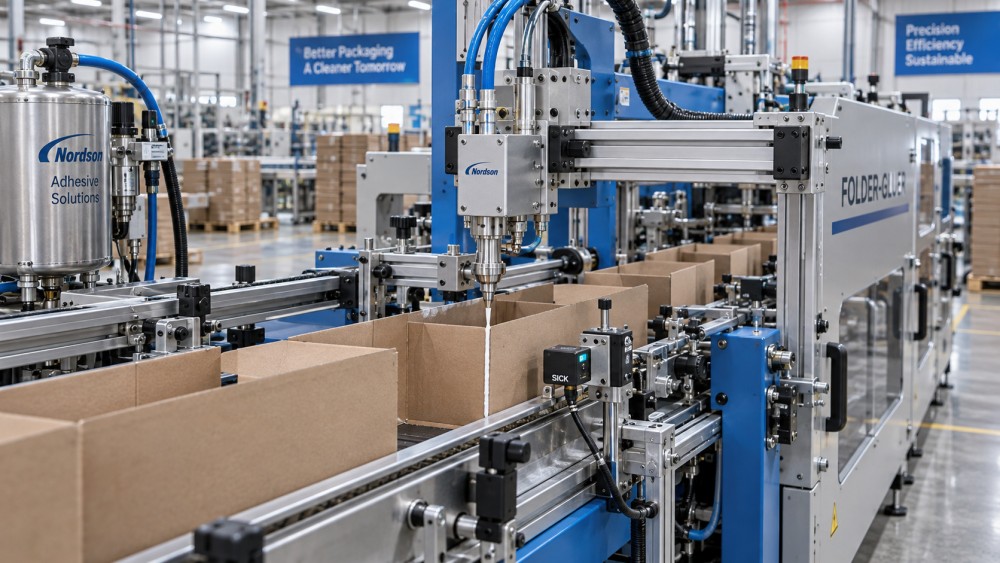
The commercial scope should identify who is responsible for:
- Mechanical installation, brackets, guarding, and access provisions.
- Electrical connections, compressed air, and other required utilities.
- Encoder and product-sensor signals, machine permissives, and relevant interlocks.
- Recipe selection, job recall, line-control communication, and data access where required.
- Glue inspection, reject tracking, and confirmation that defective products are removed.
Do not treat a glue-presence signal as proof of a good bond. Depending on the inspection technology, it may detect missing adhesive or an incorrect pattern without confirming adhesion after compression. Define what the inspection system can detect, what it cannot detect, and how quality checks will cover the remaining risks.
For retrofits, involve the existing machine supplier or a qualified integrator early. Safety-related modifications and control changes need clear ownership, not an assumption that one supplier will resolve another supplier’s interface.
Ask each manufacturer to prove the same operating conditions
A polished demonstration is useful, but a controlled acceptance trial is more valuable. Give shortlisted suppliers the same representative materials and a written test plan. Include difficult substrates, format extremes, frequent pattern changes, and realistic stop-start operation.
Where practical, use your intended production adhesive. If the supplier substitutes another material, record the difference and require validation before final acceptance.
Agree on measurable acceptance criteria
The test plan should define acceptable glue location, pattern dimensions, application consistency, bond performance, and visible contamination. Specify the measurement method, sample frequency, conditioning time for bond testing, and operating conditions. Avoid vague acceptance language such as “good glue quality at high speed.”
Separate factory acceptance testing from site acceptance testing. A factory trial can verify the supplied equipment under agreed conditions; the site trial must confirm performance with the installed line, local utilities, actual materials, and normal operators.
Include changeover and maintenance demonstrations. Ask an operator to recall a job, adjust a pattern, complete the recommended cleaning procedure, and restart production. Record the time and assistance required. This often reveals more about day-to-day usability than a long feature list.
Compare cost per accepted package, not equipment price alone
The lowest quotation may exclude inspection, installation, training, or essential spare parts. A higher-priced offer may include those items—or may simply carry a higher price. Normalize the scope before drawing conclusions.
Build a lifecycle comparison using your plant’s expected production volume and operating assumptions. Include:
- Installed cost: equipment, integration, commissioning, training, and initial spares.
- Operating cost: adhesive consumption, energy, compressed air where used, cleaning materials, and routine consumables.
- Maintenance cost: planned service labor, replacement components, and specialist support.
- Production losses: startup scrap, changeover waste, rejected packaging, and downtime attributable to dispensing faults.
Adhesive savings should come from a validated application pattern, not simply a smaller bead. Reducing consumption beyond the process’s reliable bonding window can turn a visible saving into downstream rework or customer complaints.
Use trial results where available and label estimates clearly. If a supplier claims lower adhesive use or faster cleaning, request the test conditions and check whether they resemble your production mix. Model uncertain costs as a range rather than presenting a precise payback figure built on weak assumptions.
Evaluate the manufacturer behind the equipment
Technical fit is only part of supplier qualification. Procurement teams also need to understand who designs the system, who manufactures critical components, and who will support it locally. A distributor can provide strong support, but the division of responsibility should be explicit.
Ask for references involving comparable substrates, adhesive types, line speeds, and integration complexity. During reference discussions, focus on recurring faults, spare-parts availability, commissioning experience, and support after the warranty period—not just whether the equipment runs.
Request a recommended spare-parts list with lead times and identify components whose failure would stop production. Confirm warranty exclusions, service coverage hours, remote-access arrangements, software backup procedures, and availability of manuals and electrical drawings. “Local service” should mean an identifiable service capability, not merely a regional sales contact.
Operator safety also belongs in the evaluation. Review hot surfaces, pressurized adhesive circuits, isolation procedures, and safe maintenance access as applicable. Ask what documentation supports the requirements of your installation location, without assuming that one certificate covers the entire integrated line.
Make the final decision with gates, then a scorecard
Use mandatory qualification gates before weighted scoring. A supplier that cannot demonstrate adhesive compatibility, meet agreed acceptance conditions, or provide a workable integration plan should not win because its price score compensates for those gaps.
Among qualified offers, weight process performance, integration, lifecycle cost, maintainability, and service according to your plant’s priorities. A multi-shift carton factory may place greater emphasis on recovery time and spare-parts access; a short-run converter may prioritize repeatable job recall and low-waste changeovers.
The strongest choice is the glue dispensing system manufacturer that can explain its design, demonstrate it on representative work, and commit to a clear delivery and support scope. Before issuing the purchase order, attach the agreed application brief, test protocol, responsibility matrix, and acceptance criteria. Those documents turn a promising quotation into a purchase your production team can rely on.
Related News
 How to Prevent Clogs in a High Temperature Hot Melt Glue GunPrevent high temperature hot melt glue gun clogs with practical tips on adhesive selection, safe cleaning, and maintenance to keep work flowing.Spatial Folding Strategist
 What Factors Affect the Price of a Corona Treater?Discover what affects corona treater price, from treatment width and power to installation costs. Compare quotes and choose the right system for your production line.Spatial Folding Strategist
 What to Ask a Plasma Treater Manufacturer About Surface AdhesionChoosing a plasma treater manufacturer? Ask these essential questions about adhesion testing, line integration, maintenance, and production reliability before you buy.Spatial Folding Strategist
 How to Prevent Clogging in a Precision Glue Nozzle During ProductionPrevent precision glue nozzle clogs with proven filtration, cleaning, and shutdown practices. Discover practical steps to reduce downtime and keep packaging bonds strong.Spatial Folding Strategist
 How to Adjust Compression Sections to Prevent Carton Seams OpeningAdjust Compression Sections to prevent carton seams from opening. Learn how to balance pressure, dwell time, and alignment for stronger bonds, less board damage, and fewer rejects.Spatial Folding Strategist
 How a Precision Adhesive Application System Reduces Glue WasteDiscover how a precision adhesive application system can reduce glue waste, protect bond strength, and lower packaging costs. Explore practical controls and ROI checks before you invest.Spatial Folding Strategist