Choosing a gift box making machine manufacturer requires more than comparing quotations and advertised speeds. Your decision should depend on verified production performance.
For procurement teams, the real challenge is confirming whether a supplier can deliver consistent box quality, reliable output, and responsive support under actual operating conditions.
Before committing, request evidence of manufacturing capability, material compatibility, changeover efficiency, and operating costs. A polished demonstration alone cannot establish whether equipment fits your factory.
This guide explains how to assess technical proposals, validate sample runs, check customer references, and review service commitments before making a machinery investment.
Start by Defining the Boxes You Actually Need to Produce
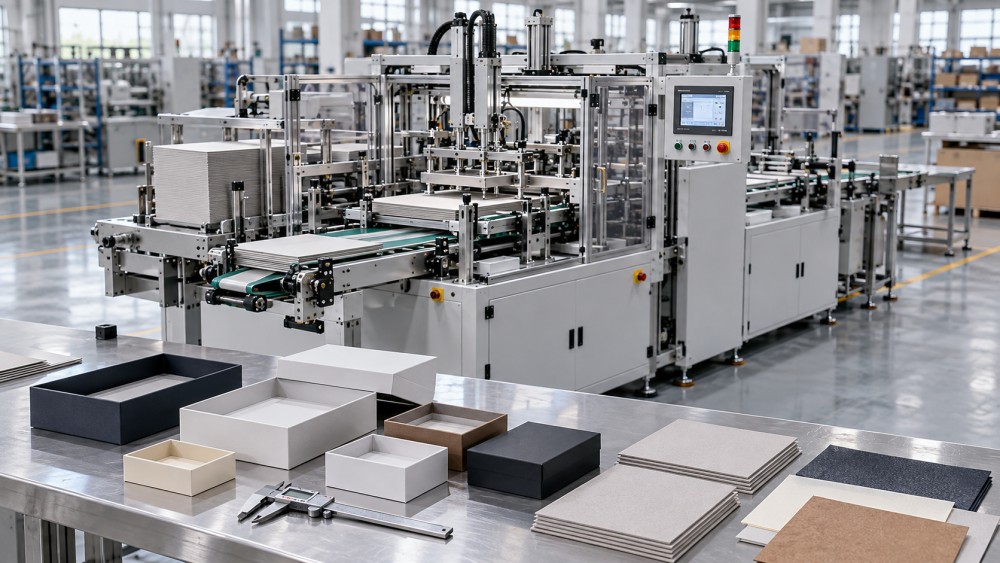
A useful supplier assessment starts with your production requirements. Without a shared specification, competing quotations may describe substantially different equipment, automation levels, and process boundaries.
Clarify whether you produce rigid setup boxes, folding cartons, magnetic closure boxes, drawer boxes, or another construction. These formats may require different machinery configurations.
For rigid gift boxes, establish whether the proposed system includes board grooving, corner pasting, paper positioning, wrapping, forming, and pressing, or only selected operations.
Also identify processes outside the quoted scope, including printing, die cutting, magnet insertion, ribbon fitting, lining, and final assembly. These omissions can change project economics.
Build a representative product matrix covering box dimensions, board thickness, covering paper, finishes, order quantities, and quality expectations. Include difficult products alongside your bestselling formats.
Give every shortlisted supplier the same matrix. Require a written response distinguishing standard capability, optional equipment, application restrictions, and any operations requiring manual assistance.
Can the Manufacturer Prove It Builds and Supports the Proposed Machine?
Establish which legal entity will sign the contract, manufacture the equipment, receive payment, and provide warranty service. Different entities require clearly allocated responsibilities.
A distributor can be a suitable supplier when its technical responsibilities are clear. Procurement risk increases when manufacturing ownership and service obligations remain ambiguous.
During a factory visit or live video inspection, examine assembly areas, component storage, inspection stations, and machines under construction. Ask to see the quoted model.
Request records showing how the supplier checks mechanical assembly, electrical wiring, positioning accuracy, and final operation. Certificates alone do not demonstrate consistent production control.
Review the proposed component list for controllers, servo drives, sensors, pneumatic parts, and adhesive systems. Confirm exact specifications and procedures for approving substitutions.
Ask who owns the control software, whether backups are supplied, and how access is restored after controller failure. Unclear arrangements can prolong future downtime.
Make the Sample Trial Reproduce Your Production Risks
The strongest evidence comes from a controlled trial using your box designs and representative materials. Supplier samples may conceal limitations relevant to your work.
Send enough board, covering paper, and other consumables for setup and sustained operation. Identify material batches so results can be traced to actual inputs.
Include challenging combinations such as thin covering paper, textured surfaces, laminated sheets, deep boxes, and products near the machine’s stated dimensional limits where relevant.
Agree on the trial method before testing. Define when measurement starts, how rejects are recorded, and which adjustments or interventions must appear in the report.
Measure finished boxes against approved drawings and reference samples. Check dimensions, squareness, corner appearance, wrapping alignment, adhesion, surface marking, and lid fit where applicable.
Inspect samples after an agreed conditioning period when adhesive curing or material relaxation could affect results. Immediate appearance may not reveal later lifting or distortion.
Compare Saleable Output, Staffing, and Changeovers Together
Advertised maximum speed rarely tells you how many acceptable boxes a shift will deliver. Box construction, material behavior, replenishment, and stoppages influence practical output.
Ask the manufacturer to distinguish mechanical cycle speed from sustained production output. Clarify whether quoted figures refer to individual components, box bases, or complete sets.
For boxes with separate lids and bases, verify how both parts will be produced and balanced. A fast single component process may leave assembly waiting.
Observe a complete job change, including tooling, guides, recipes, adhesive adjustments, trial pieces, and quality approval. Timing only the mechanical adjustment understates production disruption.
Have your intended operators participate when possible. Their experience helps reveal difficult access, confusing controls, excessive lifting, and adjustments dependent on specialist knowledge alone.
Use measured output, actual staffing, and expected job frequency in capacity planning. Avoid adding separate efficiency deductions when the measured trial already includes those losses.
Check Whether the Machine Fits Your Factory and Material Supply
A machine can perform well at the supplier’s site yet struggle after installation because utilities, ambient conditions, material consistency, or production layout differ substantially.
Request a site preparation document covering electrical supply, compressed air, extraction where needed, access clearances, floor requirements, machine dimensions, and maintenance working space.
Confirm whether compressors, adhesive preparation equipment, cooling devices, conveyors, and lifting aids are included. Auxiliary equipment can affect both installation budgets and daily operating costs.
Discuss board flatness, thickness variation, paper grain direction, surface treatments, and adhesive requirements. Ask the supplier to document material restrictions demonstrated during your trial.
Review guarding, interlocks, emergency stops, electrical documentation, and applicable local machinery requirements. Establish who supplies the evidence and completes any required conformity work.
If production data integration matters, specify required signals, interfaces, licensing, and access rights. A general promise of connectivity does not establish usable factory integration.
Calculate Total Cost per Accepted Box
Compare suppliers using a consistent ownership period and production scenario. Purchase price becomes meaningful only when evaluated alongside output, labor, materials, maintenance, and installation.
Include freight, insurance, applicable duties, rigging, utilities, commissioning, training, tooling, consumables, spare parts, and software charges. State assumptions explicitly to prevent misleading comparisons.
Estimate operating costs using your expected product mix. Short orders may make setup waste and changeover labor more significant than small differences in running speed.
Request energy and compressed air consumption under stated operating conditions. Installed electrical power is useful for infrastructure planning but does not equal actual energy consumption.
Calculate ownership cost per accepted box by dividing agreed period costs by expected saleable production. Use consistent accounting assumptions and avoid counting depreciation alongside purchase expenditure.
Test a conservative scenario with lower utilization, higher waste, or delayed commissioning. The preferred proposal should remain commercially credible when production differs from forecasts.
Verify Service Promises with Documents and Customer References
Service quality matters most when production stops. Ask who diagnoses faults, where technicians are based, and what support is available during your operating hours.
Distinguish an initial response commitment from a repair commitment. A quick acknowledgment offers limited value if diagnosis, parts dispatch, or technician attendance remains undefined.
Request a recommended spare parts list with prices, stock locations, and indicative delivery times. Identify proprietary components that could create extended dependence on the supplier.
Review warranty coverage for parts, labor, travel, shipping, and remote assistance. Confirm when coverage starts and how disputes over materials or operator error are handled.
Speak with customers running similar boxes, materials, and shift patterns. Ask about recurring faults, actual staffing, changeover experience, parts availability, and support after installation.
Seek specific examples rather than general satisfaction scores. A reference describing a recent breakdown and its resolution provides stronger evidence than an unqualified endorsement.
Turn Demonstrated Performance into Contractual Acceptance Criteria
Before ordering, convert important technical promises into a signed specification. Attach the product matrix, configuration, approved materials, trial method, and required documentation to the agreement.
Define a factory acceptance test before shipment and a site acceptance test after installation. Explain which conditions each test verifies and who records results.
Set measurable requirements for quality, saleable output, staffing, and changeover performance on agreed products. Avoid universal guarantees that ignore differences between box constructions.
Specify how failed tests trigger corrective work and retesting. Align payment milestones with verifiable deliverables, subject to terms negotiated for the project and jurisdiction.
- Identify included tooling, accessories, software access, manuals, drawings, and training deliverables.
- Document installation responsibilities, site readiness requirements, and commissioning schedules.
- Require written approval before changes to agreed components or machine configuration.
- Define acceptance records, unresolved defect handling, and the warranty commencement date.
Use a weighted supplier scorecard, but establish mandatory qualification gates first. Strong pricing should not offset an inability to meet essential product or safety requirements.
Weight the remaining criteria according to your operation. Frequent short orders justify greater emphasis on changeovers, while continuous production increases the importance of uptime.
Choose the Supplier Whose Claims You Can Verify
The right gift box making machine manufacturer should demonstrate acceptable results on your products, explain application limits clearly, and commit to practical support arrangements.
Base the final decision on documented trials, credible customer references, transparent ownership costs, and enforceable acceptance terms. These establish a stronger purchasing case than headline specifications.
If critical evidence remains missing, resolve the gap before placing the order. Procurement succeeds when promised capability becomes repeatable production performance in your own factory.