How Inline Plasma Treatment Systems Improve Cold Glue Bond Strength
For packaging quality and safety teams, a glue failure is rarely “just a glue failure.” A carton that opens during filling, a corrugated shipper with lifting flaps, or a sleeve that separates in distribution can trigger rework, rejected loads, traceability questions, and difficult conversations with customers. The adhesive may be blamed first, yet the root cause is often the surface receiving the glue.
Films, coated papers, varnished board, recycled corrugated substrates, and certain water-resistant coatings can all present a low-energy or contaminated surface. Cold glue may bead up instead of wetting the substrate, producing a bond that looks acceptable at the folder gluer but loses strength after compression, storage, humidity exposure, or handling. An inline plasma treatment system addresses this problem at the point of production by preparing the bonding area immediately before adhesive application.
For converters working with fast-moving, mixed-material packaging, plasma is not a replacement for good glue selection or disciplined machine setup. It is a controlled surface-preparation step that can make those existing controls more reliable. Understanding where it fits—and where it does not—helps quality and safety teams make more defensible decisions.
Cold glue performance begins with wetting, not curing
Cold glue is widely used in carton converting, corrugated packaging, paper bags, labels, sleeves, and display assembly because it is familiar, economical, and compatible with many paper-based production processes. Depending on the application, the adhesive may be based on starch, dextrin, polyvinyl acetate (PVA), or other water-based chemistries. Its bond development depends on several connected events: correct application volume, contact pressure, penetration or anchoring into the substrate, moisture balance, open time, and final drying conditions.
Before any of that can happen consistently, the adhesive must spread across the surface. This is known as wetting. When a glue bead spreads evenly, it creates a larger and more uniform contact area. When it retracts into droplets or skips over parts of the substrate, the bonded area becomes discontinuous. The line may still run, but the package now carries hidden variability.
Surface energy is central to this behavior. In simple terms, a higher-energy surface is easier for a liquid adhesive to wet. A low-energy surface resists the adhesive, much as water beads on a waxed surface. Packaging substrates increasingly create this challenge: coated board may contain hydrophobic binders; printed areas may carry ink additives or overprint varnish; recycled fibers can vary from batch to batch; and films used for windows, laminations, or specialty packs often require activation before bonding.
Cold glue formulations have their own surface-tension characteristics, so no single surface-energy number guarantees bond success. Still, the relationship is practical: if the substrate surface has insufficient or unstable energy relative to the adhesive, operators are more likely to see poor spread, weak edge bonds, variable peel results, and an increased need to compensate with excess glue.
What an inline plasma treatment system changes
An inline plasma treatment system generates an energized gas at atmospheric pressure and directs it onto the material surface as it travels through the machine. The treatment can remove or break down light organic contamination and modify the outermost molecular layer of the substrate. In many cases, it introduces polar functional groups that make the surface more receptive to water-based adhesive.
The effect occurs only at the surface; it does not mean the board, paper, or film has been bulk-heated or chemically coated. That distinction matters in packaging converting, where material stiffness, print appearance, food-contact compliance responsibilities, and downstream process behavior must remain controlled.
Placed inline, the plasma head treats the exact area that will receive glue—such as a carton side seam, a lock-bottom panel, a corrugated flap, or a window-patching bonding zone—just before the adhesive station. This short interval is valuable because surface activation can diminish over time. If treated blanks sit for hours or days before gluing, airborne contamination and molecular reorientation may reduce the benefit. Treating immediately before glue application reduces that exposure and makes activation part of the production recipe rather than a separate, difficult-to-track preparation step.
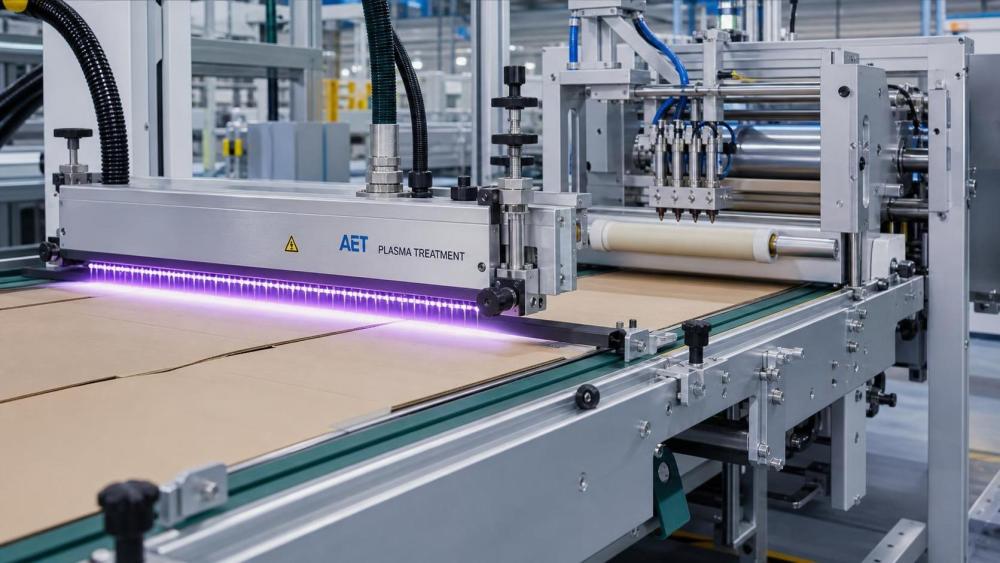
In a typical converting arrangement, the material passes under one or more treatment heads, then enters the glue application and compression stages. The usable setup depends on web or sheet width, line speed, adhesive pattern, substrate geometry, and whether only selected areas need treatment. On high-speed folder gluers and corrugated finishing lines, synchronization with production speed is particularly important. A stable process should maintain appropriate treatment coverage as speeds change, not simply apply maximum power at all times.
Why stronger bonding is only one part of the result
The most visible outcome of plasma activation is often improved bond strength. Yet quality teams may find the greater benefit is lower variation. A line that produces a strong average bond but frequent weak outliers remains a risk. Carton failures commonly emerge at the edge of the glue pattern, on a coated patch, after a print or varnish change, or in the first part of a run after setup. These are precisely the areas where inconsistent wetting becomes costly.
Better wetting can improve adhesive distribution across the intended bond area, helping the glue line develop more uniform contact. This may reduce dependence on increasing adhesive volume to overcome a difficult surface. Excess glue is not a neutral correction: it can lengthen drying time, squeeze out at seams, affect appearance, contaminate machine components, and create moisture-related distortion in paperboard.
For safety management personnel, the operational implications are equally relevant. Inadequate seams on transit packaging can contribute to load instability, product loss, and manual-handling hazards. Loose glued components may jam downstream case packers, palletizers, or conveyors, creating unplanned interventions. A more stable bond process cannot remove all plant risk, but it reduces one preventable source of packaging-related disruption.
Where plasma activation is most useful in printing and packaging
Not every cold-glue job needs plasma treatment. Uncoated, clean, absorbent paper may already provide sufficient anchoring for the selected adhesive. The strongest case usually appears where the production team sees repeatable evidence of surface-related inconsistency or where material changes have narrowed the process window.
- Coated folding cartons: Clay coatings, dispersion coatings, metallized effects, and certain varnishes may reduce adhesive receptivity at side seams or lock-bottom panels.
- Printed or varnished glue areas: When design constraints leave glue zones over ink or coating, treatment can support more dependable wetting—provided the ink and varnish system have been evaluated for the application.
- Corrugated cases with variable liners: Recycled content, surface sizing, moisture variation, and liner changes can influence glue behavior, especially in demanding e-commerce distribution conditions.
- Film-to-paper or film-to-board assemblies: Window patching, laminated structures, and specialty packs often include polymer surfaces that are naturally more difficult for water-based adhesives to wet.
- High-speed lines with short contact windows: As production speed rises, there is less tolerance for marginal surface conditions, inaccurate glue placement, or incomplete compression.
A useful warning: plasma does not automatically solve a bond failure caused by the wrong adhesive, poor folding geometry, insufficient compression, excessive board moisture, dust accumulation, or a damaged glue nozzle. It should be treated as one process control within a broader bonding system.
How to evaluate the process without relying on appearance alone
A shiny glue line or a carton that survives a quick hand pull is not a sufficient validation method. Quality control should connect surface condition, application settings, and finished-package performance. The testing plan will vary by pack type and customer specification, but it should reflect the actual failure mode that matters in use.
Surface-energy checks using dyne test inks or pens can provide a quick comparative indication on suitable smooth materials. They are useful for setup verification, but they are not a complete measure of treatment quality, particularly on porous, rough, printed, or corrugated surfaces. Contact-angle measurement, where practical, can give more detailed wetting information. In production, a treated-versus-untreated trial under controlled conditions often provides the clearest evidence.
Bond testing should go beyond initial green strength. Depending on the package, teams may use peel, tensile, compression, fiber-tear observation, seam-opening, or distribution simulation methods. The critical question is not merely whether the seam breaks, but how it breaks. A cohesive failure within the adhesive, a fiber tear in the board, and a clean adhesive-to-substrate separation point to different causes. Clean separation often indicates inadequate interfacial adhesion and is a useful signal to review surface treatment, contamination, or material compatibility.
For regulated or sensitive applications, the validation record should also identify the substrate grade, coating or ink version, adhesive batch, line speed, plasma settings, glue pattern, compression condition, and environmental conditions. This level of traceability is more valuable than treating plasma power as a standalone quality number.
Control points that determine whether inline treatment remains effective
Plasma equipment is often discussed in terms of power and treatment width, but day-to-day performance depends on a fuller set of controls. The distance between the treatment head and the substrate must remain within the supplier’s specified operating range. If warped board, uneven corrugated profiles, or sheet flutter changes that gap, treatment uniformity can change as well.
Line speed, dwell time, head-to-material distance, treatment width, substrate temperature, and ambient contamination all deserve attention. So does the interval between activation and gluing. An inline plasma treatment system is most effective when that interval is short, repeatable, and protected from unnecessary dust or handling.
Maintenance should be included in the plant’s preventive-maintenance plan rather than treated as an afterthought. Depending on the technology, teams may need to inspect electrodes, nozzles, cables, gas supply, extraction arrangements, and safety interlocks. Dust generated elsewhere in a corrugated or converting plant can undermine both surface quality and equipment cleanliness. Good housekeeping around the treatment and gluing zone supports the process more than many teams initially expect.
Standards, safety, and the questions procurement should ask
There is no universal plasma setting that can be transferred from one packaging job to another. Material construction, glue chemistry, speed, and required package performance must govern the specification. When evaluating a system, quality and safety stakeholders should ask whether treatment uniformity can be demonstrated across the working width; how settings are stored and linked to jobs; what alarms indicate loss of treatment; and how operators verify that the unit is active during production.
They should also review machine safeguarding, electrical safety, ozone or process-gas management where applicable, ventilation requirements, lockout procedures, and the supplier’s maintenance guidance. Atmospheric plasma systems may operate without vacuum chambers, but they are still industrial energy systems and must be integrated responsibly. If packaging is intended for food, pharmaceutical, or other regulated uses, the converter should assess the complete material and process configuration against the relevant customer, regional, and product-contact requirements rather than assuming surface treatment alone establishes compliance.
From a quality-system perspective, plasma activation is easiest to manage when it becomes a documented control point: approved settings by material family, startup checks, periodic verification, response actions for alarms, and retained records for critical jobs. This approach makes the process auditable and helps distinguish a genuine surface issue from other sources of gluing variation.
A practical path to adoption
The right starting point is a defined problem, not a general desire for stronger bonds. Select a representative job with known seam failures, material variability, or adhesive overuse. Establish a baseline using current glue settings and meaningful finished-pack tests. Then compare untreated and treated samples while holding as many variables as possible constant. If plasma is effective, evaluate whether adhesive application can be optimized without reducing the required performance margin.
For commercial printers, carton converters, and corrugated packaging plants, that disciplined trial can reveal whether the value lies in stronger bonds, fewer rejects, better compatibility with a new coated substrate, or more stable performance during high-speed production. The answer may differ by application.
Ultimately, an inline plasma treatment system improves cold glue bond strength by making the substrate easier for the adhesive to wet and anchor to at the moment it matters most. Its real contribution is not simply a higher test result. It is a more controlled bonding process—one that gives quality teams clearer evidence, gives operators a wider and more stable process window, and gives packaging safety programs fewer weak seams to discover after the product has already left the plant.
Related News
 How to Evaluate a Cold Glue System Manufacturer for Reliable BondingChoose a cold glue system manufacturer with proven application control, uptime-focused design, seamless integration, and responsive service for reliable bonding.Spatial Folding Strategist
 How to Stop Stringing and Poor Bonds with an Industrial Hot Melt Glue GunIndustrial hot melt glue gun troubleshooting guide: reduce stringing, improve bond strength, optimize temperature, nozzle condition, timing, and carton compression.Spatial Folding Strategist
 How Non Contact Glue Detection Systems Prevent Carton FailuresNon contact glue detection systems prevent carton failures by spotting missing or misplaced adhesive early, reducing rejects, rework, and packing-line disruptions.Spatial Folding Strategist
 What Engraved Glue Rollers Cost and Which Specs Matter MostEngraved glue rollers: compare cost drivers, cell volume, coatings, tolerances, and supplier specs to improve adhesive control, reduce waste, and protect corrugator uptime.Spatial Folding Strategist
 How Hot Melt Glue Systems Improve Bond Strength and UptimeHot Melt Glue Systems improve bond strength and uptime with precise temperature control, clean flow, accurate bead placement, and reliable compression.Spatial Folding Strategist
 How to Evaluate Glue Machine Manufacturers for Long-Term Operating CostGlue machine manufacturer evaluation guide: compare lifecycle costs, adhesive control, uptime, maintenance, changeovers, and supplier support for smarter investments.Spatial Folding Strategist