How Does a Plasma Treatment System for Printing Improve Ink Adhesion?
A plasma treatment system for printing improves ink adhesion by changing the condition of the substrate immediately before ink is applied. It does not make ink inherently stronger. Instead, it raises the material's surface energy, removes or disrupts microscopic contamination, and creates a more receptive surface for wet ink to spread and anchor.
This distinction matters in technical evaluation. A press may appear to print well during a short trial, then show scuffing, pinholes, poor solid density, tape-test failures, or delamination after curing, die-cutting, folding, or shipment. In many of these cases, the problem is not simply an ink formulation issue. It is an interface problem between the ink and the surface being printed.
Ink adhesion starts with wetting, not with drying
For ink to bond reliably, it must first wet the substrate. A liquid ink or coating needs to spread into a continuous, controlled film rather than bead up, pull back, or leave weak areas. This is governed largely by the relationship between the ink's surface tension and the substrate's surface energy.
Low-surface-energy materials resist wetting. Common examples include polyethylene, polypropylene, certain coated films, laminated structures, silicone-contaminated surfaces, and some varnished or heavily coated papers. Ink can be transferred to these materials, but transfer alone is not adhesion. If the ink cannot establish close contact with the surface, its bond remains vulnerable to abrasion, moisture, flexing, tape removal, or later converting operations.
Plasma activation modifies the outermost surface layer without changing the bulk properties that make the substrate useful for packaging. The treated surface becomes more polar and more wettable, allowing the ink vehicle, resin, coating, or adhesive to contact the material more uniformly. That wider and more consistent contact area gives the ink system a better basis for mechanical and chemical bonding during drying or curing.
The practical result is usually not just better adhesion in a laboratory test. It can mean more stable solids, fewer print defects caused by dewetting, less need to compensate with excessive ink laydown, and more reliable performance through downstream handling.
What plasma changes at the material surface
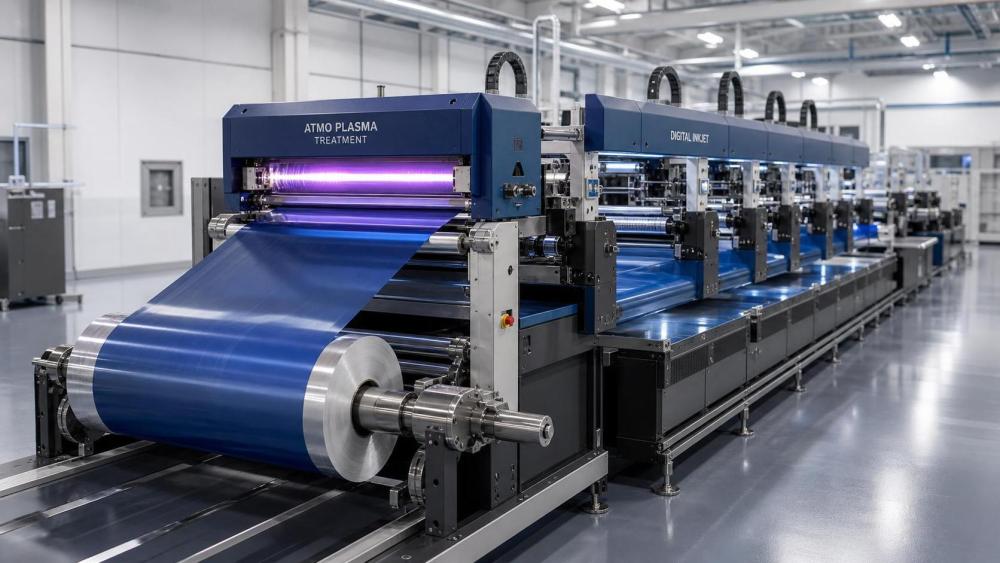
A plasma treatment system for printing creates an energized gas environment at the substrate surface. Depending on the system design and process gas, reactive species interact with the material's topmost layer. The treatment can clean light organic residues, break weak surface bonds, and introduce polar functional groups. These changes increase the surface's ability to interact with inks, coatings, laminating adhesives, and other functional layers.
It is useful to separate three effects that are often grouped together:
- Surface cleaning: Dust, oils, processing aids, fingerprints, and other light contamination can create local adhesion failures. Plasma can reduce these barriers where the treatment reaches the surface.
- Surface activation: The treatment increases surface energy and improves wetting. This is often the primary objective in printing applications.
- Surface micro-roughening: On some materials, treatment can also influence surface texture at a microscopic scale, supporting mechanical anchoring. It should not be assumed to be the main mechanism for every substrate.
These effects are strongest at the surface and may diminish over time. Many polymers undergo hydrophobic recovery: the activated surface gradually becomes less receptive as molecules rearrange or contamination returns. This is why treatment is normally placed inline, close to the printing, coating, or laminating station. Treating rolls or sheets far in advance may produce a good initial measurement but inconsistent production results later.
Why this matters in printing and converting lines
In flexographic printing, poor wetting may show up as mottled solid areas, edge voids, reduced density, or variable color strength. Operators may respond by increasing ink volume, adjusting viscosity, changing anilox specifications, or slowing the press. Those adjustments can mask a surface problem but may introduce drying, dot gain, set-off, or cost issues elsewhere.
With UV inks and UV varnishes, adequate cure does not guarantee adequate adhesion. A fully cured layer can still release from a low-energy film or contaminated coating. The same principle applies to water-based ink on coated board, digital ink on synthetic media, primer layers before printing, and overprint varnish on difficult substrates.
For corrugated and paper-based packaging, plasma is not automatically required because untreated paper and uncoated board often accept ink well. Its value becomes more relevant where coated linerboard, barrier coatings, metallized surfaces, film windows, laminated labels, specialty varnishes, or mixed-material packs create inconsistent print receptivity. It can also support reliable coding and marking on surfaces where readable variable data is essential for traceability.
Downstream converting makes weak adhesion more expensive. A print layer that survives the delivery end of a press may fail during creasing, folding, stripping, gluing, pallet handling, or abrasion in logistics. Technical evaluation should therefore assess the completed packaging process, not only a freshly printed sample.
Plasma is not a substitute for ink-substrate compatibility
Surface activation improves the conditions for adhesion, but it cannot correct every mismatch. An ink system still needs the correct resin chemistry, drying or curing mechanism, viscosity range, pigment dispersion, and flexibility for the intended substrate and application. A package that will be folded sharply, exposed to moisture, subjected to freezer conditions, or rubbed during transport may require a different ink or coating design even after successful plasma treatment.
Likewise, plasma will not reliably solve defects caused by unstable web tension, poor doctor blade condition, incorrect anilox selection, contaminated ink, insufficient UV energy, excessive drying temperature, or uneven substrate coating. The strongest evaluation approach is to treat plasma as one controlled part of the print process rather than as a universal corrective device.
Evaluate the whole process window, not a single surface-energy reading
Surface-energy testing, often using dyne solutions or test inks, is useful for checking whether activation is present. It is not sufficient as the final acceptance criterion. A high reading can coexist with poor print performance if treatment is non-uniform, the material has changed, the ink does not match the surface, or the time between treatment and printing is too long.
A more useful qualification process links measurable surface condition to the actual job requirements:
- Define the substrate families that create adhesion risk, including coating types, films, laminates, recycled-content variations, and supplier-to-supplier differences.
- Run representative ink, coating, and curing combinations at normal press speed rather than only at reduced trial speed.
- Check treatment uniformity across the web or sheet width, including edges where defects can be missed.
- Assess printed samples after the relevant drying, curing, storage, converting, and handling stages.
- Use adhesion, rub, tape, crease, fold, and visual inspection methods that reflect the pack's actual failure mode.
- Document usable settings by material and job type so operators are not forced to rediscover the process after every changeover.
This approach turns plasma from a visible but poorly understood machine feature into a controlled production variable. It also makes it easier to distinguish material variability from press, ink, or treatment issues.
Atmospheric plasma and vacuum plasma solve different integration problems
For continuous printing and converting, atmospheric plasma systems are often easier to integrate because treatment can occur inline on moving webs, sheets, or formed components. Their value is closely tied to line speed, treatment width, substrate path, web handling, exhaust arrangements, and access for maintenance.
Vacuum plasma provides a more enclosed treatment environment and can be suitable for parts or applications requiring highly controlled processing. It is less naturally aligned with high-throughput, inline packaging printing unless the production format and throughput requirements support chamber-based operation.
Common evaluation mistakes
Choosing by maximum rated power alone. Power matters only in relation to treatment width, substrate, speed, gap, electrode configuration, and required process window. A higher rating does not automatically create better adhesion; excessive treatment can damage sensitive surfaces or create an unnecessarily narrow operating window.
Testing only clean, fresh material. Production materials may carry variable slip additives, coating residues, dust, moisture, or handling contamination. Qualification should include the normal variation that the line is expected to process.
Ignoring the gap and web path. Plasma performance depends on the controlled relationship between treatment head and substrate. Web flutter, poor sheet positioning, warped board, or inconsistent gap can produce non-uniform activation even when the generator is operating correctly.
Using visual appearance as the only quality signal. A printed image can look acceptable at the press and fail later under abrasion or folding. The relevant quality test is the one connected to the package's use and converting route.
Leaving maintenance outside the evaluation. Electrode cleanliness, generator stability, cooling, extraction, shielding, and operator access affect repeatability. A system that works during commissioning but is difficult to inspect or maintain can become a recurring source of quality variation.
What a technical evaluator should confirm before specifying a system
Start with the problem material and the failure mode, not the equipment category. Identify whether the concern is poor wetting, intermittent adhesion, scuff resistance, ink holdout, coating release, variable-data readability, or downstream cracking. These symptoms can point to different root causes and require different evidence.
Then define the process envelope: substrate width and thickness range, maximum production speed, roll or sheet format, expected coating and film types, printing method, ink family, curing method, installation location, and required access. For packaging lines, also consider how the treatment system will communicate with press controls, job recipes, inspection equipment, and line safety functions.
Information platforms such as CPCS are most useful when this equipment assessment is connected to the rest of the production system. A treatment unit should be reviewed alongside flexographic press configuration, UV curing, color control, inspection, die-cutting, folding, gluing, and traceability requirements. Adhesion is a surface event, but its commercial consequence is determined by the reliability of the finished pack.
The practical decision is rarely whether plasma can improve adhesion; on difficult substrates, it often can. The more important question is whether the proposed system can deliver repeatable activation at the required speed, across the real material range, close enough to printing, and with controls that operators can maintain through normal production changeovers.
Related News
 How to Evaluate a Cold Glue System Manufacturer for Reliable BondingChoose a cold glue system manufacturer with proven application control, uptime-focused design, seamless integration, and responsive service for reliable bonding.Spatial Folding Strategist
 How to Stop Stringing and Poor Bonds with an Industrial Hot Melt Glue GunIndustrial hot melt glue gun troubleshooting guide: reduce stringing, improve bond strength, optimize temperature, nozzle condition, timing, and carton compression.Spatial Folding Strategist
 How Non Contact Glue Detection Systems Prevent Carton FailuresNon contact glue detection systems prevent carton failures by spotting missing or misplaced adhesive early, reducing rejects, rework, and packing-line disruptions.Spatial Folding Strategist
 What Engraved Glue Rollers Cost and Which Specs Matter MostEngraved glue rollers: compare cost drivers, cell volume, coatings, tolerances, and supplier specs to improve adhesive control, reduce waste, and protect corrugator uptime.Spatial Folding Strategist
 How Hot Melt Glue Systems Improve Bond Strength and UptimeHot Melt Glue Systems improve bond strength and uptime with precise temperature control, clean flow, accurate bead placement, and reliable compression.Spatial Folding Strategist
 How to Evaluate Glue Machine Manufacturers for Long-Term Operating CostGlue machine manufacturer evaluation guide: compare lifecycle costs, adhesive control, uptime, maintenance, changeovers, and supplier support for smarter investments.Spatial Folding Strategist