How Do You Choose a Glue Nozzle Supplier for Reliable Packaging Lines?
Choose a glue nozzle supplier by proving that the nozzle will hold a repeatable adhesive pattern under the actual line conditions: adhesive type, temperature, pressure, substrate variation, line speed, mounting geometry, and cleaning routine. A nozzle that produces an acceptable bead during a short demonstration can still create skips, strings, over-application, or glue migration after hours of production. The selection should therefore focus on process fit and serviceability rather than outlet shape or unit price alone.
For corrugated board, folding cartons, litho-laminated sheets, and folder-gluer work, adhesive application sits close to other variables that affect product quality. Board warp, paper absorbency, crease accuracy, compression settings, sheet position, and dwell time can all alter the apparent result. A capable supplier should be able to separate a nozzle-related issue from a problem caused by glue preparation, pumping, temperature control, or the machine itself.
Start with the bond requirement, not the nozzle catalog
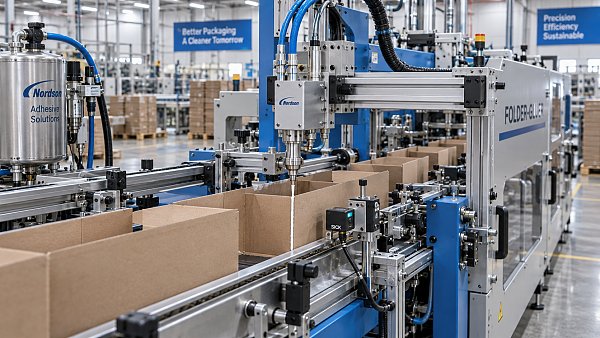
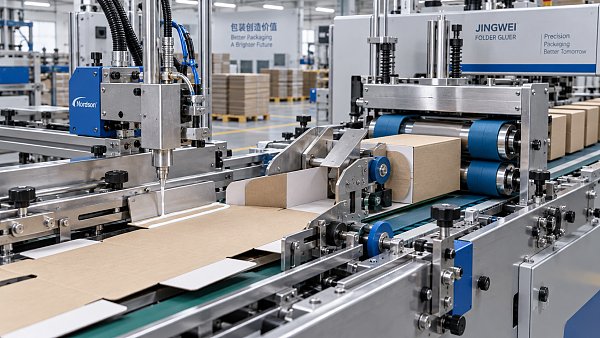
The first specification should describe the required adhesive result at the product, rather than simply requesting a particular nozzle diameter. Define where glue must land, the permitted bead width or spray coverage, the expected deposit volume, and the consequences of excess adhesive. On a folder gluer, an oversized bead may squeeze into the carton interior, contaminate printed surfaces, and create visible staining. On a corrugator, uneven adhesive placement can contribute to weak pin adhesion, washboarding, or unnecessary starch use. The same nominal nozzle may behave very differently in these applications.
Adhesive chemistry determines the design envelope. Water-based cold glue, starch adhesive, hot-melt adhesive, and reactive systems differ in viscosity behavior, solids content, temperature sensitivity, and tendency to form skin or residue. A nozzle intended for a low-viscosity liquid should not be assumed suitable for a filled or rapidly cooling adhesive. Ask for confirmation of compatible adhesive families and operating ranges, then compare that information with the actual glue data sheet and plant mixing practice.
Viscosity must be considered at the point of application. A value measured in a container at room temperature is not enough when the adhesive travels through heated hoses, filters, valves, manifolds, and a nozzle body exposed to ambient air. Temperature loss near the nozzle can raise resistance and distort the pattern. Conversely, a lower-than-expected viscosity can cause satellite droplets, misting, or uncontrolled spread on porous board.
Translate line conditions into a usable technical brief
A supplier can only recommend a suitable assembly when the operating conditions are concrete. The brief should include maximum and normal line speed, web or sheet width, adhesive delivery method, available pressure range, expected start-stop frequency, mounting distance to the substrate, and whether the nozzle is fixed or follows a moving head. Include the narrowest and widest product formats, because edge positions and short blanks often reveal problems hidden during long, centered runs.
- Substrate condition: state the grades involved, surface coatings, flute profiles, moisture variation, and whether the glue is applied to liner, medium, coated cartonboard, or a preprinted sheet. Absorbent kraft and coated board do not accept adhesive in the same way.
- Application pattern: identify continuous beads, intermittent dots, short lines, multi-lane patterns, edge sealing, flap gluing, or full-width adhesive distribution. A single-point application and a manifold-fed array create different flow-balance questions.
- Cycle behavior: note the duration of pauses, shift changes, wash-up intervals, and job changeovers. Material that remains inside a small orifice during repeated stops may dry, gel, char, or settle.
- Installation constraints: provide space around the head, hose routing, electrical or pneumatic connections, access for cleaning, and the actual distance available for opening a guard. A technically sound nozzle is of limited value if routine removal requires major machine disassembly.
The supplier response should turn this brief into explicit assumptions. General statements such as “suitable for high speed” do not establish whether the system can retain pattern definition at the required cycle rate, pressure, and stand-off distance. Request a drawing that shows the nozzle, mounting interface, connection type, adjustment range, and service-clearance requirement.
Evaluate the full flow path
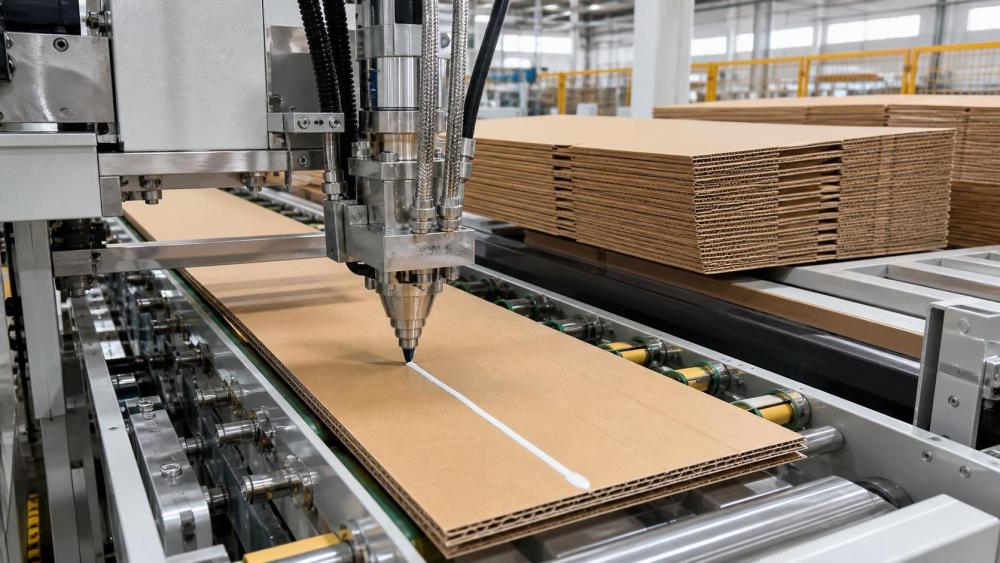
The visible tip is only the final restriction in an adhesive system. A reliable result depends on the relationship between tank or melter, pump, filter, hose, valve, manifold, nozzle, and control signal. Restricting the nozzle outlet to cure an over-application problem can increase upstream pressure and expose weak seals, unstable pump control, or poorly sized filters. Enlarging the outlet to stop clogging can reduce pattern control and raise adhesive consumption.
Ask the supplier to explain the intended pressure window and the consequences of operation near either limit. At very low pressure, a bead may pulse with pump strokes or lose definition at the beginning and end of a cycle. At excessive pressure, fine spray systems can mist, while contact or bead nozzles can produce splashing and inconsistent cutoff. Pressure readings also need context: a gauge positioned far upstream does not reveal the pressure immediately before the nozzle when long hoses, bends, or a partly blocked filter create pressure loss.
Filter selection deserves specific attention. A fine filter may protect a small orifice but can become the dominant source of pressure fluctuation if adhesive cleanliness or maintenance intervals are poor. A coarse filter may allow particles, dried adhesive, fiber, or seal fragments to reach the nozzle. The proposed filtration mesh, filter location, and method for detecting blockage should be discussed as part of the offer, not left to a generic maintenance note.
For multi-nozzle arrangements, ask how flow is balanced between lanes. Equal outlet diameters do not automatically produce equal deposits. Differences in manifold path length, valve response, local temperature, and nozzle wear can shift output from one lane to another. Where adhesive placement is repeated across a broad sheet, the supplier should identify the adjustment method and the evidence used to confirm lane-to-lane consistency.
Distinguish pattern quality from bond quality
A clean-looking bead does not guarantee a strong bond, and a bond failure does not automatically indicate a defective nozzle. Insufficient adhesive transfer may result from low deposit, poor substrate contact, an adhesive open time mismatch, cold board, excessive machine speed, or a compression problem after application. Excess glue can mask weak process control for a short time while increasing warp, drying demand, contamination, and waste.
A useful trial examines both application and finished-package performance. Observe bead continuity, start and stop cutoff, placement relative to the glue flap or flute tip, and buildup around the nozzle. Then inspect the bond after the relevant setting or curing period, including folds, edges, and areas subject to handling stress. Production samples should include normal stock and difficult but routine variants, such as coated surfaces, recycled grades, short flaps, or a frequently changed carton format.
Do not judge a supplier demonstration only by a newly cleaned nozzle. Request evidence from an extended run that includes realistic pauses and restarts. Stringing after a stop, delayed adhesive release, and a growing tail at the cutoff point often arise after thermal stabilization or residue accumulation. These symptoms affect downstream equipment because stray adhesive can collect dust, mark belts, foul guides, and transfer to finished packaging.
Service design affects uptime more than initial appearance
Nozzle serviceability should be reviewed at component level. Determine whether the tip, seal, filter, valve seat, and heater-related parts can be replaced separately. A disposable assembly may simplify a short repair, but recurring replacement can be expensive and create dependency on a single stocked item. A fully rebuildable design is not automatically preferable if rebuild quality depends on specialized tools or adjustment procedures unavailable at the line.
Cleaning instructions should identify approved flushing materials, temperature limits, disassembly sequence, and parts that must not be mechanically scraped. Aggressive cleaning can enlarge an outlet, damage a coating, deform a sealing face, or leave debris that causes a new blockage. A credible glue nozzle supplier will define the difference between routine external cleaning, planned internal flushing, and conditions requiring removal for inspection.
Spare-part availability matters most when it is tied to a clear parts list. Require item numbers, material descriptions, expected wear points, recommended on-site quantities based on the installed configuration, and lead-time information for nonstandard parts. If a nozzle uses proprietary fittings, confirm that adapters, hoses, and replacement seals are identified before installation. An otherwise small connection detail can delay a restart when a damaged fitting cannot be sourced locally.
Test supplier capability through the response, not the brochure
The quality of technical questions asked before quotation is informative. A supplier that requests adhesive properties, layout drawings, production samples, pressure data, and cleaning practices is building a recommendation around the process. A supplier that immediately selects a part number based only on nozzle width leaves important variables unresolved.
Commissioning should include an agreed acceptance method. It need not rely on a complicated protocol, but it should state the product conditions, adhesive, line state, visual criteria, and bond checks used for approval. Keep samples from the accepted setup and record the nozzle position, pressure, temperature, valve timing, and relevant machine settings. This baseline shortens troubleshooting later, especially when an adhesive batch, paper grade, or production format changes.
Compare total operating exposure
The purchase price of a nozzle is only one part of the commercial comparison. Include consumables, replacement tips, seals, filters, cleaning materials, planned labor, expected downtime for service, and the cost of adhesive lost during tuning or faulty application. A low-cost nozzle that requires frequent adjustment can consume more production time than a higher-priced design with stable positioning and repeatable cutoff.
Do not convert every quality issue into a nozzle cost. The evaluation should identify ownership boundaries between adhesive supplier, nozzle supplier, machine builder, controls integrator, and plant maintenance. For example, a late valve signal may look like nozzle stringing; poor board registration may look like inaccurate glue placement; incorrect adhesive preparation may resemble a flow restriction. Written escalation paths and diagnostic support are valuable because adhesive defects often cross these boundaries.
Selection is strongest when the supplier commits to a defined operating envelope, provides a maintainable mechanical design, and supplies evidence that the entire adhesive path has been considered. The final specification should preserve the approved configuration, including nozzle geometry, material, connection, filter arrangement, and setup values, so that later replacements do not quietly alter line behavior.
Related News
 How to Choose a Glue Dispensing System Manufacturer for Your LineChoose a glue dispensing system manufacturer with confidence. Compare adhesive compatibility, line integration, testing, and lifecycle costs to find the right fit for your production line.Spatial Folding Strategist
 How to Fix Weak Glue Bonds on Carton Folder Gluers at High SpeedsCarton Folder Gluers losing bond strength at high speeds? Learn how to optimize glue placement, adhesive selection, and compression to reduce rejects and keep production running reliably.Spatial Folding Strategist
 How Window Patching Machines Apply Film to Folding Carton WindowsDiscover how Window Patching Machines apply film to folding cartons. Learn key controls for precise placement, strong bonds, and fewer rejects before choosing your equipment.Spatial Folding Strategist
 How Does a Crash Lock Pre Breaking Unit Improve Carton Folding?Discover how a crash lock pre breaking unit reduces crease resistance, improves carton folding consistency, and supports reliable opening—with practical setup tips to avoid board damage.Spatial Folding Strategist
 How a Folder Gluer Pre-Breaking Unit Improves Carton Fold QualityDiscover how a folder gluer pre breaking unit improves carton fold quality and reduces spring-back. Get practical setup tips for consistent seam alignment and smoother production.Spatial Folding Strategist
 How to Evaluate a Cold Glue System Manufacturer for Reliable BondingChoose a cold glue system manufacturer with proven application control, uptime-focused design, seamless integration, and responsive service for reliable bonding.Spatial Folding Strategist