When High Throughput Case Packers Deliver the Best ROI
When High Throughput Case Packers Deliver the Best ROI
A high throughput case packer looks like an easy capital decision when labor is tight and volume is growing. In practice, the best ROI does not come from buying the fastest machine on the brochure. It comes when the case packer is matched to the real bottleneck of the line, the carton style, the upstream packaging stability, and the downtime culture of the plant.
That distinction matters more now than it did a few years ago. E-commerce has increased order fragmentation. Retail-ready and ship-ready corrugated formats are under more pressure. At the same time, packaging operations are dealing with sustainability demands, tighter traceability expectations, and more scrutiny around material waste. In that environment, end-of-line automation is no longer just a labor substitution story. It is an OEE story, a damage-reduction story, and often a corrugated consumption story as well.
For plants already investing upstream in faster corrugated conversion, better print control, cleaner die-cutting, and more stable folder gluer performance, the case packer becomes the point where all that precision either pays back or gets lost. That is one reason intelligence platforms such as CPCS spend so much time looking not only at major machines like corrugators, flexo presses, die-cutters, and folder gluers, but also at the motion logic and line discipline of end-of-line systems. A line can produce beautiful blanks and well-glued cartons; if final packing cannot keep pace without jams, rework, or crushed packs, the economics unravel quickly.
The ROI appears when speed solves an expensive problem
Not every operation needs high throughput case packers. If a plant runs moderate volume, stable labor, and long production windows, a simpler machine or even semi-automatic packing may still be rational. The real payback starts when one or more of the following costs are already visible:
- Manual packing is limiting line speed or forcing overtime.
- Labor availability is unpredictable across shifts or sites.
- Product handling damage is creeping up, especially with lightweight cartons or shelf-ready packs.
- Frequent format changes are eating productive hours.
- Downstream palletizing is starved because case packing cannot feed consistently.
- Quality complaints trace back to mixed counts, poor case fill, or unstable pack orientation.
In other words, the strongest ROI case is usually not “we want more automation.” It is “we are already paying for inefficiency somewhere else.” High throughput equipment pays back best when it removes a repeatable, measurable drag on margin.
Where decision-makers often misread the economics
The common mistake is to focus on nominal cases per minute and ignore the packaging system around it. Case packers live downstream, but they are hostage to upstream variation. If cartons arrive with inconsistent glue set, warped blanks, unstable dimensions, poor print-side friction, or irregular spacing, the case packer does not magically fix that. It just fails faster.
This is especially relevant in corrugated and carton environments where machine precision upstream is everything. CPCS has long tracked how cam profiles, starch behavior, die-cut register, and folder gluer timing affect downstream handling. That sounds academic until a plant discovers that its new end-of-line system spends too much time recovering from packs that are technically “in spec” but not stable enough for sustained automatic loading.
So the right financial question is not, “How fast can the case packer run?” It is, “At what sustained rate can the entire line run, with acceptable scrap, acceptable labor, and acceptable recovery time?” There is a big difference.
The plants that usually benefit most
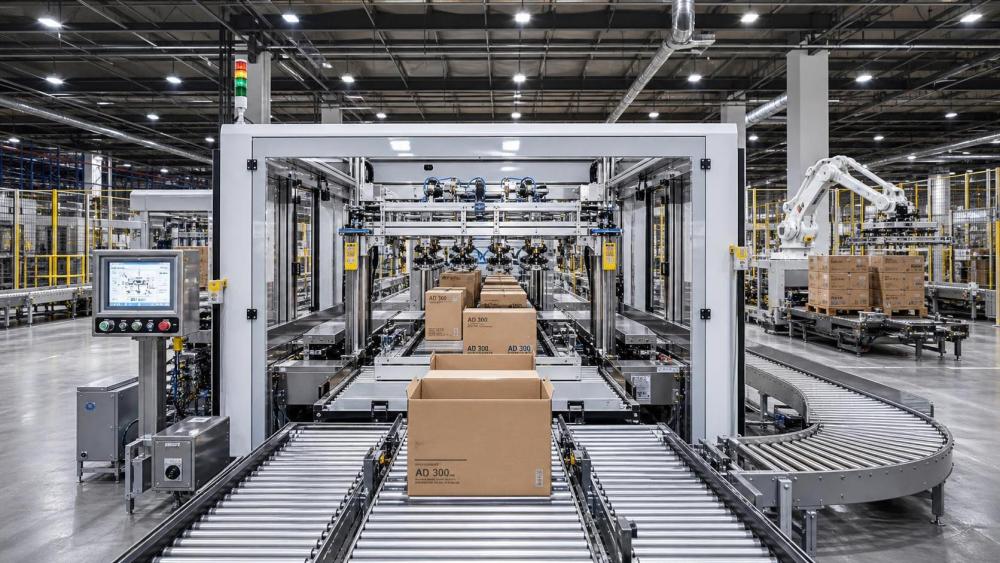
High throughput case packers tend to make the most sense in a few recurring scenarios.
One is the beverage, personal care, household goods, or food operation where primary packs are already moving at high speed and manual packing has become the soft spot in an otherwise automated line. Another is the e-commerce packaging environment where corrugated case formats need to support rapid volume swings without adding headcount every peak season. A third is any site facing strong retailer or regulatory pressure to reduce packaging inconsistency, improve coding traceability, or control material usage more tightly.
There is also a quieter use case: plants trying to protect a large upstream investment. If a company has upgraded corrugated board production, flexo print quality, die-cutting accuracy, or folder gluer capacity, but final packing still causes stoppages, the hidden cost is not just labor. It is lost return on every machine upstream. In that situation, a robust case packing cell can act less like a standalone asset and more like an OEE stabilizer for the whole converting chain.
What actually drives payback
Labor reduction is the obvious line item, but it is rarely the whole story. The better ROI models usually stack several smaller gains that become meaningful together.
First, uptime. A case packer that holds rate without constant micro-stops improves the effective output of the upstream line. Plants often underestimate how much productive time disappears into short interruptions, operator resets, and restart instability.
Second, changeover performance. If the operation runs multiple SKUs, case sizes, or pack patterns, changeover minutes matter almost as much as peak speed. A slightly slower system with repeatable, low-risk changeovers can outperform a faster machine that loses too much time between jobs.
Third, material yield. Better loading accuracy can reduce crushed cases, rejected packs, and repacking. In corrugated-heavy operations, that matters more than many buyers expect, especially when board costs and sustainability targets are under scrutiny. Businesses that follow PPWR-related packaging changes or internal waste-reduction programs already know that avoidable corrugated loss is becoming harder to justify.
Fourth, quality consistency. Proper count verification, orientation control, and compatibility with vision inspection or coding checks reduce the operational mess that comes from mixed packs and downstream exceptions. In regulated or retail-sensitive categories, one avoided error can be worth more than a modest speed increase.
What to check before approving capital
A useful buying process starts with a few uncomfortable questions.
Can the upstream line present products consistently enough for automatic loading at the target rate? Are carton dimensions and case tolerances stable across shifts and suppliers? How often does the product mix change? Is floor space forcing compromises in infeed buffering, guarding, or case handling? And perhaps most important: does the maintenance team have the bandwidth and skill to keep a high-speed system in calibration?
This is where technical due diligence matters more than vendor slide decks. In packaging machinery, especially in systems connected to corrugated conversion and cartoning, small mechanical realities have large economic effects. Timing windows, vacuum quality, lane management, servo synchronization, adhesive behavior, and case erecting stability all show up later as uptime or scrap.
Why corrugated quality still matters at the end of the line
It is easy to treat case packing as separate from board production and converting, but buyers should resist that silo. Case performance depends heavily on how the corrugated was made and converted. Board caliper variation, flute crush, warp, score quality, slot accuracy, and glue performance all influence how reliably cases are erected, filled, and moved.
That is why the broader machinery view matters. A company like CPCS, which studies everything from corrugator thermodynamics and flexo ink transfer to die-cut indexing and folder gluer kinetics, is useful precisely because ROI is rarely created by one machine in isolation. A case packer may be the purchased asset, but the return depends on the discipline of the whole packaging line.
If a plant is struggling with setup spoilage, unstable blanks, or end-of-line rejects, the answer may not be a larger case packer. It may be fixing the upstream process variation first, then selecting a machine sized to the line’s real capability.
When the investment is too early
There are times when buying high throughput case packers is simply premature. If SKU volatility is high but format standardization is low, automation can become a constant engineering project. If order volumes are inconsistent and seasonal peaks are short, the business may not use the equipment enough to justify the capital. If the operation still has chronic upstream instability, the machine can end up exposing problems rather than solving them.
This is not an argument against automation. It is an argument for sequence. In many plants, the best order is to stabilize packaging design, improve corrugated consistency, tighten coding and inspection, reduce setup loss, and then scale the end-of-line. That path often produces a cleaner payback than jumping straight to maximum speed.
A practical way to judge the opportunity
Before issuing an RFQ, it helps to quantify four things with discipline: current packed output by shift, labor exposure by line, changeover loss by SKU family, and the cost of packing-related waste or rework. Not every plant has perfect data, but even a sober estimate is better than relying on headline speed claims.
Then pressure-test the project with realistic constraints. Use actual case styles. Use actual product dimensions. Ask what happens when board quality drifts, when operators change over at 2 a.m., or when upstream equipment feeds slightly off-center. High throughput equipment earns its return in those moments, not in ideal demos.
The best ROI usually appears when the machine is fast enough, mechanically forgiving, and tightly integrated with the rest of the packaging system. If a case packer can preserve upstream precision, keep OEE high, and avoid turning corrugated into avoidable scrap, then the investment starts to make strategic sense. If it only adds speed on paper, the spreadsheet will look better than the plant floor.
Related News
 How an Automatic Folder Gluer System Reduces Carton Setup ErrorsAutomatic folder gluer system solutions reduce carton setup errors with precise feeding, folding, glue control, and compression. Discover how to improve quality and changeovers.Spatial Folding Strategist
 How to Choose a Folder Gluer Machine for Folding CartonsChoose the right folder gluer machine for folding cartons with proven guidance on speed, carton styles, glue quality, automation, testing, and lifecycle costs.Spatial Folding Strategist
 When Chain Pallet Conveyors Improve Warehouse Flow and ThroughputChain pallet conveyors improve warehouse flow by reducing forklift delays, adding controlled accumulation, and protecting packaging throughput. Discover when they deliver the strongest ROI.Spatial Folding Strategist
 How to Compare Automatic Strapping Machine Price and Total CostAutomatic strapping machine price comparison made simple: evaluate installation, throughput, consumables, labor, downtime, and total cost for a smarter investment.Spatial Folding Strategist
 What to Compare When Choosing a Pallet Wrappers SupplierCompare a pallet wrappers supplier by load stability, film efficiency, automation integration, service support, and total cost to choose the right solution.Spatial Folding Strategist
 How an Automatic Case Erecting Machine Reduces Packing DelaysAutomatic case erecting machine solutions reduce packing delays by delivering consistent, sealed cases, improving line flow, uptime, and end-of-line efficiency.Spatial Folding Strategist