When Folder Gluer Lines Need Automation Upgrades for Faster Output
In many carton plants, the warning signs do not arrive as a dramatic breakdown. They show up in smaller, more frustrating ways: a folder gluer line that never quite reaches the speed printed in the brochure, operators rushing to correct skewed blanks, glue waste creeping upward, or a backlog forming at the end of a shift because changeovers took longer than planned. For project managers and engineering leads, these are not isolated annoyances. They are signals that the line may have outgrown its original automation level.
That is why the conversation around Folder Gluer Lines has shifted. The question is no longer whether automation is “nice to have.” The real question is when an upgrade becomes necessary to support faster output without sacrificing carton quality, uptime, or labor control. In packaging production, speed only matters when it remains stable, repeatable, and commercially useful.
A modern upgrade decision usually sits at the intersection of production reality and capital discipline. Teams are asked to increase throughput, handle more short runs, reduce setup dependency on highly experienced operators, and maintain consistent glue application across a wider variety of box styles. Under those conditions, keeping an older line running is not always the lowest-cost option, even if the machine is mechanically sound.
The point where “running” is no longer the same as “performing”
Many folder gluers continue operating for years with acceptable output on familiar work. The problem begins when order patterns change. E-commerce packaging, retail-ready packs, pharmaceutical cartons, and branded folding cartons often demand tighter consistency, quicker response, and more frequent job switching than older production models were designed for.
If a line still depends heavily on manual adjustments for feeder alignment, belt positioning, folding section tuning, glue pattern correction, or delivery management, speed gains become difficult to sustain. Operators may be able to push the machine faster for a limited period, but instability follows: fish tails, cracking at the fold, glue misses, warped delivery stacks, and more rework downstream.
For an engineering project leader, the critical moment is not when the machine fails completely. It is when the line starts consuming too much hidden capacity. That hidden capacity loss often appears in four places:
- longer-than-planned setup and job changeover time,
- higher labor involvement to maintain stable output,
- quality variation at increased running speeds,
- stoppages caused by inconsistent feeding, folding, or glue control.
When those issues repeat across shifts, automation upgrades become less about modernization and more about restoring production logic.
What faster output actually means on Folder Gluer Lines
It is easy to treat output speed as a single number, but on the plant floor, faster output is a system result. A folder gluer can only deliver more saleable cartons per hour when feeding, transport, alignment, folding, gluing, compression, counting, and discharge remain synchronized.
That is why some lines technically run at high speed yet produce disappointing real throughput. Speed is lost in micro-stops, manual intervention, conservative operating limits, and rejected cartons. In other words, the bottleneck may not be the drive system alone. It may come from incomplete automation around process control.
For most upgrade evaluations, project teams should look beyond headline speed and ask more practical questions:
- Can the feeder hold registration reliably at higher blank volumes?
- Does the glue application system maintain pattern accuracy when speed rises?
- How much time is spent stabilizing the first acceptable sheets after a changeover?
- Are delivery and counting sections limiting the rest of the line?
- How dependent is performance on one or two highly experienced operators?
These questions usually reveal whether the problem is a machine-age issue or an automation-gap issue.
Where upgrades usually deliver the biggest operational impact
Not every plant needs a complete replacement. In many cases, a targeted automation package can extend the useful life of existing Folder Gluer Lines while lifting output and reducing variability. The best upgrade path depends on product mix, shift pattern, and the level of integration required with upstream and downstream systems.
Feeder and blank handling control
Inconsistent feeding is one of the earliest limits on line speed. Servo-assisted feeder upgrades, improved blank separation, automatic side guide positioning, and better suction management can reduce skewing and double-sheet issues before they affect folding accuracy. If the line struggles with mixed board grades or warped blanks, feeder modernization often returns value quickly because it stabilizes the entire process.
Recipe-based job setup
Frequent order changes are now normal in many packaging plants. A machine that requires repeated manual adjustment on rails, carriers, folding hooks, belts, and glue positions may still produce good cartons, but it loses valuable production time between jobs. Recipe storage and recall, digital position indicators, and motorized section settings can shorten setup windows and reduce trial-and-error during repeat work.
For project teams, this matters because setup efficiency is often the hidden reason overall daily output stays flat even when rated machine speed looks sufficient.
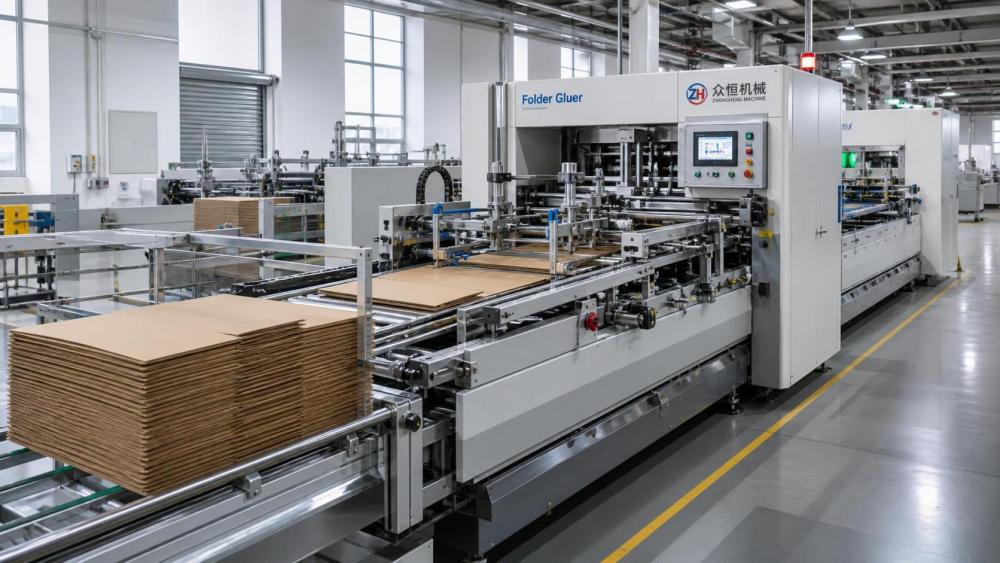
Glue application and monitoring
At higher speeds, glue quality problems become more expensive. Uneven bead placement, missed application, excess glue, or delayed detection of nozzle issues can quickly turn into scrap or customer complaints. Upgrading to more precise glue control, pattern verification, or application monitoring helps maintain bond quality while allowing the line to operate with more confidence at elevated speeds.
This is especially relevant for cartons where structural integrity, presentation quality, or barcode area cleanliness matters. In some applications, glue precision is not only a quality issue but also a downstream automation issue, because poor bonding can affect packing, stacking, and shipment reliability.
Compression, delivery, and counting automation
Plants sometimes focus on the folding section and overlook what happens after gluing. Yet output is often constrained by inadequate compression timing, unstable bundle formation, or manual counting and transfer. Delivery upgrades, automatic batching, stack separation, and smoother discharge handling can remove the end-of-line bottleneck that prevents the machine from running continuously.
In practical terms, a folder gluer does not become faster simply because the central section moves faster. It becomes faster when cartons leave the line in a controlled, manageable flow.
Control systems and diagnostics
Older control architecture can make troubleshooting painfully slow. If operators and technicians need excessive time to locate recurring faults, speed loss compounds over weeks and months. Upgraded HMI systems, alarm histories, remote diagnostics capability, maintenance alerts, and clearer parameter visibility support better decisions during production and faster recovery after stoppages.
For engineering managers, improved diagnostics also strengthen the case for standardization across multiple lines or plants, especially where labor skill levels vary.
How to judge whether an upgrade is justified
A smart upgrade decision is rarely based on machine age alone. Some older lines remain commercially effective because they match the product mix and are supported by stable crews. Others become operational liabilities much earlier because demand has shifted around them.
There are several strong indicators that automation investment deserves serious review:
- the line cannot maintain quality at the speeds needed by current order volume,
- changeovers interrupt production more than scheduled maintenance does,
- labor cost rises because experienced operators are constantly required to “rescue” jobs,
- scrap, glue waste, or rework increases when more complex carton styles are introduced,
- the folder gluer is now limiting the benefit of upstream printing or die-cutting upgrades,
- production planning avoids certain jobs because the line is too difficult to set reliably.
That last point is especially important. When planners begin shaping the order book around machine limitations rather than customer demand, the equipment is no longer supporting the business model.
The common mistake: upgrading for speed while ignoring workflow
One of the most frequent errors in folder gluer projects is treating the line as an isolated machine. In reality, faster output can create new instability if upstream blank supply, downstream packing, inspection, coding, or palletizing are not considered at the same time.
For example, a gluer upgrade that reduces changeover time may expose delays in die-cut blank staging. A faster discharge section may overwhelm manual pack-off. Better glue accuracy may improve product consistency, but without inspection or traceability alignment, the quality gain is harder to verify at scale.
This is why system-based thinking matters. In corrugated packaging and carton converting, equipment value increasingly depends on how well each section supports the next. CPCS follows this same logic across packaging machinery coverage: machinery should be evaluated not only by mechanical output, but by uptime stability, operator dependency, material control, maintenance practicality, and compatibility with broader factory automation goals.
What project managers should map before approving the upgrade
Before finalizing scope, project leaders should build a realistic picture of where the line is losing productive time. A useful review usually includes shift observations, maintenance records, setup timing by job type, scrap patterns, operator intervention frequency, and the impact of carton complexity on stable running speed.
It also helps to separate three different questions:
- What limits peak speed?
- What limits average sellable output?
- What limits repeatability across shifts and operators?
These answers are not always the same. A plant may discover that the core machine can already run fast enough, but setup inconsistency and delivery-side handling are reducing actual output. Another plant may find that glue system precision is the real barrier to higher speed on demanding work.
Once those distinctions are clear, the upgrade path becomes easier to justify internally. It also improves vendor discussions, because the conversation moves from “we want more speed” to “we need to reduce setup dependency, stabilize glue quality, and remove discharge bottlenecks on these carton formats.” That is a far stronger project brief.
Automation upgrades as a competitive response, not just a technical refresh
The market pressure behind Folder Gluer Lines is changing. Packaging producers are being pushed to process shorter runs, more SKUs, and tighter delivery windows while controlling labor exposure and maintaining quality confidence. Under those conditions, a line that performs acceptably in a narrow operating window may still hold the factory back.
Automation upgrades make the most sense when they increase usable production time, not just theoretical machine capability. They should help the line switch faster, run with fewer corrections, maintain glue and folding consistency, and communicate more clearly with the people responsible for keeping production on target.
For project managers and engineering teams, the most valuable mindset is practical rather than reactive: do not wait for the folder gluer to become an obvious failure point. Watch for the stage where manual intervention, unstable speed, and changeover losses begin to erode the economics of the whole converting process. That is usually the moment when modernization stops being optional and starts becoming the most rational path to faster output.
Related News
 What to Check Before Ordering Pallet Wrappers Direct From a FactoryBuying from a pallet wrappers factory? Check load compatibility, output, film costs, safety, and support before ordering. Use this checklist to avoid costly mistakes and buy with confidence.Spatial Folding Strategist
 How an Automatic Folder Gluer System Reduces Carton Setup ErrorsAutomatic folder gluer system solutions reduce carton setup errors with precise feeding, folding, glue control, and compression. Discover how to improve quality and changeovers.Spatial Folding Strategist
 How to Choose a Folder Gluer Machine for Folding CartonsChoose the right folder gluer machine for folding cartons with proven guidance on speed, carton styles, glue quality, automation, testing, and lifecycle costs.Spatial Folding Strategist
 When Chain Pallet Conveyors Improve Warehouse Flow and ThroughputChain pallet conveyors improve warehouse flow by reducing forklift delays, adding controlled accumulation, and protecting packaging throughput. Discover when they deliver the strongest ROI.Spatial Folding Strategist
 How to Compare Automatic Strapping Machine Price and Total CostAutomatic strapping machine price comparison made simple: evaluate installation, throughput, consumables, labor, downtime, and total cost for a smarter investment.Spatial Folding Strategist
 What to Compare When Choosing a Pallet Wrappers SupplierCompare a pallet wrappers supplier by load stability, film efficiency, automation integration, service support, and total cost to choose the right solution.Spatial Folding Strategist