When Energy Saving Shrink Wrapping Machines Deliver Real Cost Savings
A packaging line can look energy-efficient on a supplier’s specification sheet and still disappoint the finance team after installation. The reason is simple: electricity is only one part of the cost equation. If a shrink wrapper saves power but slows the line, creates inconsistent seals, wastes film during changeovers, or requires frequent intervention, the apparent utility saving can disappear into operating losses.
For financial decision-makers, energy saving shrink wrapping machines deliver real cost savings only when lower power consumption is paired with stable throughput, controlled material use, reliable uptime, and maintenance demands that the plant can realistically support. This is particularly important in commercial printing, corrugated packaging, folding carton, and end-of-line operations, where wrapping is often the final gate before pallets move to dispatch. A small disruption at this stage can hold up finished goods, labor, and delivery schedules that have already accumulated cost upstream.
The investment question, then, is not “Which machine uses the fewest kilowatts?” It is: Which wrapping system lowers the total cost of getting every sellable pack out of the building?
Why the electricity figure is rarely enough for capital approval
Heat tunnels, sealing systems, conveyors, standby modes, and controls all consume energy. In a conventional shrink wrapping setup, the tunnel is usually the largest visible energy load, so it naturally becomes the focus of vendor comparisons. But a financial review based on rated power alone can be misleading. Rated load does not show how long the tunnel runs at production temperature, how efficiently heat is retained, whether the machine idles between batches, or how many good packs are produced per unit of energy.
A more meaningful measure is energy per acceptable wrapped unit, or energy per thousand packs, calculated under conditions that resemble the actual production mix. This shifts the conversation away from a headline claim and toward production reality. A machine operating at a slightly higher instantaneous load may still be the better financial choice if it reaches temperature quickly, maintains consistent tunnel conditions, reduces rework, and keeps pace with the converting or printing line.
For plants handling corrugated bundles, printed carton blanks, promotional kits, or finished folding cartons, the load profile can be uneven. Some shifts may run long, stable orders; others may involve frequent changes in pack format, film width, product height, and bundle count. An energy-saving design that performs well only during uninterrupted high-volume production may not provide the same return in a short-run environment.
The cost stack behind a wrapped pack
Finance teams benefit from treating shrink wrapping as a cost stack rather than a single utility expense. The purchase price remains important, but it is only the opening line in a multi-year operating picture.
- Energy cost: electricity used for heating, sealing, conveying, controls, cooling, and idle operation.
- Film cost: roll consumption, oversized film, poor tracking, trim loss, torn film, and rejected wraps.
- Labor cost: loading, changeovers, manual adjustments, clearing jams, inspection, and rework.
- Downtime cost: lost output, disrupted downstream palletizing, delayed dispatch, and overtime needed to recover production.
- Maintenance cost: heaters, sensors, belts, sealing components, bearings, controls, spare parts, and technician time.
- Quality-related cost: loose bundles, distorted printed surfaces, weak seals, barcode readability issues, transport damage, and customer claims.
Each item interacts with the others. Better temperature control may lower electricity use, but its larger value may be fewer overheated packs and less film waste. A more automated film-feed system may require a higher initial investment, yet reduce operator intervention during demanding shifts. Likewise, a wrapper integrated with conveyor controls can prevent product accumulation and make the line more predictable, which matters when a folder gluer, die-cutter, digital press, or corrugator is feeding work toward a tight dispatch deadline.
Where energy-saving shrink wrapping machines can produce measurable gains
The strongest savings case usually appears where the current operation has more than one weakness. Replacing a functioning but inefficient machine merely to reduce electricity consumption may create a long payback period. Replacing equipment that also suffers from unstable seals, long warm-up time, high film usage, repeated stoppages, or heavy manual handling is a different proposition.
1. Reduced heat loss and better thermal control
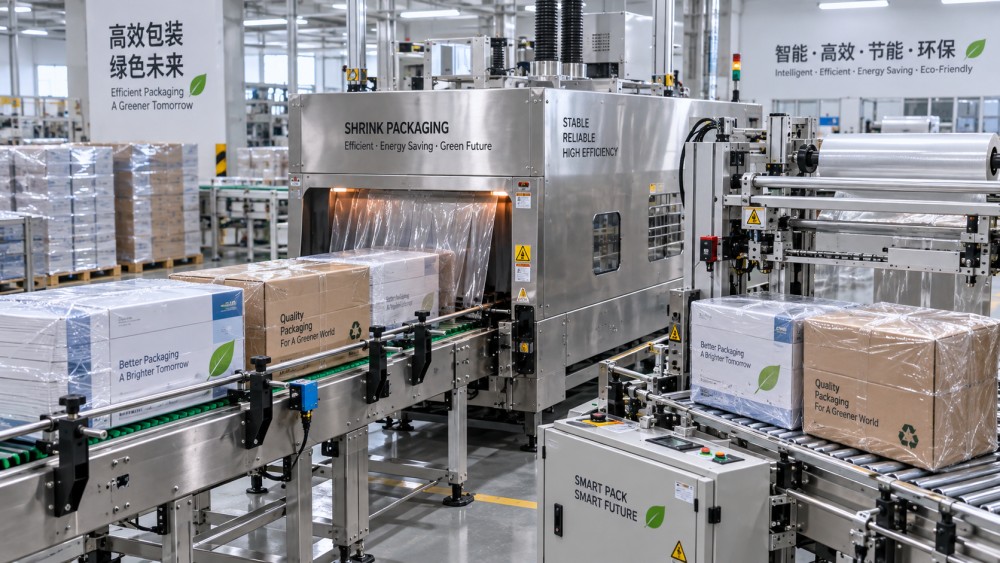
Modern shrink tunnels may use improved insulation, zoned heating, recirculated airflow, more responsive temperature control, and automatic standby functions. These features can reduce unnecessary heat loss, especially where product flow is intermittent. Their financial value is most credible when operators do not have to compensate manually for uneven tunnel performance.
Ask how the tunnel behaves during stops, product gaps, restarts, and different pack sizes. A low-energy mode is useful only if returning to production does not create a surge of under-shrunk or over-shrunk packs. The plant should also understand whether the machine can retain stable conditions during shift changes and variable ambient temperatures.
2. Film use that is controlled, not merely claimed
Film is often a larger recurring cost than decision-makers initially expect. Excess width, poor tension control, inconsistent perforation, and misaligned product entry can all consume material without improving pack protection. In paper-based packaging operations, this may be especially noticeable when bundle dimensions vary by order.
Energy saving shrink wrapping machines with accurate film tracking, recipe-based settings, dependable sealing, and controlled product spacing can reduce avoidable film loss. However, the evaluation should include the film types actually used in the plant: polyolefin, polyethylene, recycled-content films, lighter-gauge materials, or specialty films selected for transport protection. A machine that performs efficiently with one film structure may need different settings or hardware to perform reliably with another.
3. Less unplanned stopping at the end of the line
The cost of a stoppage is rarely limited to the wrapper itself. Finished cartons may queue behind it; operators may be pulled away from other tasks; palletizing schedules may become uneven; and the shipping team may wait for a batch that is technically complete but not ready to move. In a high-output corrugated or commercial print plant, the end of the line can quietly become the bottleneck.
Reliable sensors, well-designed infeed and discharge conveyors, clear HMI diagnostics, and access for routine cleaning can all protect uptime. The finance case should put a value on productive hours recovered, not just on reduced service invoices. That requires operations data: how often does the current machine stop, for how long, why, and what production value is lost or delayed during each event?
A practical way to build the total cost of ownership model
A capital request becomes more credible when the assumptions are visible. Rather than accepting a generic savings percentage, build a model around the plant’s own orders and shift pattern. Include a base case for normal production and a more difficult case involving frequent format changes or lower utilization. This prevents an optimistic forecast from becoming the only version presented to management.
Use the same boundaries for the old and proposed systems. If the existing wrapper’s energy use is measured only at the tunnel while the new system includes conveyors and controls, the comparison is distorted. Similarly, do not credit labor savings if staffing is unlikely to change or if released operators will simply be reassigned without reducing overtime, temporary labor, or capacity constraints. The goal is not to make the project look attractive on paper; it is to identify savings the business can actually retain.
Questions that expose weak supplier comparisons
A supplier proposal may contain impressive speed, power, and automation claims. They are valuable starting points, but financial approvers should push the discussion toward operating conditions. Ask for demonstration or reference information based on product dimensions, bundle weight, film type, line speed, and changeover frequency close to your own.
Useful questions include:
- What is the expected warm-up profile, and how is energy controlled during idle periods?
- At what speed and product mix was the quoted power consumption measured?
- What process adjustments are needed when changing film gauge or pack format?
- Which components require routine replacement, and what is their expected service interval?
- Can the wrapper exchange status signals with upstream printing, converting, or conveying equipment?
- How are jams, missing product, seal faults, and film breaks detected and communicated to operators?
- What installation changes are required for ventilation, electrical supply, guarding, compressed air, or material flow?
These questions matter because integration costs can change the project economics. A wrapper that fits poorly into an existing end-of-line layout may require additional conveyors, guarding modifications, controls engineering, or manual transfer points. Those expenses should be included in the approval model, along with commissioning time and the temporary productivity impact of installation.
Do not confuse automation with savings
Automation can improve consistency, labor deployment, and traceability, but more automation is not automatically the lowest-cost answer. A highly automated shrink wrapping cell may be justified where production volume is stable, labor is constrained, product handling is repetitive, and the line feeds automated palletizing or warehouse systems. In a mixed-job print operation with highly variable bundles and frequent special requirements, a simpler but robust system may offer a better balance.
The right level of automation is the level that removes repeatable waste without adding complexity the plant cannot maintain. This is where operations, maintenance, and finance need to evaluate the project together. Maintenance teams can identify service risks. Production managers can test the fit with real jobs. Finance can challenge assumptions about utilization, labor capture, and avoided downtime. None of these perspectives is sufficient alone.
When the investment case is likely to be weak
Not every older wrapper should be replaced. The business case may be limited when annual operating hours are low, current equipment is reliable, electricity prices have little effect on total conversion cost, or pack formats are about to change significantly. It can also be premature when upstream constraints mean the wrapper rarely runs near capacity. Saving energy on an underutilized asset may not address the plant’s actual bottleneck.
In such cases, lower-cost actions may deserve attention first: repair air leaks, review tunnel temperature settings, improve preventive maintenance, standardize film specifications, train operators on setup discipline, or modify product spacing and conveyor flow. These measures can also create a cleaner baseline for judging whether a new machine is truly needed later.
A finance-led conclusion: buy the operating result, not the label
For packaging and printing businesses, energy efficiency is increasingly relevant to operating margins, customer expectations, and broader sustainability reporting. Yet the most defensible investment decision is still grounded in production economics. Energy saving shrink wrapping machines are worth considering when their design reduces energy per sellable pack while also protecting throughput, film utilization, quality, and uptime.
Before approving capital, define the current cost of wrapping, identify the losses that are genuinely recoverable, and test the proposed system against the production conditions that create those losses. The best outcome is not simply a lower utility bill. It is a calmer end-of-line operation: fewer interruptions, less material thrown away, more predictable dispatch, and a total cost profile that remains convincing long after the initial equipment presentation is over.
Related News
 What to Check Before Ordering Pallet Wrappers Direct From a FactoryBuying from a pallet wrappers factory? Check load compatibility, output, film costs, safety, and support before ordering. Use this checklist to avoid costly mistakes and buy with confidence.Spatial Folding Strategist
 How an Automatic Folder Gluer System Reduces Carton Setup ErrorsAutomatic folder gluer system solutions reduce carton setup errors with precise feeding, folding, glue control, and compression. Discover how to improve quality and changeovers.Spatial Folding Strategist
 How to Choose a Folder Gluer Machine for Folding CartonsChoose the right folder gluer machine for folding cartons with proven guidance on speed, carton styles, glue quality, automation, testing, and lifecycle costs.Spatial Folding Strategist
 When Chain Pallet Conveyors Improve Warehouse Flow and ThroughputChain pallet conveyors improve warehouse flow by reducing forklift delays, adding controlled accumulation, and protecting packaging throughput. Discover when they deliver the strongest ROI.Spatial Folding Strategist
 How to Compare Automatic Strapping Machine Price and Total CostAutomatic strapping machine price comparison made simple: evaluate installation, throughput, consumables, labor, downtime, and total cost for a smarter investment.Spatial Folding Strategist
 What to Compare When Choosing a Pallet Wrappers SupplierCompare a pallet wrappers supplier by load stability, film efficiency, automation integration, service support, and total cost to choose the right solution.Spatial Folding Strategist