What to Compare When Selecting a Paper Cup Machine Manufacturer
The lowest quoted machine price rarely identifies the lowest-cost paper cup production line. A machine that runs quickly only under ideal paper conditions, requires frequent manual adjustment, or depends on hard-to-source parts can absorb its apparent savings through rejected cups, downtime, labor, and delayed delivery. Comparing a paper cup machine manufacturer therefore starts with a clear production brief: cup sizes, paper grades and coatings, print requirements, expected order mix, available utilities, and the level of automation needed around the machine.
Quoted output should be treated as a starting point rather than a final comparison point. Two machines may carry similar rated speeds while delivering very different usable output over a full shift. The more revealing question is how the machine behaves during roll changes, size changes, paper variation, heating adjustment, and ordinary stoppages. A stable line that produces fewer cups per minute on paper may produce more acceptable cups by the end of the day than a faster model that needs repeated intervention.
Compare the Machine Against the Actual Cup Specification
A cup-forming machine should be evaluated against the complete product range, not only the most common cup size. Ask for the supported diameter range, cup height, bottom diameter, and usable paper weight range, then connect those figures to the intended cup designs. A machine set up for standard single-wall hot drink cups may not be equally suitable for tall cold-drink cups, heavy paperboard, tightly rolled rims, or cups with a different bottom profile.
Material construction changes the answer. PE-coated paper, PLA-coated paper, water-based barrier board, and other treated papers do not respond identically to heating, curling, forming, or sealing. Paper stiffness, coating thickness, moisture condition, and printing coverage all influence how the blank travels through the machine. A supplier statement that a machine “handles coated paper” is too broad to be useful. The comparison should identify which material samples were run, what cup geometry was used, how the side seam was sealed, and whether the finished cups passed leak and shape inspection after cooling.
Double-wall, ripple-wall, and sleeve-related production may also require separate equipment or additional stations. A quotation can look complete while excluding the equipment needed for the finished retail product. Separate the core cup-forming machine from printing, blank preparation, inspection, sleeve application, counting, wrapping, conveying, and packing. This avoids comparing one base machine against another supplier’s more complete production scope.
Rated Speed, Effective Output, and Scrap
Speed claims need operating context. Request a witnessed test or a detailed run record showing the cup model, board specification, run duration, stopping events, and count of acceptable output. A very short demonstration can conceal warm-up losses, instability after adjustment, and interruptions caused by material feeding. The relevant measure is not only cycle speed; it is the number of cups that meet the agreed quality standard over a sustained run.
Scrap should be classified rather than presented as one undifferentiated number. Side-seam opening, bottom leakage, distorted rims, oval cup mouths, poor bottom knurling, print scuffing, and feeding jams have different causes. A frequent seam defect may point to heating control, blank overlap, or paper-coating compatibility. Uneven rim curling may relate to paper stiffness, tool condition, or setup precision. If a supplier only describes defects as “operator issues,” ask which machine settings are monitored, which are mechanically fixed, and which require manual judgment.
Changeover deserves the same scrutiny as running speed when production includes many cup sizes or artwork variations. Find out which parts are changed for each format, how many sets of tooling are included, whether settings are recorded, and whether the first acceptable cups after changeover require extended trial-and-error. A line intended for long, repetitive runs can be economical with slower format conversion. For a varied order schedule, format change time and the repeatability of stored settings can outweigh a higher maximum speed.
Mechanical Design and Process Control
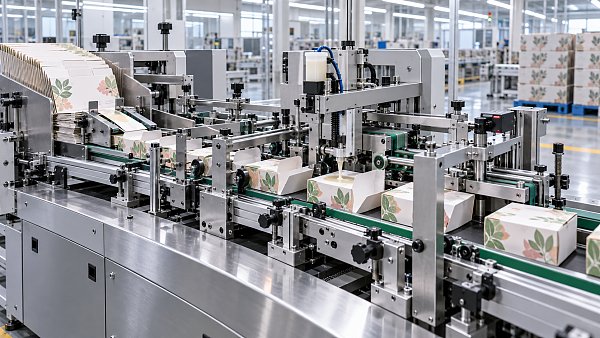
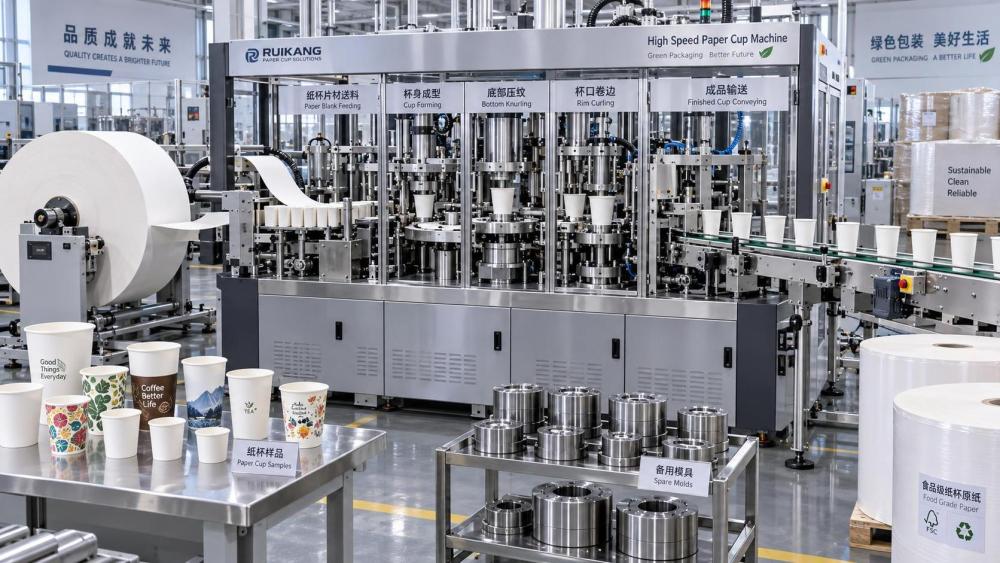
The cup-forming sequence involves feeding fan-shaped blanks, forming the cylindrical body, joining the side seam, inserting the bottom, heating or sealing, knurling, curling the rim, and ejecting the finished cup. Weakness at one station often appears later in the process. For example, poor blank positioning can produce a seam that looks acceptable before bottom insertion but leaks after filling. Compare how the manufacturer controls blank separation, transfer timing, alignment, heat delivery, and finished-cup discharge.
Ask which elements are servo-driven, mechanically cam-driven, pneumatically actuated, or adjusted by hand. There is no universal preference for one architecture. A simpler mechanical system may be easier to maintain and less demanding in a stable, limited-format application. Servo control can be valuable where frequent format changes, precise timing adjustment, or production data capture are required. The important issue is whether the design is appropriate for the intended duty cycle and whether its diagnostic methods are understandable to the maintenance staff on site.
Heating arrangements require close attention because they affect sealing consistency, power use, and material compatibility. Compare the heating zones, temperature feedback, warm-up behavior, insulation, and access for cleaning or replacement. The manufacturer should clearly state the sealing method for the proposed board. A machine demonstrated with one coating type should not be assumed to seal another material equally well without a sample trial.
Tooling quality has a direct effect on cup shape and output stability. Forming molds, bottom knurling components, curling assemblies, and guide parts experience repeated contact and wear. Ask what tooling material is used, which parts are consumable, how adjustment is made after wear, and whether replacement tools are supplied with dimensional records. A low initial machine cost can become less attractive when proprietary tooling has long lead times or when local replacement requires extensive fitting.
Automation Should Be Measured by the Work It Removes
Automation labels often obscure rather than clarify the actual operating burden. Automatic paper feeding, bottom-paper feeding, lubrication, cup counting, fault alarms, and finished-cup conveying are different functions with different value. Compare the tasks that remain manual: loading blanks, replenishing bottom rolls, removing rejects, clearing jams, verifying cup quality, collecting finished cups, and packing.
An automatic counting and discharge system is useful only if the downstream collection or packaging process keeps pace. Otherwise, cups can deform, accumulate unevenly, or require manual handling at the delivery end. Likewise, an inspection system should be judged by the defects it detects, its rejection method, and the treatment of false rejects. A camera that flags print or shape problems is not a substitute for stable sealing and forming conditions.
For installation in an existing factory, review the interface points before approving the machine layout. These include electrical supply, compressed air quality and capacity, ventilation, heating requirements where applicable, floor loading, working clearance, roll and blank storage, and routes for finished-carton movement. A line can fit within the nominal floor area yet remain difficult to service if access panels, electrical cabinets, or tooling-change points are blocked by walls or adjacent equipment.
Read the Quotation as a Boundary of Responsibility
Comparisons become unreliable when quoted scope is not normalized. Put each offer into the same structure: main machine, included molds, auxiliary equipment, inspection features, spare-parts package, installation, commissioning, training, documentation, packing, freight terms, and after-sales response. “Included accessories” should be converted into named items with quantities and specifications.
Freight packing and installation responsibility should not be left to generic wording. Confirm whether the machine is shipped in modules, whether lifting points and weights are supplied, what must be assembled on site, and which alignment work is required after positioning. Damage during transport, missing change parts, or poorly documented reassembly can delay startup even when the machine itself is technically sound.
Technical Support and Parts Availability
After-sales capability is best assessed through practical questions. Request sample manuals before purchase, including the operating manual, electrical drawings, pneumatic diagrams where relevant, lubrication schedule, fault-code list, and wear-parts catalogue. Documentation quality is a useful indicator of whether troubleshooting can be handled systematically or depends on informal messages and trial adjustments.
Spare parts should be divided into critical production spares, ordinary wear items, and longer-life components. Critical items may include sensors, heaters, relays, drive components, seals, belts, bearings, and specific forming parts, depending on the machine design. The initial package does not need to contain every possible part, but it should cover failures that could stop production while replacements are in transit. Confirm part identification, supply location, expected dispatch process, and whether common electrical or pneumatic components can be sourced locally without altering machine performance.
Support quality also includes the supplier’s response during the difficult period after commissioning. Ask how faults are diagnosed remotely, what information must be provided from the machine, whether remote access is available, and how language differences are handled in technical documentation and communication. A remote video call is useful for a simple adjustment; it is less effective when electrical drawings are incomplete or the fault history is unavailable.
Supplier Reliability Is Visible Before Delivery
Reliability is not established by a polished brochure. It is visible in the accuracy of technical answers, the consistency between quotation and layout, the willingness to test the intended materials, and the ability to explain limits without vague assurances. Compare how each manufacturer handles exceptions: unusual cup geometry, difficult coated board, a requested automation interface, or a quality issue found during trial production. Clear boundaries are more valuable than an unrestricted claim of capability.
Factory inspection should focus on the proposed configuration rather than a superficially similar machine. Verify the serial identification, installed components, tooling set, guarding, control panel, safety devices, sample output, and documentation package. Agree in advance on the cup specification and acceptance observations. A pre-shipment inspection is most useful when it records open items, responsible parties, and the conditions for closing them.
The final selection should be supported by a total operating comparison: expected acceptable output, material loss during startup and changeover, energy and air requirements, labor at the machine and downstream, planned maintenance, tooling needs, spare-parts exposure, and service responsiveness. This approach makes it easier to distinguish a low quotation from a machine system that fits the actual production requirement.
Related News
 How an Automatic Folder Gluer System Reduces Carton Setup ErrorsAutomatic folder gluer system solutions reduce carton setup errors with precise feeding, folding, glue control, and compression. Discover how to improve quality and changeovers.Spatial Folding Strategist
 How to Choose a Folder Gluer Machine for Folding CartonsChoose the right folder gluer machine for folding cartons with proven guidance on speed, carton styles, glue quality, automation, testing, and lifecycle costs.Spatial Folding Strategist
 When Chain Pallet Conveyors Improve Warehouse Flow and ThroughputChain pallet conveyors improve warehouse flow by reducing forklift delays, adding controlled accumulation, and protecting packaging throughput. Discover when they deliver the strongest ROI.Spatial Folding Strategist
 How to Compare Automatic Strapping Machine Price and Total CostAutomatic strapping machine price comparison made simple: evaluate installation, throughput, consumables, labor, downtime, and total cost for a smarter investment.Spatial Folding Strategist
 What to Compare When Choosing a Pallet Wrappers SupplierCompare a pallet wrappers supplier by load stability, film efficiency, automation integration, service support, and total cost to choose the right solution.Spatial Folding Strategist
 How an Automatic Case Erecting Machine Reduces Packing DelaysAutomatic case erecting machine solutions reduce packing delays by delivering consistent, sealed cases, improving line flow, uptime, and end-of-line efficiency.Spatial Folding Strategist