What to Check Before Ordering Pallet Wrappers Direct From a Factory
Buying direct from a pallet wrappers factory can reduce the purchase price, provided the quotation covers the machine, controls, support, and installation work your operation needs. A low equipment price can become an expensive project if the wrapper damages cartons, cannot handle peak output, or arrives without the interfaces required for your conveyor line.
Before paying a deposit, establish three things: whether the machine can wrap your actual loads reliably, what it will cost to operate, and who is responsible for getting it into production. These checks make factory quotations comparable and give you a practical basis for accepting or rejecting the finished equipment.
Start with your loads and handling method
A supplier cannot select the right pallet wrapper from pallet dimensions alone. Provide the smallest and largest complete load dimensions, including overhang, along with minimum and maximum weights. Describe the packaging, stacking pattern, load stability, and pallet condition. Photographs and videos help reveal problems that a specification sheet can miss.
In corrugated packaging and printing plants, loads may include light stacks of empty cartons, bundled sheets, or dense printed products. Each behaves differently during wrapping. A heavy, compact load may tolerate turntable rotation well, while a tall, lightweight stack may shift during acceleration. Excessive film tension can distort carton edges even when the finished pallet initially looks secure.
Use these conditions to narrow the machine configuration:
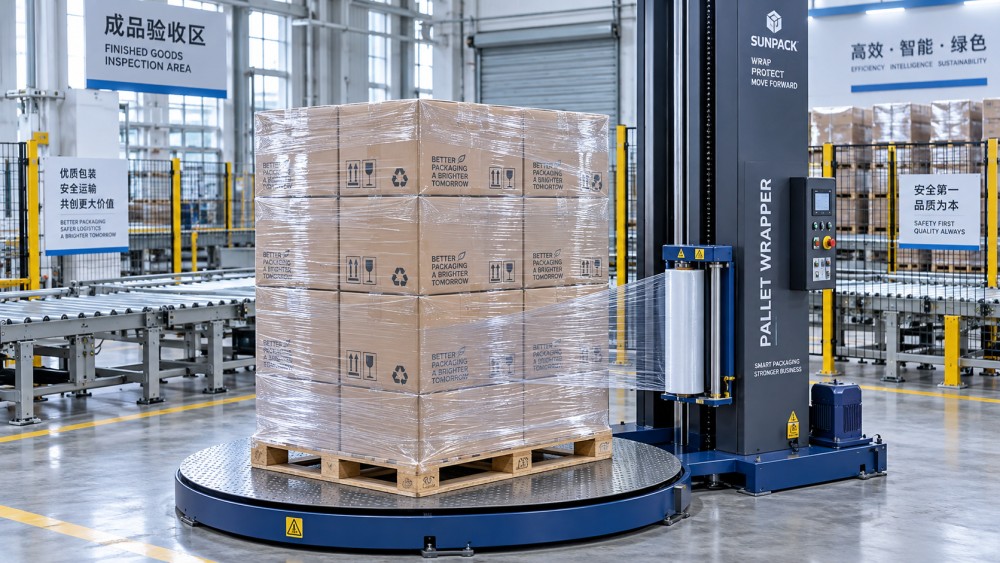
- Turntable wrappers: Often suitable for stable loads that can rotate safely. Check table capacity, load overhang, acceleration control, and access for the handling equipment.
- Rotary arm wrappers: Keep the pallet stationary while the arm travels around it. They can suit unstable loads, but require adequate clearance and a protected operating area.
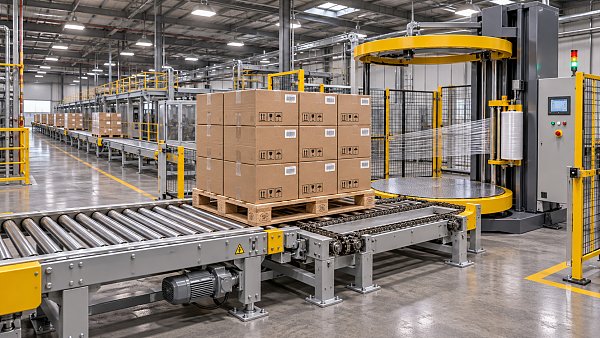
- Rotary ring systems: Can suit demanding automatic applications. Their value depends on required output, wrapping patterns, integration, and maintenance resources.
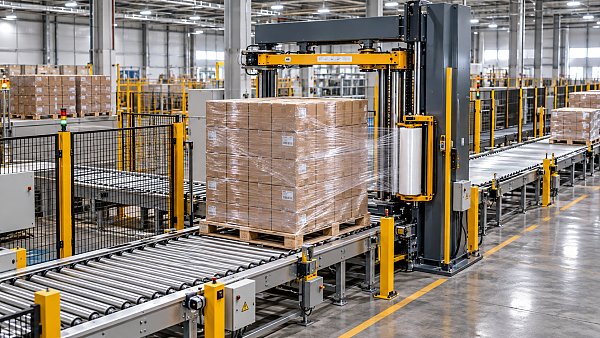
Also define how pallets reach the wrapper. A hand pallet truck may require a suitable ramp or low-profile arrangement. A forklift-fed station needs maneuvering space. Conveyor-fed equipment needs compatible conveyor height, pallet support, and transfer conditions. Check the complete handling route, including where wrapped pallets wait for collection.
Ask what the quoted capacity actually includes
Turntable speed or arm speed does not tell you how many pallets will leave the station in an hour. Usable capacity includes pallet positioning, load detection, wrapping, film cutting, discharge, and the delays between those steps.
Ask the factory to state its output assumptions: load dimensions, wrap recipe, film type, operator involvement, and whether infeed and outfeed time are included. A demonstration using a short, stable load with minimal film coverage says little about performance on a tall stack requiring reinforcement wraps.
The distinction between semi-automatic and automatic operation also needs a clear explanation. Find out who attaches the film, starts the cycle, cuts the tail, and removes the pallet. Automatic wrapping functions do not necessarily mean automatic pallet handling. Labor savings depend on the tasks that disappear from the operator’s routine.
Size the system around peak arrivals and the available buffer space. A wrapper that handles average output may still cause upstream stoppages when several production lines release pallets together. Request a capacity proposal for your expected product mix, including film changes and routine interruptions.
Measure film consumption against load protection
Film is a recurring cost, so the wrapping trial deserves as much attention as the machine quotation. Request film consumption per accepted pallet using a defined load, film specification, and wrapping recipe. Keep those conditions consistent when comparing offers.
A claimed pre-stretch percentage is insufficient evidence of low operating cost. Powered pre-stretch elongates film before application, while application tension determines how tightly the film acts on the load. Film quality, carriage condition, roller grip, overlap, and reinforcement settings all influence the result.
For corrugated cartons, increasing tension may create crushed corners or distorted stacks. Reducing tension too far can allow movement during handling. The useful result is a stable load that retains its shape and uses an appropriate amount of film.
During trials, inspect film distribution at the bottom, middle, and top. Check whether the wrap secures the load to the pallet without obstructing fork entry. Look for loose tails, punctures around sharp edges, and inadequate coverage on irregular stacks. Include handling checks and, where justified by the distribution route, transport testing; a stationary pallet does not demonstrate shipping performance.
Confirm the supported roll dimensions, core size, and film specifications. Ask the supplier to demonstrate adjustment for your preferred film so that an attractive consumption claim does not depend on a consumable that is difficult or costly to source.
Make integration and safety part of the quoted scope
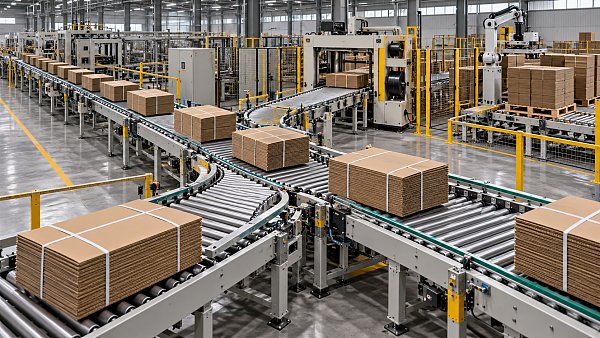
For an inline wrapper, mechanical fit is only one part of integration. The wrapper, conveyors, and palletizing equipment need agreed signals for pallet arrival, readiness, cycle completion, blocked discharge, and faults. Someone must also define how the line restarts after an interruption.
Ask for a layout showing operating clearance, guarding, maintenance access, film loading access, and pallet accumulation. Confirm voltage, frequency, electrical load, compressed-air requirements where applicable, and floor conditions. These details can expose site costs before the equipment is built.
Safety should be reviewed for the complete installed arrangement. A guarded machine can still create hazards at conveyor transfers or access points. Ask the supplier to explain access protection, emergency-stop coverage, safe isolation, and the procedures for clearing film breaks or misplaced pallets. Include documentation and conformity requirements applicable to the installation location in the contract.
Where multiple suppliers are involved, assign responsibility for the complete line’s safety design, controls integration, and commissioning. A written interface schedule helps prevent gaps between the wrapper manufacturer and the conveyor or palletizer provider.
Check what the factory builds and can support
Buying factory direct is useful when it gives you access to the people responsible for design, assembly, testing, and service. Establish which activities the supplier performs internally and which are outsourced. Outsourcing components is common; the supplier still needs control over specifications, quality, and replacement availability.
Request a live walkthrough of assembly and testing, or arrange an inspection appropriate to the order. Focus on the proposed model, its film carriage, control cabinet, drive arrangement, and safety equipment. A general factory video provides limited evidence about the machine you will receive.
Ask for a component list identifying the PLC, HMI, drives, sensors, and other critical parts. Specify that substitutions require written approval. Otherwise, the delivered machine may differ from the configuration used to compare quotations.
Support capability deserves equally concrete questions. Who diagnoses faults? During which hours is help available? Can local technicians obtain drawings, parameter backups, alarm descriptions, and maintenance instructions? Clarify access to passwords, software tools, and replacement programs needed to recover from a controller or HMI failure.
Request a recommended spare-parts package with part numbers, prices, and expected dispatch times. Distinguish ordinary wear items from proprietary assemblies that could stop production. A warranty offers limited protection against downtime if a critical part is difficult to identify or replace.
Compare the cost of an operating installation
Put every offer into the same cost structure. State the delivery term and named place, then identify which party pays for each remaining activity. This prevents a bare machine price from being compared with a quotation that includes installation and training.
For a working comparison, calculate cost per accepted pallet using a common operating period and realistic pallet volume. Include ownership costs, consumables, labor, maintenance, and expected service expenses. An accepted pallet meets the agreed wrapping and load-protection criteria; rewraps should not count as successful output.
Treat labor savings carefully. If an operator still transports pallets, attaches film, and waits nearby, faster wrapping may release only part of that person’s time. Count staffing savings only where the work arrangement supports them.
Likewise, use film savings demonstrated under comparable conditions. Small differences in recurring consumption can matter over time, but they should never be purchased at the expense of load security or carton quality.
Agree on acceptance tests before placing the order
The purchase contract should describe how performance will be demonstrated. A factory acceptance test, or FAT, checks the equipment before shipment. A site acceptance test, or SAT, checks the installed machine with your utilities, operators, and connected equipment.
Build the test around representative loads and the difficult cases within the agreed operating range. Where shipping actual products is impractical, define a substitute that reasonably reproduces their dimensions, weight distribution, surface characteristics, and instability. Record the limitations of that substitute in the test plan.
The acceptance record should cover:
- Successful wrapping of the agreed load range without unacceptable shifting or packaging damage.
- Output under defined handling conditions and wrapping recipes.
- Film consumption and finished-wrap quality using the agreed film.
- Film cutting, tail control, load detection, and recipe changeover.
- Safety functions and recovery from representative faults or interruptions.
- Delivery of drawings, manuals, backups, spare-parts information, and training.
Agree on measurable pass criteria, how failures will be corrected, and which items must be closed before shipment. Link payment milestones to identifiable deliverables. Any outstanding work should have a named responsible party and a completion deadline.
Make the final decision around your ability to operate the machine
A direct factory purchase can make sense when the specification is clear and your team can manage installation, maintenance, and supplier communication. Local service support may justify a higher initial price where downtime is costly or internal technical resources are limited.
Before releasing the order, assemble one approved package: the load specification, layout, component list, scope of supply, interface responsibilities, acceptance plan, delivery terms, and support commitments. Ask each supplier to identify exceptions explicitly. Unanswered assumptions at this stage are likely to become additional costs during commissioning.
Choose the offer that demonstrates acceptable wrapping quality at a credible operating cost and gives your plant a workable route to installation and recovery from faults. The quotation should explain exactly what you are buying and how you will know it performs.
Related News
 How to Choose Carton Counting Systems for Accurate ProductionChoose Carton Counting Systems with confidence. Compare sensors, accuracy, line integration, and testing methods to improve production reliability.Spatial Folding Strategist
 How to Troubleshoot an Automatic Case Erecting MachineTroubleshoot your automatic case erecting machine with practical steps for diagnosing jams, vacuum loss, sensor faults, and sealing issues—and restore reliable operation.Spatial Folding Strategist
 How to Choose Pallet Conveyors for a Packaging LineChoosing pallet conveyors for packaging line operations? Compare load requirements, throughput, layouts and safety to find the right solution.Spatial Folding Strategist
 How to Choose Case Packers for an Automated Palletizing LineChoose Case Packers that keep your palletizing line moving. Compare loading methods, capacity, changeovers, and integration to make a confident investment.Spatial Folding Strategist
 How Inline Pallet Wrappers Fit Into Automated Packaging LinesDiscover how inline pallet wrappers integrate with automated packaging lines, improve load stability, and help prevent costly bottlenecks.Spatial Folding Strategist
 What Affects Bundle Handling System Cost in a Sheet Plant?Bundle handling system cost depends on capacity, layout, automation, and integration. Learn how to compare total costs and choose the right system for your sheet plant.Spatial Folding Strategist