What Determines the Total Cost of an Automatic Case Erecting Machine?
What Determines the Total Cost of an Automatic Case Erecting Machine?
The purchase price of an automatic case erecting machine is only one part of its total cost. A lower upfront quote can lose its appeal once installation, compressed air, sealing consumables, maintenance, and downtime are included. Production speed, case size range, board quality, and integration with existing packaging lines also influence the investment required.
The useful question is not simply “What does the machine cost?” It is “What will it cost to deliver a correctly formed, bottom-sealed case to the next process, at the rate our operation needs?” That distinction helps separate a genuinely economical proposal from one that leaves expensive work outside the quotation.
Start by defining what the quoted machine actually includes
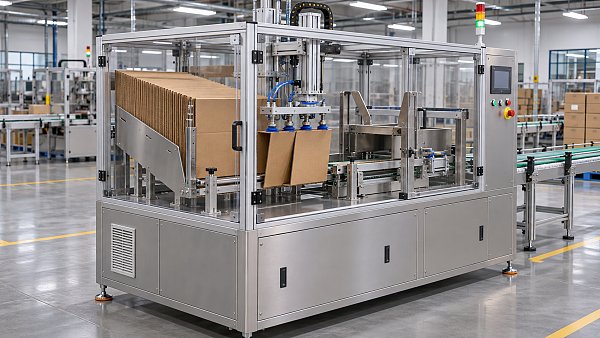
An automatic case erector generally takes flat corrugated blanks from a magazine, opens them, folds the bottom flaps, and seals the base using tape or adhesive. It does not necessarily include case packing, top sealing, or downstream conveying. “Automatic” also does not mean unattended: blanks must be replenished, consumables replaced, and faults cleared.
Supplier proposals may draw different boundaries around the same application. One may include discharge conveyors, extended blank storage, low-level warnings, and commissioning. Another may cover only the core machine. Before comparing prices, request an itemized scope that distinguishes included equipment, options, site responsibilities, and exclusions.
This system-level view reflects the approach of Global Commercial Print & Corrugated Packaging Intelligence (CPCS): packaging equipment should be assessed through its production conditions and long-term operating requirements, not its purchase price alone.
Capacity costs more when the application becomes demanding
Rated speed affects machine design, but a headline cases-per-minute figure is not enough to size the investment. Ask which case dimensions, board specifications, sealing method, and operating conditions support that rating. A demonstration on an easy-to-handle case does not establish performance across your full packaging range.
The requirement should come from downstream demand, peak production periods, and the available operating window. Buying excess speed adds capital without necessarily increasing shipments. Buying too little capacity can constrain the packing line or require additional operating hours.
Size range and changeovers can matter more than maximum speed
A facility running one case format for long campaigns has different needs from an operation switching frequently between small and large cases. Wider size ranges, powered adjustments, recipe storage, and automatic format changes can increase the initial price. They become useful when they reduce recurring setup work or adjustment errors.
Check the complete length-width-height combinations, not just the minimum and maximum for each dimension separately. A case can fall within three published limits yet still require application review because of its proportions or flap geometry. Confirm blank orientation, joint position, and required machine hand as well.
Evaluate changeover from the last acceptable case of one format to the first acceptable case of the next. Include guide adjustments, blank loading, sealing checks, and trial cases—not merely the time needed to select a recipe.
Corrugated blank quality changes the economics
The case blank is part of the operating system. Warp, inconsistent scoring, dimensional variation, damaged edges, and uneven joints can interfere with blank separation, opening, and flap folding. Vacuum pickup also depends on the board surface and the condition of the suction components.
A low-cost blank is not necessarily economical if it causes repeated stops or requires manual correction. Equally, purchasing a more sophisticated erector will not automatically compensate for uncontrolled converting quality. Equipment and corrugated suppliers need an agreed, achievable material specification.
Provide representative production blanks for trials, including difficult formats and material from normal supply sources. Where relevant, include blanks exposed to expected storage conditions. Ask suppliers to record the material specification and adjustments used during testing so that acceptance results remain meaningful.
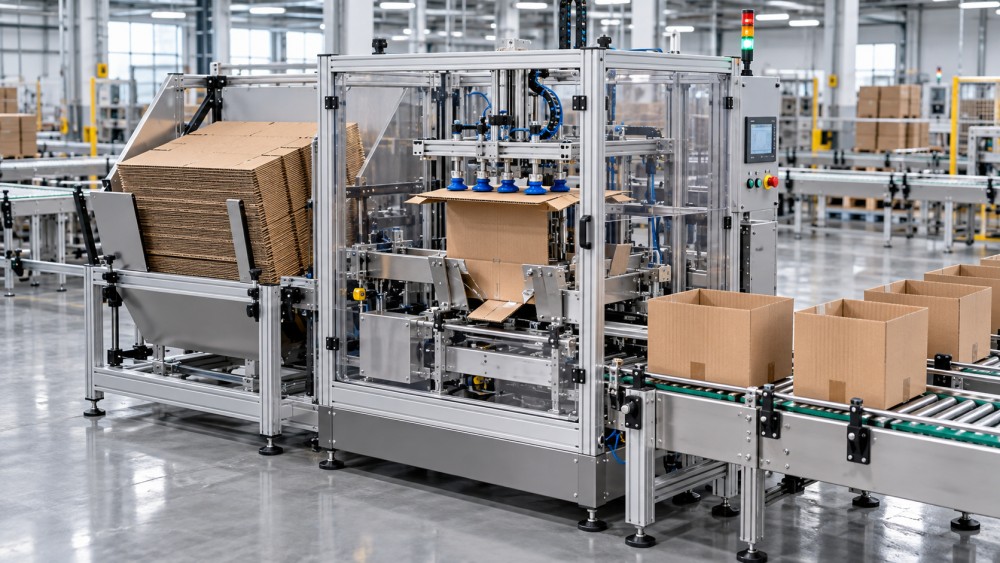
Trials should follow the full sequence from magazine feeding through squaring, flap folding, bottom sealing, and discharge. A case that opens successfully can still leave the machine out of square or with an unacceptable seal, creating handling problems at the packing station.
Sealing, utilities, and labor create recurring costs
Tape and hot-melt adhesive require different cost models. Tape consumption depends on the applied length, including the end tabs, plus losses during setup and roll replacement. Compare specified tape grades, widths, roll lengths, and compatibility—not just the price of a roll.
Hot-melt systems introduce adhesive consumption, heating energy, warm-up requirements, and applicator maintenance. Adhesive selection must suit the board surface and service conditions. Neither method is universally cheaper; calculate consumption per accepted case and validate seal performance against the intended load and distribution environment.
Electricity is only part of the utility bill. Pneumatic cylinders and air-driven vacuum generation may make compressed air a material operating expense. Request consumption at a stated production rate and supply pressure, with the measurement basis identified. Installed electrical power is not the same as average energy use.
For compressed air, assess available capacity, pressure stability, air quality, and distribution losses. If additional compressor or treatment capacity is needed, it belongs in the project budget rather than becoming a surprise after delivery.
Labor savings also need careful treatment. Automatic forming can reduce manual erection work, but replenishment, inspections, changeovers, and fault recovery remain. Count labor as a cash saving only where staffing costs can actually change. Otherwise, describe the benefit as redeployed capacity, reduced overtime, or improved handling consistency.
Installation and integration can change the quoted budget
A standalone machine price rarely captures the full installed cost. Freight, insurance, unloading, rigging, electrical work, air connections, and commissioning should be assigned explicitly. For imported equipment, confirm delivery terms, customs responsibilities, applicable duties, currency exposure, and local technical requirements.
Layout review should cover more than the machine footprint. Operators need space to load blanks and consumables. Maintenance staff need access to drives, valves, sensors, and sealing assemblies. A compact arrangement that blocks servicing can create recurring downtime costs.
At the line interface, establish conveyor heights, case orientation, transfer geometry, accumulation, and control responsibilities. The erector must respond appropriately when downstream equipment stops. Without suitable coordination, additional speed may simply produce blocked discharge and repeated restarts.
Safety responsibilities also need written boundaries. Connecting equipment can change access points and emergency-stop arrangements. Confirm who performs the integrated risk assessment and supplies the documentation required for the destination market. A machine-level declaration should not be assumed to resolve every line-level obligation.
Maintenance support affects the cost of lost production
Wear parts such as suction cups, belts, cutters, and sealing-head components should appear in the ownership model. Request a recommended spares list, maintenance schedule, and prices for commonly replaced assemblies. Separate routine consumables from components whose failure would stop production.
Serviceability matters alongside parts prices. Can technicians reach the relevant components without extensive dismantling? Are fault messages useful? Are electrical drawings, pneumatic diagrams, backups, and parts references supplied? Proprietary assemblies may be justified, but their lead times and replacement costs should be visible before purchase.
Assess support against the actual shift pattern. Confirm service hours, remote-access conditions, technician travel charges, and local spare-parts availability. A warranty can limit certain repair expenses without covering lost production, consumables, or every service visit.
Avoid treating every stopped minute as lost revenue. If a buffer absorbs a short interruption, the commercial impact may be limited. If the erector stops the only packing line during a constrained shipping window, recovery labor or overtime may be substantial. Use the plant’s real operating constraints.
Build the comparison around cost per acceptable case
Use one evaluation period and one set of production assumptions for all suppliers. A practical lifecycle model includes equipment, installation, integration, training, utilities, consumables, labor, maintenance, and attributable disruption costs, less any justified residual value. Discount future cash flows where required by company investment policy.
Cost per acceptable case = total relevant ownership cost over the evaluation period ÷ acceptable cases delivered during that period.
Keep accounting boundaries consistent. If blank purchase cost is excluded because it is common to every option, still include differences in damaged blanks and startup waste. Avoid counting the same downtime consequence twice as both lost contribution and recovery expense.
Test the model against changes in annual volume, format mix, labor deployment, consumable prices, and availability. A machine justified by continuous production may look different under intermittent demand. Sensitivity analysis shows whether the decision depends on one optimistic assumption.
Before approval, turn uncertain assumptions into written acceptance conditions:
- Agreed case formats and board specifications for factory and site trials.
- Sustained acceptable output, with test duration and stoppage definitions specified.
- Case squareness, flap condition, and bottom-seal acceptance criteria.
- Changeover scope, staffing requirements, and included training.
- Utility conditions, integration deliverables, and responsibility for unresolved faults.
The strongest proposal is not necessarily the cheapest or fastest automatic case erecting machine. It is the one whose installed scope, material compatibility, operating costs, and support arrangements withstand scrutiny. Resolve those points before issuing the purchase order; they are much harder to negotiate once the equipment is on the floor.
Related News
 How to Choose Carton Counting Systems for Accurate ProductionChoose Carton Counting Systems with confidence. Compare sensors, accuracy, line integration, and testing methods to improve production reliability.Spatial Folding Strategist
 How to Troubleshoot an Automatic Case Erecting MachineTroubleshoot your automatic case erecting machine with practical steps for diagnosing jams, vacuum loss, sensor faults, and sealing issues—and restore reliable operation.Spatial Folding Strategist
 How to Choose Pallet Conveyors for a Packaging LineChoosing pallet conveyors for packaging line operations? Compare load requirements, throughput, layouts and safety to find the right solution.Spatial Folding Strategist
 How to Choose Case Packers for an Automated Palletizing LineChoose Case Packers that keep your palletizing line moving. Compare loading methods, capacity, changeovers, and integration to make a confident investment.Spatial Folding Strategist
 How Inline Pallet Wrappers Fit Into Automated Packaging LinesDiscover how inline pallet wrappers integrate with automated packaging lines, improve load stability, and help prevent costly bottlenecks.Spatial Folding Strategist
 What Affects Bundle Handling System Cost in a Sheet Plant?Bundle handling system cost depends on capacity, layout, automation, and integration. Learn how to compare total costs and choose the right system for your sheet plant.Spatial Folding Strategist