What Determines Palletizer Robot Price and Total Cost of Ownership
For a finance approver, the quoted palletizer robot price is useful only as a boundary marker. It does not establish the capital requirement, the operating burden, or the likely return. A low robot quote can become an expensive project when the line needs custom handling, upstream modifications, safety redesign, or extended commissioning. A higher initial quote can be financially stronger when it removes unstable manual work, handles a wider product mix, and remains usable after volumes or pallet patterns change.
The most reliable way to assess a robotic palletizing proposal is to separate the investment into three questions: what capability is being purchased, what must be added to make that capability run in the plant, and what costs or savings will recur through its working life. The robot arm is only one part of that answer.
Why palletizer robot quotes differ so widely
Two systems described as “robotic palletizers” may have very different technical and commercial scopes. One may be a standard robot cell loading uniform corrugated cases onto a single pallet size. Another may include automatic pallet supply, slip-sheet handling, multiple infeed lanes, barcode-driven pattern selection, stretch wrapping interfaces, guarding, controls integration, and recipe management for frequent job changes. Comparing their headline prices without normalizing the scope leads to weak approval decisions.
Payload and reach are among the first cost drivers, but they should be read together. A robot that can lift a heavy bundle may still be unsuitable if its reach cannot serve the required pallet positions, conveyor location, and tool clearance. Conversely, selecting substantially more payload and reach than the application requires can increase capital cost, energy demand, footprint, and the mass of the end-of-arm tooling. The relevant question is not the maximum carton weight in isolation. It is the combined weight of the load, gripper, adapters, and any sheets or trays carried during the cycle, with an appropriate operating margin.
Required throughput also changes the architecture. A line with a consistent, moderate output may be served by one robot operating a straightforward pallet pattern. High-speed finishing or corrugated operations may need rapid layer building, dual pick capability, multiple discharge positions, buffering, or more than one robot. The financial risk is often not that the robot cannot reach an advertised cycle rate under ideal conditions; it is that the rest of the line cannot present products in a stable, oriented, gap-controlled flow at that rate.
Gripper design frequently explains a meaningful part of the difference between proposals. Vacuum tooling, clamp grippers, fork-style tools, layer grippers, and mixed-mode designs each have a valid place. The appropriate choice depends on carton strength, surface condition, product dimensions, pack stability, permeability, and whether the robot must pick one case, several cases, or a full layer. A low-cost gripper that struggles with dusty board, irregular case closures, damaged edges, or changing box sizes can create stoppages that erase the projected labor saving.
For carton plants and commercial print finishing departments, product variation is especially important. Short runs and frequent changes can turn a technically capable cell into a poorly utilized asset if every new format requires lengthy mechanical adjustment or programming intervention. Proposals should state which dimensions, weights, pallet patterns, and product constructions are covered by the quoted configuration, rather than describing flexibility as an unqualified feature.
Safety is another major variable that is sometimes hidden in early comparisons. Fencing, doors with interlocks, scanners, light curtains, safety-rated controls, access arrangements, and emergency-stop integration are not optional add-ons to be minimized. Their final form depends on cell layout, traffic routes, manual intervention points, pallet jack or forklift activity, and local site requirements. A compact layout can be attractive on a drawing while leaving insufficient access for clearing faults, replenishing pallets, or maintaining conveyors.
The purchase order is rarely the full installed cost
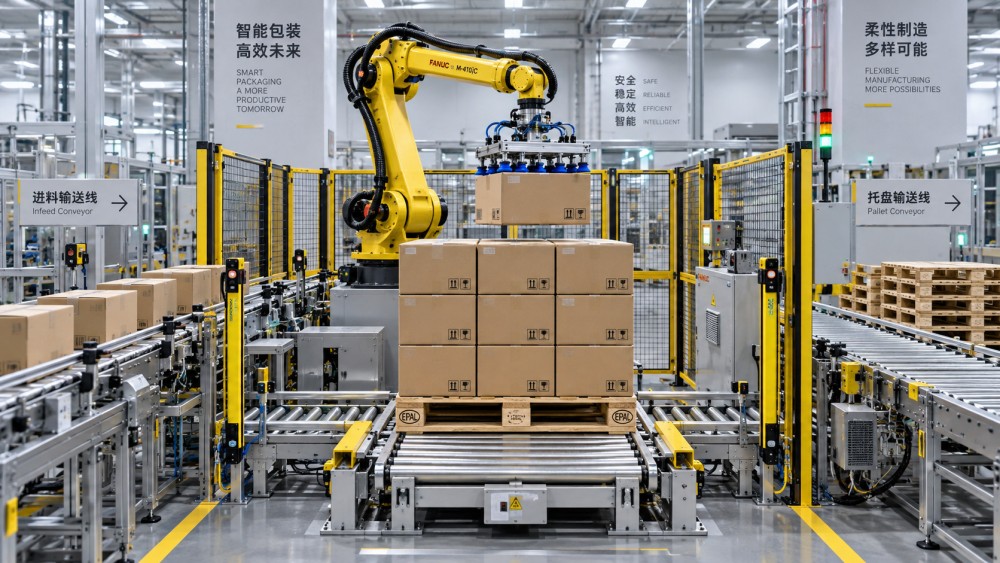
Finance reviews should treat the robot, tooling, controls, and material-handling equipment as a connected installation. The delivered system needs to receive product reliably, form a stable pallet, release completed loads, and exchange status with the surrounding equipment. Cost omissions most often appear at those interfaces.
A well-defined capital request should identify whether the quoted scope includes the following elements:
- Infeed and accumulation conveyors, product orientation, spacing, and transfer devices.
- Pallet dispensing, pallet conveyors, pallet centering, and removal of completed loads.
- Slip-sheet, top-frame, edge-protection, or other load-stabilization equipment where required.
- End-of-arm tooling, spare wear parts, change parts, and tools for the formats expected during the asset life.
- Electrical distribution, compressed air, network connection, controls cabinets, and plant-floor cabling.
- Machine guarding, safety validation, floor markings, access provisions, and changes to nearby traffic flow.
- Integration with the upstream machine, warehouse management functions, labeling, wrapping, or traceability systems.
- Freight, rigging, installation, site acceptance, operator training, and production ramp-up support.
These items do not all need to be supplied by the same vendor. They do need a named owner and a budget line. A split-scope project can be economical when internal engineering capability is strong and interface responsibilities are controlled. It can also create disputes when a missed cycle, unstable transfer, or communication fault sits between suppliers. A finance approver should ask for an interface schedule that identifies equipment boundaries, control handshakes, acceptance responsibilities, and the party responsible for resolving a fault that crosses those boundaries.
Building readiness deserves equal attention. Floor loading, slab condition, available height, power capacity, compressed-air quality, fire protection clearances, and material routes can affect both schedule and cost. In an operating packaging plant, the shutdown required to rearrange conveyor paths or install guarding may be more economically significant than a modest difference in robot purchase price. The proposal should distinguish planned installation time from the period in which the line is expected to run at reduced capacity.
Calculate total cost of ownership around uptime and changeover
Total cost of ownership is not a single supplier figure. It is a decision model constructed from stated assumptions. Over the chosen evaluation period, the model should include capital expenditure, commissioning losses, energy, planned maintenance, repairs, software or support commitments where applicable, training, consumable tooling components, and the cost of residual manual intervention. It should also include the value of the labor and capacity that the system is expected to release.
Labor savings are often the largest benefit, but they should not be modeled as a simple headcount multiple. A robotic cell may reduce the number of people required at a physically demanding station while the facility continues to retain personnel for material supply, quality checks, exception handling, and other production tasks. The financial benefit depends on whether hours are actually removed from overtime, temporary labor, vacancies, reassigned work, or future hiring needs. The approval case is stronger when the labor baseline is built from documented shift coverage, loaded employment cost, absenteeism exposure, and the time workers spend on the task that will be automated.
Uptime assumptions need similar discipline. Robot availability alone is not enough. The system’s effective output depends on case supply, pallet availability, sensor reliability, gripper performance, product quality, and the time needed to recover from jams or damaged cartons. A model based on the upstream line’s theoretical maximum speed will overstate benefits if the line spends significant time in job changeover, waiting, maintenance, or quality holds.
For this reason, a useful financial model begins with the actual palletizing demand by shift: average and peak case flow, case weights, format mix, order lengths, pallet patterns, and the hours during which product is available. It then applies realistic allowances for scheduled changeovers, planned maintenance, operator breaks, and expected interruptions. This approach may produce a lower annual savings estimate than an optimistic vendor calculation, but it provides a better basis for comparing alternatives.
Questions that expose weak return calculations
- Is the proposed rate sustained across the expected carton range, or demonstrated only with one favorable case size?
- How often will the gripper, pallet pattern, or settings require a change, and who can complete that change?
- What happens when a case is damaged, misoriented, underfilled, or outside dimensional tolerance?
- Does the design permit manual palletizing during a robot fault without creating a new safety or flow problem?
- Which labor hours disappear from the cost base, and which hours remain for replenishment and exceptions?
- What production loss is assumed during installation and commissioning?
- Are routine preventive-maintenance tasks included in the plant’s existing maintenance capacity?
Flexibility has value only when it is specified
Finance teams are often asked to approve additional cost for “future-proofing.” That request can be justified, but only when it is connected to credible operational needs. Extra pallet positions, an oversized robot, additional gripper functions, or software options may protect future capacity. They may also become unused complexity. The distinction is whether the option solves an identified probable change, such as a planned new product format, a second production line, a different pallet standard, or a shift toward smaller, more frequent orders.
Ask suppliers to define flexibility in operational terms. Which formats can run without hardware changes? Which require a stored recipe, a gripper adjustment, an operator-installed change part, or engineering support? How long does each type of change take? Can a new pallet pattern be created by trained plant personnel, and does it require safety revalidation? These details affect annual capacity and support cost far more than a generic claim that a robot is programmable.
In corrugated packaging, load quality also matters beyond the cell boundary. Pallets must remain stable through wrapping, warehouse movement, and customer delivery. A robot can build a geometrically correct pattern while still producing an unstable load if case compression strength, interlocking arrangement, overhang, pallet condition, or wrap specification are not controlled. If returned or damaged loads are a material cost, the approval should include acceptance criteria for pallet stability, not simply a count of cases placed per minute.
Use acceptance criteria before approving the budget
The most effective protection against cost escalation is a measurable specification before the order is placed. It should describe the products to be handled, operating speeds, pallet configurations, interfaces, utilities, safety scope, data requirements, and site responsibilities. It should also define what proves that the system has met its intended purpose.
A practical acceptance plan usually separates factory testing from site acceptance. Factory testing can confirm motion sequences, control logic, selected product handling, and safety functions before shipment. Site acceptance should verify performance within the actual line, using representative cartons, pallets, labels, and normal operating conditions. Throughput, changeover time, fault recovery, load quality, and operator access should all be assessed against agreed conditions. A quoted rate without an agreed test method leaves too much room for interpretation.
The supplier’s support model should be examined as part of ownership cost. Finance does not need a promise of universal support; it needs clarity on response channels, spare-parts strategy, remote diagnostic access, training boundaries, software backup ownership, and the expected competence required from the plant maintenance team. A cell that depends on external intervention for routine recovery can carry a recurring cost and operational risk that was absent from the capital justification.
The best approval decision does not select the lowest palletizer robot price or automatically select the most elaborate automation package. It selects a defined system whose installed scope, attainable output, labor effect, and maintenance burden match the plant’s actual operation. When those assumptions are visible in the budget, finance can judge the investment as an operating asset rather than a robot quotation.
Related News
 How an Automatic Folder Gluer System Reduces Carton Setup ErrorsAutomatic folder gluer system solutions reduce carton setup errors with precise feeding, folding, glue control, and compression. Discover how to improve quality and changeovers.Spatial Folding Strategist
 How to Choose a Folder Gluer Machine for Folding CartonsChoose the right folder gluer machine for folding cartons with proven guidance on speed, carton styles, glue quality, automation, testing, and lifecycle costs.Spatial Folding Strategist
 When Chain Pallet Conveyors Improve Warehouse Flow and ThroughputChain pallet conveyors improve warehouse flow by reducing forklift delays, adding controlled accumulation, and protecting packaging throughput. Discover when they deliver the strongest ROI.Spatial Folding Strategist
 How to Compare Automatic Strapping Machine Price and Total CostAutomatic strapping machine price comparison made simple: evaluate installation, throughput, consumables, labor, downtime, and total cost for a smarter investment.Spatial Folding Strategist
 What to Compare When Choosing a Pallet Wrappers SupplierCompare a pallet wrappers supplier by load stability, film efficiency, automation integration, service support, and total cost to choose the right solution.Spatial Folding Strategist
 How an Automatic Case Erecting Machine Reduces Packing DelaysAutomatic case erecting machine solutions reduce packing delays by delivering consistent, sealed cases, improving line flow, uptime, and end-of-line efficiency.Spatial Folding Strategist