What Determines Palletizer Robot Price and Long-Term ROI
What Determines Palletizer Robot Price and Long-Term ROI
A palletizing robot is often discussed as a labor-saving purchase, but that description is too narrow for a packaging plant investment review. In corrugated box plants, folding-carton operations, commercial print finishing departments, and distribution areas, the real question is not simply “What is the palletizer robot price?” It is whether the complete system can keep pace with production, handle the actual product mix, fit the available floor space, and continue running without creating a new bottleneck at the end of the line.
Two robotic palletizing proposals can look similar on paper and still have very different commercial outcomes. One may be a straightforward case-packing line with stable carton dimensions and a single pallet pattern. The other may need to process short runs, mixed carton sizes, slip sheets, multiple pallet formats, printer or vision-system handshakes, and frequent changeovers from a folder gluer or flexographic converting line. The robot arm is only part of the cost. Grippers, conveyors, guarding, controls, programming, and commissioning often determine whether the investment is modest, manageable, or unexpectedly complex.
The Robot Is Not the Whole Palletizing System
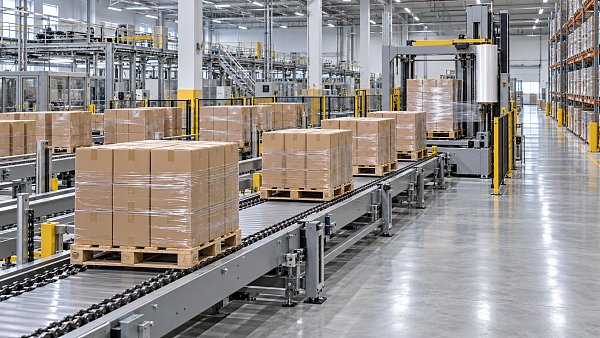
A common budgeting mistake is to compare the quoted price of a robot arm with the price of a completed palletizing cell. The arm is the most visible component, but a working end-of-line solution normally includes the end-of-arm tool, infeed conveyor arrangement, pallet dispensing, safety fencing or other safeguarding, controls integration, and software logic for pallet patterns and fault recovery. Depending on the process, it may also include pallet conveyors, stretch wrapping coordination, label verification, barcode scanning, reject handling, and production-data connectivity.
For a carton factory, the interface with upstream equipment deserves special attention. A flatbed die-cutter, folder gluer, rotary die-cutter, or case erector may release products in a way that is not immediately suitable for robotic picking. Cartons can arrive shingled, unstable, skewed, bundled, or separated by gaps that vary with machine speed. If the product presentation is poor, the palletizer needs additional singulation, accumulation, squaring, or orientation equipment. That work can add substantially to the project scope, yet it is frequently missed in early estimates.
For this reason, a useful comparison asks for a line-item view of the scope: robot, tooling, material handling, safety, electrical controls, integration, installation, training, and support. A lower initial palletizer robot price may not remain lower once the omitted interfaces are added.
Payload, Reach, and Speed Drive the Hardware Choice
Robot selection starts with the load at the wrist, not just the weight of one carton. The calculation must include the heaviest product, the gripper itself, any layer sheet or separator handled by the same tool, and a reasonable allowance for operating conditions. A robot that is technically capable of lifting the load but operates close to its limit may restrict speed, reach, or future product flexibility. That is not automatically a bad choice, but it should be a deliberate trade-off rather than an accidental one.
Reach matters in the same way. A robot serving two pallet positions, an infeed, and a slip-sheet magazine may require a larger working envelope than a single-pallet cell. Long reaches can affect cycle performance and dictate the physical layout. In a tight converting hall, a compact robot might save floor space but require a more elaborate conveyor arrangement. In a new-build facility, a larger cell with clear material flow may cost more initially while being easier to operate and maintain over time.
Speed should be assessed using the actual pallet pattern and the upstream machine’s realistic output, not a headline cycle figure. A robot may achieve fast individual movements in a demonstration, but production performance is shaped by pick position, load stability, turning motions, pallet changes, layer-sheet handling, and the time needed to correct a misaligned case. Corrugated cases with variable moisture or inconsistent squareness can behave very differently from rigid consumer-goods cartons. Plants should test the duty cycle against their own SKU mix wherever possible.
End-of-Arm Tooling Can Decide Whether Automation Works
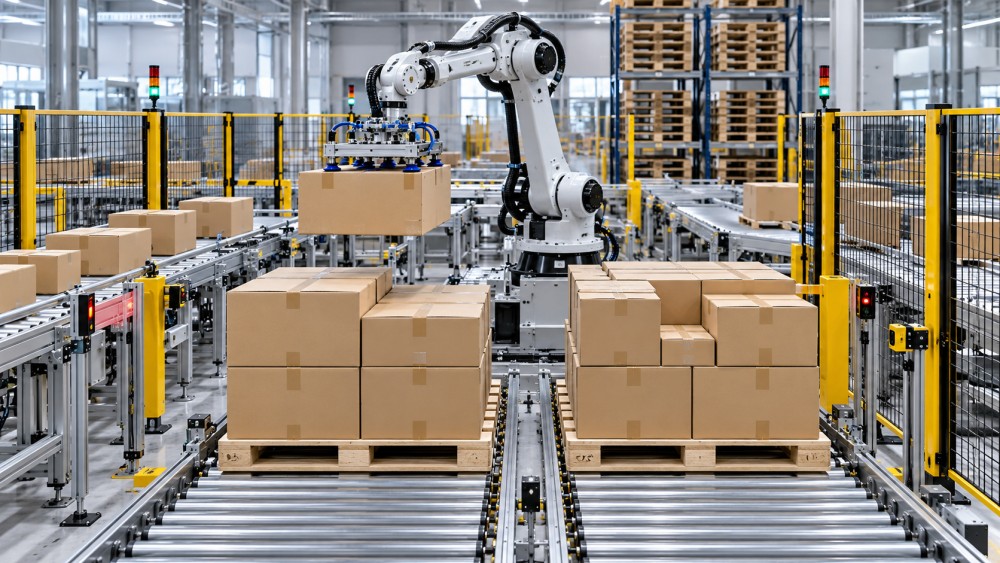
The gripper is where packaging variation becomes a mechanical reality. Vacuum tooling can be effective for many sealed corrugated cases and flat sheet materials, but its performance depends on carton surface condition, porosity, dust, leakage, and reliable vacuum generation. Clamp-style tools may suit certain bundles or cases, though they need careful force control to avoid crushing lightweight board. Fork tools are useful for layer handling in some applications, while combination tools can pick cases and manage slip sheets with fewer tool changes.
A highly flexible gripper can reduce changeover effort, but flexibility has a price. It may be heavier, more complicated to maintain, and less optimal for one dominant product format. Conversely, a simple dedicated tool can be very reliable when a plant runs a narrow range of carton sizes. Business evaluators should avoid paying for maximum flexibility if the commercial plan does not require it. They should also avoid specifying a narrow tool solely because current production is stable when sales teams are already introducing new pack formats.
The right discussion is not “standard versus custom” in the abstract. It is whether the tooling can safely pick the weakest, lightest, tallest, or most irregular product that the plant expects to ship. This is particularly important for e-commerce-ready corrugated packaging, display cartons, and lightly filled cases, where product geometry may change faster than the palletizing area was designed to accommodate.
Integration Complexity Is Often the Largest Unknown
In packaging automation, integration risk usually sits at the boundaries between machines. The palletizer must know when product is available, whether it is correctly oriented, which pallet recipe is active, when a pallet is full, and what should happen during an upstream stoppage. If a coding or traceability system is involved, the logic may also need to confirm product status before pallet release. If vision inspection rejects defective cartons upstream, accumulation control needs to prevent gaps from causing unstable layer formation.
Older plants can be more difficult than new facilities because existing equipment may have limited controls documentation, outdated communication capabilities, or unreliable product flow. That does not make retrofitting unsuitable. It means the site survey needs to be serious. Electrical capacity, compressed-air quality, floor condition, machine access, forklift routes, ceiling obstructions, and emergency-stop architecture can all affect the eventual installed cost.
A supplier should be asked to identify assumptions rather than simply issue a broad quotation. For example: Who supplies the upstream accumulation conveyor? Who owns safety validation for the combined line? How are recipe changes authorized? What happens if the stretch wrapper stops? Who is responsible for connecting the cell to a plant production-management system? Clear ownership prevents the familiar situation where equipment is delivered but no party accepts responsibility for the final interface.
How to Evaluate ROI Beyond Direct Labor Savings
Labor cost is usually the starting point for ROI, especially where repetitive pallet building is difficult to staff or has high turnover. But direct headcount reduction is not the only return. Manual palletizing can become an unstable constraint when upstream output rises, breaks vary by shift, or operators are reassigned to more urgent tasks. A robot can provide more consistent pallet patterns, predictable handoff to wrapping or warehousing, and less exposure to repetitive lifting work.
The less obvious gains should still be tested carefully. Better stack quality may reduce pallet damage in transport, but only if the pallet recipe, case quality, and wrapping process are all suitable. Reduced line stoppages may improve output, but only if accumulation capacity is adequate. Faster changeovers may help short-run work, but only if operators can select and verify recipes without excessive intervention. A credible business case assigns value only to benefits the plant can explain and measure after commissioning.
Uptime Depends on Serviceability, Not Just Robot Reliability
Industrial robots have a reputation for reliable repetitive operation, but the cell around the robot often causes the practical downtime: worn vacuum cups, damaged sensors, conveyor tracking problems, pallet dispenser jams, poorly adjusted guides, or product inconsistency from upstream. A robust cell makes these issues visible and easy to resolve. It provides safe access, sensible component placement, usable alarms, and clear recovery procedures for operators.
Service support should be assessed in operational terms. Can the plant obtain critical spare parts within an acceptable timeframe? Are trained technicians available locally or remotely? Will the integrator provide electrical drawings, pneumatic diagrams, software backup arrangements, and a clear preventive-maintenance schedule? A low-cost system that cannot be restored quickly after a controls fault can become expensive during a high-volume production period.
This is also where a platform such as Global Commercial Print & Corrugated Packaging Intelligence can be useful: not as a substitute for a site-specific engineering review, but as a way to compare how robotic palletizing connects with converting equipment, inspection systems, coding, plant data, and broader end-of-line automation. The commercial value of a palletizer is easier to judge when it is viewed as part of the production system rather than as an isolated machine.
Questions That Make Supplier Quotes Comparable
Before comparing proposals, define the operating conditions in writing. Include carton dimensions and weights, pallet sizes, required patterns, anticipated SKU changes, desired output, shift operation, available space, and downstream handling. If products vary substantially, provide samples or representative drawings. A quote built around a “typical case” may be misleading when the difficult cases are the ones that disrupt production.
It is also worth asking suppliers to separate guaranteed scope from optional scope. Clarify whether factory acceptance testing will use actual products, what conditions apply to site acceptance, which party provides pallets and consumables for trials, and whether programming for future recipes is included. These details are less exciting than robot specifications, but they are where capital projects tend to gain or lose control.
The best palletizer robot price is rarely the lowest line on a quotation. It is the cost of a system that matches the plant’s real product flow, can be supported over its operating life, and has a defensible return based on labor, output stability, and logistics requirements. When the scope is transparent, the ROI discussion becomes much less about guessing at automation benefits and much more about deciding which risks the project is genuinely designed to remove.
Related News
 What to Check Before Ordering Pallet Wrappers Direct From a FactoryBuying from a pallet wrappers factory? Check load compatibility, output, film costs, safety, and support before ordering. Use this checklist to avoid costly mistakes and buy with confidence.Spatial Folding Strategist
 How an Automatic Folder Gluer System Reduces Carton Setup ErrorsAutomatic folder gluer system solutions reduce carton setup errors with precise feeding, folding, glue control, and compression. Discover how to improve quality and changeovers.Spatial Folding Strategist
 How to Choose a Folder Gluer Machine for Folding CartonsChoose the right folder gluer machine for folding cartons with proven guidance on speed, carton styles, glue quality, automation, testing, and lifecycle costs.Spatial Folding Strategist
 When Chain Pallet Conveyors Improve Warehouse Flow and ThroughputChain pallet conveyors improve warehouse flow by reducing forklift delays, adding controlled accumulation, and protecting packaging throughput. Discover when they deliver the strongest ROI.Spatial Folding Strategist
 How to Compare Automatic Strapping Machine Price and Total CostAutomatic strapping machine price comparison made simple: evaluate installation, throughput, consumables, labor, downtime, and total cost for a smarter investment.Spatial Folding Strategist
 What to Compare When Choosing a Pallet Wrappers SupplierCompare a pallet wrappers supplier by load stability, film efficiency, automation integration, service support, and total cost to choose the right solution.Spatial Folding Strategist