What Causes Bundle Handling Systems to Jam, and How Can You Prevent It?
Bundle Handling Systems usually jam when the machine loses control of bundle shape, bundle timing, or bundle traction. In practice, the stoppage often starts earlier than the visible pile-up. A slightly skewed bundle leaving a folder gluer, a compression belt that has polished smooth, glue mist on a photoeye lens, or side guides set for the wrong board grade can each create a small tracking error. At high line speed, that error compounds within seconds and turns into a jam at a transfer, a turn section, a stacker infeed, or a discharge conveyor.
The most effective way to prevent recurring jams is to separate the fault into three questions: was the bundle formed correctly, was it handed off at the correct moment, and did the receiving section have enough grip and clearance to carry it forward? That approach avoids a common maintenance trap, where attention goes only to the final blocked point while the actual cause remains upstream.
When the bundle itself is unstable
A bundle that is too loose, too soft at the edges, or inconsistent in count will behave differently each cycle. Corrugated and printed carton bundles are especially sensitive because board caliper, moisture, warp, coating, and fresh glue all affect friction and stiffness. A bundle built from dry, flat blanks may run cleanly, while a bundle of the same dimensions made from lightly warped or recently glued material may shift under acceleration or compress unevenly under hold-down pressure.
One frequent cause is poor squareness coming out of the forming or counting section. If one side of the bundle leads by only a few millimeters, the leading corner can strike a guide rail, stop dog, side clamp, or transfer nose. Operators may describe this as a random jam, but the machine is often repeating the same geometry error. The correct fix is usually mechanical alignment or bundle forming correction, not simply increasing drive torque.
Compression settings also matter. Excessive top pressure can deform lighter board grades so the lower layers drag while the upper layers continue moving. Too little pressure lets the bundle open slightly and catch at the next transition. If the machine handles both solid board cartons and heavier corrugated packs, one setting rarely suits every job. Preventive work here means recording pressure ranges by substrate family, not relying on a single “safe” setting left over from the previous run.
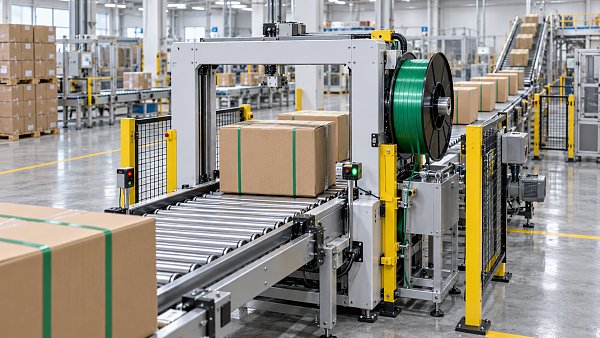
Strap-ready or wrapped bundles add another failure mode. If bundle edges are not flush before entering a squaring or strapping area, the strap can shift load distribution and create a banana-shaped pack. That distorted bundle may clear one section and jam later at a narrow guide or accumulation lane.
Transfer points create most hard stops
The handoff between two conveyors, between belts and rollers, or from a compression section into a dead plate is where many jams become visible. These zones are unforgiving because the bundle temporarily loses full support. Even a small lip, worn transfer plate, loose fastener head, or dented nose bar can catch the leading edge of paperboard.
Dead plates deserve close inspection during service calls. They often look acceptable at a glance, yet the problem may be a polished burr, a slight vertical mismatch, or adhesive contamination that increases drag only when warm. Stainless plates can wear into shallow grooves; UHMW or similar wear strips can mushroom at the edges; mounting screws can settle after repeated impact. None of those defects need to be dramatic to stop a fast-moving bundle.
Roller-to-belt transitions introduce a different issue. If the gap is too wide, narrow bundles may dip. If belt speed and roller surface speed are mismatched, the bottom layers can hesitate while the top continues under inertia. On short bundles, this can present as fishtailing; on longer bundles, the result may be a buckle near the center.
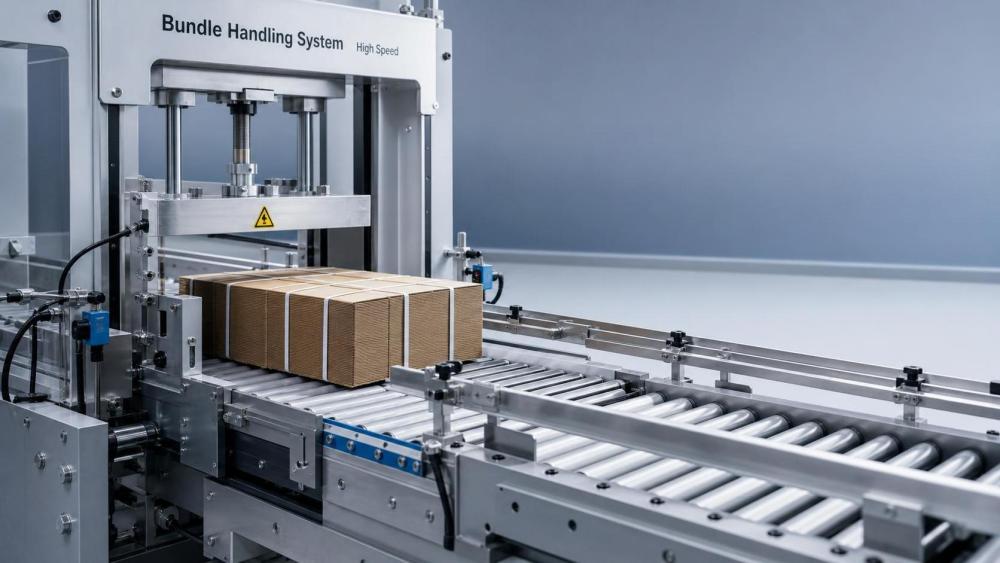
Prevention at transfer points is mostly dimensional discipline. Verify parallelism, height match, gap width, and support condition with the machine stopped, then confirm dynamic behavior at production speed. A section that looks aligned at crawl speed may still fail when vibration, belt tension, and bundle momentum increase. Slow-motion video is often useful because it shows whether the leading edge dives, bounces, or slews sideways during the handoff.
Timing faults are often mistaken for mechanical blockage
Bundle Handling Systems depend on clean timing between upstream discharge and downstream acceptance. If a metering gate opens late, if a pusher enters early, or if an accumulator releases two packs too close together, the jam can appear mechanical even though the root cause is sequence drift.
On machines with encoders and servo-driven transfers, timing can drift after coupling wear, encoder mounting looseness, or replacement of a drive component without proper phasing. On simpler lines using sensors and fixed delays, contamination and bracket movement are common. A photoeye that has shifted a few degrees may still detect product, but at a different point than intended. That changes the control window and may cause a pusher, stop, or diverter to move into the bundle path.
Intermittent faults deserve particular caution. If a jam happens only every few hundred bundles, there may be no hard mechanical interference at all. The problem could be a borderline sensor signal, backlash in a gate linkage, or pneumatic response variation. Solenoid valves with sticky spools, undersized air tubing, leaking cylinders, or low plant air pressure can delay motion enough to matter at high cycle rates. The mechanism may pass manual jog tests and still fail in automatic mode.
A good diagnostic method is to compare command time and actual motion time. If the controller issues the signal consistently but the gate or stop arrives late, the issue is in the actuator, linkage, or air supply. If actual motion is sound but the command itself shifts, then the trigger logic, sensor input, or encoder reference needs attention.
Friction changes quietly until they become a jam source
Belts, rollers, and hold-down surfaces do not fail only by breaking. More often they lose the friction characteristics the machine was tuned around. A conveyor belt glazed by dust, starch carryover, coating residue, or glue overspray may continue running and tracking normally, yet no longer accelerate the bottom of the bundle with enough authority. The bundle then slips at one section and arrives late or skewed at the next.
Paper dust is a predictable contributor, especially around cut edges and dry board grades. In converting plants, the contamination can be mixed: paper lint, adhesive stringing, varnish mist, and strap debris. That mixture forms a thin film on rollers and side guides. It does not need to be visible from several feet away to matter. Cleaning routines that focus only on floors and exposed surfaces usually miss the underside of nose bars, the inner face of side rails, the narrow land of timing belts, and the beam path of sensors.
Traction issues also appear after well-intended parts substitution. A replacement belt with the correct width and length but a different cover hardness or surface finish may alter bundle behavior. The same is true for lagged rollers, vacuum belts, and pressure wheels. Equivalent dimensions do not guarantee equivalent handling.
Where bundles are compressed from above, uneven spring force or cylinder pressure side-to-side can create asymmetrical drag. One edge advances cleanly while the other edge lags. This often shows up as repeated corner strikes at the same side frame.
Side guides, stops, and rails are adjusted too close
Many jams come from overcorrection after a previous problem. Guides get narrowed to “keep bundles straight,” but the added contact creates drag and magnifies any minor width variation. Corrugated bundles can vary because of flute recovery, sheet memory, or compression at the stack. Folding carton bundles may vary because cartons are not settling uniformly. A guide setting that works for a rigid, square bundle may be too tight for a softer one.
There is also a persistent misunderstanding around clearances: zero visible gap is not precision. Bundle Handling Systems need controlled clearance that allows stable tracking without sidewall friction building heat and dust. If guide rails are set from nominal product width alone, without accounting for warped edges, flap lift, or strap position, jams are likely at speed changes and turns.
Wear on guides can be deceptive. A rail may remain straight overall while developing a local notch where thousands of bundles have rubbed the same point. That notch steers the leading corner into the next restriction. Similar wear occurs at adjustable stops and end fences. Any component that regularly absorbs bundle impact should be inspected for mushrooming, offset, and loosened mounting hardware.
Upstream machine condition directly affects downstream jamming
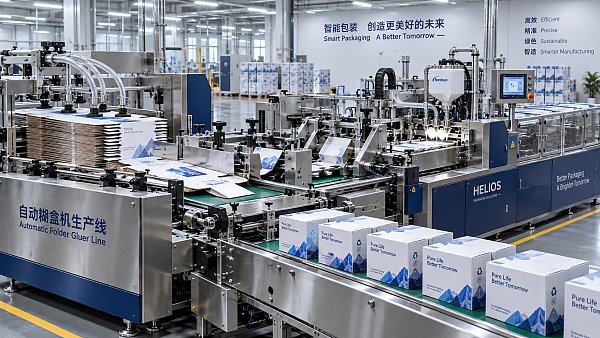
The bundle section is often blamed because that is where production stops, but the initiating defect may start in the converting process itself. Blanks with inconsistent fold memory, protruding scrap nicks, wet glue seams, curled leading edges, or variable count can enter the bundle system already unstable. On a folder gluer line, hook timing, carrier speed relation, and glue application can influence how squarely cartons nest into a bundle. On corrugated stack discharge, warp and moisture balance can determine whether the pack stays flat under acceleration.
This is why a jam investigation should include product sampling from several minutes before the stop, not only the collapsed bundle found in the machine. Looking at the failed pack alone can be misleading because secondary damage occurs after the first interference. Earlier bundles may reveal the true pattern: one side consistently taller, one edge feathered, intermittent open flaps, or count drift.
Installation and replacement work can introduce new jam behavior
After bearing replacement, belt change, conveyor removal, or frame realignment, a machine may run but behave differently under load. A bearing block tightened slightly out of square can pull a shaft out of parallel. New belts often stretch during early operation and may need retensioning. Pneumatic stops replaced with nominally identical units can have different cushioning or rod-end geometry. A transfer that was once forgiving may become narrow enough to catch product only at full speed.
Fastener choice matters as well. Low-profile hardware replaced by standard socket heads can intrude into product flow. Shim packs omitted during reassembly can change plate height. Even cable routing can matter if it limits sensor bracket rigidity or vibrates against a moving section. None of these issues are exotic, but they explain why a jam sometimes appears “after maintenance” without any obvious failed part.
Commissioning after mechanical work should include more than a dry run. Use actual product across the expected size range, confirm sensor repeatability, and observe the first hour for settling, dust release, and thermal growth. Some alignment changes do not show until the machine reaches normal operating temperature.
What usually prevents repeat stoppages
Preventive action works best when it is built around failure patterns rather than generic housekeeping. A line that repeatedly jams at the same transfer should have measured reference values for plate height, side-guide spacing, belt tension, and sensor position. A line that shows random late-release faults should have air pressure stability, valve response, and encoder integrity reviewed before major mechanical disassembly.
- At the jam point, inspect for witness marks first. Scraped coating, polished corners, fiber buildup, and impact lines usually identify where the bundle first touched something it should have cleared.
- Keep a retained sample of the bundles produced just before the stop when possible. Their shape often explains more than the crushed pack removed from the machine.
- Clean product-contact surfaces with methods that remove adhesive film rather than only loose dust. Some residues need the correct solvent and a non-abrasive pad; otherwise the surface becomes smoother and less controllable.
- Verify timing under real speed. Jog mode confirms sequence logic, but it does not reproduce inertia, pneumatic lag, or slip.
- After replacing wear parts, compare material, finish, and geometry with the removed component instead of checking dimensions alone.
If jams keep returning with no clear damage point, the machine may be operating too close to the stability limit for that bundle style. In that situation, a small reduction in speed, a revised compression setting, or a slight change in transfer support can be more effective than repeated part replacement. The goal is to restore a margin where normal variation in board, glue, and friction does not immediately turn into a stoppage.
Bundle Handling Systems run cleanly when bundle formation, motion timing, and contact surfaces stay in balance. Once one of those shifts, the jam is usually a symptom rather than the starting event. Finding the first small deviation is what shortens downtime and keeps the same fault from coming back on the next shift.
Related News
 What to Check Before Ordering Pallet Wrappers Direct From a FactoryBuying from a pallet wrappers factory? Check load compatibility, output, film costs, safety, and support before ordering. Use this checklist to avoid costly mistakes and buy with confidence.Spatial Folding Strategist
 How an Automatic Folder Gluer System Reduces Carton Setup ErrorsAutomatic folder gluer system solutions reduce carton setup errors with precise feeding, folding, glue control, and compression. Discover how to improve quality and changeovers.Spatial Folding Strategist
 How to Choose a Folder Gluer Machine for Folding CartonsChoose the right folder gluer machine for folding cartons with proven guidance on speed, carton styles, glue quality, automation, testing, and lifecycle costs.Spatial Folding Strategist
 When Chain Pallet Conveyors Improve Warehouse Flow and ThroughputChain pallet conveyors improve warehouse flow by reducing forklift delays, adding controlled accumulation, and protecting packaging throughput. Discover when they deliver the strongest ROI.Spatial Folding Strategist
 How to Compare Automatic Strapping Machine Price and Total CostAutomatic strapping machine price comparison made simple: evaluate installation, throughput, consumables, labor, downtime, and total cost for a smarter investment.Spatial Folding Strategist
 What to Compare When Choosing a Pallet Wrappers SupplierCompare a pallet wrappers supplier by load stability, film efficiency, automation integration, service support, and total cost to choose the right solution.Spatial Folding Strategist