What Affects the Total Cost of a High Speed Strapping Machine?
The total cost of a high speed strapping machine depends on more than its purchase price. Machine configuration, actual production throughput, conveyor integration, strap consumption, maintenance, labor, and downtime all affect the investment. In a corrugated packaging plant, a lower quotation can become the more expensive option if operators must repeatedly clear feeding faults or stop a folder gluer because finished bundles cannot move downstream.
The most useful comparison is cost per accepted bundle over a defined operating period, supported by a separate calculation of installed project cost. Start with your bundle sizes, straps per bundle, production schedule, and handling requirements. Then ask suppliers to quote against the same conditions rather than comparing headline speeds or differently scoped equipment packages.
Establish the production requirement before comparing prices
A machine rated for a fast strapping cycle may not deliver the required bundle output. Strap feeding, tensioning, sealing, and release are only part of the sequence. Bundle entry, positioning, compression, multiple strap application, and discharge also consume time. The slowest step determines the usable throughput of the station.
For example, bundles leaving a folder gluer may arrive unevenly during short-run production. A machine can have sufficient average capacity yet still create a queue during bursts. Conversely, buying substantially more speed than the upstream equipment can supply may add capital cost without increasing shipped output.
Prepare a production specification that includes:
- Minimum and maximum bundle dimensions, weight, and stability.
- Required accepted bundles per minute, including peak arrival conditions.
- Number, position, and direction of straps on each bundle.
- Product characteristics, including loose sheets, folded cartons, or compressible corrugated stacks.
- Shift pattern, order-change frequency, and expected product mix.
- Permitted bundle marking, deformation, and movement after strapping.
Do not convert a supplier’s straps-per-minute figure directly into bundles per minute. Request a demonstrated cycle for the complete handling sequence using representative products, including the more difficult sizes.
Which specifications increase the machine price?
The initial price generally rises with the equipment needed to control bundles reliably, accommodate variation, and sustain production. A basic automatic arch machine and a fully integrated compression strapping station may both be described as high-speed equipment, but their scope is different.
Higher specification is not automatically better value. Automatic recipe selection has a stronger justification where bundle formats change frequently than where one stable product runs continuously. Likewise, compression should match the packaging requirement; excessive pressure can damage a bundle even when the strap joint is sound.
For PP or PET strapping, verify the machine’s approved material, width, thickness, and tension range. Do not assume that a machine can switch between strap types without different components or settings.
The quoted machine is not the installed system
Integration is often where apparently comparable quotations separate. One supplier may include powered conveyors, guarding, and commissioning, while another prices only the strapping unit. Both quotations need a clear boundary showing what enters the supplier’s scope and what remains with the buyer.
At a minimum, review conveyor height, transfer gaps, bundle orientation, available floor space, electrical supply, and any compressed-air requirement. Confirm how the strapping station communicates with upstream and downstream equipment. A downstream blockage should trigger a coordinated response rather than allow bundles to accumulate against the machine.
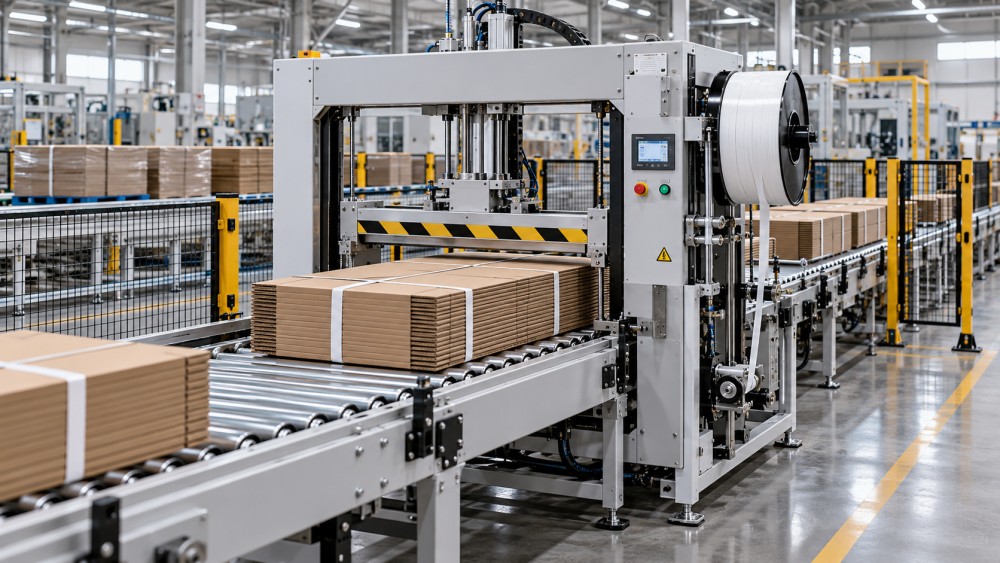
Safety integration also needs a defined owner. Guarding, access points, emergency-stop interfaces, and restart behavior must be assessed for the connected installation, not just the standalone machine. Qualified personnel should confirm the applicable site requirements before the layout and control design are finalized.
Request separate line items for freight, insurance, unloading, positioning, electrical work, air connections, installation, programming, commissioning, and training. Confirm applicable duties and taxes separately. Site preparation and the planned production shutdown belong in the project budget even when they are not supplier charges.
Calculate strap cost from usable bundles, not roll price
Strap is a recurring cost tied directly to production volume. Consumption depends on bundle perimeter, straps per bundle, sealing overlap, threading losses, failed cycles, and discarded roll ends. Compression can change the strapped perimeter, so estimates should reflect the actual bundle condition at the moment of strapping.
A practical starting calculation is:
Annual strap cost = annual strap length consumed × delivered cost per unit length.
Calculate useful length from the production mix, then add a separately stated allowance for demonstrated or estimated losses. Keep that allowance visible so it can be checked during trials and reviewed after installation.
When material is quoted by weight, convert it to usable length using the supplier’s verified linear mass. Comparing roll prices alone is misleading when rolls differ in length, width, or thickness. Also check core dimensions, coil handling requirements, and whether alternate qualified suppliers are available.
Reducing strap thickness or width may lower consumption cost, but it should not be treated as a purchasing-only change. Feeding behavior, joint performance, tension retention, and load stability must remain acceptable. A cheaper strap that generates misfeeds can increase labor and interruption costs beyond the material saving.
Trials should therefore include the proposed production strap rather than only a supplier-selected material. Record feeding faults, joint consistency, and bundle condition across the agreed operating range.
Maintenance, utilities, and labor change the operating budget
Price the maintenance work, not just the spare parts
Request a maintenance schedule showing inspection tasks, cleaning requirements, lubrication points where applicable, and replacement criteria. Wear items may include feed rollers, guides, cutters, belts, and sealing components, depending on the machine design.
The useful comparison combines parts prices with replacement frequency, access time, and the skill required. A less expensive component is not necessarily economical if changing it requires a lengthy shutdown or specialist attendance. Ask for recommended startup spares, recurring wear-part lists, service rates, and delivery lead times.
Warranty terms also affect the budget. Establish whether travel, labor, consumables, and wear components are excluded, when coverage begins, and what support is available during your operating hours. Remote diagnostics can help identify a fault, but physical repair may still depend on a local technician or stocked component.
Measure utilities under representative conditions
Electrical nameplate power is not the same as average consumption. Obtain operating and standby demand for the proposed configuration, including conveyors and auxiliary equipment. Where pneumatic functions are used, request air consumption at the specified pressure and include the cost of producing that compressed air.
Utility savings should be assessed against actual annual operating hours. A difference that matters in continuous production may have a limited financial effect on a lightly utilized station.
Separate staffing reduction from task transfer
Automation may reduce manual strapping while leaving coil replacement, bundle recovery, quality checks, and cleaning unchanged. Count the labor needed for the entire station, including work transferred to maintenance or forklift operators.
Only treat labor as a cash saving when the staffing plan supports it. Time released for other duties has value, but it is different from an eliminated cost. Training should cover normal operation, changeovers, safe fault recovery, and routine care across all relevant shifts.
Put downtime and rejected bundles into the comparison
A strapping fault can have different consequences depending on the layout. With adequate accumulation and a safe recovery route, the upstream line may continue temporarily. Without that buffer, a short stop can interrupt printing or converting output. The economic impact therefore belongs to the connected production process, not only the strapping machine.
Evaluate likely interruption types separately: strap misfeeds, coil changes, bundle jams, planned maintenance, and failures requiring outside support. Use your plant’s operating records where available. For a new application, request trial evidence and calculate a range rather than presenting uncertain downtime as a precise forecast.
Reject cost should include damaged packaging, restrapping material, handling time, and disposal where relevant. Excess tension may deform corrugated edges; insufficient restraint may allow bundles to shift. Acceptance needs to cover both the strap joint and the condition of the finished bundle.
Avoid double-counting production losses. A stoppage recovered within normal spare capacity has a different financial effect from one requiring overtime or causing lost shipments. Use the appropriate recovery cost or lost contribution, rather than automatically charging the full sales value of interrupted output.
Build a comparable ownership-cost model
Use the same evaluation period, production mix, utilization assumptions, and financial treatment for every proposal. Keep the installed investment separate from recurring costs so that a cheaper purchase does not hide a more expensive operating profile.
Total ownership cost = installed investment + operating costs + maintenance and repair + attributable downtime and quality costs + end-of-life costs − residual value.
Cost per accepted bundle = total ownership cost ÷ total accepted bundles over the same period.
For a discounted cash-flow analysis, apply the same discount rate and timing assumptions across suppliers. Avoid counting both the full equipment purchase and depreciation as separate cash costs.
Test the result against changes in production volume, strap price, staffing, and downtime. This reveals whether a higher-priced machine is justified by measurable operating advantages or only by optimistic assumptions. Keep unverified supplier claims separate from demonstrated performance.
Before placing the order, attach an acceptance protocol to the agreed scope. Define representative bundle formats, strap specification, complete-cycle output, permitted faults and rejects, changeover requirements, and the duration and conditions of testing. Allocate responsibility for interface problems and document the corrective-action process.
The purchasing decision should then rest on a specific question: does the additional installed cost buy a verified reduction in cost per accepted bundle under your production conditions? Where the answer depends on untested throughput, uncertain consumable compatibility, or undefined integration work, resolve those gaps before treating the quotation as a firm project cost.
Related News
 How to Choose Carton Counting Systems for Accurate ProductionChoose Carton Counting Systems with confidence. Compare sensors, accuracy, line integration, and testing methods to improve production reliability.Spatial Folding Strategist
 How to Troubleshoot an Automatic Case Erecting MachineTroubleshoot your automatic case erecting machine with practical steps for diagnosing jams, vacuum loss, sensor faults, and sealing issues—and restore reliable operation.Spatial Folding Strategist
 How to Choose Pallet Conveyors for a Packaging LineChoosing pallet conveyors for packaging line operations? Compare load requirements, throughput, layouts and safety to find the right solution.Spatial Folding Strategist
 How to Choose Case Packers for an Automated Palletizing LineChoose Case Packers that keep your palletizing line moving. Compare loading methods, capacity, changeovers, and integration to make a confident investment.Spatial Folding Strategist
 How Inline Pallet Wrappers Fit Into Automated Packaging LinesDiscover how inline pallet wrappers integrate with automated packaging lines, improve load stability, and help prevent costly bottlenecks.Spatial Folding Strategist
 What Affects Bundle Handling System Cost in a Sheet Plant?Bundle handling system cost depends on capacity, layout, automation, and integration. Learn how to compare total costs and choose the right system for your sheet plant.Spatial Folding Strategist