What Affects Bundle Handling System Cost in a Sheet Plant?
Bundle handling system cost depends on the required flow of finished bundles, the distance and complexity of the route, the degree of automation, and the work needed to connect the system to existing equipment. The equipment quotation is only one part of the decision: installation, production disruption, maintenance, energy, and staffing can materially change the total investment.
In a sheet plant, bundles may leave several converting machines at different rates and compete for limited space near strapping, palletizing, or dispatch. A low-priced conveyor may move bundles adequately on its own but fail to resolve congestion at a shared transfer point. Before approving a budget, define the full route and compare proposals against the same operating conditions.
Start with the handling scope, not the equipment list
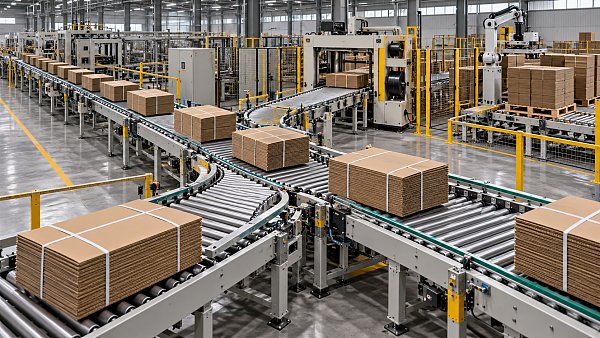
A bundle handling system may include conveyors, transfers, turners, alignment devices, accumulation zones, strappers, palletizing interfaces, and controls. Not every project needs all of them. The cost depends heavily on where the supplier’s responsibility begins and ends: collecting bundles at one machine, linking several production lines, or delivering bundles to a palletizing or dispatch area are different scopes.
Draw the intended path from each converting machine’s delivery to the next receiving point. Identify existing equipment that will stay, manual handling points, crossings, and areas where bundles must change direction or orientation. Then mark the physical and control interfaces. A quotation for conveyors alone should not be compared directly with one that includes guarding, control integration, installation, and commissioning.
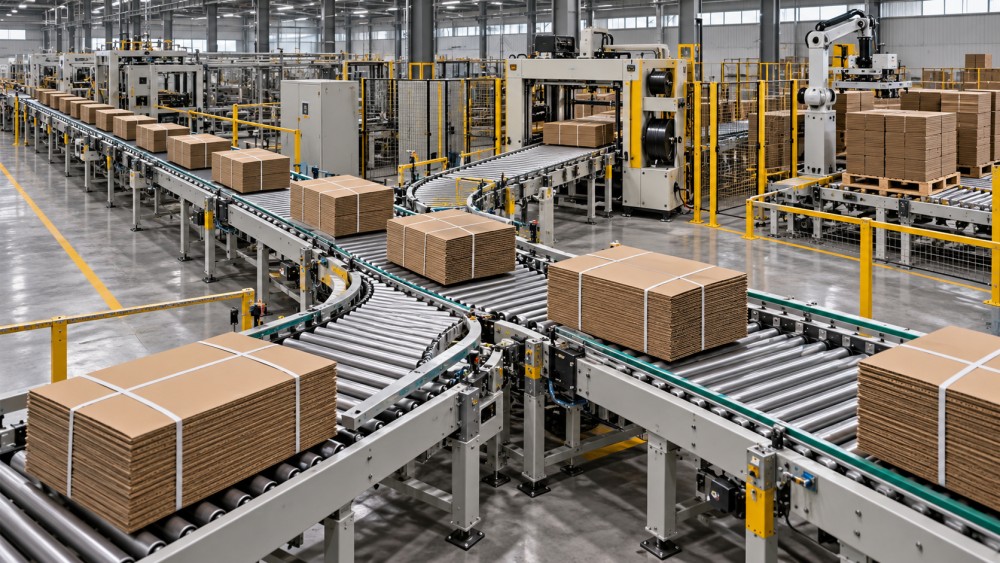
For budgeting, separate the project into equipment, integration, site preparation, installation, commissioning, and ongoing operating costs. Ask each supplier to identify exclusions against those categories. An omitted item is not necessarily a defect in a proposal, but it must be priced elsewhere before the proposals can be compared.
Capacity is determined by the busiest flow, not just daily volume
Suppliers need more than the plant’s average output. Bundle arrivals can be uneven because machines run different orders, stop for changeovers, or discharge at the same time. A system designed around an average rate may need extra accumulation or manual intervention when several lines converge.
Provide the expected bundle rate at each infeed, the number of simultaneous operating lines, and the duration and frequency of peak periods. Specify whether the system must handle current production only or a defined future machine. Additional capacity may require wider or faster conveyors, more robust drives, extra merge logic, or a different layout; its value should be weighed against the probability and timing of the expansion.
Capacity claims also need a common basis. A supplier may quote a conveyor’s transport speed while the plant needs a reliable throughput at a merge or palletizer. Request the limiting rate for the complete proposed route, including transfers, gaps between bundles, strapping, and downstream acceptance. The slowest shared operation can govern practical output even when individual conveyors are fast.
Bundle characteristics change the design
Bundle dimensions, weight, board grade, stack stability, and strap configuration affect handling requirements. Small bundles may need closer roller spacing or different transfer arrangements. Large or heavy bundles can increase load ratings and drive requirements. Poorly aligned or unstable bundles may require guides, squaring, or controlled acceleration.
Give suppliers the operating range rather than a single typical bundle. Include unusual but commercially important formats and identify products that cannot tolerate compression or rough transfers. A design that handles the full range automatically may cost more than one requiring an operator to intervene on exceptions; quantify the frequency of those exceptions before choosing between them.
Layout and building work can outweigh a simple equipment saving
Existing columns, doors, pedestrian routes, forklift aisles, and machine access points can force a longer or more complex path. Changes in direction, elevation, and bundle orientation add transfer devices and controls. A compact layout may reduce conveyor length but restrict maintenance access or create conflicts with material movement.
Site preparation can include floor repairs, anchoring, electrical distribution, network connections, compressed air where needed, and protective barriers. Check whether each item is in the supplier’s quotation or remains a plant responsibility. Also review removal or relocation of existing equipment and disposal of redundant components.
Installation timing matters financially. A route that requires a long shutdown may have a lower equipment price but a higher project cost once lost production, temporary handling, and restart risk are included. Ask for an installation sequence showing what can be assembled while production continues, which connections require shutdown, and what conditions must be met before commissioning.
Automation level: compare the work it removes with the work it adds
A basic system may convey bundles between defined points while operators manage orientation, exceptions, and downstream loading. More automated configurations can merge flows, track destinations, adjust routing, and coordinate with strapping or palletizing. Those functions increase equipment and control scope, but may reduce manual touches or allow production to flow more consistently.
Do not count every task removed as a full labor saving. Determine whether the change eliminates paid hours, avoids overtime, postpones recruitment, or simply moves an operator to another activity. Record each category separately. A redeployment can improve capacity or resilience, but it is not the same cash saving as a reduction in payroll.
Integration is a project cost, not a minor accessory
Connecting to an existing folder gluer, counter ejector, strapper, or palletizer may involve mechanical modifications as well as control signals. The supplier needs to know how upstream machines indicate bundle availability and how downstream equipment requests or stops flow. Where job information or destination data is exchanged, establish which system owns that information and what happens when it is missing or incorrect.
Ask both the handling supplier and the existing equipment supplier to define their responsibilities. An interface matrix should identify the connection, required signals, hardware, software changes, testing, and who resolves faults. Without that agreement, a low initial quotation can leave the plant responsible for unpriced engineering or delays between suppliers.
Include abnormal conditions in the design review: a jam at a transfer, a full accumulation zone, an emergency stop, a restarted machine, or a rejected bundle. The system should have an agreed recovery sequence, including whether operators must clear or re-enter tracking information. Evaluate guarding and access with the installation team as part of the layout, rather than assuming safety work is included in every equipment price.
Build a comparable total cost of ownership
Use the same evaluation period and operating assumptions for each bid. The analysis should distinguish the initial cash requirement from recurring costs and from benefits that depend on future operating conditions.
- Acquisition and delivery: equipment, controls, freight, applicable taxes or duties, and any items purchased separately.
- Implementation: design, site work, mechanical and electrical installation, interface changes, training, commissioning, and production interruption.
- Operations: staffing, energy, consumables where applicable, cleaning, and the handling of products outside the automatic range.
- Support and upkeep: preventive maintenance, replacement parts, software support, service travel, and the internal time needed to maintain the system.
- Residual and future costs: major component replacement, expansion interfaces, and any supported residual-value assumption at the end of the evaluation period.
For electricity, use the supplier’s expected operating consumption or load profile where available, together with plant operating hours and the applicable tariff. Installed motor capacity alone does not establish actual energy use. For maintenance, request a schedule and recommended spare-parts list; distinguish parts needed for commissioning from stock intended to reduce future downtime.
Contingency should reflect unresolved scope rather than hide it. An unknown floor condition or unconfirmed machine interface deserves an identified allowance and an owner responsible for resolving it. Once the scope is verified, update the comparison instead of applying the same unexplained percentage to every proposal.
Test the business case against measurable constraints
The simplest payback calculation divides the net initial investment by expected annual net cash savings. It is useful as an initial screen, but it ignores the timing of cash flows after payback and does not show the value of money over time. Where required by the approval process, use discounted cash flow or net present value with the organization’s approved assumptions.
Separate benefits into those that can be supported by current records and those that remain conditional. Paid overtime, outsourced handling, and maintenance spending may be traceable in plant accounts. Extra production is only a financial benefit if there is a demonstrated constraint, sufficient demand, and an estimate of the incremental contribution after relevant costs. Avoid valuing the same improvement twice as both labor savings and additional throughput.
Run a sensitivity check on the variables most likely to change the decision: actual operating hours, realized labor reduction, maintenance costs, and the proportion of production that can use the automated route. Show a downside case in which volumes are lower or savings take longer to appear. A proposal that remains affordable under that case may be preferable to one whose justification depends entirely on an optimistic utilization estimate.
Set acceptance conditions before releasing the order
Commercial terms should link the final scope to observable performance. Define the bundle sizes and weights to be tested, the route involved, the agreed throughput measurement, and the operating conditions during the test. State who supplies test material and labor, how faults are recorded, and what constitutes successful commissioning.
Confirm warranty coverage, response arrangements, spare-parts availability, documentation, and operator and maintenance training. A throughput guarantee should also describe exclusions and the treatment of upstream or downstream stoppages; otherwise, the parties may measure different things.
Before approval, reconcile every proposal to one scope and maintain an exceptions list. The preferred bid is not necessarily the one with the lowest equipment price: it is the one whose complete cost, verified capacity, implementation risk, and support obligations fit the plant’s defined operating requirement.
Related News
 How to Choose Carton Counting Systems for Accurate ProductionChoose Carton Counting Systems with confidence. Compare sensors, accuracy, line integration, and testing methods to improve production reliability.Spatial Folding Strategist
 How to Troubleshoot an Automatic Case Erecting MachineTroubleshoot your automatic case erecting machine with practical steps for diagnosing jams, vacuum loss, sensor faults, and sealing issues—and restore reliable operation.Spatial Folding Strategist
 How to Choose Pallet Conveyors for a Packaging LineChoosing pallet conveyors for packaging line operations? Compare load requirements, throughput, layouts and safety to find the right solution.Spatial Folding Strategist
 How to Choose Case Packers for an Automated Palletizing LineChoose Case Packers that keep your palletizing line moving. Compare loading methods, capacity, changeovers, and integration to make a confident investment.Spatial Folding Strategist
 How Inline Pallet Wrappers Fit Into Automated Packaging LinesDiscover how inline pallet wrappers integrate with automated packaging lines, improve load stability, and help prevent costly bottlenecks.Spatial Folding Strategist
 What Affects Bundle Handling System Cost in a Sheet Plant?Bundle handling system cost depends on capacity, layout, automation, and integration. Learn how to compare total costs and choose the right system for your sheet plant.Spatial Folding Strategist