Stacking Conveyors vs. Conventional Conveyors: Which Fits Your Line?
Meta Title: Stacking Conveyors vs. Conventional Conveyors: Which Fits Your Line?
If you are comparing Stacking Conveyors with conventional conveyors for a packaging or printing line, the decision usually comes down to one practical question: do you only need to move product, or do you also need to buffer, accumulate, and stabilize flow between machines running at different rhythms? That difference affects line efficiency more than many teams expect. In high-speed corrugated, printing, die-cutting, and folder gluer environments, the wrong conveyor choice can quietly create jams, sheet damage, idle downstream equipment, and wasted floor space.
A short answer is this: Stacking Conveyors make sense when your line needs controlled accumulation, temporary buffering, or smoother handoff into downstream operations. Conventional conveyors are often the better fit when material transfer is simple, continuous, and timing between machines is already well synchronized. The better option is not the more advanced one. It is the one that matches the instability points of your actual line.
Why this comparison matters more on fast lines
On a slow or lightly loaded line, many conveyor choices look acceptable. On a high-speed line, small differences in product flow become expensive. A flexo folder gluer, die-cutter, stacker, or end-of-line pack station may all have different operating patterns. Some run continuously. Some stop intermittently. Some are highly sensitive to sheet spacing, orientation, or stack consistency.
That is why conveyor selection should be treated as a line-balance decision, not a simple transport purchase. Technical assessment teams often focus first on machine nameplate speed. In practice, line stability is usually influenced more by transitions: discharge, accumulation, spacing correction, stack building, and release into the next process.
In corrugated and commercial printing environments, this becomes even more relevant because sheets and blanks are not forgiving. Warp, curl, static, surface scuffing, misaligned bundles, and edge crush all show up when material handling is poorly matched to line behavior.
Stacking Conveyors are not just “conveyors with extra capacity”
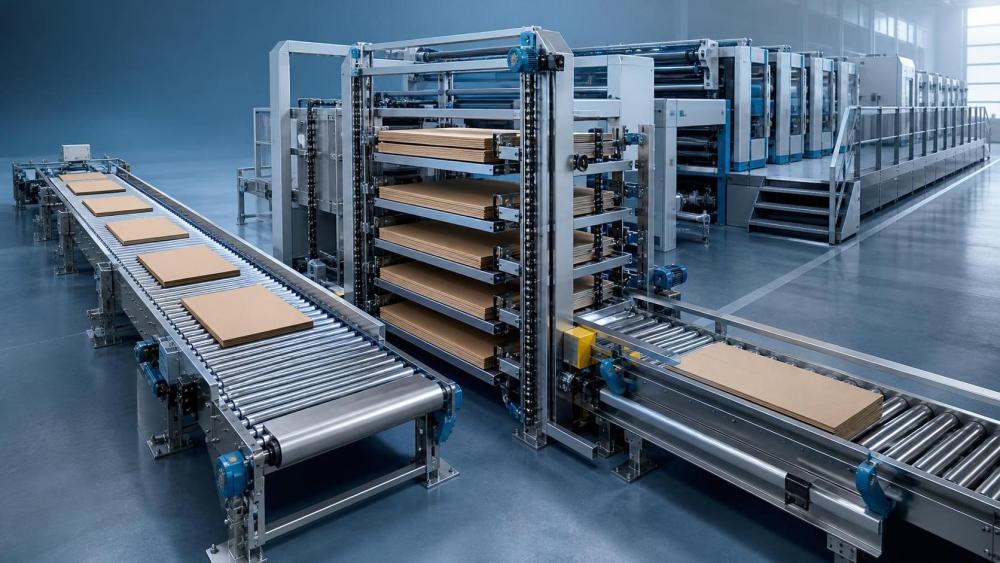
This is one of the more common misunderstandings in evaluations. A conventional conveyor is mainly there to move product from point A to point B. A stacking conveyor is usually part of flow control. It helps create ordered accumulation, often allowing products, sheets, or bundles to build in a controlled manner before transfer, packing, inspection, or palletizing.
That distinction matters because the engineering objective changes. With a conventional conveyor, the main questions are speed, width, belt type, and transfer geometry. With a stacking conveyor, you also need to assess accumulation logic, release behavior, compression risk, stack integrity, and how the system behaves when upstream output temporarily exceeds downstream capacity.
In other words, a stacking conveyor is often solving a timing problem, not just a transport problem.
Where conventional conveyors still make more sense
There is no reason to over-specify this. If your line has stable machine-to-machine synchronization, low product sensitivity, and minimal need for accumulation, a conventional conveyor is usually cleaner, cheaper, and easier to maintain.
That is often true in situations like:
- straight transfer sections between matched-speed modules
- lines with consistent product dimensions and low changeover complexity
- operations where downstream stoppages are rare and brief
- plants where floor space allows simple, linear layouts
Conventional conveyors can also be the better choice when operators need full visual access and quick intervention. More complexity is not automatically more productive. If the process does not benefit from accumulation or stack control, added conveyor logic can become one more thing to troubleshoot.
Where Stacking Conveyors usually earn their cost
The strongest case for Stacking Conveyors appears when the line has rhythm mismatches. That is common in end-of-line sections, especially when upstream machines produce faster than downstream pack-out, inspection, bundling, or palletizing can consistently absorb.
Typical examples include:
- corrugated sheet or box plants where downstream handling pauses during unit formation
- folder gluer output sections where bundles need controlled collection before transfer
- die-cut blank handling where temporary accumulation protects uptime during intermittent downstream stops
- printing and converting lines where inspection, coding, or packing introduces cycle variation
In these cases, stacking conveyors help isolate one machine from another. That buffer can improve OEE because a short interruption downstream does not immediately force the upstream machine to slow or stop.
There is also a quality angle. When well designed, stacking conveyors can reduce chaotic pileups that damage sheet edges or distort bundle shape. That matters more than it may sound, because downstream robotic handling, counting, strapping, and palletizing usually depend on consistent geometry.
What technical teams should check first
When assessment teams get stuck, it is often because they compare conveyor types in isolation. A better approach is to map the unstable points in the line first.
Start with these questions:
- Where does material flow become uneven?
- Which downstream station causes the most micro-stops?
- Is product arriving as single sheets, shingled flow, counted batches, or formed stacks?
- How sensitive is the product to pressure, sliding, skew, or edge contact?
- What happens during changeover, not just at steady-state speed?
The last question is easy to overlook. Many conveyor systems look fine during a clean factory acceptance demonstration. Real trouble appears during mixed order sizes, operator intervention, partial stops, and restart sequences. A stacking conveyor that handles these transitions well can deliver more value than one that simply looks efficient on paper.
Footprint, access, and maintenance: the part people underweight
Technical buyers usually notice throughput first. Maintenance and access issues tend to show up later, when the line is already installed.
Stacking conveyors may reduce lost time caused by flow interruptions, but they can also require more careful design around guarding, access points, sensors, and jam recovery. If operators cannot safely clear faults quickly, the theoretical buffer advantage shrinks fast.
Conventional conveyors are often easier to understand, easier to clean, and easier to keep running with standard spare parts. That simplicity has real value in plants where maintenance resources are stretched or where changeovers are frequent and staffing varies by shift.
So the choice should include a practical question: does your site have the maintenance discipline to support a more control-intensive accumulation system? If not, a simpler conveyor may deliver better uptime in daily operation, even if it looks less capable in a technical comparison.
Do not judge only by maximum speed
Nameplate speed is one of the least reliable ways to choose between these systems. The better indicator is flow stability under actual operating conditions.
A conventional conveyor rated for high speed can still underperform if products arrive inconsistently or if downstream release timing is uneven. A stacking conveyor with lower headline speed may produce better net throughput by absorbing short disruptions and keeping the rest of the line running.
That is why experienced teams usually review three layers together:
- steady-state throughput
- behavior during stoppages and restart
- impact on product quality and waste
For corrugated and printing lines, waste is not just scrap volume. It also includes rehandling, damaged edges, skewed bundle formation, and extra operator attention. Those hidden losses can easily outweigh the initial savings from choosing a simpler conveyor layout.
A useful way to frame the decision
If your line’s main problem is distance, use a conventional conveyor.
If your line’s main problem is timing, accumulation, or unstable handoff, look closely at Stacking Conveyors.
That framing is simple, but it is usually accurate.
Many users hesitate because they think stacking systems are only justified on very large automated plants. That is not always true. Mid-scale operations can benefit as well, especially where downstream manual packing, inspection, or robotic pick-and-place creates variable capacity. On the other hand, some large plants still do perfectly well with conventional conveyors in stable transfer zones. Line behavior matters more than plant size.
Common selection mistakes
One mistake is choosing based on a single bottleneck without checking whether it is chronic or occasional. If the downstream pause happens only rarely, a stacking conveyor may be more system than you need.
Another is assuming accumulation always protects product quality. Poorly designed stacking behavior can create compression, misalignment, or unstable release. Product type matters. Lightweight printed sheets, corrugated blanks, and finished folded cartons do not behave the same way.
A third mistake is ignoring upstream and downstream controls integration. The conveyor is only one part of the answer. Sensor logic, machine communication, speed matching, and release sequencing often determine whether the installation works smoothly.
This is where specialist line knowledge helps. CPCS, which tracks high-speed corrugated board lines, flexo presses, die-cutters, folder gluers, and quality-critical end-of-line systems, is useful not because it promotes one conveyor type, but because it frames conveyor selection inside the larger OEE and waste-reduction picture. That is the right level to evaluate the decision.
How I would approach the final recommendation
If I were reviewing this for a technical assessment team, I would avoid asking which conveyor is “better.” I would ask which failure mode is more expensive on your line:
- unnecessary complexity and maintenance burden
- or lost uptime from poor buffering and unstable transfer
Choose conventional conveyors when flow is already disciplined and the job is straightforward transport.
Choose Stacking Conveyors when the line needs breathing room between machines, especially where stop-start downstream behavior threatens upstream productivity or product condition.
Before signing off, confirm five things on the actual line layout: product range, accumulation requirement, jam recovery access, controls integration, and restart behavior after short stops. Those five points usually tell you more than a brochure comparison ever will.
Near the end of most evaluations, the right answer becomes fairly clear. If your process needs controlled accumulation to protect throughput and downstream stability, Stacking Conveyors are usually the better fit. If your process simply needs reliable transfer with low complexity, conventional conveyors remain the smarter choice.
FAQ
Are Stacking Conveyors always better for high-speed lines?
No. They are better when speed comes with flow variation, downstream pauses, or accumulation needs. A stable high-speed transfer may still be better served by a conventional conveyor.
Can a conventional conveyor be upgraded later if buffering becomes a problem?
Sometimes, but not always cleanly. Layout space, controls architecture, and guarding design can limit retrofit options. It is worth checking expansion paths early.
What is the biggest hidden risk with stacking systems?
Poor release control and difficult jam recovery. If accumulated product cannot discharge cleanly, the buffer becomes a new bottleneck.
Which option is usually easier for operators?
Conventional conveyors are usually easier to understand and maintain. Stacking systems need better operator training and clearer fault-handling routines.
Image Placeholder List
Suggested placement: after the section explaining the functional difference between stacking and conventional conveyors.
Suggested image: side-by-side diagram showing straight transfer on a conventional conveyor versus buffered accumulation and controlled release on a stacking conveyor.
Suggested alt text: Comparison of stacking conveyor and conventional conveyor flow in a packaging line
Internal Link Anchor Text Suggestions
- corrugated line material handling design: category page or guide on conveyor and transfer systems
- how to improve OEE in folder gluer lines: article on downtime and end-of-line optimization
- die-cutter discharge and sheet handling best practices: technical article or solution page
- vision inspection and end-of-line integration: guide on downstream line stability
- buffering and accumulation in packaging systems: educational page on line balancing
External Authority Source Suggestions
- OEM official technical documentation for conveyor, stacker, and end-of-line handling systems
- industry association materials from corrugated, packaging, or converting organizations
- safety and controls guidance from recognized industrial automation or machinery standards bodies
Related News
 How an Automatic Folder Gluer System Reduces Carton Setup ErrorsAutomatic folder gluer system solutions reduce carton setup errors with precise feeding, folding, glue control, and compression. Discover how to improve quality and changeovers.Spatial Folding Strategist
 How to Choose a Folder Gluer Machine for Folding CartonsChoose the right folder gluer machine for folding cartons with proven guidance on speed, carton styles, glue quality, automation, testing, and lifecycle costs.Spatial Folding Strategist
 When Chain Pallet Conveyors Improve Warehouse Flow and ThroughputChain pallet conveyors improve warehouse flow by reducing forklift delays, adding controlled accumulation, and protecting packaging throughput. Discover when they deliver the strongest ROI.Spatial Folding Strategist
 How to Compare Automatic Strapping Machine Price and Total CostAutomatic strapping machine price comparison made simple: evaluate installation, throughput, consumables, labor, downtime, and total cost for a smarter investment.Spatial Folding Strategist
 What to Compare When Choosing a Pallet Wrappers SupplierCompare a pallet wrappers supplier by load stability, film efficiency, automation integration, service support, and total cost to choose the right solution.Spatial Folding Strategist
 How an Automatic Case Erecting Machine Reduces Packing DelaysAutomatic case erecting machine solutions reduce packing delays by delivering consistent, sealed cases, improving line flow, uptime, and end-of-line efficiency.Spatial Folding Strategist