How to Compare Palletizer Robot Price Against Throughput and ROI
How to Compare Palletizer Robot Price Against Throughput and ROI
Comparing a palletizer robot price is rarely as simple as comparing two supplier quotations. In a corrugated plant, carton converting operation, or commercial print facility, the robot itself may be only one part of the investment. The final number can also include infeed conveyors, layer forming, pallet dispensers, safety guarding, end-of-arm tooling, controls integration, commissioning, and changes to the surrounding production layout.
That is why a lower initial quote does not automatically mean a lower-cost project. A robot that struggles with mixed carton sizes, needs frequent manual intervention, or cannot keep pace with a folder gluer or case packer can become an expensive bottleneck. On the other hand, a more capable system may be difficult to justify if its capacity is far beyond the plant’s actual production profile.
The practical question is not simply, “What is the palletizer robot price?” It is: What level of reliable output, labor reduction, handling quality, and operating flexibility does that price buy over the life of the line?
Start With the Real End-of-Line Requirement
Many automation projects start with a target such as cartons per minute or pallets per hour. Those figures matter, but they are not enough on their own. A palletizing cell must be assessed against what arrives at the end of the line, not against an idealized average.
For corrugated converters, products may range from lightweight regular slotted cartons to large die-cut blanks, bundled shipping cases, displays, or unstable stacks with changing footprints. Commercial printers and folding-carton operations may have smaller pack formats but more frequent SKU changes, short runs, and stricter requirements for bundle orientation and traceability. A line producing one consistent case size is a very different automation problem from a plant that processes dozens of order formats every week.
Before requesting prices, document the operating reality:
- Minimum, maximum, and most common product dimensions
- Product weight, compression strength, surface condition, and stack stability
- Required pallet patterns, pallet sizes, and maximum pallet height
- Actual peak output rather than only nominal machine speed
- Number of changeovers per shift and how they are managed today
- Whether product flow is continuous, batch-based, or affected by downstream truck scheduling
- Available floor space, forklift traffic, safety access, and pallet supply arrangements
This information prevents a common procurement mistake: receiving a technically valid robot quote that is based on incomplete product assumptions. A supplier may price a single gripper and a straightforward pallet pattern, while the plant actually needs multiple handling tools, automatic pattern selection, slip-sheet handling, or a solution for irregular bundles. The gap appears later, often after the project budget has already been approved.
Throughput Is More Than Robot Cycle Time
A robot’s stated cycle time is useful, but it should not be treated as the system’s guaranteed throughput. Palletizing output depends on every action around the robot: product accumulation, orientation, gripping, placement, layer completion, pallet exchange, label handling, and recovery after a stoppage. If cartons do not arrive in a stable and correctly spaced flow, a fast robot cannot compensate indefinitely.
In practice, decision-makers should ask for a throughput discussion based on the full operating sequence. Does the robot pick one case at a time, a row, or a complete layer? Is the cell expected to palletize product from one line or multiple lines? Does it lose productive time when a finished pallet is removed? Is an accumulation conveyor sized for real interruptions, or only for normal flow?
A system designed close to its theoretical maximum may look attractive in a proposal but can be fragile in daily use. Packaging production rarely runs under laboratory conditions. Carton quality changes, bundles arrive slightly skewed, operators pause upstream equipment, and urgent orders introduce less familiar formats. Some capacity margin is often more valuable than the highest advertised speed, particularly where a palletizer supports a high-speed corrugator, flexographic line, folder gluer, or automated finishing section.
The right comparison is therefore required sustained output versus demonstrated system output under representative conditions. A supplier should be able to explain the assumptions behind the estimate, including load weight, reach distance, pick configuration, pallet pattern complexity, and expected changeover process.
What Is Usually Included in the Palletizer Robot Price?
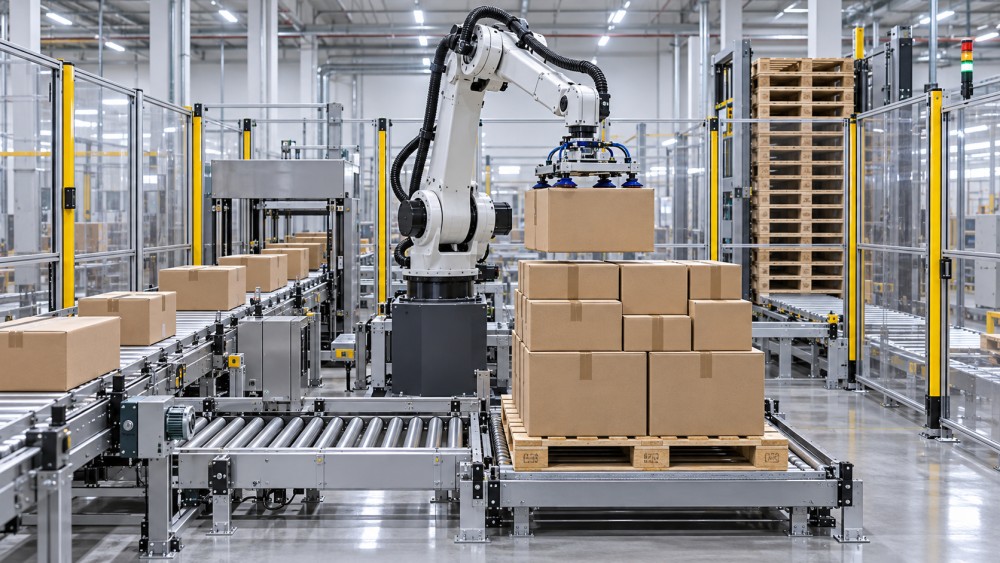
A robot arm is visible and easy to compare. The less visible components are where quotations often become difficult to evaluate. One proposal may include a complete end-of-line cell; another may cover only the robot, controller, and basic tooling. Neither approach is inherently wrong, but they should not be compared as if they represent the same scope.
It is also worth separating one-time capital costs from recurring operating costs. Energy consumption, preventive maintenance, replacement parts, software support, remote diagnostics, training, and service response arrangements can all influence ownership cost. The cheapest equipment can be a reasonable choice when local technical support is strong and the application is simple. It becomes a risk when specialized components, unfamiliar controls, or limited service coverage create long downtime after a fault.
Calculate ROI Around Avoided Constraints, Not Just Labor Headcount
Labor savings are usually the first ROI input, and they should be included. Manual palletizing is repetitive, physically demanding work, especially when cases are large, shifts are long, or loads are unstable. But a credible business case should not assume that every operator immediately disappears from the payroll. In many plants, labor is reassigned to quality checks, material handling, changeovers, machine support, or other work that has been difficult to staff consistently.
A better model considers labor exposure, overtime dependence, recruitment difficulty, injury risk, production delays, and the cost of manual handling errors. If a line regularly slows down because no operator is available to clear pallets, the lost production time may be more material than the direct labor calculation.
For a basic financial review, estimate annual value from several categories:
- Labor cost that can genuinely be removed, redeployed, or no longer added as volume grows
- Reduced overtime or reduced reliance on temporary labor
- Additional sellable output when palletizing no longer limits the line
- Lower damage, rework, or rejected pallet risk caused by inconsistent manual stacking
- Expected maintenance, utilities, service, and spare-parts costs
- Financing cost, installation downtime, and any building or layout modifications
A simple payback calculation can be useful for screening options: divide the total installed project cost by the estimated annual net benefit. However, it should be treated as a decision aid, not a complete answer. Two systems can show similar payback periods while carrying very different risks. A cell with more reliable integration, better product flexibility, and realistic support provisions may be the safer investment even if its initial payback appears slightly longer.
Do Not Ignore Changeovers and Product Variability
In packaging plants, the “average product” is often misleading. Shorter runs, e-commerce formats, promotional displays, and customer-specific shipping requirements have made end-of-line variability a normal operating condition. A robotic palletizer that is excellent for one standard case may not suit a factory where pallet patterns and carton dimensions change repeatedly during the day.
Ask how a new pattern is created and approved. Can trained plant personnel make controlled changes, or is supplier programming required? How are recipes linked to job data? Can the system manage different pallet types, orientations, layer pads, or stacking sequences? These questions become particularly important where production data management, coding, inspection, and automated material flow are already being connected across the factory.
There is a trade-off here. Highly flexible systems may require more complex tooling, programming, sensors, and operator training. A simple fixed-pattern cell may be more economical and easier to maintain. The sensible choice depends on the product mix and on whether variability is a temporary inconvenience or a permanent part of the business model.
Compare Uptime Assumptions Before Signing
A palletizer does not create value when it is standing still. Reliability is not just a question of robot brand; it is a system issue involving gripper wear, sensor placement, conveyor alignment, pallet quality, software logic, operator access, and preventive maintenance discipline.
During supplier evaluation, request clarity on acceptance testing, fault recovery, operator training, recommended spare parts, and the practical path for technical support. It is reasonable to ask what happens when a carton is misaligned, a pallet is not positioned correctly, or a product falls within the guarded area. The answer should describe safe recovery procedures, not merely promise that such events are unlikely.
For operations running multiple shifts, remote support and local service capability deserve attention. A low purchase price can lose its appeal quickly if a minor controls issue leaves the end of the line dependent on manual stacking for several days. This is one reason project teams should involve maintenance personnel early rather than leaving the decision entirely to production or purchasing teams.
Use a Like-for-Like Evaluation Sheet
The most reliable way to compare palletizer robot price is to issue the same application brief to every supplier and normalize their responses. Ask each bidder to state included equipment, excluded equipment, throughput assumptions, product range, required utilities, floor-space requirements, changeover method, commissioning scope, training, warranty, and service conditions.
Then review each offer through three lenses: installed cost, sustained output, and operational fit. Installed cost shows the actual budget commitment. Sustained output indicates whether the cell can support the line without becoming a constraint. Operational fit covers issues that are easy to overlook in a spreadsheet: forklift access, cleaning needs, operator usability, maintenance access, software ownership, and future product development.
For packaging businesses investing in broader factory automation, palletizing should also be considered as part of the material-flow system. It may need to communicate with upstream converting equipment, inspection stations, labeling systems, warehouse transport, or production scheduling tools. A standalone cell can be appropriate, but it should not accidentally block the next stage of automation.
The Best Price Is the One That Matches the Production Reality
A well-judged palletizing investment is not necessarily the lowest quote or the most sophisticated robotic cell. It is the system that handles the actual product mix safely, maintains required output through normal production disruptions, and produces a believable return after installation and operating costs are included.
For corrugated packaging, commercial printing, and converting operations, the most useful comparison starts at the end of the line: what arrives, how often it changes, where it must go, and what happens when the flow is interrupted. Once those conditions are clear, the palletizer robot price becomes easier to evaluate as part of a broader decision about throughput, labor exposure, uptime, and scalable factory automation.
Related News
 How an Automatic Folder Gluer System Reduces Carton Setup ErrorsAutomatic folder gluer system solutions reduce carton setup errors with precise feeding, folding, glue control, and compression. Discover how to improve quality and changeovers.Spatial Folding Strategist
 How to Choose a Folder Gluer Machine for Folding CartonsChoose the right folder gluer machine for folding cartons with proven guidance on speed, carton styles, glue quality, automation, testing, and lifecycle costs.Spatial Folding Strategist
 When Chain Pallet Conveyors Improve Warehouse Flow and ThroughputChain pallet conveyors improve warehouse flow by reducing forklift delays, adding controlled accumulation, and protecting packaging throughput. Discover when they deliver the strongest ROI.Spatial Folding Strategist
 How to Compare Automatic Strapping Machine Price and Total CostAutomatic strapping machine price comparison made simple: evaluate installation, throughput, consumables, labor, downtime, and total cost for a smarter investment.Spatial Folding Strategist
 What to Compare When Choosing a Pallet Wrappers SupplierCompare a pallet wrappers supplier by load stability, film efficiency, automation integration, service support, and total cost to choose the right solution.Spatial Folding Strategist
 How an Automatic Case Erecting Machine Reduces Packing DelaysAutomatic case erecting machine solutions reduce packing delays by delivering consistent, sealed cases, improving line flow, uptime, and end-of-line efficiency.Spatial Folding Strategist