How to Compare Automatic Strapping Machine Price and Total Cost
An automatic strapping machine price should be evaluated as the first line of a cost model, not the investment decision by itself. Two machines can both apply plastic strap around a carton or pallet, yet produce very different results in labor demand, rejected loads, consumable waste, line interruptions, and maintenance exposure. The lower quotation can remain the lower-cost choice when the duty cycle is light and the packs are uniform. It becomes expensive when its limits create recurring manual intervention on a busy packaging line.
Start by separating the quoted machine price from the installed and operating cost. A quotation may cover the frame, strapping head, standard conveyor table, and basic controls, while excluding infeed and discharge conveyors, guarding, electrical work, compressed-air connections, commissioning, training, spare parts, or interface programming. Comparing only the base machine price gives a distorted view when one proposal includes line-ready equipment and another requires several later additions.
Put every quotation on the same scope
Before comparing figures, write down the exact packaging task each machine is expected to perform. The relevant description is more specific than “strap cartons.” It should state carton or load dimensions, weight range, board grade, strap orientation, number of straps, production flow, shift pattern, and whether packs arrive manually, from a conveyor, or from a palletizing cell.
A side-seal machine used beside a packing station has a different cost profile from an inline top-seal unit handling corrugated cases at conveyor speed. A pallet strapping system may require a movable lance, strap dispenser, driven conveyors, load positioning, and safety devices. These are not optional refinements when the load is large or the strapping path is inaccessible; they are part of the functional system.
Ask for exclusions in writing. “Installation included” can mean the machine is placed on the floor and powered, or it can mean mechanical alignment, electrical hookup, safety validation, parameter setup, test production, and handover under real packs. The difference becomes visible only after the equipment arrives.
Translate speed claims into usable throughput
Cycle speed is frequently misunderstood. A machine rated for a certain number of cycles per minute may achieve that figure with a small, stable, centered package, a short strap path, and no waiting time between cycles. The actual line rate is constrained by the slowest point: carton accumulation, squaring, conveyor gaps, sensor timing, strapping, discharge, label application, pallet transfer, or downstream wrapping.
For carton applications, observe whether a case must stop squarely in the arch before the strap is fed. Light corrugated cases, narrow packs, or cartons with uneven contents can shift under conveyor motion. If a guide rail, side belt, compression device, or stop gate is needed to stabilize the pack, include it in the scope. A fast strapping head does not correct unstable product presentation.
Load variability matters as much as average volume. A line producing one carton footprint over long runs benefits from a simple fixed setup. Mixed SKU work with frequent width, height, or strap-count changes needs accessible adjustments and reliable recipe handling. Otherwise, nominal automation is offset by repeated setup time and avoidable restart errors.
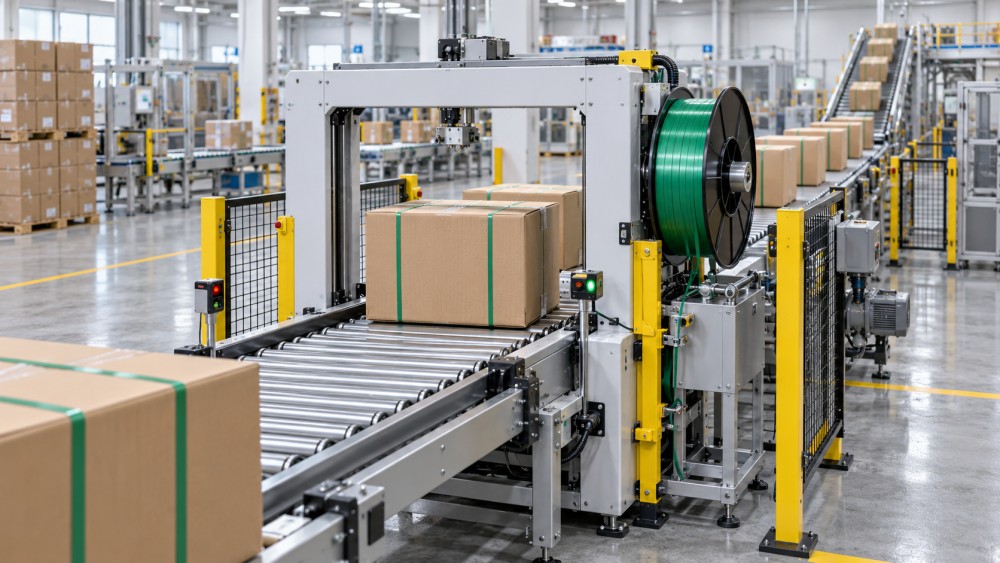
Use the expected production pattern rather than peak capacity as the basis for comparison. Record daily volume, busiest periods, package mix, planned operating hours, and the consequence of a stoppage. Where a strapping station sits after a folder gluer, case erector, or high-speed printing and converting process, a brief interruption may force upstream accumulation or manual bypass. In a standalone dispatch area, the same interruption may be easier to absorb. The machine price should reflect the cost of the condition in which it will run, not its highest advertised rate.
Consumables are a technical compatibility issue
Strap cost is not simply the price of a coil. Polypropylene and polyester straps differ in stiffness, retained tension, surface behavior, and suitability for different loads. A strap that runs cleanly through one feed system may create feeding faults, poor joints, or excessive dust in another. Confirm the permitted strap dimensions and material range before calculating consumption from a generic unit cost.
Strap tension also needs to match the package. Too little tension leaves a loose bundle that can open during handling. Excessive tension can crush light corrugated board, deform printed cartons, cut into edge protectors, or make opening difficult at the receiving point. A machine able to deliver high tension is not automatically the better choice for folding cartons or lightweight e-commerce packs. Stable, repeatable tension at the required setting is more valuable than the widest possible range.
Waste has several forms: unused strap from misfeeds, rejected seals, tails that are longer than necessary, and packs restrapped because the first application was unreliable. A proposal with a lower strap-per-cycle estimate should be examined alongside seal quality and real package geometry. Reducing the tail length is useful only when it does not compromise joint strength or create a greater risk of rework.
Estimate labor effects without treating all manual work as removable
Automatic strapping can remove repetitive wrapping and tensioning work, but the labor calculation should describe the actual station. Someone may still load strap coils, clear jams, position irregular packs, inspect seals, recover diverted cartons, and coordinate changeovers. These activities do not invalidate automation; they define the remaining labor content and the skill required to sustain the line.
Manual strapping is particularly difficult to compare when it is performed intermittently by staff assigned to several tasks. Replacing that task does not always release a full position. The relevant value may instead come from reducing bottlenecks during dispatch peaks, keeping production staff away from a repetitive handling point, or allowing one packaging cell to maintain flow with fewer handoffs. Treat these outcomes separately from a direct payroll reduction.
Look closely at exceptions. A system that handles ninety standard cartons easily but requires manual intervention for the ten most frequent nonstandard cartons can still produce a weak result if those exceptions occur during the busiest orders. Package samples should include short cases, tall cases, low-friction printed surfaces, damaged board, partly filled cartons, and the heaviest normal load. Demonstrations based only on ideal samples conceal the source of later intervention.
Downtime has causes that require different remedies
“Reliable” is too broad to compare quotations. Ask which components wear during normal strapping: cutters, grippers, feed rollers, seal surfaces, bearings, sensors, and tensioning elements. Clarify which parts are designed for quick replacement and which require a technician, detailed realignment, or extended access to the machine. A lower-priced head can be economical in low use, while a more robust construction can justify its cost where continuous operation makes stoppages disruptive.
Feed jams and seal failures should not be treated as a single category. Feeding faults may arise from incorrect strap quality, coil installation, dust, worn rollers, or a strap path that is poorly matched to the application. Seal defects can result from contaminated sealing surfaces, poor temperature control, mechanical wear, or tension settings. The corrective action, spare-parts requirement, and lost production time are different in each case.
Service access is often overlooked during layout review. Check whether the strap dispenser can be loaded safely without blocking a walkway, whether the head can be reached without moving conveyors, and whether panels and guards open in the available clearance. A machine that is technically serviceable but awkwardly installed accumulates longer interruptions over its life.
Include site work and integration risk in the capital request
The installed cost should cover delivery handling, foundations or floor preparation where needed, electrical supply, air preparation, network or control connection, safety fencing, conveyor modifications, and acceptance testing. Freight dimensions and unloading method deserve attention for large arches and pallet systems. A machine that fits the production layout may still be difficult to bring through a loading door or to position under low overhead services.
Integration deserves particular scrutiny in automated end-of-line systems. The strapping machine needs clear rules for product arrival, stop position, ready status, fault status, emergency stop, and release to the next station. A simple dry-contact interface may be sufficient for a basic conveyor. Systems connected to palletizers, barcode verification, print-and-apply units, or warehouse controls may need more extensive programming and test time. Neither approach is inherently excessive; the appropriate scope follows the line architecture.
Acceptance criteria should use the real package range and define the conditions of a successful test: correct strap placement, acceptable joint appearance, repeatable tension, consistent discharge, no unacceptable carton damage, and normal recovery after a strap change. This prevents a dispute in which the machine technically cycles but does not perform the required packaging function.
Build a cost model that exposes the trade-offs
A useful total-cost model does not need speculative precision. It needs transparent categories and consistent assumptions over the expected service period. Separate one-time spending from recurring cost, then identify the items most sensitive to production volume and uptime.
- Initial outlay: machine, selected options, transportation, installation, controls integration, guarding, commissioning, and initial spare parts.
- Running materials: strap consumption, expected waste from setup or faults, and any special consumables required by the sealing arrangement.
- Operational input: electricity, compressed air where applicable, routine cleaning, and the remaining labor at the station.
- Maintenance exposure: planned wear parts, service visits, repair labor, and the cost of holding critical components locally.
- Interruption cost: lost output, manual bypass, overtime, delayed dispatch, or upstream congestion when the strapping point is unavailable.
- Residual and replacement considerations: expected working life, controls obsolescence, availability of parts, and whether the machine can be redeployed if the packaging format changes.
Run at least two operating cases. The first should represent normal volume and ordinary product mix. The second should represent a demanding but credible condition, such as peak dispatch, frequent format changes, or a period when one line cannot absorb stoppages. A low-capital option often looks attractive in the normal case; the stressed case reveals whether its lower robustness has a meaningful financial consequence.
Do not turn a cost model into a false certainty exercise. Inputs such as actual downtime, labor allocation, and strap waste are estimates. State the source of each assumption, use the same basis for competing proposals, and identify the few assumptions that would reverse the result. That makes the comparison more credible than presenting a single precise-looking total.
Read price differences as design differences
A higher automatic strapping machine price may reflect a larger arch, heavier-duty transport, a more accessible strapping head, improved sensor arrangement, greater tension control, integrated conveyors, or a control package suited to a connected line. It may also reflect options that are unnecessary for a simple, low-volume application. The purpose of comparison is to distinguish necessary capability from unused capacity.
The strongest choice is the configuration whose verified operating limits match the packaging flow, whose full installation scope is visible, and whose ongoing costs remain understandable under normal and demanding conditions. A transparent proposal with clear exclusions and realistic performance boundaries is easier to approve than a low initial figure that leaves the consequential costs undefined.
Related News
 How to Choose Carton Counting Systems for Accurate ProductionChoose Carton Counting Systems with confidence. Compare sensors, accuracy, line integration, and testing methods to improve production reliability.Spatial Folding Strategist
 How to Troubleshoot an Automatic Case Erecting MachineTroubleshoot your automatic case erecting machine with practical steps for diagnosing jams, vacuum loss, sensor faults, and sealing issues—and restore reliable operation.Spatial Folding Strategist
 How to Choose Pallet Conveyors for a Packaging LineChoosing pallet conveyors for packaging line operations? Compare load requirements, throughput, layouts and safety to find the right solution.Spatial Folding Strategist
 How to Choose Case Packers for an Automated Palletizing LineChoose Case Packers that keep your palletizing line moving. Compare loading methods, capacity, changeovers, and integration to make a confident investment.Spatial Folding Strategist
 How Inline Pallet Wrappers Fit Into Automated Packaging LinesDiscover how inline pallet wrappers integrate with automated packaging lines, improve load stability, and help prevent costly bottlenecks.Spatial Folding Strategist
 What Affects Bundle Handling System Cost in a Sheet Plant?Bundle handling system cost depends on capacity, layout, automation, and integration. Learn how to compare total costs and choose the right system for your sheet plant.Spatial Folding Strategist