How to Choose an Automatic Case Sealing Machine for Your Line
Start With the Carton Flow, Not the Machine Catalog
An automatic case sealing machine earns its place when it removes a recurring bottleneck at the end of the line without creating a new one upstream or downstream. For a procurement team, the first decision is not which model has the highest stated speed. It is whether the machine can handle the cartons your operation actually runs, at the pace and consistency the rest of the line can sustain.
A machine that seals quickly but requires frequent manual adjustment for carton changes can be a poor fit for a mixed-order packaging operation. Conversely, a fully automatic random-size case sealer may add cost and complexity where one or two stable carton formats account for nearly all volume. The suitable level of automation depends on carton variation, production rhythm, labor availability, and the consequences of a weak or inconsistent seal in distribution.
Before comparing suppliers, build a simple operating profile from production records. Include carton length, width, and height ranges; board grade and carton condition; average and peak cases per minute; frequency of size changes; tape type; shift pattern; and the layout of infeed, sealing, labeling, checkweighing, and palletizing equipment. This profile will expose whether the line needs a uniform-case machine, a manually adjusted format-change machine, or a random-case sealing system with automatic adjustment.
Choose the Automation Level Around Order Mix
Case sealers are often grouped by how they adapt to box dimensions. That distinction has more commercial importance than many specification sheets suggest.
Uniform-case sealers
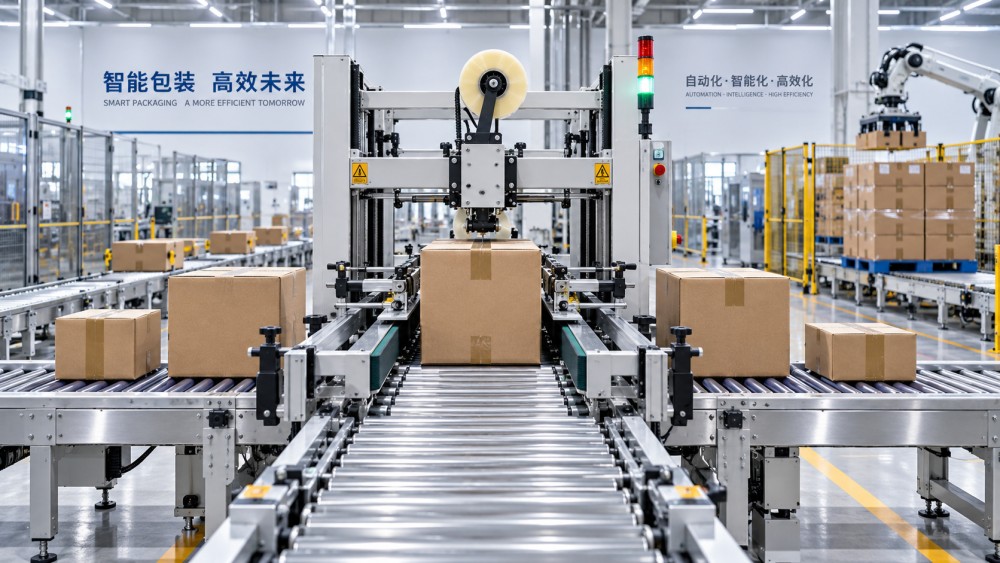
A uniform-case machine is set for one carton size and runs that format continuously or for a long production block. It is usually the most straightforward option for operations packing one standard shipping case, or where format changes are infrequent and planned. Its advantages are a simpler mechanical arrangement, lower initial cost, easier operator training, and fewer moving adjustment systems to maintain.
It becomes less attractive when production shifts among different box dimensions several times per shift. Each change requires guides, drive belts, tape heads, and top compression components to be reset correctly. Even when adjustment is quick, the hidden cost is not only the downtime. Incorrect settings after a changeover can cause skewed tape application, damaged flaps, poorly centered cartons, or jams that interrupt the entire end-of-line sequence.
Manual-adjustable sealers
Many plants operate with a semi-automatic or manually adjustable automatic case sealing machine. The operator selects the carton, adjusts width and height settings, and the machine carries out the tape application. This approach can work well when carton sizes vary but changes are limited, batches are large enough to justify the adjustment time, and trained operators remain available.
Procurement should ask how those adjustments are made. Handwheels, scales, and clearly marked reference points can make repeatable setup easier. Loose guide rails, unmarked adjustment points, or a tape-head position that must be manually recalibrated create more room for inconsistent results. A supplier demonstration should include a real format change, not simply a run of pre-set cartons.
Random-case sealers
Random-case systems detect or accommodate changing case dimensions automatically as cartons arrive. They are suited to fulfillment operations, co-packers, contract packagers, and factories handling short runs or mixed cartons. The higher purchase price may be justified by reduced changeover time and less dependence on precise manual setup.
However, “random” does not mean the machine accepts every box without limits. It still has a defined minimum and maximum case range, requirements for flap condition, constraints on box rigidity, and a practical limit on how abruptly dimensions can change between consecutive cases. Some systems also need a controlled infeed gap and predictable carton orientation. Those conditions should be examined early, particularly where operators load irregularly erected cases by hand.
For operations with a heavily concentrated volume mix, it can be more economical to use a stable-format line for the dominant carton and reserve a flexible station for exceptions. Buying maximum flexibility for all volume is not automatically the lowest-cost decision.
Validate Carton Condition and Dimensional Range
The published carton range is a starting point, not a proof of compatibility. A corrugated shipping case is a variable product: board grade, moisture exposure, score quality, flap geometry, printing or coating, and how squarely the case was erected all influence sealing performance.
Weak, bowed, or poorly squared cartons are more likely to drift between side belts. Overfilled cases may hold the top flaps above the intended sealing plane. Underfilled cases can collapse under top compression. Cases with excessively springy flaps may resist folding and lift the tape after application. An automatic case sealer can compensate for some variation, but it cannot correct a badly controlled case-erecting process.
Ask the supplier to evaluate the difficult end of your carton portfolio, not just the most common case. That includes the smallest case, the tallest case, the lightest empty case, the heaviest filled case, and any carton with a different flute profile or surface coating. If both regular slotted containers and specialty mailers are in scope, confirm whether one machine can process both reliably. A nominal dimensional overlap does not guarantee equivalent conveying and sealing behavior.
Box orientation also matters. Many sealers assume that major flaps arrive in a fixed direction and that the leading minor flap is properly folded. If the packing process leaves flaps open, uneven, or incorrectly overlapped, the machine may need added flap-folding capability, a redesigned infeed, or better discipline at the packing station. It is usually cheaper to improve carton presentation before the sealer than to address repeated jams through increasingly complex machine options.
Measure Required Throughput at the Line Level
Cases per minute is useful only when it reflects the conditions under which the line will run. A stated maximum rate may assume a consistent carton size, correct spacing, ideal flap presentation, no downstream stops, and continuous tape supply. The purchasing question is whether the sealer will sustain required output across normal product mixes and normal interruptions.
Calculate demand from the packaging line rather than from a desired headline figure. Start with the number of packed cases that must leave the station during a shift, then account for planned breaks, format changes, replenishment, routine cleaning, and expected short stops. Add a sensible capacity margin, but avoid oversizing so far that the machine runs well below its intended operating range while consuming unnecessary floor space and capital.
Line balance is especially important where the sealer sits between a case packer and downstream equipment. If the sealer pauses when a tape roll ends, can cartons accumulate safely upstream? If a labeler or palletizer stops, does the sealer have a controlled stop-and-restart sequence? Without accumulation or communication between machines, a fast case sealer may simply transfer downtime to the next station.
- Confirm whether speed is quoted for top sealing only, or for top and bottom sealing together.
- Check the required case pitch, infeed height, conveyor speed, and transfer method.
- Ask what happens to cases already inside the machine during an emergency stop or downstream blockage.
- Review restart behavior after a jam, tape break, or tape-roll replacement.
- Establish who controls line speed when the sealer is integrated with upstream and downstream equipment.
For a new automated line, controls integration deserves the same attention as mechanical capacity. Signals for machine ready, fault, low tape, emergency stop, blocked discharge, and speed demand should be defined before purchase. Retrofitting this logic after installation often turns a simple machine project into an avoidable controls project.
Tape Application Is a Quality and Operating-Cost Issue
Most automatic case sealing machines use pressure-sensitive tape, but tape performance depends on more than roll width. The carton surface, storage conditions, tape adhesive, tape tension, wipe-down pressure, and tape-head condition all affect adhesion. A seal that appears acceptable at the machine may fail after warehouse handling, temperature changes, vibration, or contact with dusty corrugated surfaces.
Select tape width and overlap based on the carton, transport risk, and customer requirements. Wider tape or longer tape legs may improve closure security, but they also increase consumable usage. Very aggressive adhesive is not a universal answer. It may leave residue, perform poorly under certain storage conditions, or create unwanted difficulty when a recipient opens the case. The practical goal is a repeatable seal appropriate to the distribution route, not the maximum possible amount of tape.
Evaluate whether the tape head is a common, serviceable design and how easily wear parts can be replaced. Blades, rollers, springs, belts, and tape-path components are small items, yet they determine whether the machine stays productive. A tape head that requires extensive disassembly for a routine blade change can increase maintenance time and encourage operators to continue running with degraded cutting performance.
Low-tape indication is worth assessing carefully. On a lightly staffed line, a warning delivered early enough for planned replenishment can prevent a full line stop. For higher-value or traceable shipments, a missing-tape detection function may be justified, particularly when sealed cases move directly into labeling, inspection, or palletizing with little opportunity for visual checking.
Look Beyond Purchase Price in the Supplier Comparison
Two machines with similar nominal speed can differ substantially in operating cost and disruption risk. Procurement should compare the entire support package: commissioning scope, operator training, access to spare parts, documentation quality, remote troubleshooting capability, and the availability of local technical service where relevant.
A well-built machine can still underperform if no one has a clear method for setting belts, cleaning tape paths, changing blades, correcting tape tracking, or diagnosing a carton jam. Request the preventive maintenance schedule and identify which tasks can be handled by plant maintenance staff. Also ask for a recommended critical spare-parts list. Keeping appropriate wear parts on site is generally more useful than holding a large inventory of non-critical components.
Safety and access should be reviewed in the installed layout, not only in a brochure image. Operators need room to load tape, clear cartons, perform adjustments, and access emergency stops without reaching across live conveyors. Guarding must allow safe maintenance while still giving practical access to common service points. A compact footprint is valuable only if it does not make routine work slower or less safe.
Electrical supply, pneumatic requirements, machine noise, dust exposure, and washdown conditions also deserve confirmation. A standard dry packaging-floor design may not be suitable for a dusty conversion area, a chilled warehouse, or a location requiring frequent washdown. When the application is unusual, the supplier should state the environmental limits and any protective options in writing.
Use a Trial to Test the Failure Modes
The most useful acceptance trial is not a demonstration of uninterrupted operation with ideal samples. It is a structured test that includes the cartons, tape, pack weights, and production scenarios most likely to create problems. Provide representative cases across the full dimensional range, including cartons from normal production rather than specially prepared samples.
During the trial, observe tape centering, tape cut quality, flap closure, case tracking, belt marks, jams, and ease of recovery. Run deliberate format changes if the application requires them. Check whether operators can replenish tape without awkward access or lengthy setup. Where possible, send trial-sealed cases through the same handling conditions they will face after installation, including labeling, conveying, stacking, and pallet transport.
The trial should also establish acceptance criteria that both parties understand. These may include the carton range to be processed, required line speed, permitted tape placement tolerance, response to low-tape conditions, and the conditions under which the machine is expected to restart after a stop. Clear criteria reduce the risk of discovering a different interpretation of “successful operation” during commissioning.
Make the Decision Fit the Next Few Years, Not an Imagined Future
Future flexibility has value when it is tied to credible changes in the packaging program: a planned expansion into e-commerce fulfillment, more frequent short runs, an expected move to new carton dimensions, or integration with automated packing and palletizing. It has less value when it is purchased only because a broader specification appears safer.
A sound selection normally leaves reasonable room for growth in throughput and carton range while keeping maintenance, controls, and operator demands proportionate to the line. The final comparison should connect each machine to the same operating profile and weigh the cost of format changes, tape use, stoppages, service, and integration alongside the equipment price. That is where the difference between an acceptable case sealer and a dependable end-of-line asset becomes visible.
Related News
 What to Check Before Ordering Pallet Wrappers Direct From a FactoryBuying from a pallet wrappers factory? Check load compatibility, output, film costs, safety, and support before ordering. Use this checklist to avoid costly mistakes and buy with confidence.Spatial Folding Strategist
 How an Automatic Folder Gluer System Reduces Carton Setup ErrorsAutomatic folder gluer system solutions reduce carton setup errors with precise feeding, folding, glue control, and compression. Discover how to improve quality and changeovers.Spatial Folding Strategist
 How to Choose a Folder Gluer Machine for Folding CartonsChoose the right folder gluer machine for folding cartons with proven guidance on speed, carton styles, glue quality, automation, testing, and lifecycle costs.Spatial Folding Strategist
 When Chain Pallet Conveyors Improve Warehouse Flow and ThroughputChain pallet conveyors improve warehouse flow by reducing forklift delays, adding controlled accumulation, and protecting packaging throughput. Discover when they deliver the strongest ROI.Spatial Folding Strategist
 How to Compare Automatic Strapping Machine Price and Total CostAutomatic strapping machine price comparison made simple: evaluate installation, throughput, consumables, labor, downtime, and total cost for a smarter investment.Spatial Folding Strategist
 What to Compare When Choosing a Pallet Wrappers SupplierCompare a pallet wrappers supplier by load stability, film efficiency, automation integration, service support, and total cost to choose the right solution.Spatial Folding Strategist