How to Choose a Folder Gluer Machine for Folding Cartons
A folder gluer is not a generic finishing machine. Its value depends on whether it can run the carton styles, substrates, glue patterns, and job-change rhythm that define a plant’s actual order mix. A machine that delivers high belt speed on a long straight-line carton may be a poor fit for four-corner pharmaceutical cartons, small cosmetic sleeves, warp-prone metallized board, or short runs requiring frequent setup.
The most reliable purchasing decision starts with production evidence rather than a catalogue speed, a broad “carton range,” or a supplier’s standard configuration. The machine should be assessed against representative dielines and board samples, including the difficult jobs that currently create rejects, slowdowns, or excessive manual work. For folding cartons, the relevant question is not simply “How fast can it run?” but “At what stable output, with what setup time and rejection rate, on the carton mix that generates revenue?”
Define the production envelope before comparing machines
Folder gluer comparisons become unreliable when suppliers are asked to quote only a maximum sheet width and speed. A meaningful request for quotation should describe the operating envelope: carton styles, dimensions, board grades, coatings, caliper range, print and finishing treatments, glue type, monthly volume by format, expected batch size, and acceptable quality limits.
Carton style is the first filter. Straight-line cartons are the least demanding format and can run on relatively simple configurations. Crash-lock bottom cartons introduce pre-folding and bottom-locking requirements. Four-corner and six-corner cartons require accurate backfolding systems, section timing, and transport stability through multiple folding operations. Sleeves, tapered cartons, wallet cartons, double-wall cartons, and specialty structures may need dedicated carriers, guide arrangements, or custom tooling. A machine that handles the claimed style “in principle” is not necessarily capable of sustained commercial production at the required quality level.
Board behavior matters as much as carton geometry. SBS, FBB, recycled board, coated board, laminated stock, metallized substrates, and light microflute can respond very differently to folding pressure and belt transport. Stiff material may resist a sharp fold; heavily coated surfaces can complicate adhesive bonding; curled sheets may wander; recycled board can vary in stiffness and crease response from lot to lot. If the plant runs both lightweight cosmetic cartons and heavier food or household-product packs, the usable production range must be proven rather than assumed from a nominal board-thickness specification.
A practical job matrix makes this visible. It should include the smallest and largest blanks, the narrowest glue flap, the heaviest and lightest board, the most complex lock-bottom design, the shortest repeat order, and the formats with difficult coatings or tight squareness tolerances. These are the jobs that reveal whether a folder gluer machine for folding cartons is properly specified.
Read speed specifications in the context of real throughput
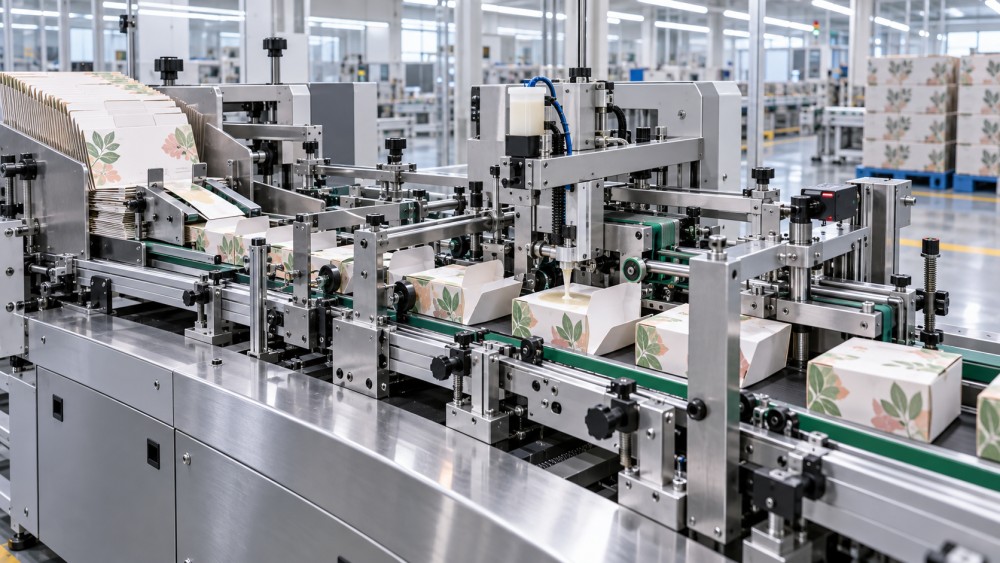
Maximum mechanical speed is useful only as an indication of machine design capacity. It does not equal saleable carton output. Actual throughput is constrained by feeder stability, blank separation, pre-fold quality, glue response, carton alignment, compression time, delivery stacking, and the time lost during setup and cleaning.
For long straight-line work, a high-speed configuration can be economically justified if blank quality is consistent and order lengths are sufficient. For short-run work, the larger productivity gain may come from faster job recall, accessible adjustments, servo-controlled settings, and fewer manual corrections. A lower nominal speed machine that reaches stable production quickly can produce more acceptable cartons per shift than a faster machine that requires extended tuning after every changeover.
Output should therefore be evaluated using net productive time. This includes startup waste, the time required to reach acceptable glue and fold quality, planned cleaning, carton jams, operator interventions, and stoppages caused by unstable feeding or inaccurate delivery. When comparing alternatives, ask suppliers to distinguish between maximum belt speed, demonstrated running speed for the proposed carton, and expected setup time for a documented job change. Those are different measurements and should not be treated as interchangeable.
Match feeder and transport design to blank quality
The feeder is often where a folder gluer either earns its productivity or loses it. Folding-carton blanks may vary because of die-cutting quality, static charge, curl, embossed areas, uneven varnish, dust, or slight differences in pile condition. A feeder that separates clean, flat blanks at high speed in a demonstration may behave differently with irregular plant production.
Evaluate the feeder’s ability to control overlap, detect double sheets, maintain registration, and handle the shortest and narrowest blanks in the job matrix. Adjustable belts, independently controlled feed sections, vibration or separation assistance, and accessible pile adjustments can be valuable, but their usefulness depends on the carton range. For high-value cartons, blank-detection and jam-management functions may reduce waste, provided they are properly integrated and do not create unnecessary nuisance stops.
Transport through the folding sections requires equally close attention. Side guides, carriers, upper belts, hooks, and folding rails must hold the carton without marking printed surfaces or forcing the crease in a way that causes spring-back. Narrow cartons and asymmetric designs are especially sensitive to side-to-side movement. Cartons with extensive varnish, lamination, or delicate decorative finishes should be tested for scuffing, belt marks, and loss of alignment under normal production pressure.
The compression section deserves more scrutiny than it often receives. Adhesive needs time and pressure to develop a stable bond, but excessive pressure can distort panels, damage windows, or mark cartons. Insufficient compression may allow glue flaps to open later in packing, filling, or distribution. Conveyor length, belt condition, pressure adjustment, and delivery design should match the adhesive system and carton construction—not just the desired machine footprint.
Specify the folding and pre-folding functions that the carton design requires
Pre-folding is essential for many cartons that will later be erected on automated filling lines or by end users. It creates a memory fold on designated creases, improving opening behavior and reducing downstream handling problems. However, not all pre-fold units have the same usable range. Buyers should verify which crease lines can be pre-folded, the minimum panel dimensions, and whether the required arrangement remains stable at production speed.
Crash-lock and multi-corner cartons need more than a standard pre-fold section. The geometry of the bottom, the sequence of panel movement, and the timing of folding elements must be coordinated precisely. Servo-driven carriers and electronically controlled backfolding can improve repeatability on complex styles, but the relevant issue is whether they reduce setup risk on the intended work—not whether servo control appears on a feature list.
Special carton structures may justify dedicated attachments or a purpose-built configuration. Trying to force every format through one heavily equipped line can create a costly compromise: excessive setup complexity for simple work and insufficient stability for specialist jobs. Where the order mix has two clearly different production profiles, such as high-volume straight-line cartons and lower-volume multi-corner cartons, separate machines or an explicitly segmented production strategy may be more economical than one universal specification.
Glue application is a quality system, not an accessory
Adhesive failure can remain hidden until cartons reach the packing line or end customer. The gluing system should therefore be selected with the substrate, coating, glue chemistry, and inspection requirement in mind.
Cold-glue disc systems are widely used for standard paperboard cartons and can be effective when maintained correctly. Their practical limitations include sensitivity to glue viscosity, disc condition, cleaning discipline, and changes in coating or board surface. Nozzle-based cold-glue systems can offer more controlled patterns for certain applications, while hot-melt systems may be required where rapid setting or difficult surfaces make cold glue unsuitable. Neither system is automatically superior; each changes consumable management, cleaning needs, safety controls, and operating cost.
The important questions are operational. Can glue position be adjusted repeatably? Is the glue line visible and accessible for inspection? How quickly can operators clean and restart the system? Does the proposed setup apply adhesive consistently at the required running speed? Can it accommodate the narrowest glue flap without contamination of the carton face?
For regulated, premium, or machine-erected cartons, consider whether glue detection, flap-position monitoring, or carton ejection is justified. Such systems can identify missing or misplaced glue, but they must be configured around realistic defect criteria. Inspection that generates frequent false rejects can undermine the same productivity it is intended to protect. Suppliers should explain the detection principle, reject mechanism, supported carton range, and what happens when a fault is detected at speed.
Automation should solve a defined operating problem
Automation can reduce adjustment time, improve repeatability, and make complex jobs less dependent on individual operator skill. Its value is strongest where orders change frequently, formats recur, or precise coordinated movements are difficult to set manually. Motorized adjustments, recipe storage, servo positioning, barcode job loading, and production-data interfaces can all be useful, but only if the factory has reliable job data and a disciplined process for managing settings.
A recipe is not a guarantee of immediate restart. Board curl, humidity, die-cut variation, glue condition, and belt wear can still require correction. The better question is how much of the setup is repeatable, which settings remain manual, and whether the saved setup time outweighs the capital cost and service complexity.
Integration should also be examined at both ends of the line. An automatic packer, conveyor, inspection device, or downstream case-packing system can constrain the folder gluer if its speed range, carton orientation, or buffer capacity is mismatched. Conversely, a highly automated folder gluer may have little benefit if cartons are manually collected and counted at delivery. Line automation should be specified as a flow of material and information, not as isolated equipment options.
Use acceptance testing to turn claims into purchasing criteria
Factory acceptance testing should be based on agreed cartons, agreed materials, and measurable acceptance conditions. Generic language such as “machine runs smoothly” leaves too much room for disagreement. The test protocol should identify the carton drawing and revision, board grade and caliper, adhesive type, approved samples, target operating speed, allowable setup time, and the quality attributes to be checked.
Relevant checks may include blank feeding consistency, fold position, carton squareness, glue-flap bond integrity, lock-bottom formation, scuffing, glue contamination, reject handling, and stack quality at delivery. For cartons that will feed automatic packing or filling equipment, the test should also consider erection behavior and dimensional consistency rather than judging only the flat folded carton.
Site acceptance is equally important because compressed air quality, electrical supply, floor levelness, ambient conditions, operator training, and upstream blank quality affect performance. Installation scope should define who is responsible for utilities, commissioning materials, mechanical positioning, guarding, training, documentation, and performance verification. If remote diagnostics are offered, clarify connectivity requirements, access controls, response arrangements, and whether local service capability exists in the operating region.
Compare lifecycle exposure, not only the purchase price
The initial machine price captures only part of the investment. A lower-cost configuration can become expensive if it requires more operators, generates persistent glue waste, runs slowly on critical formats, or depends on difficult-to-source parts. Conversely, an over-specified machine ties up capital and can raise maintenance demands without improving the economics of the actual job mix.
A useful comparison separates costs into machine purchase, installation, utilities, consumables, spare parts, preventive maintenance, operator training, expected setup labor, quality losses, and downtime exposure. Critical spares deserve special attention: belts, bearings, sensors, glue-system components, folding accessories, electronic drives, and format-specific devices do not have the same replacement lead times or local availability.
Request a recommended spare-parts list for commissioning and for the first period of operation, together with part numbers, expected replacement intervals where applicable, and service documentation. A supplier’s ability to provide accurate drawings, electrical schematics, software backup procedures, maintenance schedules, and clear fault guidance can be as important as the machine’s mechanical specification.
Compliance requirements should be addressed early. The applicable safety, electrical, and machinery requirements depend on the country of installation and the machine’s scope of supply. Where CE marking, UL-related electrical requirements, or other local obligations are relevant, the contract should identify the required documentation and responsibility for compliance rather than relying on informal assurances.
The strongest selection is usually the one with the clearest limits
A credible supplier will state not only what the folder gluer can do, but where its performance boundaries lie: minimum practical carton size, limitations with certain coatings, speed reductions for complex styles, glue-system constraints, and conditions required for stable production. This is more useful than an unrestricted performance claim because it allows the buyer to plan capacity honestly and avoid disputes after installation.
The final decision should favor documented fit over feature quantity. A folder gluer that has demonstrated stable feeding, accurate folding, secure gluing, manageable changeovers, and supportable maintenance on representative cartons is a stronger investment than a machine selected primarily for its headline speed or broadest advertised format range. For folding-carton production, repeatable quality and usable uptime are the capacities that ultimately matter.
Related News
 How to Choose Carton Counting Systems for Accurate ProductionChoose Carton Counting Systems with confidence. Compare sensors, accuracy, line integration, and testing methods to improve production reliability.Spatial Folding Strategist
 How to Troubleshoot an Automatic Case Erecting MachineTroubleshoot your automatic case erecting machine with practical steps for diagnosing jams, vacuum loss, sensor faults, and sealing issues—and restore reliable operation.Spatial Folding Strategist
 How to Choose Pallet Conveyors for a Packaging LineChoosing pallet conveyors for packaging line operations? Compare load requirements, throughput, layouts and safety to find the right solution.Spatial Folding Strategist
 How to Choose Case Packers for an Automated Palletizing LineChoose Case Packers that keep your palletizing line moving. Compare loading methods, capacity, changeovers, and integration to make a confident investment.Spatial Folding Strategist
 How Inline Pallet Wrappers Fit Into Automated Packaging LinesDiscover how inline pallet wrappers integrate with automated packaging lines, improve load stability, and help prevent costly bottlenecks.Spatial Folding Strategist
 What Affects Bundle Handling System Cost in a Sheet Plant?Bundle handling system cost depends on capacity, layout, automation, and integration. Learn how to compare total costs and choose the right system for your sheet plant.Spatial Folding Strategist