How to Choose a Disposable Paper Cup Machine for Stable Output
Procurement decisions around a disposable paper cup machine tend to look simple from the outside. The brochure shows cups per minute, a compact frame, and a promise of automation. But on the factory floor, “stable output” means something more demanding: a machine that can run for long shifts without drifting out of tolerance, feeding paper smoothly, sealing reliably, and maintaining acceptable scrap rates even when material lots change.
That is why buyers who focus only on headline speed often end up disappointed. A faster machine that stops frequently, produces inconsistent rims, or struggles with coated paperboard is not truly productive. For procurement teams, the better question is not “Which machine is fastest?” but “Which machine will deliver predictable output, controllable waste, and manageable operating risk over time?”
In the current packaging climate, this question matters even more. Foodservice operators, converters, and cup producers are under pressure from plastic-reduction policies, cost volatility, and rising expectations around sustainable paper-based packaging. A poor machine choice affects more than throughput. It can disrupt delivery commitments, inflate maintenance costs, and create quality issues that damage customer confidence.
Start with the output you actually need, not the output printed in the catalog
A practical evaluation begins with production reality. Before comparing machine models, define what “stable output” means in your own operation. For one buyer, it may mean steady production of standard hot-drink cups in long runs. For another, it may involve frequent size changes, different cup heights, double PE or PLA-coated stocks, or stricter print registration requirements.
Ask your team to clarify five basics:
- Target cup sizes and daily production volume
- Expected operating hours per shift and per week
- Paperboard specifications, including coating type and GSM range
- Tolerance for scrap during startup and changeover
- Labor availability for operation, setup, and maintenance
This sounds elementary, but many purchasing mistakes begin here. A machine that performs well on one cup format may become unstable when running a broader size range. Another may be efficient at medium speed yet unsuitable for high-mix production because adjustments take too long. Stable output is always tied to a specific production profile.
Mechanical stability matters more than cosmetic features
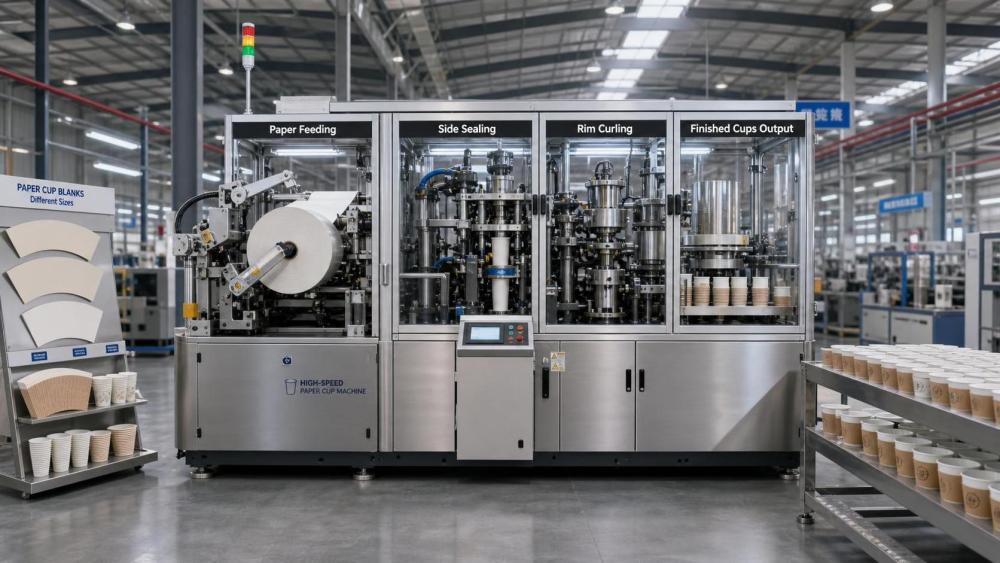
When evaluating a disposable paper cup machine, the frame and motion system deserve close attention. Cup forming is a sequence of synchronized actions: paper feeding, side sealing, bottom punching, bottom insertion, heating, knurling, curling, discharge. If these movements are not mechanically stable, quality variation will appear quickly.
Look beyond painted covers and touchscreen interfaces. Focus on the core machine architecture:
- Transmission design: Is the main drive mechanically robust and suited for continuous operation?
- Cam and indexing stability: Smooth, repeatable motion reduces vibration and lowers wear.
- Frame rigidity: A stronger machine body helps maintain alignment at higher running speeds.
- Bearing and component quality: Weak components often reveal themselves through unplanned stops rather than immediate failure.
- Heat control consistency: Side sealing and bottom bonding depend on stable thermal conditions, not just nominal heater power.
For procurement professionals, this is where machinery evaluation overlaps with broader converting and packaging equipment logic. In high-speed paper processing, output stability is rarely the result of one “smart” feature. It is the result of repeatable mechanics, controlled heat, synchronized motion, and manageable wear points. The same truth applies across corrugated, printing, die-cutting, and folding systems: OEE is built into the machine’s motion discipline long before software dashboards start reporting it.
Do not separate speed from waste control
A machine that advertises high cups-per-minute output may still perform poorly if startup waste, side-seal rejects, or bottom leakage rates are hard to control. Procurement teams should ask for a more complete view of productivity, including how the machine behaves during ramp-up, shift changes, and material variation.
Stable output depends on whether the machine can hold quality without constant intervention. Key questions include:
- How sensitive is the machine to paper curl or slight board variation?
- What are the common defect points during continuous running?
- How much operator adjustment is typically needed during long shifts?
- How quickly can the line recover after a stop?
- What reject detection or fault alarm functions are included?
It is easy to underestimate the cost of waste in paper cup converting. Scrap is not only material loss. It also consumes labor, energy, machine time, and downstream packing capacity. Buyers focused on lifecycle value should treat waste stability as a primary selection criterion, not a secondary quality issue.
Material compatibility is no longer a side question
With sustainability regulations tightening and brand owners shifting specifications, material flexibility has become a strategic requirement. A disposable paper cup machine may run standard PE-coated stock well, yet struggle with newer paper structures, barrier-coated boards, or heavier substrates required for certain applications.
That makes substrate testing essential. Instead of relying on general claims such as “suitable for various paper materials,” request evidence of machine performance on the paperboard grades that match your real sourcing plan. Pay attention to:
- Single PE, double PE, or PLA-coated board compatibility
- Heating and sealing performance across coating types
- Forming quality at different board thicknesses
- Behavior of printed blanks, especially where ink coverage affects sealing
- Bottom sealing integrity under speed and temperature variation
This point is especially relevant for buyers serving export markets or large foodservice chains. Material substitution may happen with little warning due to regulation, cost, or supply chain shifts. A machine with narrow compatibility can create future procurement risk, even if it looks economical today.
Automation should reduce dependence on operator improvisation
Automation is often marketed as a convenience feature, but for procurement teams it should be evaluated as a risk-reduction tool. The right level of automation improves repeatability and reduces the machine’s dependence on highly experienced operators.
Consider whether the machine includes practical functions such as automatic lubrication, servo-assisted feeding, fault diagnostics, cup counting, and safety interlocks that do more than satisfy checklists. Useful automation is the kind that shortens the distance between a problem occurring and a problem being corrected.
At the same time, more automation is not automatically better. A complex control layer built on a mechanically unstable platform will not solve the real issue. Buyers should look for a balanced design where automation supports process consistency rather than masking weak fundamentals.
Changeover time quietly shapes your ROI
If your production schedule includes multiple cup sizes or short-to-medium runs, changeover efficiency will influence actual output more than rated top speed. A machine that runs quickly but requires long adjustments during format changes can create hidden losses every week.
Ask suppliers to explain what must be changed when moving between cup sizes. Are parts modular? Are adjustments accessible? How much setup relies on manual skill? Is there a standard procedure that maintenance and operations teams can learn quickly?
Procurement teams sometimes view changeover as an operations issue to be solved later. In reality, it is a purchasing issue because it affects labor planning, spare parts inventory, and total line availability from day one.
Supplier support is part of the machine
A disposable paper cup machine is not just steel, motors, and heaters. It also comes with documentation quality, installation discipline, parts availability, troubleshooting response, and training effectiveness. These support elements determine whether the machine becomes a stable asset or a recurring source of production anxiety.
During supplier assessment, look for signs of maturity rather than polished sales language. Can the supplier clearly explain wear parts? Do they provide preventive maintenance guidance? Are electrical diagrams, mechanical drawings, and parts lists usable? Can they support remote diagnosis? Is commissioning handled by people who understand forming stability, not just basic startup?
For buyers in regulated or export-oriented environments, the documentation side matters even more. Clear technical support helps reduce downtime and supports more disciplined maintenance planning. In complex packaging industries, strong after-sales capability often separates durable investments from expensive experiments.
How to compare machines during evaluation without getting lost in claims
A structured comparison process helps teams avoid being swayed by a single strong demo. One useful approach is to score candidate machines across a set of decision factors, with weighted importance based on your business model.
Typical comparison areas include:
- Stable running speed under your cup specification
- Material compatibility with current and likely future substrates
- Scrap control during startup and continuous operation
- Ease of maintenance and accessibility of critical parts
- Operator skill dependency
- Changeover time and tooling management
- Supplier technical support and spare parts responsiveness
- Safety, documentation, and control system usability
Whenever possible, request sample production using your own paper blanks or a close equivalent. A live test reveals far more than a catalog sheet. It helps your team observe sealing consistency, reject behavior, machine noise, discharge uniformity, and the quality of supplier problem-solving under real conditions.
Common buying mistakes that weaken stable output
Some selection errors appear repeatedly in cup machinery procurement. The most common is buying for peak speed instead of average useful output. Another is assuming all paper cup machines handle sustainable substrate changes equally well. A third is treating maintenance as an afterthought, only to discover that routine servicing requires excessive downtime or hard-to-source components.
There is also a softer mistake: underestimating operator reality. If a machine requires constant fine-tuning from a highly experienced technician, output stability may collapse when shifts rotate or labor conditions change. Procurement should always ask whether the machine is robust in ordinary hands, not just expert hands.
What a confident purchasing decision looks like
A confident decision rarely comes from finding the “best” disposable paper cup machine in the abstract. It comes from matching machine capability to production strategy with clear eyes. The right machine for stable output is usually the one that balances mechanical reliability, substrate flexibility, manageable automation, practical changeovers, and dependable supplier support.
For procurement teams, that balance is where long-term value lives. In paper converting, uptime is earned through disciplined machine design and service support, not promised by speed numbers alone. If you evaluate machines through the lens of OEE, waste control, and process consistency, your shortlist becomes clearer—and the risk of buying a machine that looks impressive but performs unevenly becomes much lower.
In a market moving toward sustainable paper packaging and tighter operating margins, that kind of discipline is not cautious. It is competitive.
Related News
 How an Automatic Folder Gluer System Reduces Carton Setup ErrorsAutomatic folder gluer system solutions reduce carton setup errors with precise feeding, folding, glue control, and compression. Discover how to improve quality and changeovers.Spatial Folding Strategist
 How to Choose a Folder Gluer Machine for Folding CartonsChoose the right folder gluer machine for folding cartons with proven guidance on speed, carton styles, glue quality, automation, testing, and lifecycle costs.Spatial Folding Strategist
 When Chain Pallet Conveyors Improve Warehouse Flow and ThroughputChain pallet conveyors improve warehouse flow by reducing forklift delays, adding controlled accumulation, and protecting packaging throughput. Discover when they deliver the strongest ROI.Spatial Folding Strategist
 How to Compare Automatic Strapping Machine Price and Total CostAutomatic strapping machine price comparison made simple: evaluate installation, throughput, consumables, labor, downtime, and total cost for a smarter investment.Spatial Folding Strategist
 What to Compare When Choosing a Pallet Wrappers SupplierCompare a pallet wrappers supplier by load stability, film efficiency, automation integration, service support, and total cost to choose the right solution.Spatial Folding Strategist
 How an Automatic Case Erecting Machine Reduces Packing DelaysAutomatic case erecting machine solutions reduce packing delays by delivering consistent, sealed cases, improving line flow, uptime, and end-of-line efficiency.Spatial Folding Strategist