How to Choose Stacking Conveyors for Space-Saving Material Flow
Buyers searching for stacking conveyors are usually not asking what the machine is. They are trying to answer a harder question: will a space-saving conveyor actually improve plant flow, or will it simply move congestion from one point in the line to another? In high-speed packaging and converting environments, especially where corrugated sheets, die-cut blanks, bundled cartons, or finished cases must be accumulated in a controlled footprint, the right answer depends less on brochure dimensions and more on how the conveyor behaves under real production variability.
That matters because floor space has become an expensive production variable. E-commerce volume, shorter runs, more SKU changes, and tighter labor availability have pushed many plants to add automation into buildings that were never designed for today’s throughput. A stacking conveyor can help recover usable space and reduce manual handling, but only when it is selected as part of a material-flow decision, not as a standalone piece of equipment.
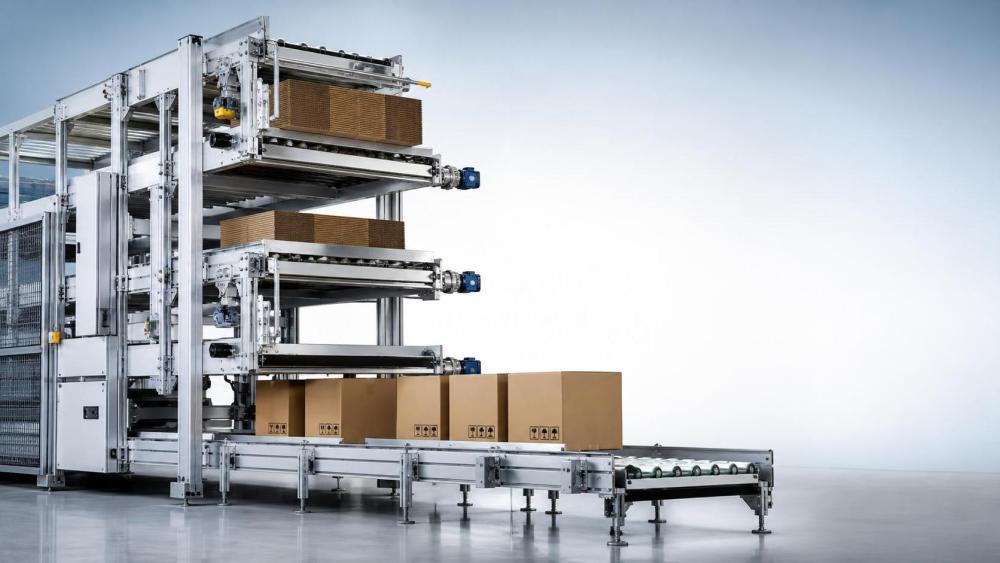
For procurement teams, the most useful starting point is this: a stacking conveyor should be evaluated as a buffer, accumulation, orientation, and handoff system all at once. If one of those functions is weak, the “space-saving” advantage can disappear quickly in the form of jams, unstable loads, poor operator access, or OEE losses upstream.
Start with the flow constraint, not the machine footprint
A common mistake in conveyor selection is to begin with available floor area and then search for the most compact model. That is understandable, but incomplete. Space reduction is only valuable if the conveyor can absorb the actual rhythm of the line. In converting plants, flow is rarely uniform for an entire shift. Speeds change, product dimensions vary, stack counts fluctuate, and downstream pack-out or palletizing may pause unexpectedly.
So the first procurement question is not “How small can this conveyor be?” but “What kind of interruption, accumulation window, and stack behavior do we need it to handle?”
In practice, buyers should clarify several operating conditions before comparing suppliers:
- What product is being stacked: corrugated sheets, folded cartons, bundles, trays, or finished cases?
- Is the conveyor buffering a continuous process or feeding an intermittent one?
- How often does downstream equipment stop, slow, or change recipe?
- What stack height, stack count, or load weight is required?
- Does the product remain dimensionally stable at line speed, or is it prone to shifting, curling, sliding, or edge damage?
- Will operators need frequent manual intervention for inspection, rework, or batch separation?
Without these answers, footprint comparisons are misleading. A smaller conveyor may look efficient on layout drawings while performing poorly when the line experiences the normal starts, stops, and surges of production.
What “space-saving” really means in plant terms
In procurement discussions, “space-saving” often gets reduced to length and width. But in operating plants, space efficiency is broader than that. It includes vertical use of space, aisle preservation, access for forklift or AGV traffic, maintenance clearance, and the ability to separate operators from moving loads safely.
A stacking conveyor that reduces linear floor length but creates a difficult maintenance zone or blocks access to a die-cutter, folder gluer, or bundler is not truly saving space. It is borrowing space from another part of the process. The best systems improve density without degrading visibility, safety, or service access.
This is especially relevant in corrugated and printing facilities where end-of-line systems must coexist with strapper units, labelers, inspection points, and palletizing cells. In these environments, the real benefit of a compact stacking conveyor is often not the square meters saved on paper, but the fact that it allows a cleaner material path with fewer manual touches and fewer awkward turns.
Choose the conveyor around stack stability
For many buyers, the make-or-break issue is not accumulation volume but stack stability. A conveyor can appear technically adequate until product mix broadens. Then the line starts seeing uneven piles, leaning bundles, sheet skew, or unstable discharge to the next process. That is where the cost of a poor fit emerges: downtime, operator intervention, damaged product, and inconsistent pallet loads.
Stack stability depends on a combination of factors:
- Product geometry and center of gravity
- Surface friction between units
- Conveyor speed transitions
- Side guiding and alignment control
- Drop height or transfer method
- Batch separation logic
- Environmental conditions such as dust or humidity
In corrugated applications, for example, board grade, sheet size, warp condition, and surface finish can all affect how reliably material stacks and transfers. For folded cartons or printed blanks, finish quality and edge condition may matter just as much as weight. Buyers should press suppliers to explain how the proposed design maintains alignment and load stability during acceleration, deceleration, and discharge, not just in ideal steady-state operation.
If a supplier mainly speaks in terms of conveyor speed and motor power, but has little to say about stack control under variable product conditions, that is usually a warning sign.
Integration is often more important than the conveyor itself
Stacking conveyors sit in the middle of broader line logic. Their value depends heavily on how well they communicate with upstream and downstream machines. For buyers in packaging and converting, this means the selection process should include controls compatibility, signaling logic, and exception handling from the beginning.
A well-chosen system should support predictable responses to events such as:
- upstream overproduction
- downstream pause or fault
- batch changeover
- mixed SKU handling
- quality reject diversion
- palletizer or robot cycle variation
In high-speed environments, poor integration is a direct OEE problem. A stacking conveyor that cannot buffer short stoppages cleanly may force upstream equipment to slow down or stop more often. That is particularly costly when the upstream asset is a high-output press, die-cutter, or folder gluer where lost minutes carry disproportionate economic impact.
This is one reason buyers should ask not only about mechanical design, but also about PLC architecture, HMI visibility, diagnostics, alarm handling, and communication with existing line equipment. In many projects, the performance gap between two similar conveyor platforms comes from controls maturity rather than steelwork.
Not every compact design is suitable for high-mix production
Another common assumption is that a compact stacking solution is automatically more flexible. In reality, some space-saving designs work very well in stable, repetitive production and less well in plants running broad SKU mixes, frequent size changes, or shifting order patterns.
Buyers should look carefully at setup burden. If the conveyor requires repeated manual guide adjustments, mechanical resets, or sensitive tuning for different stack formats, its compactness may come at the expense of labor efficiency and repeatability. This is particularly relevant for plants handling short runs or frequent order changes, where changeover discipline matters as much as nominal line speed.
For procurement, that leads to a practical test: ask the supplier to describe the full changeover sequence, the number of manual touchpoints, the typical reset time, and what happens when operators skip or mis-set an adjustment. A machine that appears simple during demonstration can become expensive in live production if its repeatability depends too much on operator judgment.
Use OEE logic, but do not reduce the business case to labor savings
Labor reduction is often the first benefit attached to stacking conveyors, and sometimes that is justified. Yet in packaging operations, the stronger business case may come from improved flow continuity, reduced handling damage, cleaner stack presentation to downstream automation, and fewer stoppages on critical assets.
That broader view is important because conveyor projects are often evaluated against larger capital priorities. If procurement frames the investment too narrowly, a worthwhile system may be undervalued. A better evaluation looks at where the conveyor protects line uptime and material yield.
In a corrugated or carton converting setting, these effects can include:
- less manual restacking after unstable accumulation
- fewer edge-crushed or scuffed units during transfer
- better downstream feeding consistency
- lower interruption rates at strapper, wrapper, or palletizer stations
- reduced risk of quality mix-ups between orders or batches
For plants already focused on OEE and waste control, this aligns with a wider trend: end-of-line handling is no longer treated as a secondary utility. It is part of how throughput and material yield are protected, especially when upstream machinery runs at increasingly high speed.
Questions buyers should ask before shortlisting suppliers
Good procurement work on stacking conveyors is less about collecting the most data and more about forcing the right comparisons. A short, disciplined question set is often more revealing than a long generic specification sheet.
These questions are especially useful when several vendors claim similar throughput and footprint. In many cases, the real difference appears in operational resilience, not headline capacity.
Watch the hidden constraints: safety, access, and future line changes
Space-saving equipment often introduces tighter layouts, and tighter layouts raise two risks that are easy to underestimate during procurement. The first is safe intervention. Operators and maintenance teams still need to clear jams, inspect product, and service components. The second is future adaptability. A conveyor selected around today’s exact dimensions may become awkward if product range expands or if downstream automation changes.
That is why buyers should review layouts with operations, maintenance, and safety stakeholders together rather than relying only on engineering drawings. A machine can be technically installable and still operationally inconvenient. Clearance around guarding, sensor access, stack removal, and emergency reach zones deserves serious attention.
Depending on geography and application, machine safety expectations and compliance requirements may vary, and exact obligations should be confirmed for the destination market【待核实】. For multinational packaging groups, internal safety standards may be stricter than local minimum requirements, so supplier flexibility on guarding and controls architecture should be assessed early.
When a stacking conveyor is the right investment, and when it is not
A stacking conveyor is usually worth serious consideration when a plant has one or more of the following conditions: constrained floor space, rising throughput on existing lines, recurring manual accumulation bottlenecks, unstable handoff to end-of-line automation, or a need to separate batches more cleanly without expanding the building footprint.
It may be a weaker investment when the underlying problem is not accumulation at all, but poor line balancing, inconsistent upstream output, weak palletizing logic, or product instability that begins earlier in the process. In those cases, installing a more compact conveyor can mask the symptom without solving the root cause.
For procurement teams, the practical lesson is simple: do not buy stacking conveyors as a generic efficiency upgrade. Buy them when they clearly improve flow architecture. In high-speed packaging and converting plants, the best systems are not the ones that occupy the least space in isolation. They are the ones that preserve uptime, maintain stack quality, and create a cleaner operational margin between tightly linked processes.
That is the standard worth using when the goal is not just to fit more equipment into the plant, but to make the plant run better within the space it already has.
Related News
 How an Automatic Folder Gluer System Reduces Carton Setup ErrorsAutomatic folder gluer system solutions reduce carton setup errors with precise feeding, folding, glue control, and compression. Discover how to improve quality and changeovers.Spatial Folding Strategist
 How to Choose a Folder Gluer Machine for Folding CartonsChoose the right folder gluer machine for folding cartons with proven guidance on speed, carton styles, glue quality, automation, testing, and lifecycle costs.Spatial Folding Strategist
 When Chain Pallet Conveyors Improve Warehouse Flow and ThroughputChain pallet conveyors improve warehouse flow by reducing forklift delays, adding controlled accumulation, and protecting packaging throughput. Discover when they deliver the strongest ROI.Spatial Folding Strategist
 How to Compare Automatic Strapping Machine Price and Total CostAutomatic strapping machine price comparison made simple: evaluate installation, throughput, consumables, labor, downtime, and total cost for a smarter investment.Spatial Folding Strategist
 What to Compare When Choosing a Pallet Wrappers SupplierCompare a pallet wrappers supplier by load stability, film efficiency, automation integration, service support, and total cost to choose the right solution.Spatial Folding Strategist
 How an Automatic Case Erecting Machine Reduces Packing DelaysAutomatic case erecting machine solutions reduce packing delays by delivering consistent, sealed cases, improving line flow, uptime, and end-of-line efficiency.Spatial Folding Strategist