How an Automatic Folder Gluer System Reduces Carton Setup Errors
Carton setup errors usually begin before the first acceptable carton reaches the delivery section. A feeder set too tight can scuff or bow blanks. A carrier position that is only slightly off can pull a crease open unevenly. Glue that appears correct at low speed may land beside the intended flap when the blank accelerates. By the time a carton opens at packing or fails a compression check, the original setting error may be difficult to trace.
An automatic folder gluer system reduces these errors by turning critical adjustments into controlled, repeatable positions rather than relying on repeated manual estimation. It coordinates sheet feeding, side-guide alignment, folding carrier geometry, glue timing, compression, and delivery counting around a defined carton layout. Automation does not remove the need to understand the blank, but it makes the relationship between machine settings and finished-carton quality easier to hold steady from job to job.
Errors often start with an unstable blank path
A folded carton can only be as accurate as the blank entering the machine. When blanks enter skewed, overlap inconsistently, or arrive with variable gaps, every downstream setting becomes harder to control. Folding rails and carriers may appear incorrectly adjusted when the real issue is intermittent feeding. Glue timing may seem inconsistent because the leading edge is not arriving at the glue unit at a consistent position.
Automatic feeders reduce this variation through controlled belt speed, vacuum or friction separation, adjustable side guides, and monitored sheet transport. The objective is not simply to send blanks through faster. It is to present each blank in the same orientation and at the same spacing. This gives the folding and gluing sections a stable reference point.
Blank quality still matters. Warped board, excessive curl, cracked scores, poorly stripped waste, or uneven die-cut dimensions can create errors that no machine adjustment fully corrects. A well-controlled system makes these upstream problems more visible because the machine is no longer adding a large amount of setup variation of its own. If a carton starts drifting after a stable setup, the condition of the incoming blank should be examined before repeatedly moving guides or folding belts.
Stored settings reduce variation during changeovers
Frequent job changes create a common source of carton defects: the new setup is based on memory, rough reference marks, or the previous job rather than a verified position. A small error in one folding carrier may be hidden during hand inspection, yet produce a noticeable difference in carton squareness after the cartons are packed flat and transported.
Servo-driven or electronically positioned sections allow job settings to be saved and recalled for repeat work. Depending on the machine configuration, this may include carrier positions, side guides, pre-fold devices, folding belts, glue-gun offsets, compression settings, and delivery controls. Recalling a recipe does not eliminate make-ready checks. It places the machine near the proven setting quickly, so adjustment begins from a known reference rather than from an approximate starting point.
The most reliable job record contains more than dimensional positions. It should distinguish between the nominal carton design and the production conditions that affected the final setting. Board caliper, grain direction, coating, print coverage, crease behavior, glue type, and carton style can all influence the final result. Two blanks with identical flat dimensions may need different folding pressure or glue timing when one is heavily coated or uses a stiffer substrate.
A recipe should also record the inspection point used to approve the job. “Carton looked good” is too vague to support a repeatable restart. Better references include the position of the manufacturer's joint, flap alignment, diagonal squareness, glue-line placement, opening behavior, and the condition of the carton after the compression section. These details give a later setup a meaningful target.
Folding control prevents errors that appear after gluing
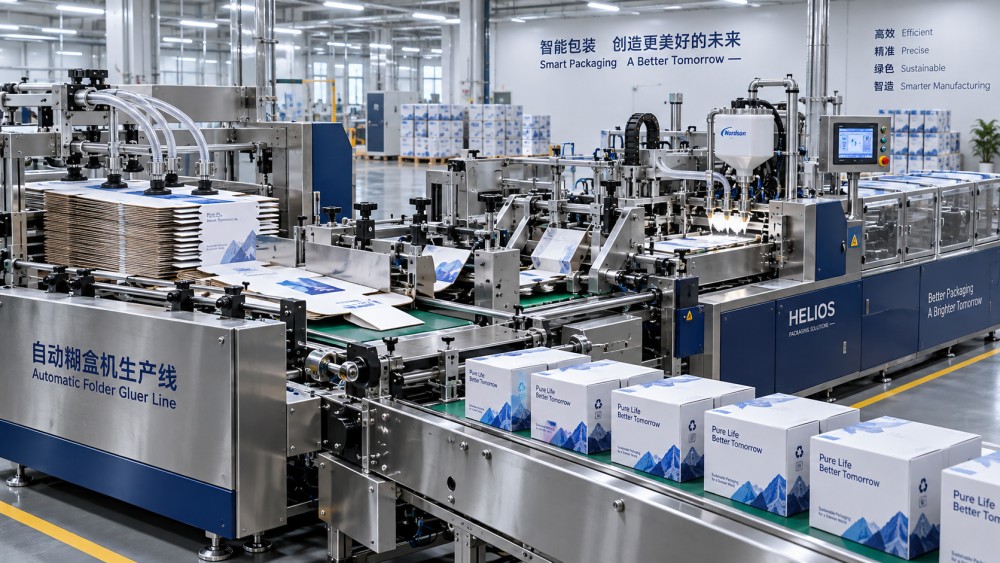
Many folding defects are not caused by the glue unit. They are caused by a fold arriving at the glue station in the wrong position or closing before the adhesive can make the intended contact. An automatic system controls belt speed relationships, carrier placement, and folding path geometry so that the blank follows a repeatable route through pre-fold, lower fold, and final fold sections.
Pre-fold settings are especially important on cartons that must open easily on filling equipment. If the pre-fold is too weak, a crease may resist opening later. If it is overworked, the board can crack or lose its intended shape. The correct setting is linked to the score quality and material behavior, not merely to the printed layout. A deep, clean score may fold predictably with moderate guidance, while a shallow score on stiff board can require a different belt and carrier relationship.
Final-fold errors often show up as fish-tailing, unequal panel overlap, crooked side seams, or cartons that rock when placed on a flat surface. These symptoms should not be treated as one problem. Fish-tailing can result from a skewed feed, unequal belt traction, a blank that was die-cut out of square, or a carrier that is steering the fold too aggressively. A crooked glue seam may come from late glue application, but it can also occur when the outer panel reaches the joint before the inner panel has settled into position.
Automation is valuable because adjustments can be made in controlled increments and returned to a reference setting. That makes fault isolation more disciplined. When a defect occurs, changing the feeder, both side guides, folding carriers, and glue position at once may produce a temporary acceptable sample while concealing the actual cause. A stable automatic setup supports one-variable changes followed by a short, representative inspection run.
Glue application becomes easier to verify
Glue failures are often described as “not enough glue,” even when the adhesive volume is adequate. A bead placed too close to the edge can squeeze out under compression and contaminate the carton surface. A bead placed too far inward may fail to reach the mating panel. Intermittent bonding can come from cold adhesive, clogged nozzles, poor board contact, insufficient compression time, or a timing offset between the glue trigger and blank position.
Automatic glue controls synchronize application with the movement of each blank. Encoders or related position feedback allow the glue pattern to follow the actual transport distance rather than a rough timed delay. This is especially useful where carton length changes between jobs or where short gaps make timing errors more visible. Controlled application also reduces the temptation to compensate for poor positioning by applying a wider or heavier bead.
Verification should focus on the joint after it has passed through the compression section, not only on the visible wet-glue pattern. A clean bead before folding does not prove a sound bond. Inspect the seam for continuous contact, glue squeeze-out, dry areas, offset panels, and opening resistance. For lock-bottom or multi-panel cartons, inspect the sequence of closing actions as well. Adhesive may be correctly deposited while a panel still blocks another panel from reaching its intended position.
Material changes alter the glue window
Coated stock, laminated surfaces, high-recycled-content board, and corrugated microflute materials do not behave like a single material category. Surface energy, porosity, stiffness, and moisture condition affect how adhesive wets the surface and how quickly the joint develops handling strength. A setting that works on absorbent uncoated board can produce a weak joint on a less porous surface even when the glue bead looks similar.
Temperature and line speed also interact with adhesive performance. Raising speed reduces the time available between application, folding, and compression. Increasing adhesive output may not solve a joint that lacks enough contact time or pressure. Conversely, excessive compression can distort a delicate carton or force adhesive beyond the flap edge. The useful setup question is whether the adhesive, substrate, fold sequence, and compression path are working together, not whether one value has been increased.
Compression and delivery reveal whether setup is truly stable
The compression section is where a good-looking fold becomes a bonded carton. Belt pressure, upper carrier height, dwell length, and transport speed must keep the glued panels in contact without crushing the carton or shifting the seam. Cartons that leave the machine with acceptable alignment but open later may have insufficient bonding time. Cartons with rubbed print, crushed edges, or distorted windows may be receiving excessive pressure or poorly distributed pressure.
Delivery settings also affect the quality of the finished batch. If cartons are ejected too aggressively, stacked unevenly, or counted before they have settled, minor setup defects can turn into bent corners and mixed orientation. A controlled delivery section supports consistent stacking and makes sample inspection more representative of the cartons that will be packed and shipped.
When production resumes after a stop, the first cartons deserve separate attention. Adhesive flow, belt traction, and blank spacing can change during a pause. Some systems provide automatic restart sequences or waste separation, but the condition of the initial output should still be judged before it is combined with approved cartons. This is particularly important after clearing a jam, replacing a glue nozzle, changing adhesive containers, or adjusting a carrier.
Useful controls are only effective when the reference is maintained
Automation reduces repeatability errors, but a saved position cannot compensate for worn belts, contaminated sensors, loose carriers, incorrect calibration, or damaged folding rails. Preventive maintenance therefore has a direct relationship with setup accuracy. Belt surfaces should provide even traction across their width. Guide rails must remain clean and secure. Glue nozzles require inspection for partial blockage or inconsistent shutoff. Sensors used for blank detection need a clean signal and a confirmed physical reference.
Calibration matters most after mechanical work, collisions, or component replacement. If a servo axis reports the correct digital position while its mechanical zero has shifted, recalled recipes create confident but inaccurate setups. The resulting defects can be difficult to diagnose because the screen values appear normal. A documented reference check after maintenance prevents this mismatch between commanded position and actual position.
Setup quality is also improved when the job approval sample is retained or clearly documented. Comparing a new run against an approved folded carton can expose subtle changes in seam placement, fold sharpness, and squareness that are easy to miss when evaluating a single carton in isolation. The purpose is not to preserve every previous adjustment forever; it is to preserve the conditions that produced an acceptable carton so later changes have a reliable baseline.
An automatic folder gluer system reduces carton setup errors by making the blank path, fold sequence, glue placement, compression, and delivery behavior repeatable. Its strongest benefit appears when machine settings are linked to the actual board and carton design, verified at the finished joint, and protected through calibration and maintenance. That combination turns changeover from a sequence of estimates into a controlled production setup.
Related News
 How to Choose Carton Counting Systems for Accurate ProductionChoose Carton Counting Systems with confidence. Compare sensors, accuracy, line integration, and testing methods to improve production reliability.Spatial Folding Strategist
 How to Troubleshoot an Automatic Case Erecting MachineTroubleshoot your automatic case erecting machine with practical steps for diagnosing jams, vacuum loss, sensor faults, and sealing issues—and restore reliable operation.Spatial Folding Strategist
 How to Choose Pallet Conveyors for a Packaging LineChoosing pallet conveyors for packaging line operations? Compare load requirements, throughput, layouts and safety to find the right solution.Spatial Folding Strategist
 How to Choose Case Packers for an Automated Palletizing LineChoose Case Packers that keep your palletizing line moving. Compare loading methods, capacity, changeovers, and integration to make a confident investment.Spatial Folding Strategist
 How Inline Pallet Wrappers Fit Into Automated Packaging LinesDiscover how inline pallet wrappers integrate with automated packaging lines, improve load stability, and help prevent costly bottlenecks.Spatial Folding Strategist
 What Affects Bundle Handling System Cost in a Sheet Plant?Bundle handling system cost depends on capacity, layout, automation, and integration. Learn how to compare total costs and choose the right system for your sheet plant.Spatial Folding Strategist