How an Automatic Case Erecting Machine Reduces Packing Delays
Packing delays often begin before products reach the sealing station. When empty cases are erected manually, the line depends on a worker keeping pace with variable product flow, locating the correct blank, opening it cleanly, folding the bottom flaps, and placing the case in the required position. A short interruption at this point can leave case packers, checkweighers, labelers, and palletizing equipment waiting for cartons rather than processing finished goods.
An automatic case erecting machine reduces this constraint by converting flat corrugated blanks into square, bottom-sealed cases at a controlled and repeatable rate. Its value is not simply labor replacement. In a well-designed end-of-line system, it creates a predictable supply of usable cases, stabilizes the interface between production and packing, and makes delays easier to identify and manage.
The practical result depends on the full line design. A case erector cannot solve packing delays caused by inconsistent case blanks, inadequate accumulation, unstable product feeding, or poor changeover planning. It can, however, remove a common source of stop-and-start operation when the equipment, materials, controls, and downstream stations are matched properly.
Why manual case formation creates disproportionate delays
Manual case handling appears simple when viewed as an individual task. Its impact becomes more significant when it is connected to continuous or semi-continuous packaging equipment. A cartoner or case packer may operate steadily for several minutes, then stop because erected cases are not available at the infeed. The immediate issue is a missing carton, but the operational consequence can include product backup, restart procedures, rejected packs, delayed labeling, and disruption to pallet patterns.
The problem is particularly visible where product output is irregular. Batch production, short runs, mixed SKU schedules, and frequent packing format changes can create periods of sudden demand for cases. Manual operators must respond to these peaks while also handling replenishment, removing defective blanks, and communicating with adjacent stations. The line then relies on individual timing rather than an engineered material flow.
Case erection also requires consistency that is difficult to sustain manually over long periods. A carton that is only partly squared, has an uneven bottom seal, or is presented in the wrong orientation may pass briefly through the process before causing a jam at filling, taping, printing, or conveying. These events are often recorded as downstream machine faults, even though the root cause was the condition of the erected case.
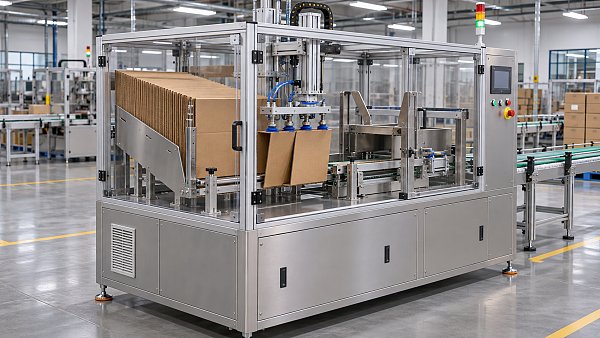
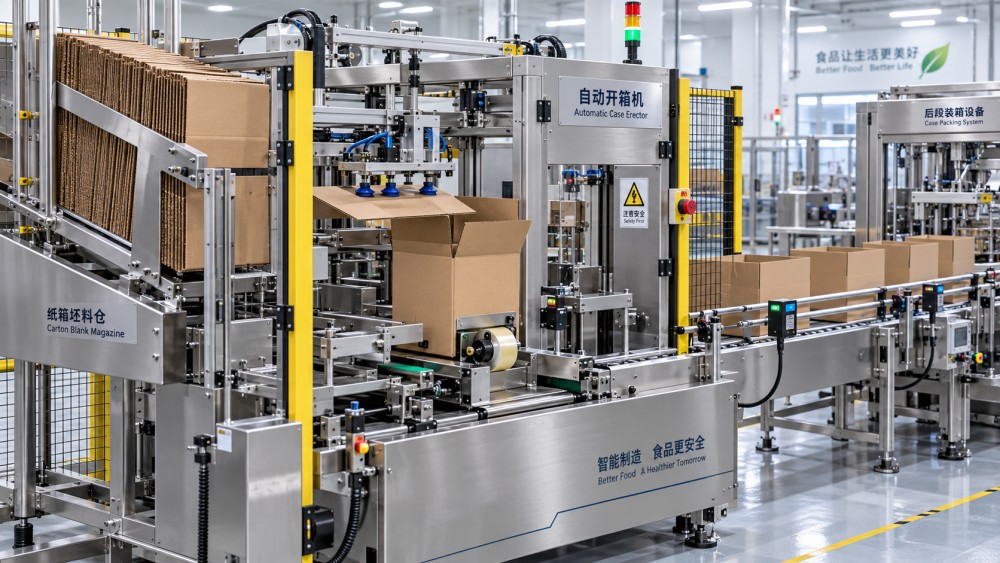
Automation changes that relationship. The machine draws blanks from a magazine, opens them through vacuum or mechanical handling, squares the case, folds the lower flaps, and applies tape or hot-melt adhesive depending on the configuration. Sensors verify key positions and identify conditions such as low blank supply, failure to open, flap-folding errors, or case discharge blockage. This does not eliminate all interruptions, but it shifts case formation from a manually variable activity to a controlled process with defined fault signals.
A stable case supply improves the whole end-of-line rhythm
The most useful way to assess an automatic case erector is not by its nominal cycle speed alone. The relevant question is whether it can supply correctly formed cases at the rate required by the downstream process, including foreseeable peaks, changeovers, and short recovery periods after stops.
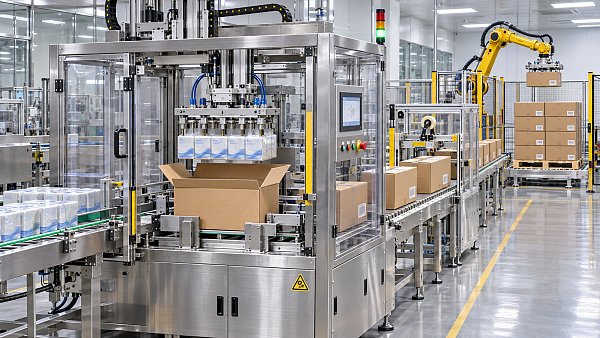
When the erector is correctly integrated, it acts as a buffer-controlled source of cases. A short conveyor or accumulation section between the erector and case packer can hold a limited quantity of erected cartons. This reserve allows the packer to continue working during brief interruptions such as blank replenishment or minor erector corrections. Conversely, when downstream equipment pauses, accumulation logic can signal the erector to slow or stop before cases become congested on the conveyor.
This coordination matters because an end-of-line packing system rarely operates as one uninterrupted mechanical sequence. Product feed can vary. Inspection equipment may reject items. Printers may pause for consumable intervention. A palletizer may be completing a layer. Without suitable control logic, each local interruption becomes a line-wide stop. With appropriate interlocks and accumulation, disruptions can remain local instead of immediately starving or blocking the rest of the system.
Case supply stability also helps planning. If the packing line receives cases in a consistent orientation and position, downstream machines can be adjusted around a repeatable infeed condition. This reduces the need for operators to correct carton alignment by hand and makes fault investigation more specific. Instead of a general complaint that “packing is delayed,” the team can distinguish whether the loss originated from blank quality, erection failure, infeed congestion, product availability, or downstream discharge.
The machine must be sized around effective output, not catalogue speed
A common planning error is to compare the maximum stated output of a case erector with the target output of a case packer and assume that a small margin is sufficient. The effective operating rate is affected by blank magazine replenishment, case dimensions, adhesive warm-up and application, carton stiffness, fault recovery, format changeover, and the operating behavior of the connected line.
If a downstream packer needs 20 cases per minute, selecting an erector rated at 20 cases per minute leaves little room for normal variation. Any minor interruption can empty the case buffer. The required capacity margin is not a universal percentage; it should be based on the line’s operating pattern, the duration of planned replenishment activities, expected case mix, and the ability of downstream equipment to pause without creating product loss.
Case dimensions are equally important. A machine may handle a published range of length, width, and height, but that range does not mean every carton within it will perform identically. Narrow cases, shallow cases, heavily recycled board, high-slip coatings, and blanks with variable score quality can affect opening reliability and squareness. Larger cases may demand different magazine settings, suction arrangements, conveyor guides, or discharge support. A project specification should identify the full case family, including the smallest, largest, most difficult, and most frequently used formats.
Where multiple blank styles are planned, the engineering question is not simply whether the erector can “run” them. It is whether the changeover can be completed safely and repeatably within the available production window. Tool-less adjustments, stored format settings, clearly marked guides, and recipe-controlled parameters can reduce setup risk, but only when the physical differences between formats are within the equipment’s design capability.
Corrugated blank quality is part of the automation project
Case erection performance is closely tied to corrugated blank consistency. Packaging projects can fail to recognize this because the case blank is treated as a consumable rather than as an engineered input to an automated machine.
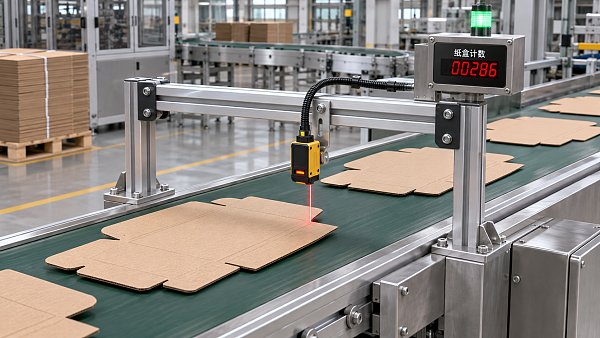
For reliable opening and bottom sealing, blanks need consistent dimensions, score positions, flap geometry, board flatness, and surface characteristics. Excessive warp can prevent reliable pickup or cause the case to leave the machine out of square. Inconsistent scoring can interfere with flap folding. Poorly controlled blank bundles may feed unevenly in the magazine. Variations in board caliper and compression behavior can affect tape adhesion or hot-melt bond performance.
This does not mean that every corrugated case requires premium material. It means the case specification must reflect the demands of automated handling. If blank procurement, carton design, and equipment engineering are managed separately, the line may be asked to compensate mechanically for a packaging input that was never designed for its operating conditions.
Blank quality should therefore be reviewed during project development, not only after commissioning problems emerge. Useful checks include dimensional tolerances, score alignment, blank squareness, flatness after storage, print and coating effects on vacuum pickup, and the behavior of cases under the expected warehouse humidity conditions. Where tape is used, the bottom flap closure must provide a surface and geometry suitable for consistent tape application. Where hot melt is selected, the adhesive, substrate, application pattern, and compression time need to work together.
Case erector integration is a controls and layout issue as much as a machine issue
An automatic case erecting machine can be mechanically capable while still causing delays if its surrounding layout is poorly resolved. Space is required not only for the equipment footprint but also for blank delivery, operator access, magazine loading, jam clearance, maintenance, safety guarding, and the conveyor path to the case packing station.
Blank replenishment deserves particular attention. If operators must cross an active conveyor, reach into a constrained area, or move bundles through a shared forklift route, replenishment becomes slower and less safe. The frequency of loading depends on blank size, magazine capacity, case consumption, and bundle configuration. A compact magazine may suit a low-volume line but create frequent interventions on a higher-output operation. A larger magazine can reduce intervention frequency but requires more floor space and may complicate material handling.
Control integration should establish clear machine states. The erector needs to communicate whether it is available, running, starved of blanks, blocked at discharge, in fault, or waiting for downstream release. The case packer should communicate demand and downstream blockage. If a line control system or manufacturing execution layer is present, recurring fault types and stoppage duration can be recorded for improvement work. The objective is not to collect data for its own sake; it is to distinguish chronic sources of lost time from isolated events.
Safety design must also be considered early. Case erection uses moving mechanisms, vacuum systems, conveyors, and often hot-melt adhesive equipment. Guard access, interlocked doors, emergency-stop zoning, safe restart procedures, adhesive unit placement, and lockout access should be reviewed as part of the integrated cell. A machine that is difficult to access after a jam can extend a minor interruption into a lengthy recovery.
Changeovers can become the next bottleneck
Automating case erection does not automatically make a line flexible. In facilities with frequent SKU changes, the case erector may need adjustments to the magazine width, side guides, folding mechanisms, discharge rails, tape head position, or recipe settings. If the adjustment sequence is unclear or requires repeated trial runs, the time saved during production can be lost between orders.
The useful distinction is between occasional format variation and routine format switching. A line running a small number of stable case sizes may benefit from a straightforward fixed-format or limited-range machine. A line handling many carton dimensions, customer-specific shipping cases, or short production batches requires more attention to changeover design, stored settings, adjustment indicators, and verification procedures.
Format planning should include the practical question of who makes the change, what parts are adjusted, how the correct settings are confirmed, and whether the upstream blank supply is changed at the same time. A recipe can store target positions, but it cannot correct a wrong blank loaded into the magazine or a guide that was not mechanically secured. Visual management, identification of blank bundles, and a defined first-case inspection remain useful controls.
Where automatic erection will not remove the real cause of delay
Not every packing delay is a case erection problem. Installing automation at the front of the line will have limited effect if the main constraint lies elsewhere. Product accumulation may be insufficient; the case packer may run below required output; labels may be applied inconsistently; or pallet discharge may regularly block the final conveyor.
There are also applications where manual erection remains reasonable. Very low-volume operations, highly irregular case styles, temporary packing areas, and products requiring frequent non-standard packing decisions may not justify a dedicated automatic solution. The decision should be based on operational fit, not on the assumption that every manual task must be automated.
Another misconception is that an erector can compensate for poor case design. Cases with difficult opening geometry, unstable bottom flaps, unsuitable board properties, or excessive dimensional variation may require packaging redesign or tighter blank controls. Repeated machine adjustment is not a durable substitute for correcting an incompatible input.
What a credible implementation review should establish
Before committing to equipment, the project team should map the actual path from flat blank delivery to loaded, sealed, labeled, and pallet-ready case. The map should identify average and peak case demand, case formats, blank bundle handling, required buffer capacity, likely stop points, and the consequences of a temporary interruption at each station.
It is also important to define acceptance around line behavior rather than isolated machine demonstration. A case erector may perform well in a standalone run yet reveal integration problems when connected to the packer, conveyors, printer, inspection system, and discharge equipment. Commissioning should test normal production, blank replenishment, downstream blocking, planned stops, restart behavior, representative format changes, and the less favorable case blanks expected in routine supply.
The central benefit of automatic case erection is operational predictability. By delivering square, sealed cases at a controlled pace and communicating clearly with adjacent equipment, it reduces one of the recurring causes of packing starvation. Its strongest contribution appears when it is treated as part of a coordinated end-of-line system—supported by suitable corrugated blanks, realistic capacity planning, adequate accumulation, disciplined changeovers, and accessible maintenance design.
Related News
 How to Choose Carton Counting Systems for Accurate ProductionChoose Carton Counting Systems with confidence. Compare sensors, accuracy, line integration, and testing methods to improve production reliability.Spatial Folding Strategist
 How to Troubleshoot an Automatic Case Erecting MachineTroubleshoot your automatic case erecting machine with practical steps for diagnosing jams, vacuum loss, sensor faults, and sealing issues—and restore reliable operation.Spatial Folding Strategist
 How to Choose Pallet Conveyors for a Packaging LineChoosing pallet conveyors for packaging line operations? Compare load requirements, throughput, layouts and safety to find the right solution.Spatial Folding Strategist
 How to Choose Case Packers for an Automated Palletizing LineChoose Case Packers that keep your palletizing line moving. Compare loading methods, capacity, changeovers, and integration to make a confident investment.Spatial Folding Strategist
 How Inline Pallet Wrappers Fit Into Automated Packaging LinesDiscover how inline pallet wrappers integrate with automated packaging lines, improve load stability, and help prevent costly bottlenecks.Spatial Folding Strategist
 What Affects Bundle Handling System Cost in a Sheet Plant?Bundle handling system cost depends on capacity, layout, automation, and integration. Learn how to compare total costs and choose the right system for your sheet plant.Spatial Folding Strategist